Introduction
Understanding the difference between free chlorine and total chlorine is essential for maintaining safe water and accurate disinfection control. Whether you manage a swimming pool, hot tub, drinking water system, or industrial process, knowing which chlorine value matters can help you improve water quality, reduce chemical costs, and avoid unnecessary troubleshooting.
Our engineering team has helped swimming pools, water treatment facilities, and industrial users solve many real-world chlorine monitoring problems. Some issues were caused by incorrect sampling systems, while others resulted from improper installation rather than faulty instruments.
In this guide, you’ll learn how free chlorine, combined chlorine, and total chlorine work together, how to test them correctly, and how to avoid common mistakes based on real engineering experience.
Quick Answer: Free Chlorine vs Total Chlorine
The difference is simple.
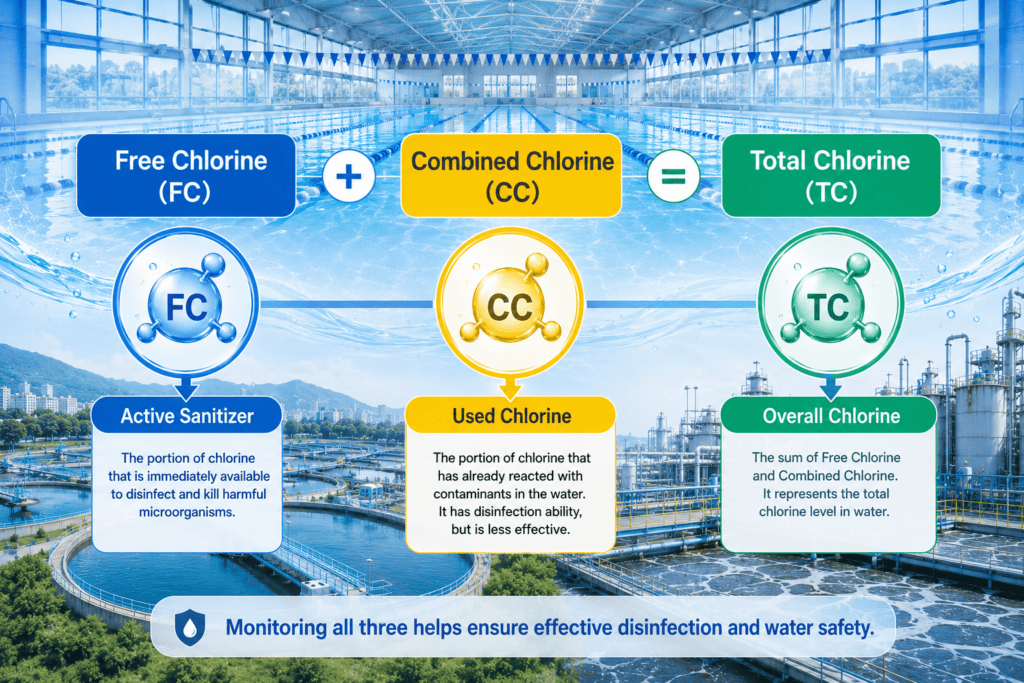
Free Chlorine (FC) is the chlorine that is still available to disinfect water.
Combined Chlorine (CC) is chlorine that has already reacted with contaminants such as sweat, ammonia, and organic matter. It has very little disinfecting ability.
Total Chlorine (TC) is the sum of free chlorine and combined chlorine.
Formula:
Total Chlorine = Free Chlorine + Combined Chlorine
or
TC = FC + CC
For example:
| Free Chlorine | Total Chlorine | Combined Chlorine | Water Condition |
|---|---|---|---|
| 3.0 ppm | 3.0 ppm | 0 ppm | Excellent |
| 1.0 ppm | 3.0 ppm | 2.0 ppm | Poor sanitation |
| 4.0 ppm | 4.2 ppm | 0.2 ppm | Acceptable |
A healthy water system should keep combined chlorine as close to zero as possible.
Why Understanding the Difference Matters
Many operators only look at the total chlorine value.
However, total chlorine alone cannot tell you whether the water is properly disinfected.
For example, two swimming pools may both show 3 ppm total chlorine, but their water quality can be completely different.
If almost all of that chlorine is free chlorine, the water is well protected.
If most of it is combined chlorine, the water may have unpleasant odors, eye irritation, and poor disinfection performance.
For this reason, professional water treatment systems always monitor free chlorine instead of relying only on total chlorine.
Chlorine Basics
Chlorine remains one of the most effective disinfectants used in recreational and industrial water treatment.
After chlorine is added to water, it forms hypochlorous acid (HOCl) and hypochlorite ions (OCl⁻).
These compounds destroy bacteria, viruses, and algae while providing continuous residual disinfection.
The effectiveness of chlorine depends on several factors, including:
- Free chlorine concentration
- Water pH
- Water temperature
- Organic contamination
- Sunlight exposure
- Water circulation
Keeping these factors balanced helps maintain stable water quality and reduces chemical consumption.
What Is Free Chlorine?
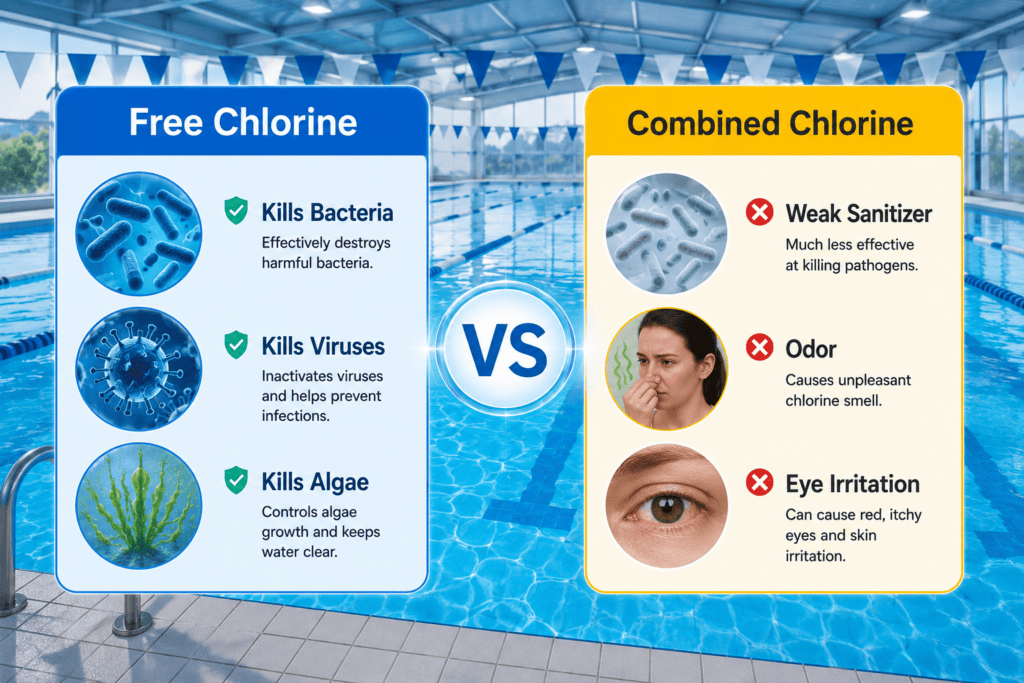
Free chlorine refers to the chlorine that is still available to disinfect water.
It consists mainly of hypochlorous acid (HOCl) and hypochlorite ions (OCl⁻).
When sodium hypochlorite, chlorine tablets, or other chlorine products are added to water, they produce free chlorine.
This is the chlorine that actively destroys microorganisms.
Typical free chlorine targets include:
- Residential pools: 1–3 ppm
- Public pools: 2–4 ppm
- Hot tubs: 3–5 ppm
- Drinking water: 0.5–1.0 mg/L
If free chlorine becomes too low, operators may notice:
- Cloudy water
- Green algae
- Slippery pool surfaces
- Poor water clarity
- Increased bacteria growth
Maintaining an appropriate free chlorine residual is one of the most important steps in water quality management.
What Is Combined Chlorine?
Combined chlorine is formed after free chlorine reacts with contaminants.
These contaminants may include:
- Sweat
- Urine
- Skin cells
- Cosmetics
- Sunscreen
- Industrial process contaminants
Unlike free chlorine, combined chlorine has very weak disinfecting ability.
High combined chlorine levels usually cause:
- Strong chlorine odor
- Eye irritation
- Skin irritation
- Reduced sanitizing performance
Many people believe a strong chlorine smell means there is too much chlorine.
In reality, it usually indicates too much combined chlorine.
Combined chlorine can be calculated using the following formula:
Combined Chlorine = Total Chlorine − Free Chlorine
As a general guideline, combined chlorine should remain below 0.2–0.4 ppm.
If combined chlorine exceeds this level, breakpoint chlorination or shock treatment is usually recommended.
What Is Total Chlorine?
Total chlorine represents all chlorine present in the water.
It includes both:
- Free chlorine
- Combined chlorine
For example:
If:
- Free Chlorine = 2.0 ppm
- Total Chlorine = 2.5 ppm
Then:
Combined Chlorine = 0.5 ppm
When total chlorine and free chlorine are nearly identical, it usually means the water is well maintained.
The larger the difference between total chlorine and free chlorine, the more combined chlorine is present.
This is why professional operators monitor both values instead of relying on only one measurement.
Why the Difference Between Free and Total Chlorine Matters
Simply knowing that chlorine is present is not enough.
What really matters is how much chlorine is still available to disinfect the water.
Two water systems can show exactly the same total chlorine value while delivering completely different water quality.
For example, a swimming pool with 3.0 ppm free chlorine and 3.0 ppm total chlorine has almost no combined chlorine. This indicates excellent disinfection performance.
However, another pool may also have 3.0 ppm total chlorine, but only 1.0 ppm free chlorine. The remaining 2.0 ppm is combined chlorine.
In this situation, the water may develop a strong chlorine odor, irritate swimmers’ eyes, and provide poor disinfection even though the total chlorine reading appears normal.
For this reason, professional operators monitor both free chlorine and total chlorine, rather than relying on a single chlorine value.
How to Test Free and Total Chlorine
Regular testing is the foundation of effective chlorine control.
For residential swimming pools, testing two or three times each week is usually sufficient.
Commercial pools and industrial water systems require much more frequent monitoring, with many facilities using continuous online analyzers.
Common testing methods include:
Test Strips
Test strips are inexpensive and easy to use.
They provide a quick indication of chlorine levels but are generally less accurate.
They are suitable for home pools but not for critical industrial applications.
DPD Liquid Test Kits
The DPD colorimetric method is widely used because it measures both free chlorine and total chlorine separately.
It offers much better accuracy than test strips and is commonly used for routine verification.
Digital Photometers
Digital photometers provide highly accurate measurements by analyzing the color intensity of the DPD reaction.
Many commercial swimming pools and laboratories use this method for verification testing.
Online Chlorine Analyzers
Large swimming pools, drinking water plants, and industrial facilities usually rely on continuous online chlorine analyzers.
These instruments provide real-time measurements and automatically control chemical dosing systems.
Compared with manual testing, online monitoring improves response speed, reduces labor costs, and minimizes chemical waste.
From Our Field Experience:
Why an Accurate Free Chlorine Analyzer Still Produced Incorrect Readings
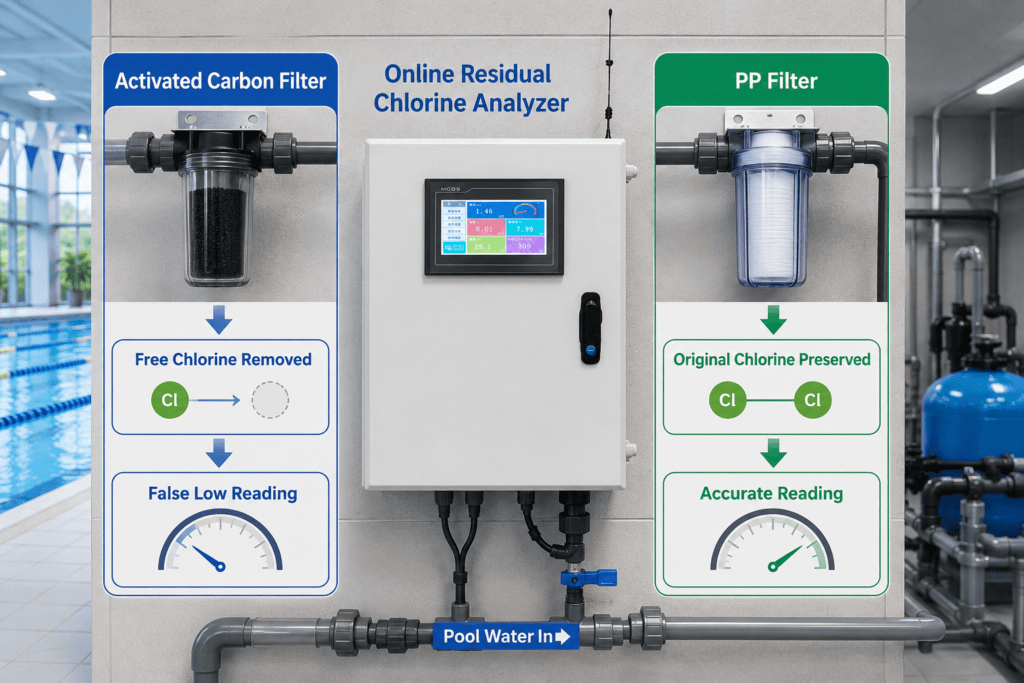
Many operators assume that inaccurate free chlorine readings automatically mean the analyzer or sensor has failed.
In our experience, the sampling system is often the real source of the problem.
We once supported an indoor heated swimming pool that installed a complete online water quality monitoring system, including online analyzers for free chlorine, ORP, turbidity, total alkalinity, and temperature.
Shortly after commissioning, the customer reported that the free chlorine analyzer consistently displayed readings lower than expected.
Their first assumption was that the sensor had failed or that the analyzer had not been calibrated correctly.
Our engineers first checked the analyzer’s measuring range, operating mode, and sensor calibration.
Everything was functioning normally.
Next, we collected two water samples.
One sample came directly from the main circulation pipeline.
The second sample was taken from the analyzer’s flow cell.
The laboratory results immediately revealed the problem.
The free chlorine concentration in the main pipeline was significantly higher than the concentration measured inside the analyzer.
This confirmed that the sampling line itself was changing the water sample before it reached the analyzer.
Further inspection showed that the pretreatment filter installed ahead of the analyzer contained an activated carbon filter cartridge.
Activated carbon is designed to adsorb and reduce free chlorine.
As water passed through the filter, part of the free chlorine was removed before entering the analyzer.
As a result, the analyzer continuously displayed chlorine concentrations that were lower than the actual pool water.
Following our recommendation, the customer replaced the activated carbon cartridge with a PP sediment filter, which removes suspended particles without affecting chlorine concentration.
Immediately after the modification, the analyzer readings matched the laboratory measurements and remained stable during long-term operation.
This project taught us an important lesson: before replacing an online chlorine analyzer, always inspect the sampling system. An unsuitable pretreatment filter can significantly change the chlorine concentration before the sample reaches the sensor.
Typical Free Chlorine and Total Chlorine Levels
Different applications require different chlorine concentrations.
The table below provides general operating recommendations.
| Application | Free Chlorine | Combined Chlorine | Recommended pH |
|---|---|---|---|
| Residential Pool | 1–3 ppm | <0.4 ppm | 7.2–7.6 |
| Public Pool | 2–4 ppm | <0.2 ppm | 7.2–7.6 |
| Hot Tub | 3–5 ppm | <0.4 ppm | 7.2–7.6 |
| Drinking Water | 0.5–1.0 mg/L | Near Zero | Depends on local regulations |
These values may vary depending on local regulations and operating conditions.
How to Increase Free Chlorine Safely
When free chlorine drops below the recommended range, operators should increase chlorine carefully rather than adding excessive chemicals.
Common methods include:
- Sodium hypochlorite dosing
- Trichlor tablets
- Dichlor granules
- Automated dosing systems
If combined chlorine continues to increase, breakpoint chlorination is usually required.
As a general rule, adding approximately ten times the combined chlorine concentration can effectively destroy chloramines.
After shock treatment, always retest free chlorine, total chlorine, and pH before reopening the pool or returning the system to normal operation.
The Role of pH, Alkalinity, and Calcium Hardness
Free chlorine does not work alone.
Its disinfecting performance is strongly influenced by water chemistry, especially pH, alkalinity, and calcium hardness.
pH
pH has the greatest impact on chlorine efficiency.
When pH rises above 7.8, a larger portion of free chlorine converts into hypochlorite ions (OCl⁻), which are much weaker disinfectants than hypochlorous acid (HOCl).
For most swimming pools and hot tubs, the recommended pH range is 7.2–7.6.
Total Alkalinity
Total alkalinity acts as a pH buffer.
Maintaining alkalinity between 80 and 120 ppm helps prevent rapid pH fluctuations and improves chlorine performance.
Calcium Hardness
Calcium hardness protects pool surfaces and equipment.
If calcium hardness is too low, water becomes corrosive.
If it is too high, scale can form on heat exchangers, sensors, and chlorine analyzers.
For complete water quality control, free chlorine monitoring should always be combined with pH and ORP monitoring.
Free Chlorine Monitoring in Industrial and Municipal Water Systems
Free chlorine monitoring is not limited to swimming pools.
It is widely used in:
- Drinking water treatment
- Municipal water distribution
- Cooling towers
- Food and beverage production
- Pharmaceutical water systems
- Industrial process water
Continuous monitoring helps operators maintain stable disinfectant residuals while reducing chemical consumption.
Compared with manual testing, online analyzers provide continuous data, automatic alarms, and dosing control.
From Our Field Experience:
Why Correct Installation Is Just as Important as Choosing the Right Analyzer
Selecting the right free chlorine analyzer is only part of the solution.
Proper installation is equally important for obtaining reliable measurements.
We once supported an indoor heated swimming pool that installed one of our online free chlorine analyzers as part of a complete water quality monitoring system.
The customer completed the installation independently.
Soon after commissioning, the analyzer consistently reported free chlorine concentrations that were lower than expected.
As a result, the automatic dosing pump continuously injected sodium hypochlorite into the circulation system.
Over time, the actual free chlorine concentration in the pool exceeded 2.5 mg/L, causing skin irritation, swimmer complaints, and unnecessary chemical consumption.
The customer believed the analyzer was defective and requested replacement of the entire instrument.
Our engineers first verified the analyzer using standard calibration procedures.
The analyzer and sensor were both operating normally.
The investigation then focused on the installation.
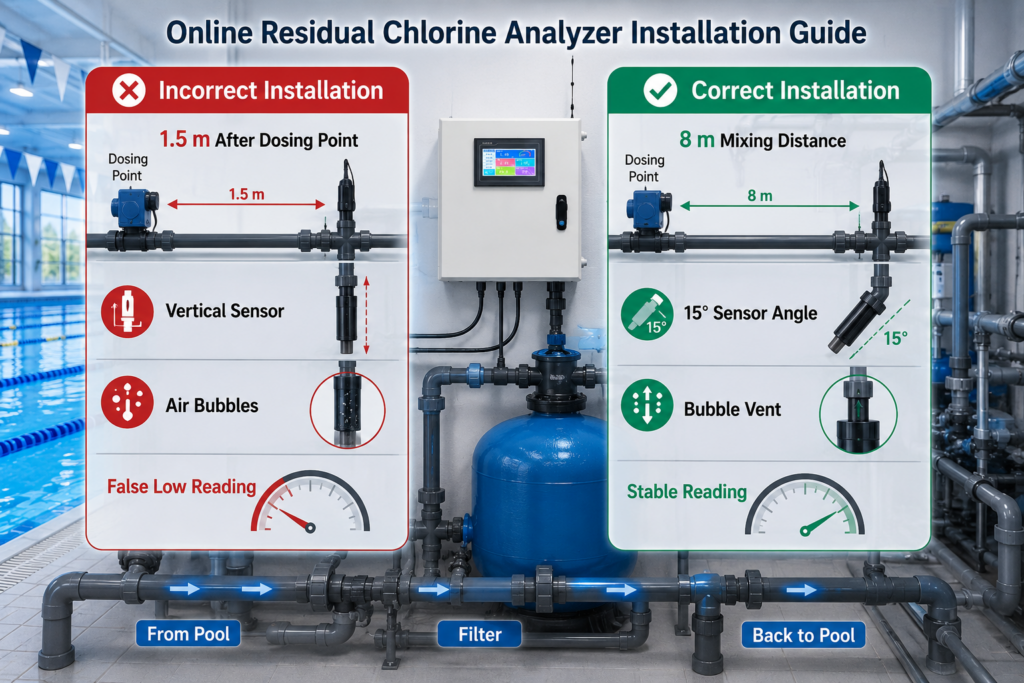
We discovered two critical problems.
First, the sampling point had been installed only 1.5 meters downstream of the sodium hypochlorite dosing point.
The disinfectant had not fully mixed with the circulating water, so the analyzer was measuring a non-representative water sample.
Second, the sensor had been installed vertically inside a level flow cell.
Air bubbles accumulated on the sensor surface, partially isolating the measuring electrode from the water and causing the analyzer to display artificially low chlorine readings.
To solve the problem, we relocated the sampling point to the return pipeline upstream of the circulation pump, more than 8 meters away from the dosing point, allowing sufficient mixing before sampling.
We also reinstalled the sensor at a 15–30° angle and modified the flow cell with a bottom vent so that trapped air bubbles could escape naturally instead of adhering to the sensor surface.
After these adjustments, the analyzer readings matched laboratory results, the dosing system returned to normal operation, and the customer was satisfied with the system performance.
This project highlights an important lesson: accurate chlorine monitoring depends not only on the analyzer itself but also on sampling location, mixing distance, sensor orientation, and proper flow-cell design.
Practical Tips for Maintaining Accurate Chlorine Measurements
Whether you operate a swimming pool or an industrial water treatment system, these practices can improve long-term measurement reliability.
For pool operators:
- Test free chlorine regularly.
- Keep combined chlorine below 0.4 ppm.
- Maintain pH between 7.2 and 7.6.
- Record chlorine and pH trends.
For industrial users:
- Verify online analyzers against laboratory measurements.
- Clean sensors regularly.
- Inspect sampling lines and filters.
- Check sensor installation after maintenance.
- Recalibrate according to the manufacturer’s recommendations.
Preventive maintenance is far less expensive than emergency troubleshooting.
Frequently Asked Questions
Which is more important, free chlorine or total chlorine?
Free chlorine is the most important value because it represents the chlorine available to disinfect water. Total chlorine alone cannot indicate water quality.
Why is total chlorine higher than free chlorine?
The difference represents combined chlorine formed after free chlorine reacts with contaminants.
What causes a strong chlorine smell?
A strong chlorine smell is usually caused by high combined chlorine rather than excessive free chlorine.
How often should free chlorine be tested?
Residential pools should be tested at least two or three times each week.
Commercial pools and industrial systems are best monitored continuously using online analyzers.
Why does my online chlorine analyzer show incorrect readings?
Possible causes include:
- Incorrect sampling location
- Activated carbon pretreatment filters
- Air bubbles
- Poor sensor installation
- Improper calibration
- Sensor fouling
Always inspect the sampling system before replacing the analyzer.
About Chlorine Monitoring Solutions
Accurate chlorine monitoring is essential for maintaining safe water quality, protecting public health, and optimizing chemical dosing. However, achieving reliable measurements requires more than selecting a high-quality analyzer. Sampling design, installation practices, calibration, and routine maintenance all play critical roles in long-term performance.
Wuxi Wohuan Instrument specializes in online free chlorine analyzers, total chlorine analyzers, multi-parameter controllers, and water quality monitoring systems. With extensive experience supporting swimming pools, drinking water plants, industrial facilities, and municipal water treatment projects, we help customers improve measurement accuracy, reduce maintenance costs, and achieve reliable long-term operation.
Need Help Choosing the Right Chlorine Monitoring Solution?
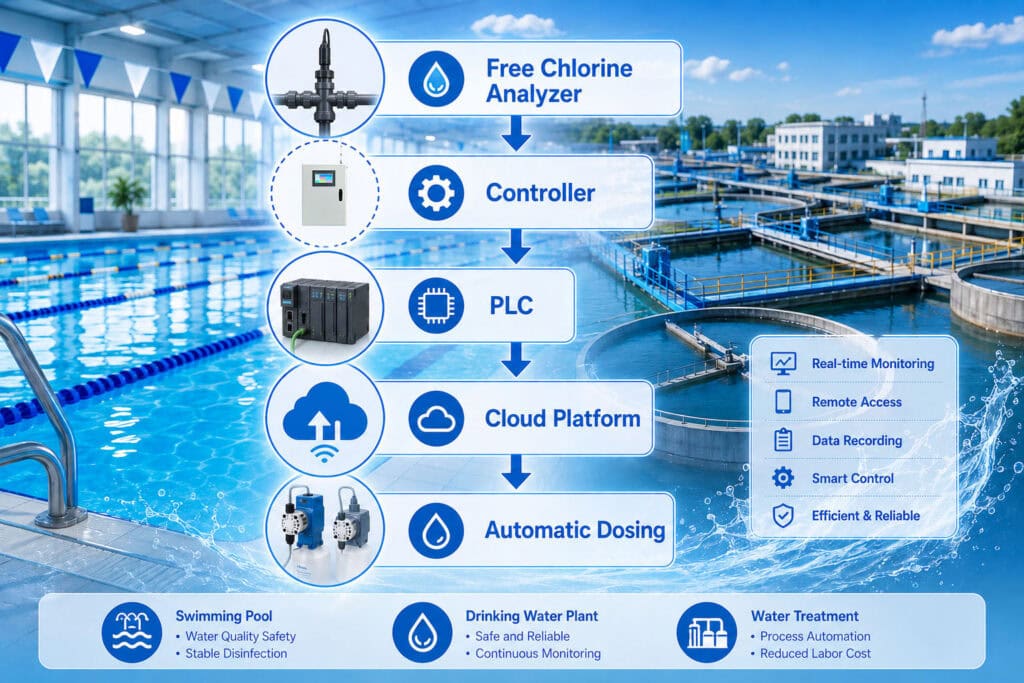
Every water treatment system has different operating conditions.
Choosing the right chlorine analyzer depends on water quality, sampling method, installation environment, communication requirements, and control strategy.
If you are planning a new monitoring project or upgrading an existing system, our engineering team can recommend a suitable solution based on your application.
Explore More
Homepage
https://wxinstrument.com/
Water Quality Monitoring Solutions
https://wxinstrument.com/application/indoor-swimming-pool-water-monitoring/
Online Chlorine Analyzers
https://wxinstrument.com/product-cate/water-quality-controllersensor/
Contact Our Engineers
https://wxinstrument.com/contact/
Get a Quote
Tell us your application, water source, chlorine range, and installation conditions. Our engineers will recommend a suitable monitoring solution for your project.