Introduction
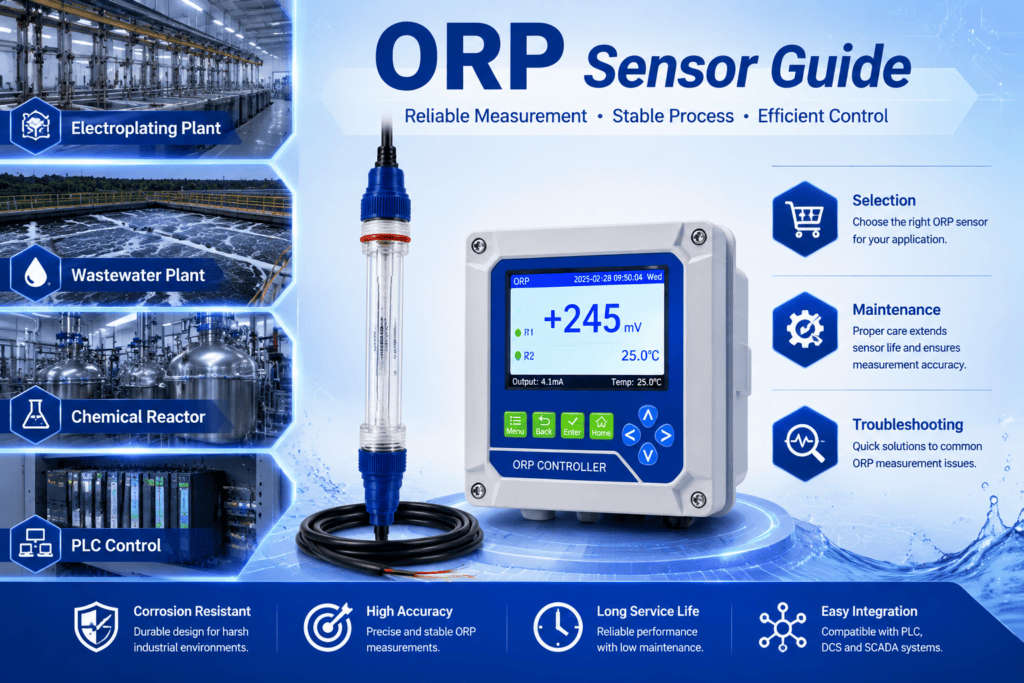
Selecting the right ORP sensor is essential for reliable oxidation-reduction monitoring in wastewater treatment, electroplating, chemical processing, drinking water, and industrial disinfection systems. The right sensor improves process control, reduces chemical consumption, and minimizes maintenance costs.
This guide explains how an ORP sensor works, how it differs from a pH sensor, how to choose the right probe for different water conditions, and how to maintain it for long-term stability. Drawing on our field experience from industrial water treatment and electroplating projects, we’ll also share real engineering cases that show how proper sensor selection and installation can dramatically improve performance.
By the end of this guide, you’ll understand how to select the right ORP sensor, avoid common application mistakes, and keep your monitoring system operating accurately for years.
Quick Answer
An ORP sensor (Oxidation-Reduction Potential sensor) measures the tendency of a solution to either gain or lose electrons. The measurement is displayed in millivolts (mV) and indicates the oxidation or reduction strength of the process.
Unlike pH sensors, ORP sensors do not measure acidity or alkalinity. Instead, they provide a direct indication of oxidation-reduction conditions, making them ideal for automatic chemical dosing and process control.
Industrial ORP sensors are widely used in:
- Municipal wastewater treatment
- Drinking water disinfection
- Electroplating
- Chemical manufacturing
- Swimming pools
- Food and beverage production
- Pharmaceutical water systems
Continuous ORP monitoring allows operators to automate chemical dosing, improve treatment efficiency, and reduce operating costs.
What Is an ORP Sensor?
An ORP sensor is an electrochemical probe that continuously measures oxidation-reduction potential in liquids.
A typical industrial ORP sensor consists of:
- A platinum or gold sensing element
- A reference electrode
- Reference electrolyte
- Reference junction
- Industrial sensor body
The sensing element detects electron transfer occurring in the process liquid.
The reference electrode provides a stable electrical reference.
The analyzer measures the voltage difference between the two electrodes and converts it into an ORP value expressed in millivolts.
Because ORP responds immediately to changes in water chemistry, it is widely used for continuous online monitoring and automatic process control.
How Does an ORP Sensor Work?
An ORP sensor does not measure the concentration of one specific chemical.
Instead, it measures the overall oxidation-reduction condition of the solution.
When oxidizing chemicals such as chlorine, ozone, hydrogen peroxide, or permanganate become stronger, the ORP value increases.
When reducing substances such as sulfides, organic contaminants, or reducing agents dominate, the ORP value decreases.
Typical industrial ORP ranges include:
- +650 to +900 mV — Strong oxidation and effective disinfection
- +250 to +600 mV — Normal oxidation processes
- 0 mV — Balanced oxidation and reduction
- Negative ORP values — Reducing environments commonly found in biological denitrification
Because ORP responds almost instantly to chemical changes, it is widely used for automatic process control instead of relying on manual sampling.
ORP Sensor vs. pH Sensor
Although ORP and pH sensors often look similar, they measure completely different process parameters.
| ORP Sensor | pH Sensor |
|---|---|
| Measures oxidation-reduction potential | Measures hydrogen ion concentration |
| Unit: mV | Unit: pH |
| Indicates oxidation or reduction strength | Indicates acidity or alkalinity |
| Controls oxidation, reduction, and disinfection | Controls acid-base reactions |
Many industrial processes monitor both parameters simultaneously.
For example:
- pH determines whether the chemical environment is suitable.
- ORP confirms whether oxidation or reduction reactions are occurring effectively.
Using both measurements together provides much better process control than monitoring either parameter alone.
Why ORP Monitoring Matters
Many industrial treatment processes depend on stable oxidation-reduction reactions.
Without continuous ORP monitoring, operators often rely on fixed dosing schedules or personal experience, making process control inconsistent.
A properly selected ORP sensor helps operators:
- Optimize chemical dosing
- Improve process consistency
- Reduce chemical consumption
- Prevent over-dosing and under-dosing
- Improve product quality
- Enable automatic process control
Because ORP responds immediately to changes in process chemistry, operators can react much faster than they can with periodic laboratory testing.
Common Industrial Applications of ORP Sensors
ORP sensors are used in many industries where oxidation and reduction reactions directly affect product quality or treatment efficiency.
Municipal Wastewater Treatment
ORP monitoring is widely used to control denitrification, biological treatment, and chemical disinfection.
Real-time ORP values help operators optimize carbon source dosing while improving nitrogen removal efficiency.
Drinking Water Treatment
ORP sensors verify the effectiveness of chlorine or ozone disinfection and help prevent excessive chemical dosing.
Electroplating
ORP monitoring controls oxidation-reduction reactions in copper, nickel, chromium, and precious metal plating processes.
Accurate ORP measurement improves bath stability, reduces chemical waste, and enhances product quality.
Chemical Manufacturing
Many oxidation and reduction reactions require precise ORP control to maintain consistent product quality and reaction efficiency.
Swimming Pools
ORP sensors continuously monitor oxidation capacity and automatically control disinfectant dosing, helping maintain safe water quality while minimizing chemical consumption.
How to Choose the Right ORP Sensor
Selecting the right ORP sensor involves much more than comparing specifications or prices.
The best sensor depends on your process chemistry, contaminants, maintenance capability, and installation environment.
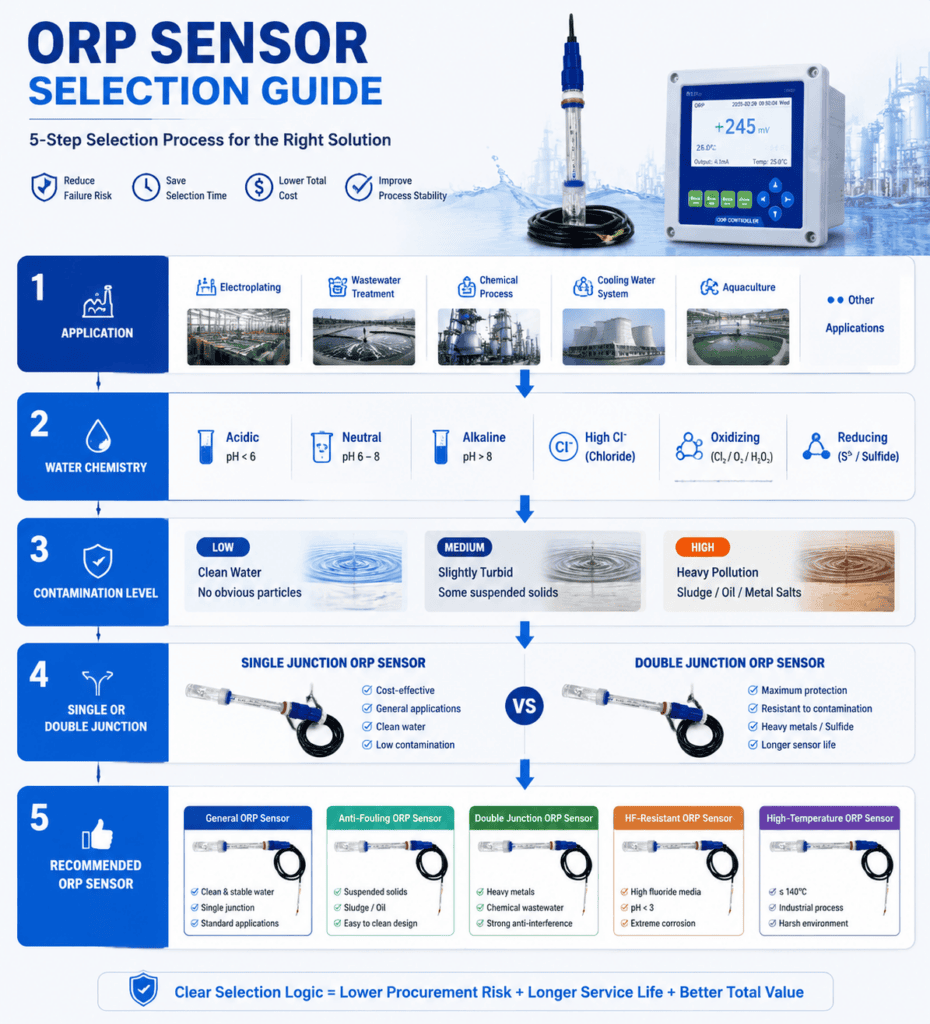
Before purchasing an ORP sensor, evaluate the following factors.
1. Understand Your Process Conditions
Different industries expose ORP sensors to very different environments.
Before selecting a sensor, identify:
- Water or chemical type
- Oxidation or reduction process
- Presence of suspended solids
- Heavy metals or plating chemicals
- Chloride concentration
- Oil contamination
- Sulfide or sulfur compounds
Matching the sensor to the process environment is the first step toward reliable long-term operation.
2. Choose the Right Sensor Construction
Many users focus only on the sensing element.
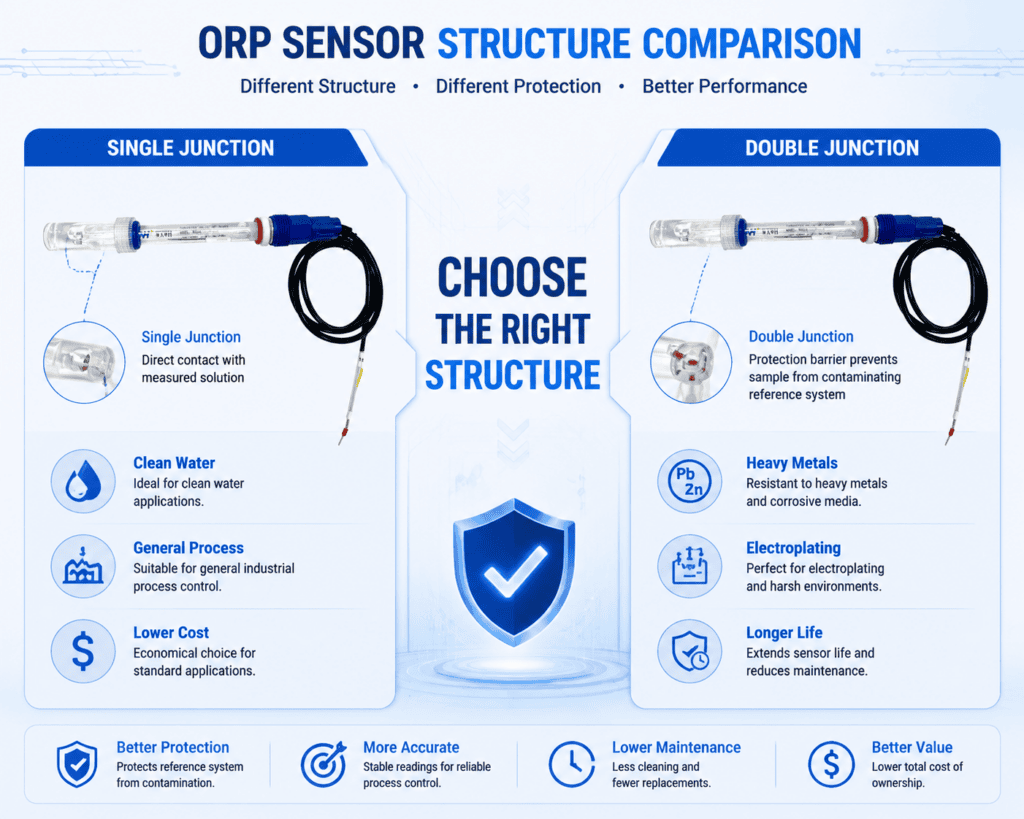
However, the reference junction structure often determines how long an ORP sensor will survive in aggressive process liquids.
Standard Single-Junction ORP Sensors
Single-junction sensors are suitable for relatively clean process water.
Typical applications include:
- Drinking water
- Swimming pools
- Cooling water
- General industrial water
Advantages include:
- Lower purchase cost
- Simple construction
- Easy maintenance
However, contaminated process liquids can quickly block the reference junction.
Double-Junction Industrial ORP Sensors
Double-junction sensors provide an additional protective barrier between the process liquid and the internal reference system.
They are recommended for:
- Electroplating
- Mining
- Chemical wastewater
- High chloride solutions
- Heavy metal wastewater
- High-pollution industrial processes
Advantages include:
- Better contamination resistance
- Longer service life
- More stable measurements
- Lower maintenance frequency
For aggressive industrial applications, the reference junction design is often more important than the measuring range itself.
3. Select the Right Sensing Material
Industrial ORP sensors typically use either platinum or gold.
Platinum
Best for:
- Municipal wastewater
- Drinking water
- Chlorination
- Ozone
- General oxidation processes
Gold
Best for:
- Cyanide solutions
- Precious metal recovery
- Electroplating
- Special reducing environments
Choosing the correct sensing material improves both response speed and long-term stability.
4. Consider Lifetime Operating Costs
The lowest-priced sensor rarely provides the lowest operating cost.
Before purchasing, compare:
- Cleaning frequency
- Calibration interval
- Expected service life
- Replacement frequency
- Labor cost
- Spare parts cost
A higher-quality industrial sensor often reduces total ownership cost over several years.
From Our Field Experience:
Choosing the Right ORP Sensor Increased Service Life by Eight Times
Many users assume that any industrial ORP sensor can operate reliably in electroplating solutions.
Our field experience shows that process chemistry has a much greater influence on sensor life than many operators expect.
We supported an electroplating manufacturer measuring acidic copper etching solution containing high concentrations of chloride ions, copper salts, and suspended copper particles.
The customer originally used a standard single-junction ORP sensor.
Within only a few days of operation, copper salt deposits repeatedly blocked the ceramic reference junction, preventing the reference electrolyte from diffusing normally.
At the same time, the highly corrosive solution attacked the standard sensing surface, increasing response time from approximately 2 seconds to more than 30 seconds.
Operators had to remove and clean the sensor every day, while overall service life was only 7–15 days.
After reviewing the process conditions, our engineers recommended replacing the standard sensor with an industrial double-junction ORP sensor.
The double-junction reference system isolated heavy metals and chloride ions from the internal reference electrode, while the refillable outer reference chamber significantly delayed junction contamination.
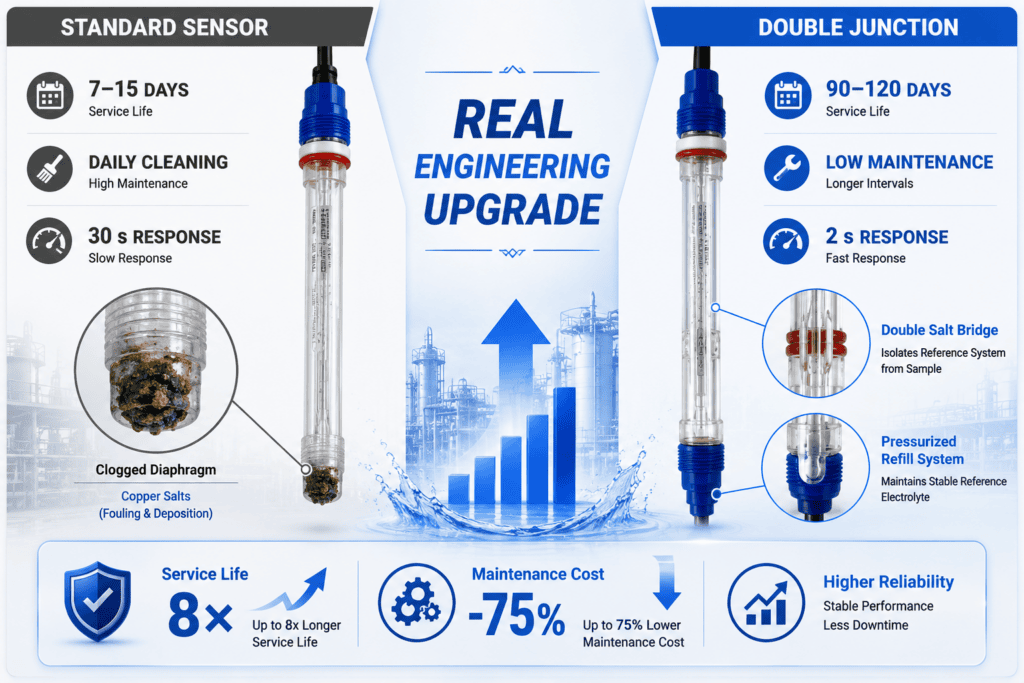
The improvement was dramatic.
- Sensor service life increased from 7–15 days to 90–120 days.
- Overall service life improved by approximately eight times.
- Combined maintenance and replacement costs decreased by about 75%.
This project demonstrated that selecting the correct reference junction structure is often more important than purchasing a more expensive sensor. Matching the ORP sensor to the process chemistry greatly improves reliability in aggressive electroplating applications.
Common ORP Sensor Selection Mistakes
Many ORP problems begin long before installation.
The most common purchasing mistakes include:
Selecting Only by Price
A lower purchase price often results in higher maintenance costs and more frequent replacement.
Always evaluate the total cost of ownership instead of the initial equipment cost.
Choosing the Wrong Reference Junction
A single-junction sensor may perform well in clean water but fail quickly in heavy metal or high-salt applications.
Always match the junction design to the actual process.
Ignoring Process Chemistry
High chloride concentrations, sulfides, oils, suspended solids, and heavy metals all influence sensor performance.
Understanding the process chemistry is essential before selecting a sensor.
Underestimating Maintenance Requirements
Cleaning frequency, calibration intervals, and replacement costs directly affect long-term operating expenses.
Choosing a lower-maintenance sensor often produces greater value over its service life.
Overlooking Installation Conditions
Even the best ORP sensor cannot deliver reliable measurements if installed in stagnant water, sludge accumulation zones, or locations with poor process circulation.
Proper installation is just as important as selecting the right sensor.
ORP Sensor Maintenance, Cleaning, and Calibration
Routine maintenance is essential for keeping an ORP sensor accurate and responsive.
Unlike many users assume, ORP sensors rarely fail suddenly. Most measurement problems develop gradually because the sensing surface becomes contaminated or the reference junction is blocked.
A preventive maintenance program helps maintain stable readings while extending sensor life.
Routine Cleaning
Cleaning methods depend on the application.
For municipal wastewater, rinse the sensor with clean water and gently remove sludge or biofilm using a soft cloth.
For electroplating or chemical processes where sulfide deposits, heavy metals, or scale accumulate, soak the sensing tip in 5% diluted hydrochloric acid for several minutes before rinsing thoroughly with clean water.
Never polish the platinum sensing surface with abrasive materials, as this may permanently damage the electrode.
Calibration
Unlike pH sensors, ORP sensors usually require verification instead of frequent calibration.
If the sensor responds correctly in a certified ORP standard solution, recalibration is generally unnecessary.
Calibration should be checked:
- After deep cleaning
- After long shutdown periods
- If response becomes unusually slow
- During scheduled preventive maintenance
Regular verification helps detect contamination before it affects process control.
Proper Storage
If an ORP sensor will not be used for an extended period:
- Clean the sensing surface.
- Rinse with clean water.
- Install the protective cap.
- Store according to the manufacturer’s recommendations.
Correct storage protects both the sensing element and the reference junction from unnecessary contamination.
Common ORP Sensor Problems and Troubleshooting
Many unstable ORP readings are caused by installation conditions rather than sensor failure.
Before replacing the sensor, inspect both the process environment and the sensing surface.
| Problem | Possible Cause |
|---|---|
| Slow response | Contaminated sensing surface |
| Constant low ORP | Sulfide deposits or poor installation |
| Reading drift | Blocked reference junction |
| Unstable readings | Poor flow, sludge accumulation, air bubbles |
| Frequent cleaning | Incorrect sensor selection for the application |
A systematic inspection usually identifies the real cause much faster than repeatedly replacing sensors.
From Our Field Experience:
Replacing Three Sensors Didn’t Solve the Problem—The Installation Location Did
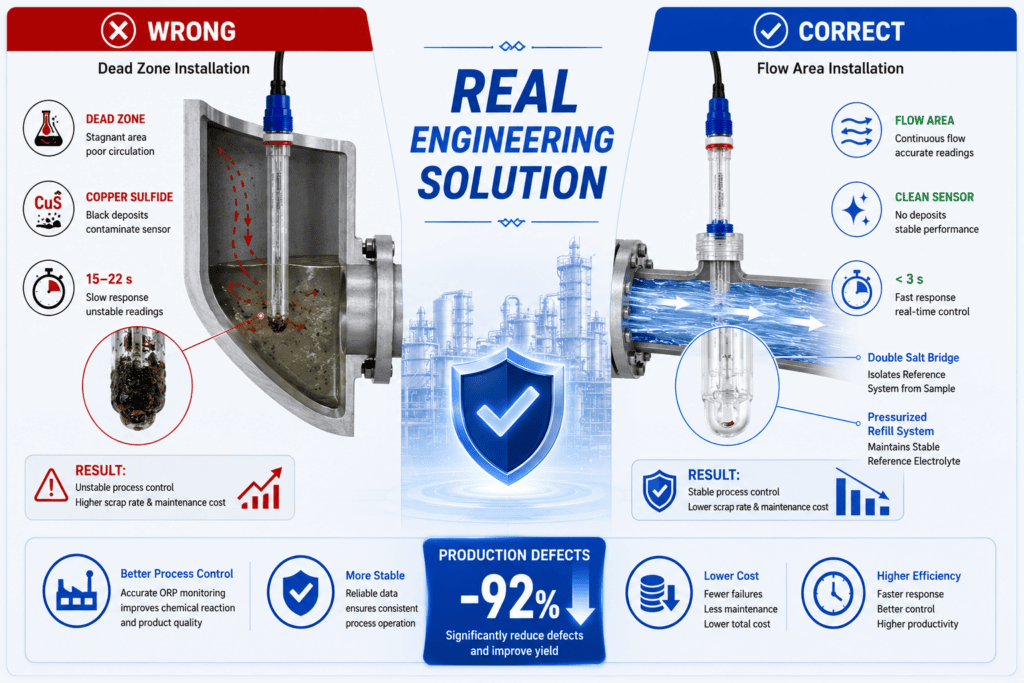
An electroplating manufacturer contacted us because the ORP value remained consistently below the required process limit of 120 mV.
The automatic dosing system continuously added excessive oxidizing chemicals, upsetting the chemical balance and increasing product defects.
The customer believed the ORP sensor had failed.
Three brand-new standard ORP sensors were installed over several weeks, yet each sensor developed exactly the same problem after only three to five days.
The customer concluded that the sensors were defective.
Our engineers first tested the sensors.
Calibration and electrical inspection confirmed that all three sensors were operating normally.
The investigation then focused on the process itself.
We found that the sensor had been installed inside a solution circulation dead zone where almost no liquid flowed across the sensing surface.
After removing the probe, we discovered that the ceramic reference junction was covered with a thin layer of copper sulfide deposits mixed with oil contamination.
Because the standard single-junction structure provided little protection against the aggressive plating solution, contamination quickly blocked the reference junction and slowed the electrochemical response.
Instead of replacing another sensor, we recommended:
- Relocating the installation point to an area with continuous solution circulation.
- Replacing the standard probe with an industrial double-junction ORP sensor.
- Cleaning the sensing tip using 5% diluted hydrochloric acid for approximately three minutes to remove copper sulfide deposits.
After the improvements:
- Response time improved from 15–22 seconds to less than 3 seconds.
- Production defects caused by unstable ORP control decreased by approximately 92%.
This project demonstrates an important engineering lesson: repeatedly replacing ORP sensors cannot solve problems caused by poor installation conditions or an incorrect sensor design. Before purchasing a new sensor, always inspect the installation location, process flow, and reference junction condition.
Frequently Asked Questions
What is a normal ORP value?
There is no universal ORP value.
Different applications require different operating ranges.
For example, drinking water disinfection typically requires positive ORP values, while biological denitrification in wastewater often operates under negative ORP conditions.
Always follow the requirements of your specific process.
How often should an ORP sensor be cleaned?
Cleaning frequency depends on the process.
Wastewater, electroplating, and chemical applications usually require more frequent inspection because sludge, sulfides, oils, and heavy metals can contaminate the sensing surface.
Preventive cleaning is more effective than waiting for unstable readings to appear.
How long does an industrial ORP sensor last?
Service life depends on process chemistry, installation quality, and maintenance.
Under clean water conditions, sensors may operate reliably for several years.
In aggressive industrial environments, selecting the correct sensor structure and following a maintenance schedule has a much greater impact on service life than the sensor brand alone.
Why is my ORP reading unstable?
Common causes include:
- Incorrect installation location
- Poor solution circulation
- Contaminated sensing surface
- Blocked reference junction
- Incorrect sensor selection
Most unstable readings are caused by application conditions rather than electronic failure.
Can an ORP sensor measure pH?
No.
Although ORP and pH sensors have similar appearances, they measure different process parameters.
An ORP sensor measures oxidation-reduction potential, while a pH sensor measures hydrogen ion concentration.
Conclusion
Selecting the right ORP sensor requires more than comparing specifications.
Long-term performance depends on choosing the correct sensor structure, matching it to the process chemistry, installing it in the right location, and following a preventive maintenance program.
As the engineering examples in this guide demonstrate, many ORP measurement problems are caused by unsuitable sensor selection or poor installation rather than sensor failure.
A properly selected ORP sensor provides more stable measurements, reduces maintenance costs, improves process control, and helps maintain consistent product quality.
About ORP Sensor Solutions
Reliable ORP monitoring is essential for wastewater treatment, electroplating, chemical processing, drinking water disinfection, and many industrial oxidation-reduction processes. Successful ORP measurement depends not only on sensor quality but also on selecting the right probe structure, installation method, and maintenance strategy.
Wuxi Wohuan Instrument manufactures industrial ORP sensors, ORP analyzers, double-junction ORP probes, multi-parameter water quality analyzers, and complete online monitoring systems. With practical engineering experience across municipal wastewater, electroplating, and industrial water treatment projects, our team helps customers improve measurement reliability while reducing maintenance costs and extending sensor service life.
Need Help Choosing the Right ORP Sensor?
Every process has different chemical conditions.
Choosing the right ORP sensor depends on solution chemistry, contamination level, installation method, and maintenance requirements.
Explore Related Solutions
Explore our Industrial ORP Analyzers and Online Water Quality Monitoring Solutions for wastewater, electroplating, and industrial process control.
You can also compare our pH Sensors, Dissolved Oxygen Analyzers, Residual Chlorine Analyzers, Conductivity Meters, and Turbidity Meters to build a complete online water quality monitoring system.
If you’re unsure which ORP sensor is suitable for your application, our engineering team can recommend the best solution based on your actual operating conditions.
Request a Free Consultation
Please provide:
- Application
- Process liquid
- Temperature
- ORP range
- Installation method
- Communication requirements
Our engineers will recommend the most suitable ORP sensor and provide professional technical support for your project.