Introduction
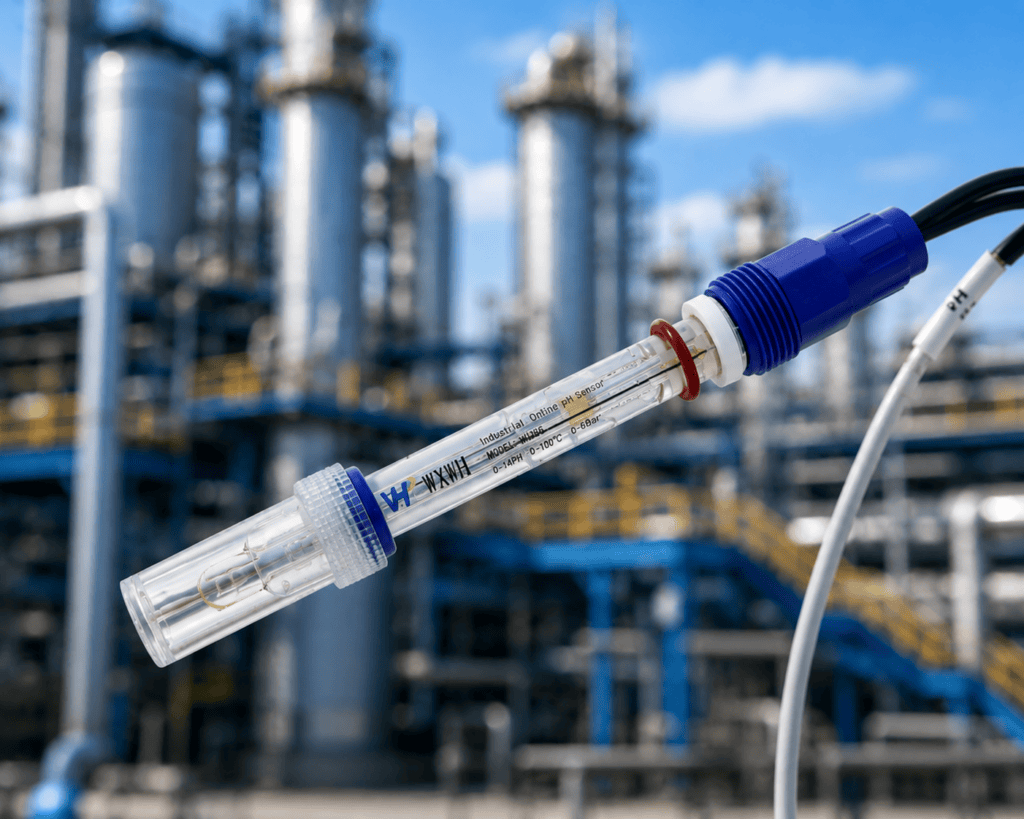
Have you ever wondered why a pH electrode can accurately measure acidity, yet sometimes becomes slow, unstable, or inaccurate? Understanding the pH glass electrode working principle is the key to solving many common measurement problems.
Over the years, we have helped wastewater treatment plants, chemical factories, and industrial users troubleshoot countless pH measurement issues. In this guide, you’ll learn how a pH electrode works, how each component contributes to accurate measurements, and what practical factors affect long-term performance in real-world applications.
Quick Answer
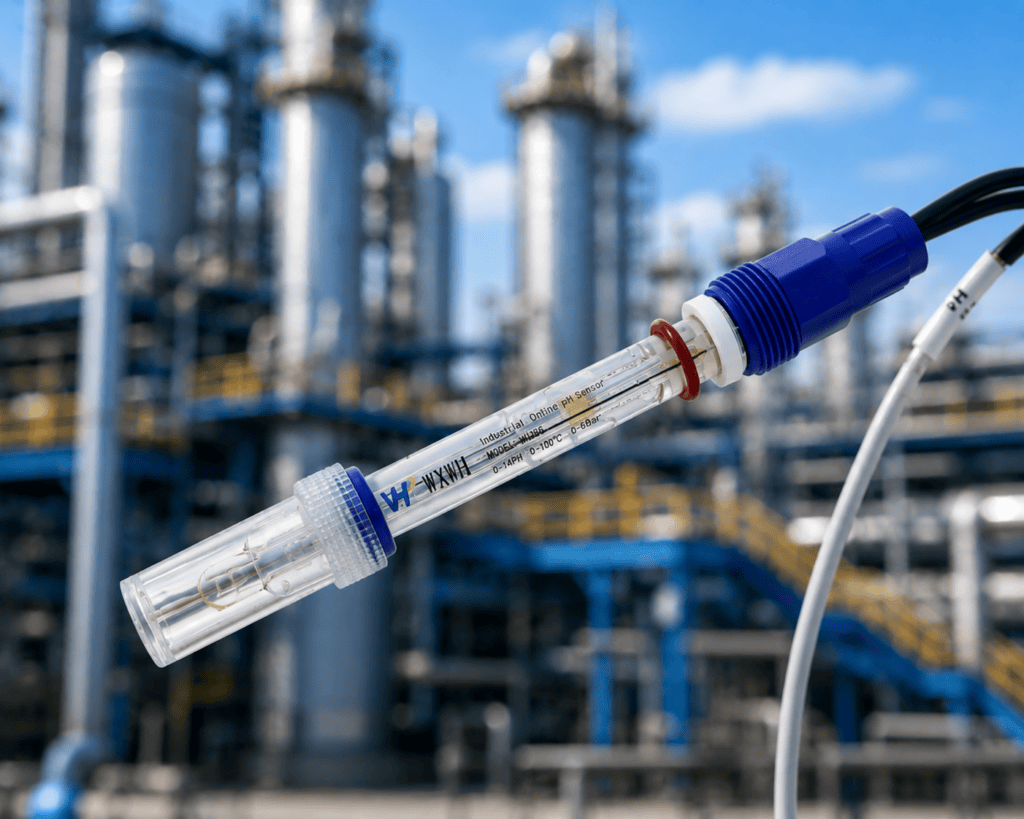
A pH electrode works by generating a small electrical voltage across a thin glass membrane when it comes into contact with a solution. Hydrogen ions in the sample interact with the hydrated layer on the glass surface, creating a potential difference proportional to the solution’s acidity.
Inside the probe, a stable reference system provides a constant baseline. The pH meter measures the voltage difference and converts it into a pH value using the Nernst relationship, which is approximately 59 mV per pH unit at 25°C.
pH Electrode Working Principle: The Electrochemical Foundation
The pH electrode working principle is based on the interaction between hydrogen ions and a specially formulated glass membrane.
When solutions with different hydrogen ion concentrations contact opposite sides of the glass membrane, an electrical potential develops. This voltage changes predictably with pH and forms the basis of pH measurement.
A typical pH measurement system consists of:
- Glass measuring electrode
- Reference electrode
- High-input impedance pH meter
Together, these components convert chemical activity into a readable pH value.
The Glass Electrode for pH Measurement: Construction and Hydrated Gel Layer
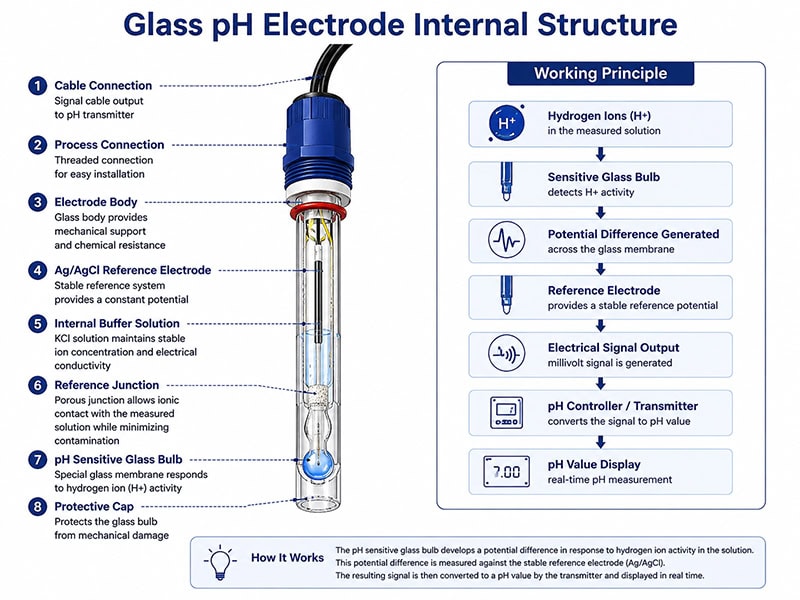
The sensing element of a pH electrode is a thin glass membrane.
Inside the probe, a silver/silver chloride electrode is immersed in a stable internal buffer solution. When the glass membrane contacts the sample, hydrogen ions interact with hydrated layers on the glass surface.
This ion exchange creates a voltage proportional to the difference between the sample pH and the internal reference solution.
One of the most important yet often overlooked parts of the sensor is the hydrated gel layer. This microscopic layer forms naturally when the glass bulb is exposed to water. Without it, the electrode cannot respond properly to hydrogen ions.
If the glass membrane dries out, sensitivity decreases and response time becomes significantly slower.
From Our Field Experience: Improper Storage Can Permanently Damage a pH Electrode
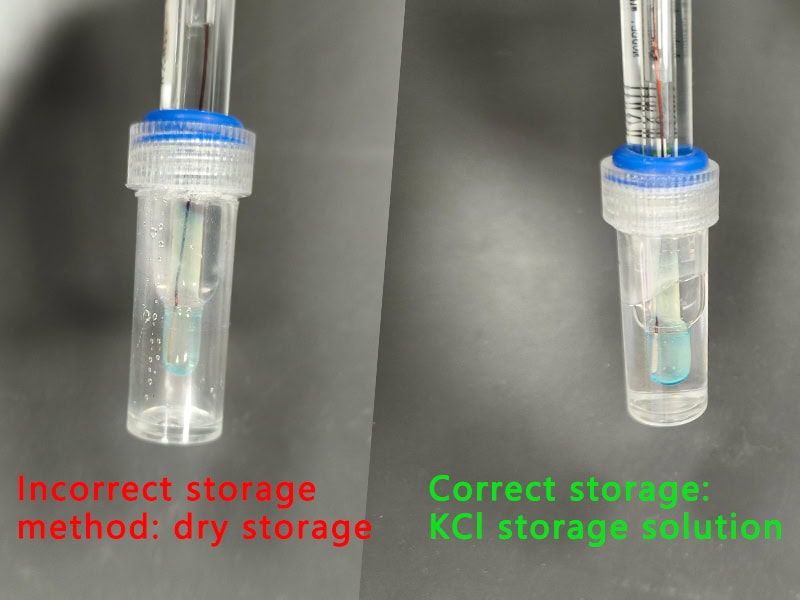
The importance of the hydrated gel layer is often underestimated until a sensor stops working.
We once supported an electroplating plant that used an online pH meter to control the pH of its cleaning solution. During a production line upgrade, the customer removed the pH electrode and stored it for several weeks.
However, the electrode was not stored according to the operating manual. The protective cap was placed back on the sensor, but no storage solution was added inside the cap. As a result, the electrode remained in a completely dry environment.
When production resumed and the pH meter was put back into service, the readings became inaccurate. Even after recalibration, the measurement results remained unreliable.
After inspection, our engineers found that the hydrated gel layer on the glass membrane had dried out and cracked due to prolonged dehydration. The sensing structure had been permanently damaged, causing the electrode to fail.
For short shutdown periods, pH electrodes should be stored in KCl storage solution and should never be left dry or soaked in pure water for long periods. For long-term storage, the protective cap should be filled with storage solution and properly sealed to prevent dehydration of both the glass membrane and reference junction.
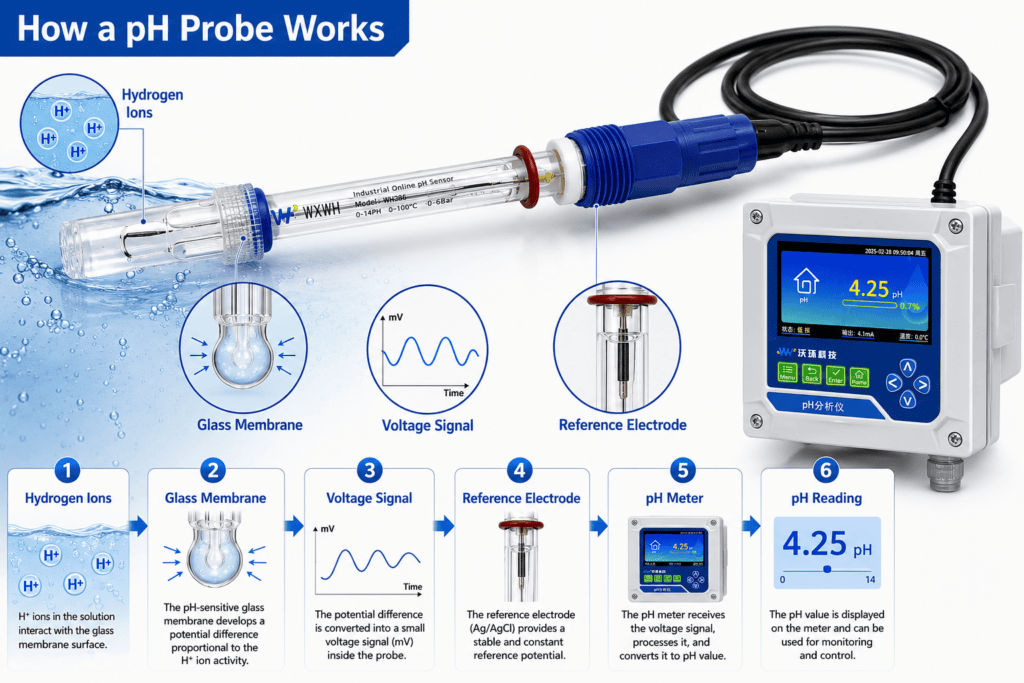
How a pH Probe Works: Step-by-Step
The measurement process follows four basic steps:
Step 1: Hydrogen Ion Interaction
Hydrogen ions in the sample interact with the hydrated surface of the glass membrane.
Step 2: Voltage Generation
The ion exchange process creates a voltage across the glass membrane.
Step 3: Reference Comparison
The internal reference electrode provides a stable baseline against which the membrane voltage is measured.
Step 4: Signal Conversion
The pH meter converts the voltage difference into a pH value displayed on screen.
Understanding the Nernst Equation in Simple Terms
The voltage generated by a pH electrode follows a logarithmic relationship with hydrogen ion concentration.
In practical terms:
Every change of one pH unit produces approximately 59 mV of voltage change at 25°C.
Because this relationship is predictable, the pH meter can accurately convert voltage into pH readings.
Labeled pH Electrode Diagram: Understanding Each Component
A pH electrode contains several critical components.
Glass Membrane
The sensing surface where hydrogen ion exchange occurs.
Internal Buffer Solution
Provides a stable internal pH reference.
Internal Ag/AgCl Electrode
Generates a stable internal potential.
Reference Electrode
Provides the reference potential needed for measurement.
Liquid Junction
Allows ionic contact between the reference electrolyte and process liquid.
Protective Housing
Protects internal components from mechanical and chemical damage.
Each component contributes to overall measurement stability and accuracy.
Combination pH Electrode: Why It Became the Industry Standard
Most modern pH sensors are combination electrodes.
They integrate:
- Measuring electrode
- Reference electrode
into a single probe body.
Advantages include:
- Easier installation
- Reduced contamination risk
- Simplified maintenance
- Improved reliability
This design is widely used in laboratories, wastewater treatment plants, and industrial process applications.
Types of pH Electrodes: From Glass to ISFET
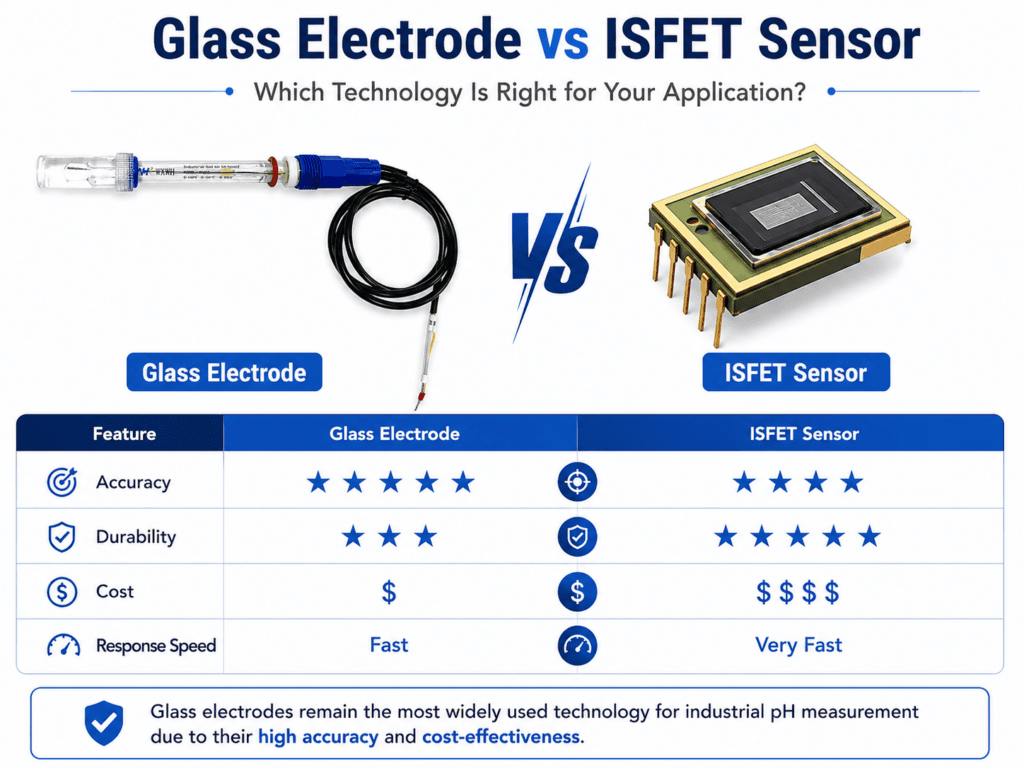
Different applications require different sensor technologies.
Glass pH Electrodes
The most widely used option.
Advantages:
- High accuracy
- Wide pH range
- Proven reliability
ISFET pH Sensors
Used when faster response or greater mechanical durability is required.
Advantages:
- No fragile glass bulb
- Faster response
- Better resistance to mechanical shock
Each technology has specific advantages depending on the application.
From Our Field Experience: Not Every Process Can Use a Standard pH Electrode
Selecting the correct electrode is just as important as understanding how it works.
We once worked with a chemical manufacturing plant that installed an online pH meter to monitor a reactor vessel. The customer believed that a standard industrial pH electrode would be sufficient because the sensor included automatic temperature compensation (ATC).
However, the reactor operated at approximately 140°C and remained at elevated temperature throughout the production process.
The customer assumed that because the electrode had ATC functionality, it could safely operate under these conditions.
In reality, ATC only compensates for temperature-related measurement deviations. It does not increase the physical temperature resistance of the electrode itself.
Most standard industrial pH electrodes are designed for temperatures between 0°C and 80°C.
In this application, the excessive temperature caused the internal reference electrolyte to expand and evaporate rapidly. Over time, electrolyte loss led to junction instability, sensor drift, and eventual electrode failure.
After reviewing the process conditions, we recommended a high-temperature pH electrode specifically designed for elevated-temperature applications. The upgraded sensor used temperature-resistant materials and a reference system capable of operating reliably under high-temperature conditions.
This case highlights a common misunderstanding:
Temperature compensation improves measurement accuracy, but it does not increase the temperature tolerance of the electrode itself.
Always select the electrode according to the actual process temperature, not simply the presence of ATC functionality.
How to Interpret a pH Meter Diagram
A typical pH meter diagram contains three main elements:
- Electrode system
- Temperature compensation system
- Display and signal processing unit
Understanding these elements makes troubleshooting easier and helps operators identify potential measurement problems.
pH Probe Calibration and Maintenance
Even the most advanced pH electrode requires proper calibration and maintenance.
Calibration Procedure
A typical two-point calibration uses:
- pH 7.00 buffer
- pH 4.00 or pH 10.00 buffer
For higher accuracy requirements, three-point calibration may be used.
Always:
- Use fresh buffer solutions
- Rinse between calibration points
- Allow readings to stabilize
- Follow manufacturer recommendations
Storage Best Practices
Proper storage is essential for maintaining sensor performance.
Recommended practices include:
- Store in KCl solution
- Keep the glass membrane hydrated
- Avoid long-term pure water immersion
- Never store the sensor dry
Cleaning and Troubleshooting
Routine cleaning removes:
- Oil deposits
- Protein contamination
- Scale buildup
- Process coatings
If readings become unstable:
- Check the liquid junction
- Inspect for contamination
- Verify calibration
- Review installation conditions
In many cases, measurement problems originate from the electrode rather than the meter itself.
pH Meter vs. pH Probe: What’s the Difference?
Many users confuse these two components.
pH Meter
The electronic instrument that:
- Measures voltage
- Processes signals
- Displays pH values
pH Probe
The sensor that:
- Generates the electrical signal
- Contains the measuring and reference electrodes
The probe is usually the component that requires regular maintenance and replacement.
Frequently Asked Questions
What is the working principle of a pH electrode?
A pH electrode measures hydrogen ion activity by generating a voltage across a glass membrane. The voltage is proportional to pH and is converted into a pH value by the meter.
How does a glass electrode measure pH?
Hydrogen ions interact with the hydrated glass surface, creating an electrical potential relative to the internal reference system.
How often should a pH probe be calibrated?
Calibration frequency depends on the application. For critical industrial processes, regular verification and calibration are recommended according to site procedures.
What causes pH electrodes to fail?
Common causes include:
- Dry storage
- High temperatures
- Contamination
- Aging
- Physical damage
Conclusion
Understanding the pH electrode working principle helps operators make more reliable measurements and troubleshoot problems more effectively.
While the underlying electrochemistry is well established, real-world performance depends heavily on proper storage, correct electrode selection, calibration practices, and operating conditions.
As the field examples in this guide demonstrate, many pH measurement problems are not caused by the meter itself but by installation, storage, or application-related factors. By understanding these details, users can improve measurement accuracy, extend sensor life, and reduce maintenance costs.
About Industrial pH Electrodes and Accurate pH Measurement
Reliable pH measurement plays a critical role in wastewater treatment, chemical processing, electroplating, food production, and many other industrial applications. However, achieving stable and accurate results depends on much more than simply connecting a pH meter.
As discussed throughout this guide, factors such as electrode storage, operating temperature, installation conditions, calibration practices, and application-specific requirements can significantly influence measurement performance. Many pH measurement problems that appear to be sensor failures are often caused by improper storage methods, unsuitable electrode selection, or operating conditions that exceed the sensor’s design limits.
Understanding how a pH electrode works—and selecting the right electrode for the application—can help improve measurement reliability, reduce maintenance costs, and extend sensor service life.
Wohuan Instrument specializes in industrial pH electrodes, online pH analyzers, built-in ATC pH sensors, and water quality monitoring solutions. With extensive experience supporting wastewater treatment plants, chemical factories, and industrial process applications, we help customers identify suitable solutions for challenging operating environments and long-term monitoring requirements.
Need Help Selecting the Right pH Electrode?
Selecting a pH electrode involves more than choosing a measurement range. Process temperature, chemical composition, contamination levels, installation conditions, and maintenance requirements all affect long-term measurement accuracy and electrode lifespan.
Whether you are monitoring wastewater treatment processes, electroplating solutions, chemical reactors, or industrial process water, selecting the correct pH electrode can significantly improve measurement stability and reduce operating costs.
If you are evaluating industrial pH electrodes, online pH analyzers, or water quality monitoring systems, our engineering team can help identify suitable solutions based on your application requirements.
Explore More
Homepage
https://wxinstrument.com/
Industrial pH Electrodes & Online pH Analyzers
https://wxinstrument.com/product-cate/online-ph-meter/
Contact Our Engineering Team
https://wxinstrument.com/contact/
Send us your application details, measuring medium, operating temperature, installation method, and process conditions. Our engineers will recommend suitable products and provide technical support for your project.
Request a Quote | Download Catalog | Contact Our Team