Introduction
A turbidity analyzer requires more than simply selecting an instrument with the correct measurement range.
To obtain reliable turbidity data, users need to consider:
- The purpose of measurement.
- The characteristics of the liquid.
- The measurement method.
- The installation environment.
- The maintenance requirements.
Turbidity measurement is widely used across industries where water clarity directly affects product quality, equipment protection, and regulatory compliance.
Applications include:
- Drinking water treatment.
- Wastewater management.
- Beverage production.
- Pharmaceutical manufacturing.
- Chemical processing.
- Industrial process water.
A turbidity analyzer converts visible cloudiness into measurable data by detecting suspended particles, organic matter, and microorganisms that scatter light.
This allows operators to identify:
- Contamination events.
- Filtration problems.
- Process instability.
- Water quality changes.
For example, in beverage production, turbidity monitoring helps maintain consistent product appearance. In industrial water treatment, continuous turbidity measurement helps protect equipment and improve process control.
This guide explains:
- What a turbidity analyzer is.
- How turbidity sensors work.
- How beverage turbidity testing is performed.
- How to select the right turbidity analyzer.
- Common measurement problems and troubleshooting methods.
What Is a Turbidity Analyzer?
A turbidity analyzer is an instrument used to measure the cloudiness of a liquid caused by suspended particles.
These particles may include:
- Suspended solids.
- Organic matter.
- Microorganisms.
- Colloidal particles.
- Other light-scattering substances.
Unlike parameters such as pH or conductivity, turbidity does not directly measure dissolved substances.
Instead, it evaluates how particles interact with light passing through the sample.
The measurement result is usually expressed in:
- NTU (Nephelometric Turbidity Unit)
- FNU (Formazin Nephelometric Unit)
Understanding Turbidity and Its Measurement
Turbidity represents the optical property of a liquid.
When water is clear:
- Light passes through with minimal scattering.
- The turbidity value remains low.
When suspended particles increase:
- More light is scattered.
- The turbidity value increases.
This makes turbidity an important indicator for evaluating:
- Filtration efficiency.
- Water treatment performance.
- Product consistency.
- Process stability.
Even small changes in particle concentration can indicate potential problems.
For example:
- Increased turbidity after filtration may indicate filter damage.
- Rising turbidity in wastewater may indicate poor separation performance.
- Turbidity changes in beverages may affect product appearance.
Accurate turbidity measurement provides operators with objective data instead of relying on visual judgment.
What Is a Turbidimeter? Clarifying the Terminology
A turbidity analyzer is often called a turbidimeter or turbidity meter.
These terms describe instruments that measure liquid clarity by analyzing light scattered by suspended particles.
The difference is usually related to application and deployment.
Turbidimeter
A turbidimeter usually refers to:
- Laboratory instruments.
- Portable turbidity meters.
- Manual testing equipment.
These instruments are mainly used for:
- Spot checks.
- Laboratory verification.
- Field inspection.
Turbidity Analyzer
A turbidity analyzer usually refers to:
- Online monitoring systems.
- Continuous measurement equipment.
- Industrial process instruments.
These systems are designed for applications requiring:
- Real-time monitoring.
- Automatic recording.
- Alarm functions.
- Process integration.
In industrial environments, the main advantage of a turbidity analyzer is not only measurement accuracy but also continuous data availability.
Operators can detect changes immediately instead of waiting for manual sampling results.
Why Turbidity Monitoring Matters
Turbidity monitoring plays an important role in many industries because changes in suspended particles often indicate changes in process conditions.
Drinking Water Treatment
In drinking water systems, turbidity monitoring helps verify filtration and treatment performance.
High turbidity may indicate:
- Filter failure.
- Incomplete treatment.
- Particle breakthrough.
Continuous turbidity monitoring allows operators to identify abnormal conditions quickly and maintain water quality.
Wastewater Treatment
Wastewater applications often require turbidity monitoring to evaluate:
- Biological treatment efficiency.
- Clarification performance.
- Final discharge quality.
Changes in turbidity may indicate:
- Sludge carryover.
- Poor sedimentation.
- Process fluctuations.
For environmental compliance, continuous turbidity data also provides valuable historical records.
Industrial Process Water
Industrial facilities use turbidity monitoring to protect equipment and improve operational stability.
Typical applications include:
- Boiler feed water.
- Cooling water.
- Water reuse systems.
- Filtration systems.
Stable turbidity measurement helps:
- Detect contamination.
- Prevent equipment damage.
- Optimize treatment processes.
How Does a Turbidity Analyzer Work?
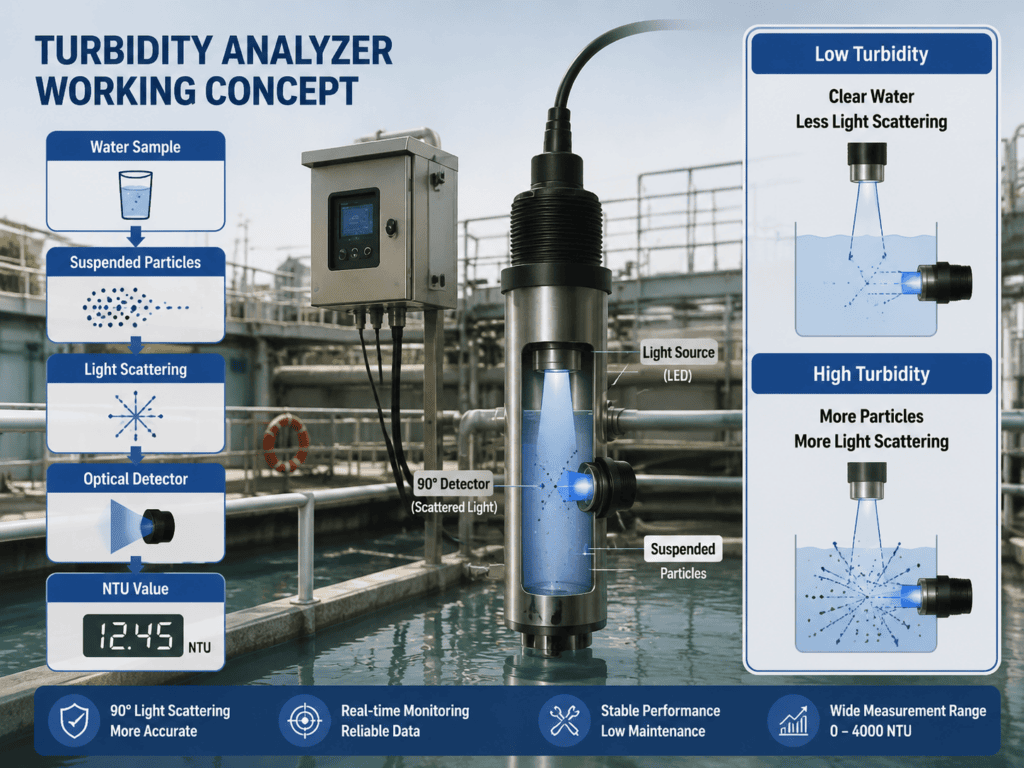
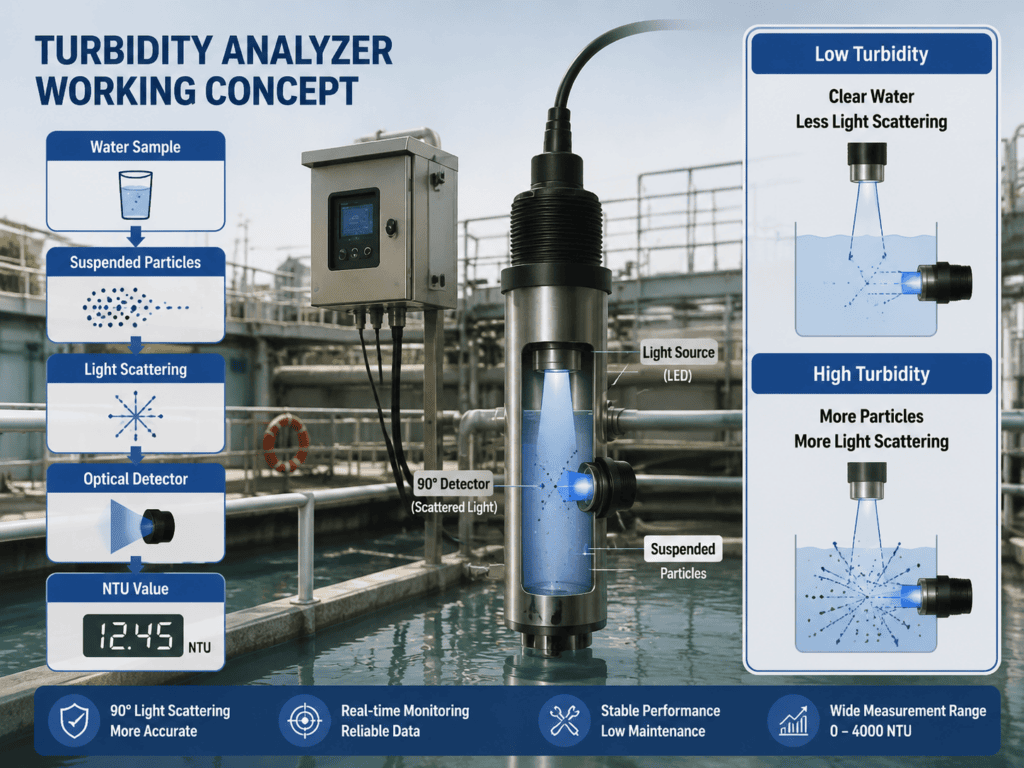
The core principle of turbidity measurement is based on light scattering.
A typical turbidity analyzer works through four steps:
- A light source sends light into the sample.
- Suspended particles scatter the light.
- A detector measures scattered light intensity.
- The analyzer converts the signal into an NTU value.
The more suspended particles present, the stronger the scattered light signal.
The Light Scattering Method Explained
Most modern turbidity analyzers use the nephelometric measurement principle.
The process works as follows:
A light source, commonly an LED, emits a stable light beam through the water sample.
Suspended particles in the sample scatter the light in different directions.
A detector positioned at approximately 90 degrees from the incoming light beam measures the scattered light.
The analyzer then calculates the turbidity value.
Higher particle concentration:
↓
More light scattering
↓
Higher NTU reading
Why Optical Design Matters
The optical structure directly affects turbidity measurement stability.
Important design factors include:
- Stable LED light source.
- Sensitive photodetector.
- Optimized optical chamber.
- Protection against stray light interference.
In continuous monitoring applications, optical contamination is also a major consideration.
If particles or deposits accumulate on the optical surface:
- Light transmission conditions change.
- Measurement signals drift.
- Calibration frequency increases.
Therefore, many industrial turbidity analyzers include:
- Automatic cleaning.
- Self-diagnostic functions.
- Fouling-resistant designs.
What Is a Turbidity Sensor? Key Components and Function
The turbidity sensor is the core component of the analyzer.
It converts optical changes caused by suspended particles into an electrical signal.
A typical turbidity sensor includes:
Light Source
Usually an LED designed for:
- Long service life.
- Stable output.
- Low measurement drift.
Photodetector
The detector measures scattered light intensity.
A high-sensitivity detector improves measurement resolution, especially in low turbidity applications.
Optical Measurement Chamber
The optical chamber provides a controlled environment where:
- Light enters the sample.
- Scattered light is measured.
- Interference is minimized.
Automatic Cleaning System
For continuous industrial monitoring, sensor contamination is a common challenge.
Advanced turbidity sensors may include:
- Ultrasonic cleaning.
- Automatic air cleaning.
- Mechanical wiping systems.
These functions help maintain stable measurement over long operating periods.
From Our Field Experience:
Why Boiler Feed Water Systems Require Continuous Turbidity Monitoring
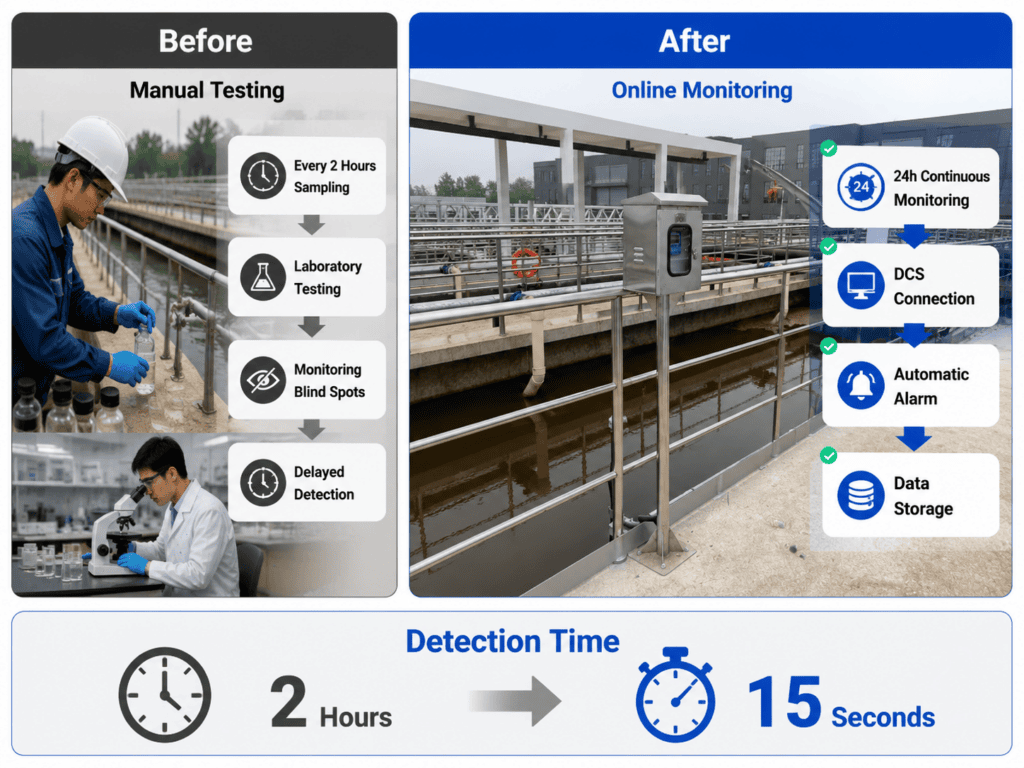
For critical industrial processes, periodic laboratory testing may not provide enough protection.
We worked with a thermal power company where turbidity monitoring was applied to boiler feed water and softened water systems.
Before the upgrade, operators collected water samples every two hours and performed laboratory turbidity testing.
Although this method provided basic water quality information, several limitations appeared:
- Monitoring intervals created blind spots.
- Pretreatment leakage could not be detected immediately.
- Resin failure could cause suspended particles to enter the boiler system.
- Manual sampling required significant labor.
For boiler systems, suspended particles in feed water may contribute to:
- Scale formation.
- Equipment efficiency reduction.
- Long-term reliability risks.
The customer required:
- 24-hour continuous turbidity monitoring.
- 4–20 mA signal transmission to the DCS system.
- Automatic alarm functions.
- Historical data storage.
The facility was upgraded with an online turbidity analyzer connected to the plant control system.
After implementation:
- Monitoring changed from every 2-hour manual sampling to 24-hour continuous measurement.
- Water sampling and laboratory workload decreased by 60%.
- Pretreatment leakage and resin failure abnormalities were detected within 15 seconds instead of up to 2 hours.
- Turbidity data was automatically stored for operation management and safety records.
This project demonstrated that for critical water systems, continuous turbidity monitoring provides faster response and better protection than periodic laboratory testing.
Step-by-Step Guide for Beverage Turbidity Testing
Turbidity measurement is especially important in the beverage industry because product appearance, consistency, and quality control depend on maintaining stable optical characteristics.
Unlike wastewater or industrial applications, beverage turbidity testing often requires higher attention to:
- Sample preparation.
- Temperature control.
- Bubble removal.
- Measurement consistency.
Small differences in turbidity may affect:
- Product appearance.
- Batch consistency.
- Customer perception.
- Quality inspection results.
A reliable beverage turbidity testing process should ensure that the sample condition is stable before measurement.
Step 1: Sample Preparation
Proper sample preparation is the first step toward accurate turbidity measurement.
Before testing, operators should consider:
- Sample temperature.
- Container cleanliness.
- Mixing condition.
- Presence of bubbles.
Incorrect sample preparation may create measurement errors even when the turbidity analyzer is working correctly.
Sample Homogenization
For beverages containing suspended components, the sample should be mixed properly before testing.
This helps ensure:
- Uniform particle distribution.
- Representative measurement results.
- Better repeatability.
However, excessive shaking should be avoided because it may introduce air bubbles.
Step 2: Bubble Removal
Air bubbles are one of the most common factors affecting turbidity measurement accuracy.
Because turbidity analyzers measure light scattering, bubbles may scatter light in a similar way as suspended particles.
This can result in:
- False high turbidity readings.
- Poor repeatability.
- Measurement instability.
For carbonated beverages, bubble removal is especially important.
Common methods include:
- Gentle degassing.
- Waiting for bubbles to disappear naturally.
- Using proper sample handling procedures.
Step 3: Temperature Stabilization
Temperature changes can influence measurement consistency.
Before testing, the sample should be stabilized to the required measurement condition.
Temperature control helps reduce:
- Density changes.
- Bubble formation.
- Measurement variation.
For quality control laboratories, consistent temperature conditions improve comparison between different batches.
Step 4: Turbidity Measurement
After sample preparation:
- Place the sample into the measurement chamber.
- Ensure the optical path is clean.
- Start measurement.
- Record the turbidity value.
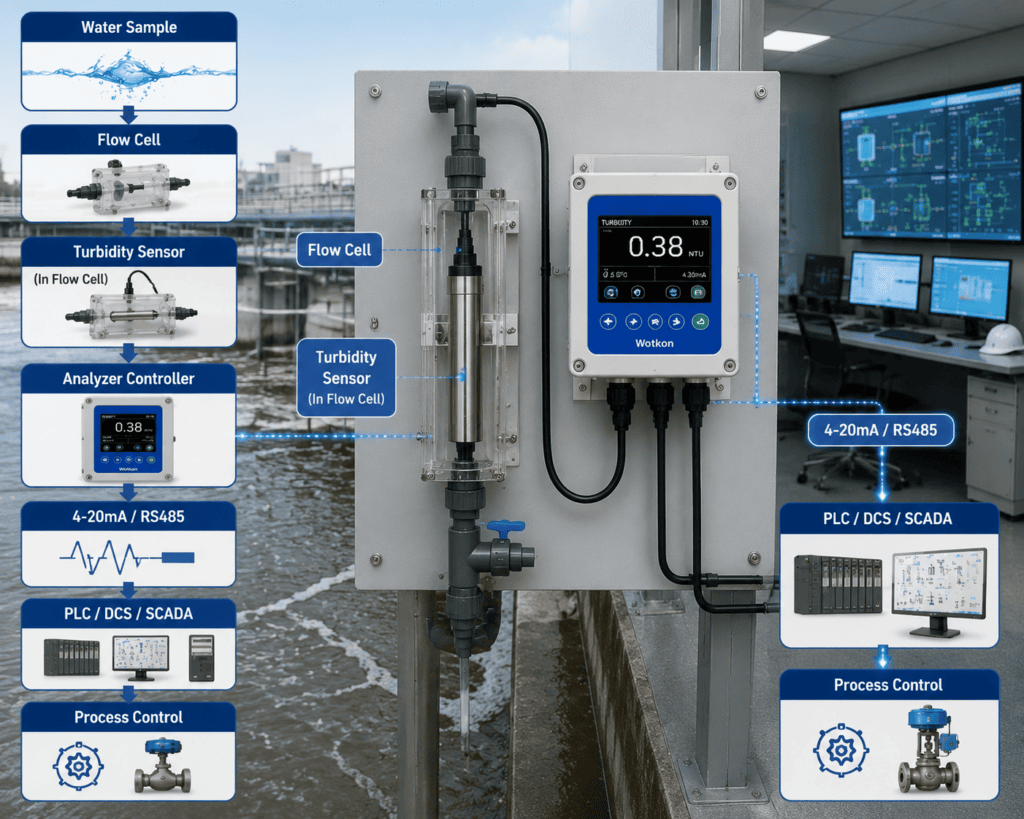
For industrial online turbidity analyzers, the process is automated:
Water sample
↓
Turbidity sensor
↓
Optical measurement
↓
NTU calculation
↓
Data transmission
↓
Monitoring system
Quality Control Standards and Compliance
Turbidity measurement plays an important role in quality management.
Different industries have different requirements.
Beverage Industry
In beverage production, turbidity monitoring helps maintain:
- Product appearance.
- Batch consistency.
- Filtration performance.
Typical monitoring points include:
- Raw water.
- Filter outlet.
- Final product.
- Process water.
Pharmaceutical Industry
Pharmaceutical water systems require strict control of water quality.
Turbidity monitoring helps verify:
- Filtration performance.
- Purification system operation.
- Water quality stability.
Industrial Water Treatment
Industrial applications use turbidity measurement to monitor:
- Pretreatment systems.
- Filtration units.
- Water reuse systems.
Continuous monitoring helps detect abnormal conditions before they affect production.
How to Choose a Turbidity Analyzer
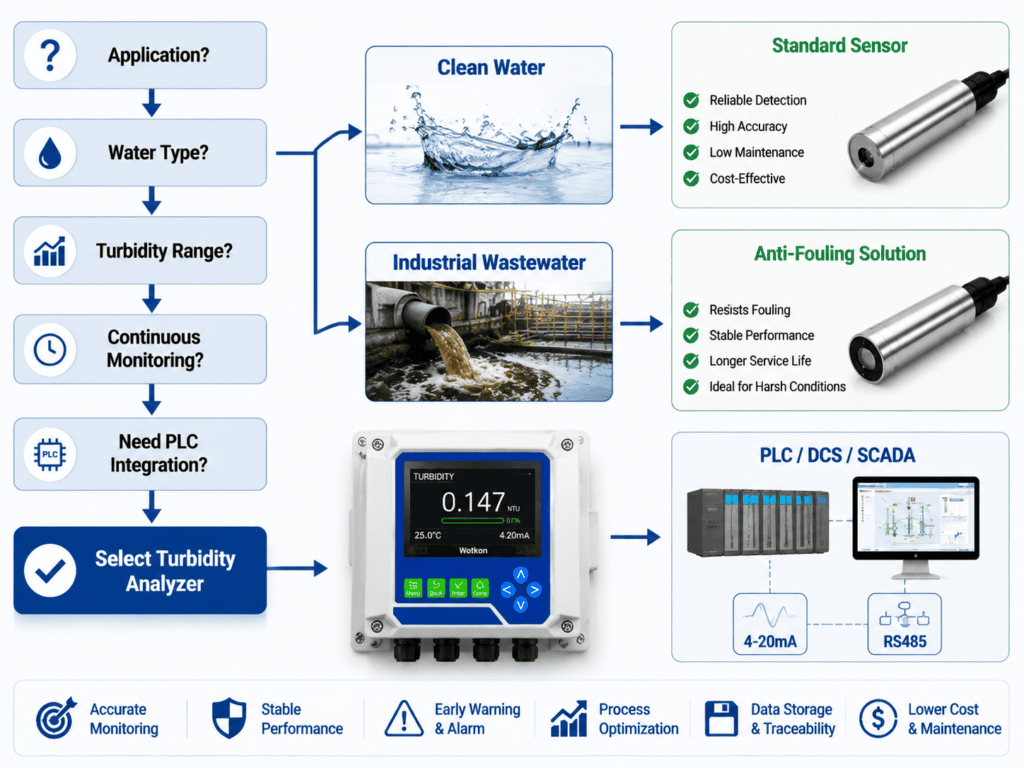
Selecting a turbidity analyzer requires evaluating the actual application rather than only comparing specifications.
Important factors include:
- Measurement range.
- Accuracy requirements.
- Water characteristics.
- Cleaning requirements.
- Communication functions.
- Installation conditions.
1. Measurement Range
The measurement range should match the expected turbidity level.
Different applications require different ranges.
Examples:
Low Turbidity Applications
Examples:
- Drinking water.
- Filtered water.
- Boiler feed water.
Requirements:
- High sensitivity.
- Low detection limit.
- Stable low-NTU measurement.
High Turbidity Applications
Examples:
- Wastewater.
- Industrial process water.
- Raw water.
Requirements:
- Strong contamination resistance.
- Suitable measurement range.
- Easy maintenance.
Choosing an unsuitable range may reduce measurement reliability.
2. Measurement Accuracy
Accuracy requirements depend on the application.
For applications involving:
- Regulatory compliance.
- Product quality.
- Critical process control.
Higher measurement stability is required.
Factors affecting accuracy include:
- Optical design.
- Sensor cleanliness.
- Calibration method.
- Sample conditions.
3. Calibration Requirements
Calibration is essential for maintaining measurement reliability.
The required calibration frequency depends on:
- Water quality.
- Particle concentration.
- Sensor design.
- Operating environment.
Clean water applications usually require less maintenance, while industrial wastewater may require more frequent inspection.
4. Self-Cleaning Capability
For continuous turbidity monitoring, sensor fouling is one of the biggest challenges.
Particles and deposits may accumulate on:
- Optical windows.
- Measurement chambers.
- Sensor surfaces.
Self-cleaning functions can reduce maintenance requirements.
Common solutions include:
- Automatic air cleaning.
- Ultrasonic cleaning.
- Mechanical wiping.
For long-term industrial operation, self-cleaning capability can significantly improve measurement stability.
5. Real-Time Output and Communication
Modern turbidity analyzers are often integrated into automation systems.
Common outputs include:
- 4–20 mA.
- RS485.
- Modbus.
- PLC communication.
These functions allow users to:
- Monitor turbidity remotely.
- Set alarms.
- Store historical data.
- Control treatment processes automatically.
6. Diagnostic Functions
Advanced turbidity analyzers may provide diagnostic information such as:
- Sensor status.
- Cleaning reminders.
- Calibration alerts.
- Measurement abnormal warnings.
These functions help operators identify problems before they affect process operation.
Selecting Between a Turbidimeter and a Turbidity Analyzer
Although both devices measure turbidity, they serve different purposes.
The selection depends on the monitoring objective.
Choose a Turbidimeter When:
A turbidimeter is suitable for:
- Manual testing.
- Laboratory verification.
- Occasional inspections.
Advantages:
- Simple operation.
- Low investment.
- Flexible measurement locations.
Limitations:
- No continuous monitoring.
- No automatic control.
- Manual data recording.
Choose a Turbidity Analyzer When:
An online turbidity analyzer is suitable for:
- Continuous monitoring.
- Process control.
- Environmental compliance.
- Automated operation.
Advantages:
- Real-time measurement.
- Automatic data storage.
- Alarm functions.
- PLC/SCADA integration.
Turbidimeter vs Turbidity Analyzer Comparison
| Item | Turbidimeter | Turbidity Analyzer |
|---|---|---|
| Measurement Method | Manual sampling | Continuous online measurement |
| Application | Inspection and verification | Process monitoring |
| Data Recording | Manual | Automatic |
| Alarm Function | No | Yes |
| PLC Integration | Usually unavailable | Supported |
| Maintenance | Operator dependent | System-based management |
| Best For | Spot checks | 24/7 monitoring |
When Should You Upgrade to an Online Turbidity Analyzer?
An upgrade is recommended when:
- Water quality changes frequently.
- Manual testing cannot provide enough data.
- Process control depends on turbidity.
- Compliance requires continuous records.
- Operators need remote monitoring.
For many industrial applications, online turbidity monitoring provides greater value because it transforms turbidity from a periodic measurement into a real-time process control parameter.
Common Turbidity Analyzer Problems and Troubleshooting
Even with a high-quality turbidity analyzer, measurement problems may still occur during long-term operation.
In many practical applications, abnormal turbidity readings are not caused by instrument accuracy problems alone.
Common causes include:
- Optical surface contamination.
- Unstable sample flow.
- Air bubble interference.
- Incorrect installation.
- Poor maintenance practices.
- Improper calibration.
Before replacing a turbidity analyzer, it is important to check the complete measurement system.
Problem 1: Turbidity Reading Is Higher Than Expected
Possible Causes
Optical Window Contamination
Suspended solids, organic matter, and mineral deposits may accumulate on the optical surface.
This changes the light scattering condition and causes:
- Higher NTU readings.
- Measurement drift.
- Frequent calibration requirements.
Air Bubble Interference
Air bubbles may scatter light similarly to suspended particles.
Common causes:
- Excessive turbulence.
- Improper piping design.
- Pump suction problems.
- Unstable flow conditions.
Incorrect Sampling Conditions
If the sample is not representative, the turbidity value may not reflect the actual water quality.
Possible issues:
- Sampling point selection problems.
- Low flow rate.
- Sediment accumulation.
- Dead zones in pipelines.
Recommended Solutions
Check:
- Optical window cleanliness.
- Sample flow stability.
- Bubble presence.
- Calibration condition.
- Sampling system design.
Problem 2: Turbidity Reading Fluctuates Frequently
Possible Causes
Unstable Sample Flow
Changes in flow rate may affect the amount of particles passing through the measurement chamber.
Rapid Water Quality Changes
Some processes naturally have variable turbidity.
Examples:
- Wastewater treatment.
- Raw water intake.
- Industrial production processes.
Sensor Installation Problems
Incorrect installation locations may cause:
- Poor sample mixing.
- Excessive turbulence.
- Unrepresentative measurement.
Recommended Solutions
- Confirm installation location.
- Stabilize sample flow.
- Check pipeline design.
- Verify whether process changes are causing real turbidity variation.
Problem 3: Online Turbidity Value Does Not Match Laboratory Results
This is one of the most common issues reported by users.
Possible reasons include:
Different Sampling Conditions
The online analyzer and laboratory sample may not represent the same water condition.
Differences may come from:
- Different sampling points.
- Different sampling times.
- Particle settling during transportation.
Sensor Contamination
The online sensor may gradually accumulate deposits while laboratory samples are measured under cleaner conditions.
Calibration Difference
Incorrect calibration procedures may create measurement deviation.
Troubleshooting Steps
Before replacing the instrument:
- Compare samples under identical conditions.
- Clean the optical surface.
- Check calibration status.
- Inspect the sampling system.
Problem 4: Frequent Calibration Is Required
Frequent calibration usually indicates that the measurement system needs improvement.
Possible causes:
- High contamination water.
- Lack of automatic cleaning.
- Incorrect sensor selection.
- Poor sampling design.
- Unstable operating conditions.
Possible improvements:
- Select a turbidity analyzer suitable for the application.
- Add automatic cleaning.
- Improve sample flow conditions.
- Establish a maintenance schedule.
From Our Field Experience:
Turbidity Analyzer Drift Was Caused by Optical Fouling, Not Sensor Failure
In industrial wastewater applications, turbidity drift is not always caused by analyzer accuracy problems.
We worked with a centralized wastewater treatment plant in a chemical industrial park where an online turbidity analyzer was installed to monitor biological treatment effluent before discharge.
The system used a flow-cell type turbidity analyzer.
After a period of operation:
- The turbidity reading gradually increased.
- Online values remained higher than laboratory test results.
- Calibration was required approximately every 10 days.
- False high turbidity alarms occurred frequently.
The customer initially suspected that the turbidity analyzer itself had poor accuracy.
However, after inspection, our engineers found that the instrument was operating normally.
The actual problem came from contamination inside the measurement system.
The wastewater contained:
- Small amounts of inorganic salts.
- Colloidal suspended particles.
During continuous operation:
- Deposits formed on the flow cell wall.
- Optical windows became contaminated.
- The optical scattering path changed.
- The measured turbidity value gradually shifted upward.
In addition, the sampling pipeline flow rate was too low, causing suspended particles to accumulate.
Improvement Measures
The solution included:
- Cleaning the flow cell and optical components.
- Optimizing sample flow conditions.
- Improving maintenance procedures.
- Establishing a more suitable cleaning schedule.
Results After Improvement
The system performance improved significantly:
- Maximum drift over 28 days decreased from 0.15 NTU to 0.03 NTU.
- Calibration interval increased from 10 days to 40 days.
- Flow cell cleaning frequency extended from every 10 days to 35 days.
- False turbidity alarms decreased by 85%.
- Manual maintenance workload was significantly reduced.
This project demonstrated that reliable turbidity monitoring depends not only on analyzer accuracy, but also on:
- Optical cleanliness.
- Sampling system design.
- Maintenance strategy.
Turbidity Analyzer Maintenance Best Practices
Proper maintenance extends equipment life and improves measurement reliability.
1. Keep Optical Surfaces Clean
Because turbidity measurement depends on light scattering, optical contamination directly affects accuracy.
Recommended actions:
- Inspect optical windows regularly.
- Clean deposits promptly.
- Use automatic cleaning systems when necessary.
2. Maintain Stable Sampling Conditions
A reliable sample system should provide:
- Representative water.
- Stable flow.
- Minimal air bubbles.
- Proper installation conditions.
Sampling problems are one of the most common causes of inaccurate turbidity measurements.
3. Perform Regular Calibration
Calibration frequency depends on:
- Water quality.
- Measurement requirements.
- Sensor design.
Recommended practices:
- Follow manufacturer calibration procedures.
- Verify readings with reference standards.
- Adjust maintenance frequency based on actual conditions.
4. Monitor Analyzer Status
Advanced turbidity analyzers may provide diagnostic functions.
Operators should regularly check:
- Sensor condition.
- Cleaning status.
- Calibration reminders.
- Alarm history.
Early detection prevents unexpected measurement failures.
Frequently Asked Questions
What is a turbidity analyzer used for?
A turbidity analyzer measures suspended particles in water by detecting light scattering.
It is widely used in:
- Drinking water.
- Wastewater.
- Industrial process water.
- Beverage production.
- Boiler feed water.
What is the difference between a turbidity analyzer and a turbidity meter?
A turbidity meter or turbidimeter is usually used for manual measurement.
A turbidity analyzer is designed for continuous online monitoring and process control.
How does a turbidity analyzer measure NTU?
A turbidity analyzer sends light through a water sample and measures the light scattered by suspended particles.
The scattered light intensity is converted into an NTU value.
Why does my turbidity analyzer reading keep increasing?
Common causes include:
- Optical window contamination.
- Flow cell deposits.
- Suspended particle buildup.
- Poor cleaning frequency.
- Sampling problems.
The sensor should be inspected before replacing the instrument.
How often should a turbidity analyzer be calibrated?
Calibration frequency depends on:
- Water quality.
- Application conditions.
- Measurement stability requirements.
Clean water applications may require less frequent calibration, while industrial wastewater may require more frequent maintenance.
Conclusion
A turbidity analyzer is an essential instrument for monitoring water quality in industrial and municipal applications.
Compared with manual turbidity testing, online turbidity analyzers provide:
- Continuous measurement.
- Real-time data.
- Automatic alarms.
- Process integration.
- Historical records.
When selecting a turbidity analyzer, users should consider:
- Measurement range.
- Accuracy requirements.
- Water characteristics.
- Cleaning capability.
- Communication functions.
- Maintenance requirements.
However, reliable turbidity monitoring depends on more than the instrument itself.
A complete solution requires:
- Correct sensor selection.
- Proper installation.
- Stable sampling conditions.
- Effective cleaning strategy.
- Regular calibration.
By selecting the right turbidity analyzer and designing the complete monitoring system correctly, users can improve process stability, reduce maintenance workload, and achieve more reliable water quality management.
Turbidity Monitoring Solutions
Reliable turbidity monitoring requires a complete solution rather than only a measurement device.
Wuxi Wohuan Instrument provides complete turbidity monitoring solutions, including:
- Online turbidity analyzers
- Turbidity sensors
- Portable turbidity testers
- Turbidity transmitters
- Flow cell sampling systems
- Automatic cleaning solutions
- Industrial water quality monitoring systems
Our solutions are designed for:
- Industrial wastewater.
- Drinking water treatment.
- Boiler feed water.
- Beverage production.
- Water reuse systems.
- Process water monitoring.
Based on water characteristics, monitoring requirements, and installation conditions, our engineering team helps customers select suitable turbidity monitoring solutions to improve measurement stability and reduce long-term operation costs.
Need Help Choosing the Right Turbidity Analyzer?
Selecting the correct turbidity analyzer depends on more than the NTU measurement range.
The suitable solution should consider:
- Application type
- Water characteristics
- Required measurement frequency
- Installation environment
- Communication requirements
- Maintenance expectations
Whether you need an online turbidity analyzer for continuous process monitoring or a turbidity meter for routine verification, our engineering team can help evaluate your application and recommend the right solution.
Explore Related Solutions
Explore more industrial water quality monitoring solutions:
- Online Turbidity Analyzer
- Residual Chlorine Analyzer
- pH Analyzer
- ORP Analyzer
- Dissolved Oxygen Analyzer
- Conductivity Analyzer
- Multi-Parameter Water Quality Analyzer
Our engineers provide technical recommendations based on your water conditions and process requirements.
Request a Free Consultation
Please provide:
- Application or industry
- Water type
- Expected turbidity range
- Installation method
- Sampling conditions
- Communication requirements
- Maintenance requirements
Our engineering team will recommend the most suitable turbidity monitoring solution and provide technical support for reliable long-term operation.