Introduction
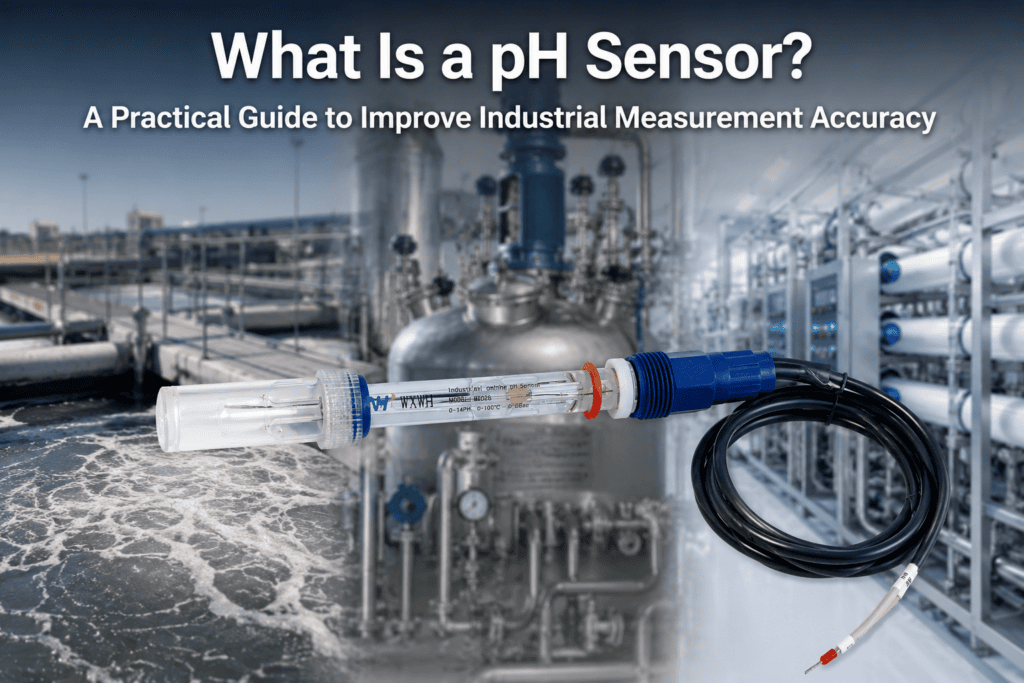
Choosing the right pH sensor is critical for stable process control, accurate chemical dosing, and reliable water quality monitoring. In this guide, you’ll learn how pH sensors work, where they are used, and how to avoid common measurement problems that cause unstable readings or premature sensor failure.
Over the years, our engineers have helped wastewater plants, pharmaceutical facilities, petrochemical companies, and power stations solve challenging pH measurement issues in real-world applications.
By the end of this article, you’ll understand how to select, maintain, and troubleshoot a pH sensor more effectively, helping you improve measurement accuracy and reduce maintenance costs.
Quick Answer: What Is a pH Sensor?
A pH sensor is an electrochemical device used to measure how acidic or alkaline a liquid is.
It converts hydrogen ion activity in a solution into an electrical signal, which is then processed by a pH meter, transmitter, controller, or online analyzer.
Industrial pH sensors are widely used in:
- Wastewater treatment
- Drinking water systems
- Chemical processing
- Pharmaceutical manufacturing
- Power plants
- Food and beverage production
A properly selected pH sensor helps operators:
- Improve product quality
- Optimize chemical dosing
- Prevent corrosion
- Meet environmental regulations
- Reduce operating costs
Understanding the pH Scale
The pH scale ranges from 0 to 14.
- pH 7 = Neutral
- pH below 7 = Acidic
- pH above 7 = Alkaline
Common examples include:
| pH Range | Example |
|---|---|
| 1–2 | Battery Acid |
| 3–4 | Vinegar |
| 5–6 | Coffee |
| 7 | Pure Water |
| 8–9 | Seawater |
| 10–12 | Ammonia Solution |
| 13–14 | Sodium Hydroxide |
In industrial applications, pH directly affects:
- Corrosion rates
- Chemical reactions
- Biological treatment efficiency
- Product quality
- Environmental compliance
This is why pH measurement is considered one of the most important process parameters in modern industry.
How Does a pH Sensor Work?
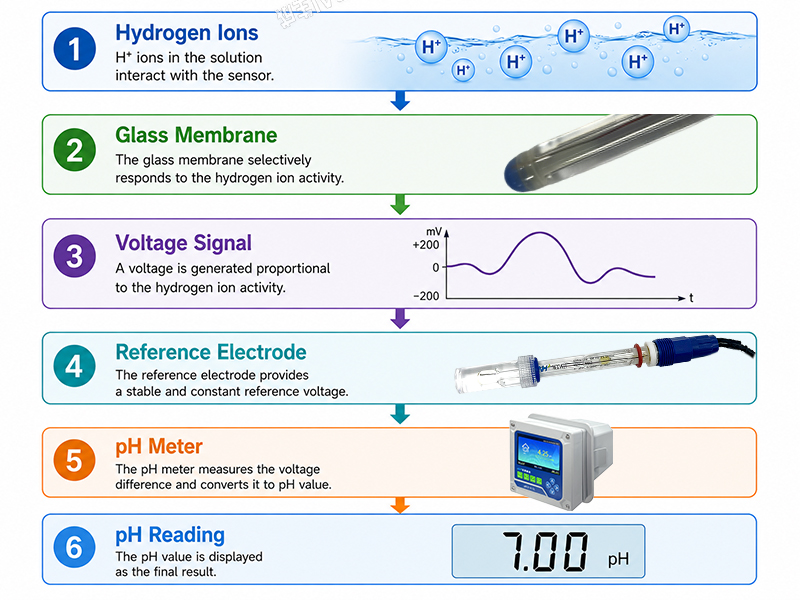
A pH sensor works by detecting hydrogen ion activity in a liquid.
Inside the sensor are two key components:
- Measuring electrode
- Reference electrode
The measuring electrode responds to hydrogen ions.
The reference electrode provides a stable electrical potential.
The sensor measures the difference between these two signals and converts it into a pH value.
This value is then displayed on a controller, transmitter, or monitoring system.
The Glass Electrode and Reference System
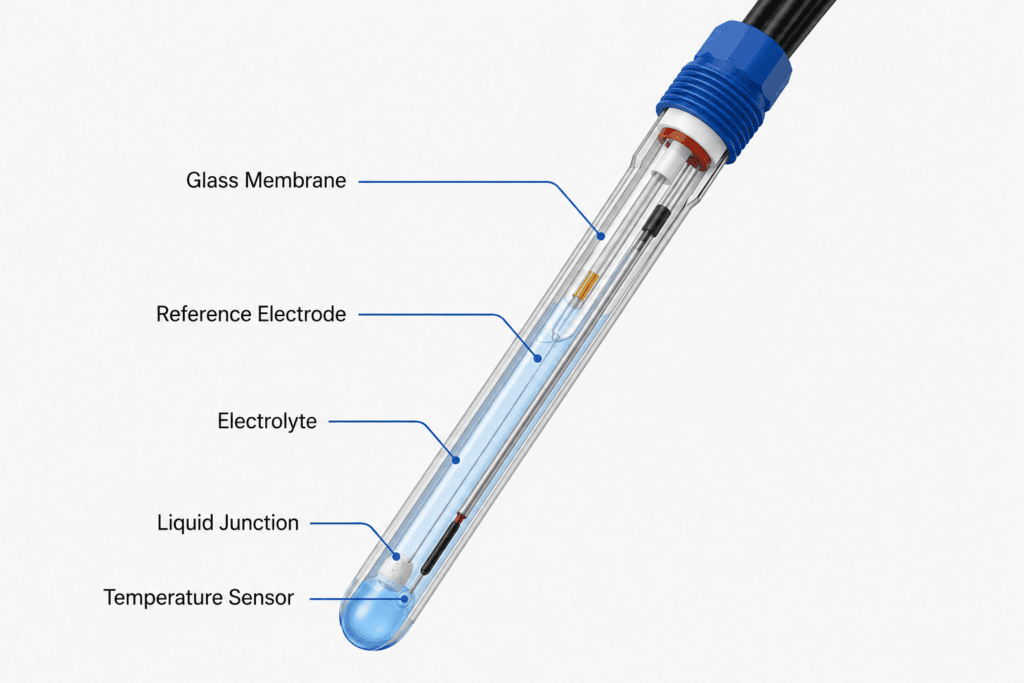
Most industrial pH sensors use a glass electrode design.
The glass membrane is sensitive to hydrogen ions and creates a voltage that changes as pH changes.
The reference system typically consists of:
- Ag/AgCl reference electrode
- Potassium chloride electrolyte
- Liquid junction
Together, these components create a stable electrochemical measurement system.
When either the glass membrane or reference junction becomes contaminated, measurement accuracy begins to decline.
Main Types of Industrial pH Sensors
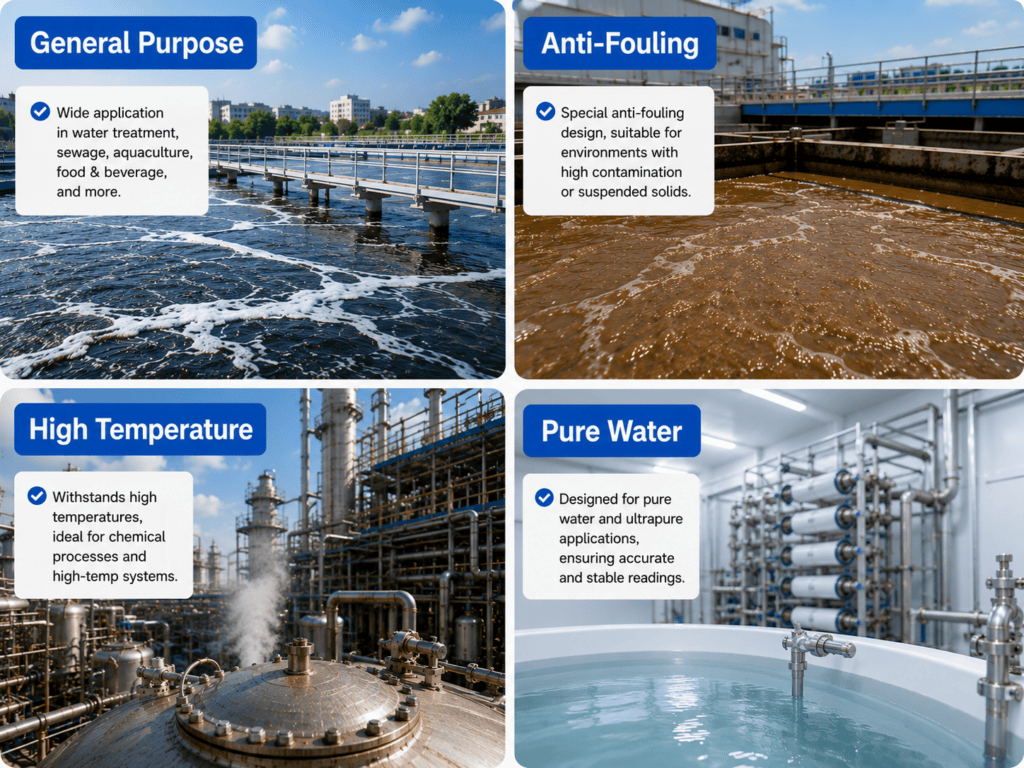
Different applications require different pH sensor designs.
Using the wrong sensor often leads to unstable readings, excessive maintenance, and shortened service life.
General-Purpose pH Sensors
General-purpose sensors are suitable for:
- Municipal water treatment
- Cooling water
- Clean process water
- General industrial applications
Advantages:
- Cost-effective
- Easy maintenance
- Suitable for most standard applications
Anti-Fouling pH Sensors
Anti-fouling sensors are designed for contaminated water and harsh industrial environments.
Typical applications:
- Wastewater treatment
- Textile wastewater
- Electroplating wastewater
- Industrial effluent monitoring
Advantages:
- Better contamination resistance
- Longer service life
- Reduced maintenance frequency
High-Temperature pH Sensors
High-temperature pH sensors are designed for:
- Chemical reactors
- Petrochemical processes
- High-temperature process water
- Desulfurization systems
Advantages:
- Wider temperature range
- Improved stability
- Better resistance to electrolyte loss
Pure Water pH Sensors
Pure water applications require specialized sensors.
Typical applications:
- Boiler feed water
- Pharmaceutical water systems
- Semiconductor manufacturing
- Deionized water systems
Advantages:
- Stable measurements in low-conductivity water
- Reduced concentration-gradient effects
- Improved reference stability
Many standard pH sensors struggle in pure water because the conductivity is too low for stable measurement.
This is why dedicated pure-water pH sensors are recommended for these applications.
Where Are pH Sensors Used?
Industrial pH sensors are used in a wide range of industries.
Wastewater Treatment
pH sensors help control:
- Neutralization systems
- Chemical dosing
- Biological treatment processes
Maintaining the correct pH improves treatment efficiency and helps facilities meet discharge standards.
Drinking Water Treatment
Water plants use pH sensors to:
- Optimize coagulation
- Reduce corrosion
- Improve water quality
Chemical Processing
Chemical plants rely on pH monitoring to:
- Control reactions
- Improve yields
- Protect equipment
Power Generation
Power plants use pH sensors to monitor:
- Boiler feedwater
- Condensate systems
- Cooling water circuits
Accurate pH control helps reduce corrosion and extend equipment life.
Common pH Sensor Problems and Solutions
Even a high-quality pH sensor can produce inaccurate readings if the application conditions are not suitable.
Most pH measurement problems fall into four categories:
- Sensor contamination
- Incorrect sensor selection
- Improper installation
- Poor maintenance
Understanding these issues can help reduce downtime and improve measurement reliability.
Problem 1: Unstable or Fluctuating Readings
Unstable readings are one of the most common complaints in industrial applications.
Possible causes include:
- Installation near chemical dosing points
- Air bubbles attached to the sensor surface
- Excessive flow velocity
- Contaminated glass membrane
- Blocked reference junction
Before replacing the sensor, always check the installation environment and process conditions.
Problem 2: Slow Response Time
A healthy pH sensor should respond relatively quickly to changes in pH.
If the response becomes slow, common causes include:
- Sensor aging
- Fouled glass membrane
- Dehydrated sensing surface
- Reference junction contamination
Regular cleaning can often restore performance.
Problem 3: Frequent Calibration Failure
When a pH sensor repeatedly fails calibration, the problem is often related to:
- Contaminated buffer solutions
- Damaged glass membrane
- Reference system failure
- Incorrect sensor selection
Many users immediately assume the sensor has reached the end of its life, but this is not always the case.
Proper troubleshooting should always be performed before replacement.
How to Use and Maintain a pH Sensor
Good maintenance practices can significantly extend sensor life and improve measurement accuracy.
Recommended maintenance practices include:
- Clean the sensor regularly
- Use fresh calibration buffers
- Inspect the reference junction
- Store the sensor properly during shutdowns
- Follow the manufacturer’s calibration procedure
For difficult applications, maintenance intervals should be shortened to prevent contamination buildup.
From Our Field Experience:
Why a Calibrated pH Sensor Still Produced Incorrect Readings
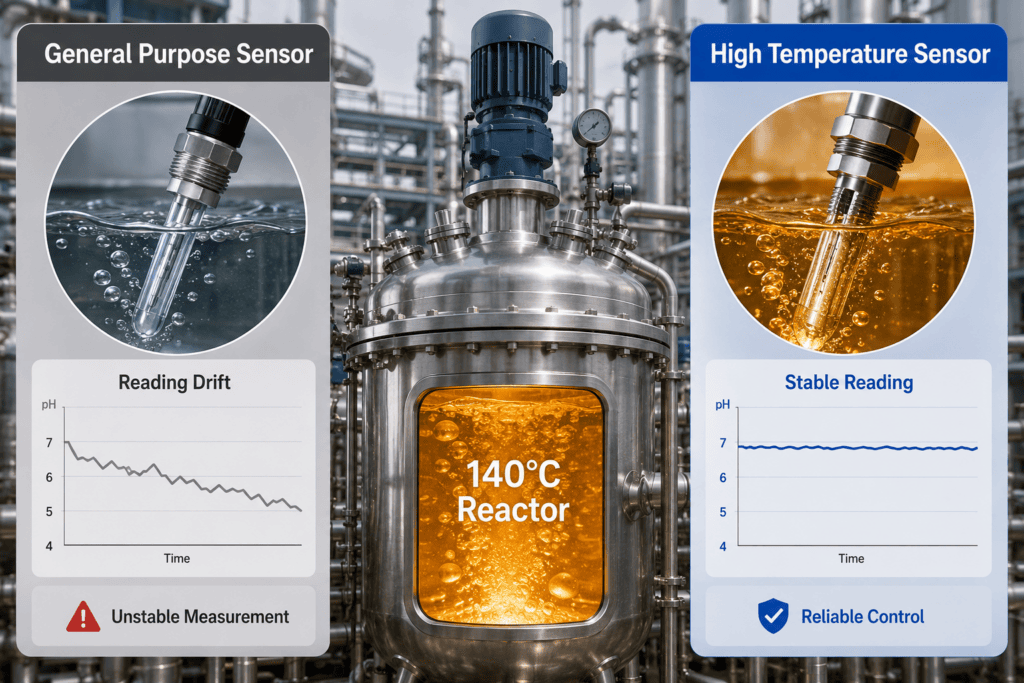
Many users assume that if a pH sensor passes calibration, it should automatically provide accurate measurements in the process.
In reality, calibration alone cannot compensate for an incorrect sensor design.
We once worked with a petrochemical plant that used an online pH monitoring system to control acid-base reactions inside a high-temperature reactor.
The customer reported that the pH sensor had been calibrated successfully, yet the measured values remained unstable and inaccurate during operation.
Initially, the customer suspected an installation issue.
Since incorrect installation near chemical dosing points is a common cause of unstable readings, our engineers first inspected the installation location.
However, the sensor had already been installed in a well-mixed zone away from the dosing point, and the installation was correct.
Further investigation revealed the real problem:
The customer was using a general-purpose pH sensor in a high-temperature process.
Although the sensor could be calibrated under normal conditions, the process temperature exceeded the operating range of the standard electrode.
Most general-purpose pH sensors are designed for temperatures between approximately 40°C and 80°C.
When exposed to higher temperatures:
- Electrolyte loss accelerates
- Reference stability decreases
- Measurement drift increases
- Readings become unstable
After replacing the sensor with a dedicated high-temperature pH sensor designed for elevated process temperatures, the readings became stable and accurate.
This case demonstrates an important lesson: successful calibration does not guarantee accurate measurement. The sensor itself must be suitable for the actual process conditions, especially temperature.
Calibration Best Practices
Calibration is essential for maintaining accurate pH measurements.
For industrial applications, three-point calibration is generally recommended.
Typical sequence:
- pH 7.00 Buffer
- pH 4.00 Buffer
- pH 10.00 Buffer
Benefits of three-point calibration include:
- Improved accuracy
- Better linearity verification
- Early detection of sensor aging
Always use:
- Fresh buffer solutions
- Clean containers
- Stable temperatures
Avoid returning used buffer solution to the original bottle.
Proper Storage During Shutdowns
Incorrect storage is one of the fastest ways to destroy a pH sensor.
Short-term shutdown:
- Store in KCl storage solution
Long-term shutdown:
- Fill the protective cap with storage solution
- Keep the junction hydrated
- Prevent complete drying
Never store a pH sensor in:
- Distilled water
- Deionized water
- Dry environments
Improper storage can permanently damage both the glass membrane and reference system.
When Should a pH Sensor Be Replaced?
Even with proper maintenance, pH sensors eventually reach the end of their service life.
Common replacement indicators include:
- Slow response
- Excessive drift
- Frequent calibration failure
- Reduced slope
- Physical damage
In clean water applications, sensors may last several years.
In harsh industrial environments, replacement intervals are often shorter.
Selecting the correct sensor type is one of the most effective ways to maximize service life.
How to Choose the Right pH Sensor for Your Application
Selecting the right pH sensor is one of the most important decisions in any pH monitoring project.
Many measurement problems are caused not by instrument failure, but by choosing the wrong sensor for the application.
Before selecting a pH sensor, consider:
- Process temperature
- Contamination level
- Conductivity
- Chemical composition
- Pressure conditions
- Installation method
- Maintenance requirements
The more challenging the process environment, the more important sensor selection becomes.
Recommended Sensor Selection Guide
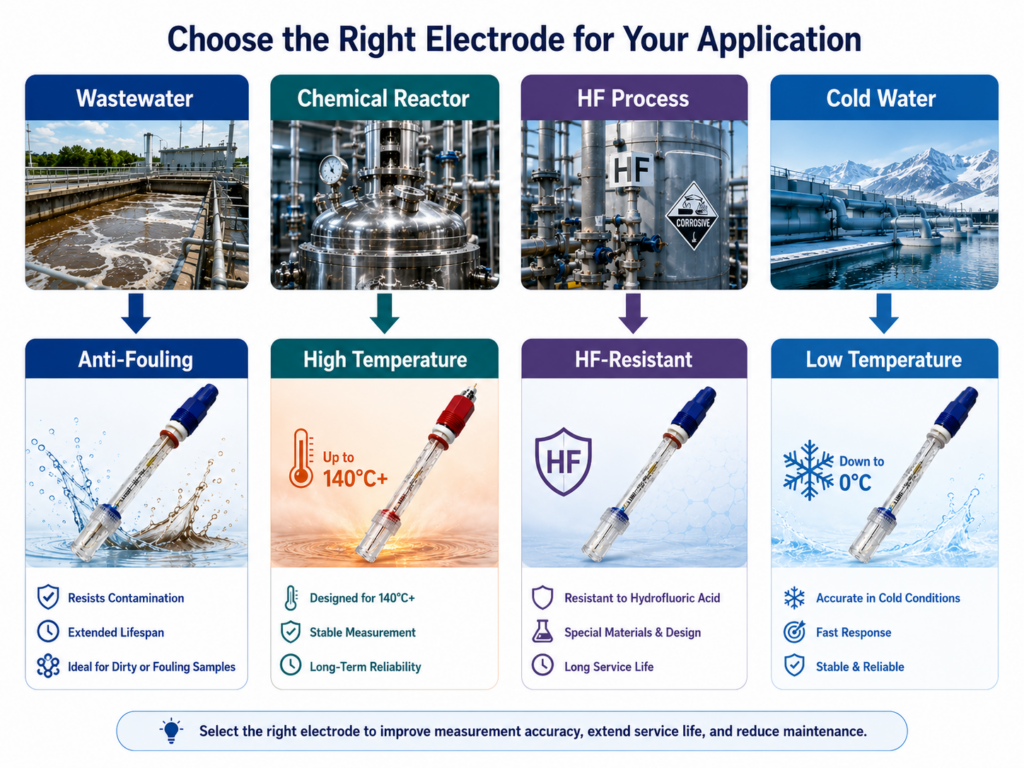
| Application | Recommended Sensor Type |
|---|---|
| Drinking Water | General-Purpose pH Sensor |
| Municipal Water Treatment | General-Purpose pH Sensor |
| Wastewater Treatment | Anti-Fouling pH Sensor |
| Textile Wastewater | Anti-Fouling pH Sensor |
| Electroplating Wastewater | Double-Junction Anti-Fouling pH Sensor |
| Chemical Reactors | High-Temperature pH Sensor |
| Boiler Feed Water | Pure Water pH Sensor |
| Pharmaceutical Water Systems | Pure Water pH Sensor |
| Semiconductor Water Systems | Pure Water pH Sensor |
Using the correct sensor type can significantly improve stability and reduce maintenance costs.
From Our Field Experience:
How the Wrong pH Sensor Selection Caused Measurement Problems
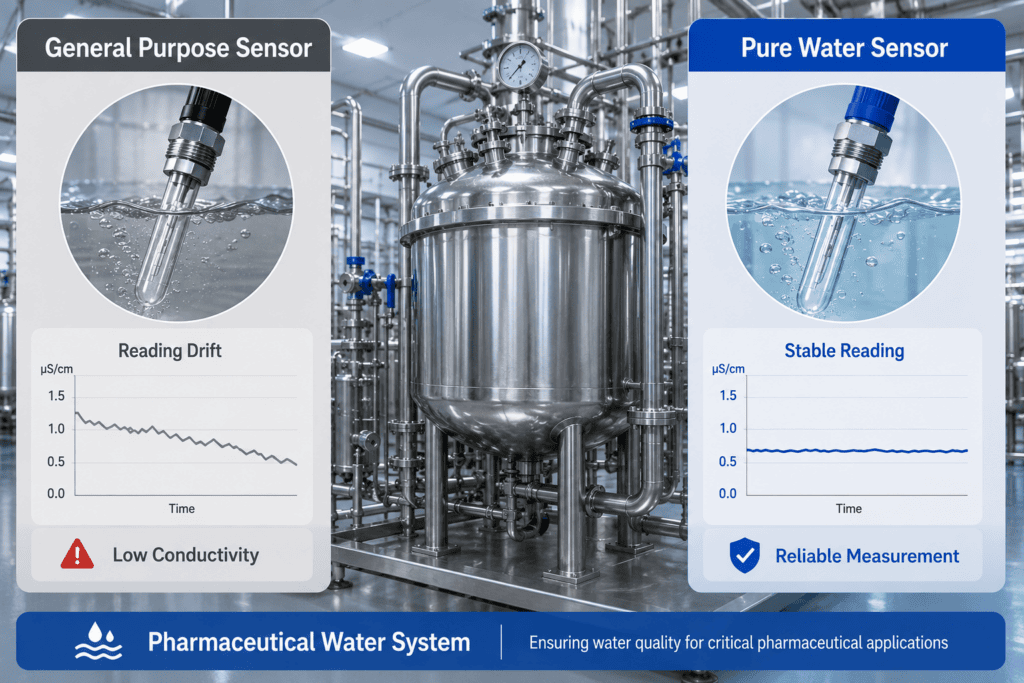
Choosing the wrong type of pH sensor is one of the most common causes of unstable readings and shortened sensor life.
We once supported a pharmaceutical manufacturer that used an online pH monitoring system in a purified water production system.
During the initial installation, a general-purpose pH sensor was selected because it appeared suitable for the required pH range.
However, the customer soon experienced unstable readings and poor measurement repeatability.
The root cause was not calibration, wiring, or controller configuration.
The issue was that the process medium was ultra-pure water.
Pure water has extremely high electrical resistance and contains very few ions.
Standard pH sensors rely on a stable ionic pathway between the reference electrolyte and the sample.
In ultra-pure water applications, conventional junction designs often struggle to maintain a stable reference potential.
In addition, potassium chloride from the reference electrolyte can influence the local ionic environment around the junction, causing measurement instability.
After reviewing the application, our engineers recommended a dedicated pure-water pH sensor equipped with a double-junction reference system and optimized electrolyte design.
The upgraded sensor significantly reduced concentration-gradient effects and provided a more stable electrochemical pathway for measurement.
After the replacement, the pH readings became stable, repeatable, and suitable for process monitoring.
This case highlights an important selection principle: pH range alone should never determine sensor selection. Conductivity, contamination level, temperature, and process conditions are equally important factors.
Frequently Asked Questions
What is a pH sensor used for?
A pH sensor measures the acidity or alkalinity of a liquid and is commonly used in water treatment, wastewater treatment, chemical processing, pharmaceuticals, and industrial manufacturing.
How long does a pH sensor last?
Service life depends on the application.
In clean water systems, a pH sensor may last several years.
In high-temperature, contaminated, or corrosive environments, the lifespan is typically shorter.
Why does my pH sensor drift?
Common causes include:
- Sensor contamination
- Junction blockage
- Incorrect installation
- Sensor aging
- Incorrect sensor selection
Can a pH sensor be calibrated if it is damaged?
Calibration may temporarily improve performance, but it cannot repair a damaged glass membrane, contaminated reference system, or worn-out sensor.
What is the difference between a standard pH sensor and a pure-water pH sensor?
Pure-water pH sensors are specifically designed for low-conductivity applications.
They typically use optimized reference systems and double-junction designs to provide more stable measurements in ultra-pure water.
Conclusion
A pH sensor is much more than a simple measuring device.
It plays a critical role in process control, water quality monitoring, chemical dosing, and environmental compliance.
As the field examples in this guide demonstrate, many pH measurement problems are not caused by controller failures or calibration errors.
In many cases, the real issue is incorrect sensor selection.
By understanding how pH sensors work, selecting the correct sensor type, and following proper maintenance practices, users can significantly improve measurement accuracy, reduce downtime, and extend sensor life.
Whether you are monitoring wastewater, pure water, chemical reactors, or industrial process water, choosing the right pH sensor is one of the most effective ways to achieve reliable long-term performance.
About Industrial pH Measurement
Accurate pH measurement is essential for wastewater treatment, pharmaceutical manufacturing, chemical processing, power generation, and industrial water treatment.
However, achieving stable long-term performance requires more than simply installing a pH sensor.
As the real-world examples throughout this guide show, factors such as temperature, conductivity, contamination level, and sensor design often have a greater impact on measurement accuracy than the instrument itself.
Wohuan Instrument specializes in industrial pH sensors, online pH analyzers, and water quality monitoring systems. With extensive experience supporting wastewater plants, pharmaceutical facilities, chemical factories, and power stations, we help customers improve measurement reliability and reduce maintenance costs in demanding industrial environments.
Need Help Selecting the Right pH Sensor?
Choosing the right pH sensor depends on more than just the measurement range.
Process temperature, contamination level, conductivity, and installation conditions all affect long-term measurement performance.
Whether you are monitoring wastewater treatment systems, pure water systems, chemical reactors, pharmaceutical processes, or industrial process water, selecting the correct sensor can improve measurement accuracy and reduce downtime.
If you are looking for industrial pH sensors, online pH analyzers, or complete water quality monitoring solutions, our engineering team can help recommend suitable options based on your application requirements.