Introduction
The question of what is the pH of distilled water seems straightforward until you actually measure it. Lab technicians, plant operators, and quality managers often see readings that contradict textbook expectations.
This guide explains why distilled water rarely tests at pH 7.0, how to interpret your readings, and what this means for drinking water, scientific experiments, and industrial processes.
Quick Answer: What Is the pH of Distilled Water?
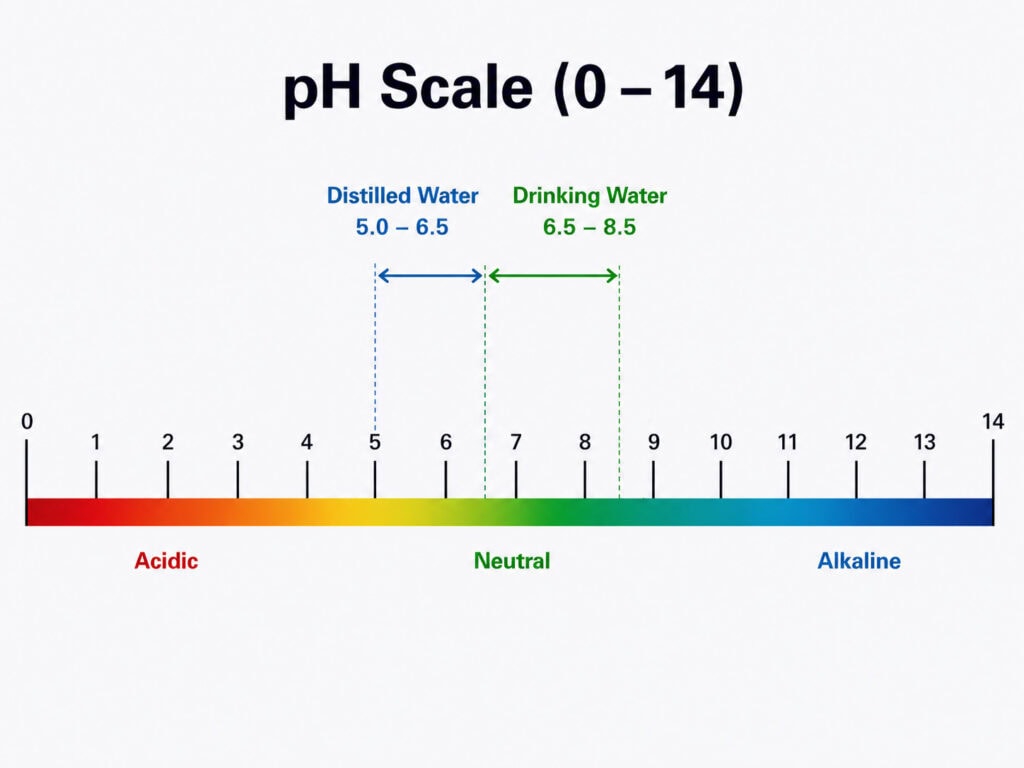
Freshly distilled water has a theoretical neutral pH of 7.0 at 25°C, but exposure to air causes its pH to drop due to CO₂ absorption. In practice, distilled water is typically slightly acidic, with a pH range of approximately 5.0 to 6.5 because carbon dioxide dissolves into the water and forms weak carbonic acid.
This slightly acidic reading is completely normal and does not indicate contamination.
Typical pH values:
| Water Type | Typical pH |
|---|---|
| Freshly distilled (sealed) | ≈ 7.0 |
| Distilled water exposed to air | 5.5–6.5 |
| Municipal tap water | 7.0–8.0 |
| Alkaline water | 8.0–9.5 |
For industrial applications, pH should always be interpreted together with conductivity and temperature data.
What Does pH Mean for Water and Other Substances?
The term pH stands for “potential of hydrogen” and measures hydrogen ion concentration in a solution.
At 25°C:
- pH 7 = Neutral
- pH < 7 = Acidic
- pH > 7 = Alkaline
Water pH plays an important role in:
- Drinking water quality
- Industrial process control
- Wastewater treatment efficiency
- Chemical reaction management
At Wohuan Instrument, we design online pH monitoring systems for industrial water, wastewater, and process applications where continuous pH monitoring is essential.
How Is Distilled Water Produced and Why Isn’t It Always pH 7?
Distilled water is produced by boiling water into steam and condensing it back into liquid form. This process removes most dissolved salts, minerals, and contaminants.
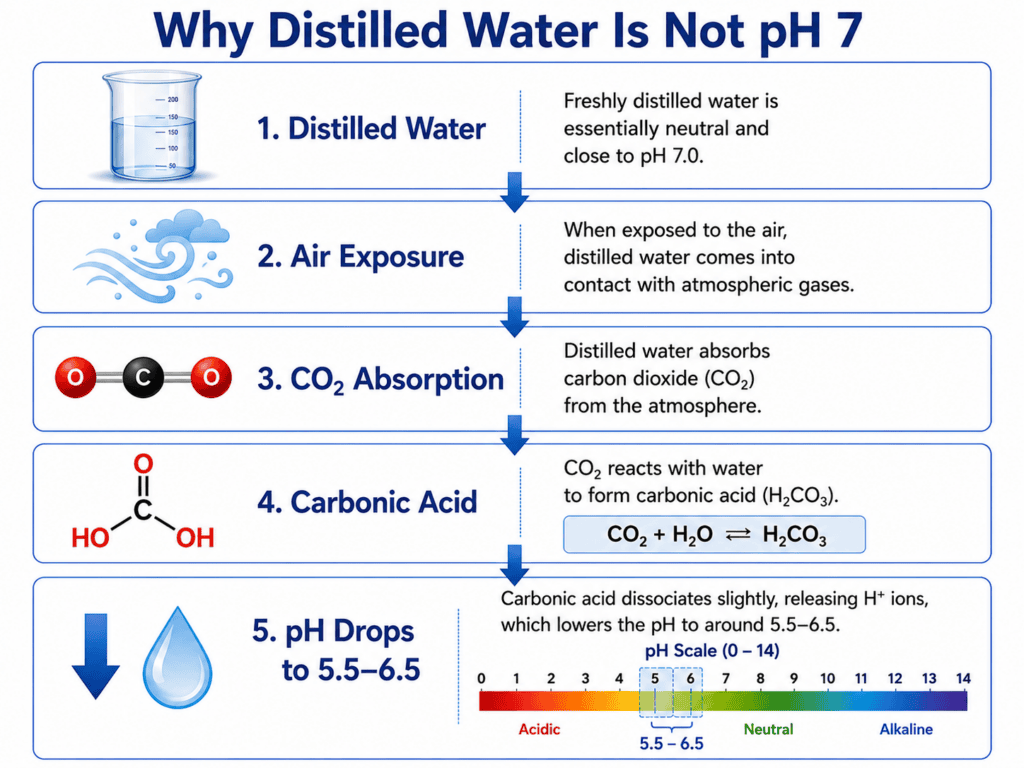
Immediately after condensation in a sealed environment, distilled water is approximately pH 7.0.
However, pure water is chemically unstable.
Once exposed to air, carbon dioxide dissolves into the water and reacts to form carbonic acid:
CO₂ + H₂O → H₂CO₃
As a result, the pH gradually decreases and typically stabilizes between pH 5.0 and 6.5.
Even storage containers, piping systems, and surrounding air can influence the final measured value.
Typical pH of Distilled Water vs Different Waters
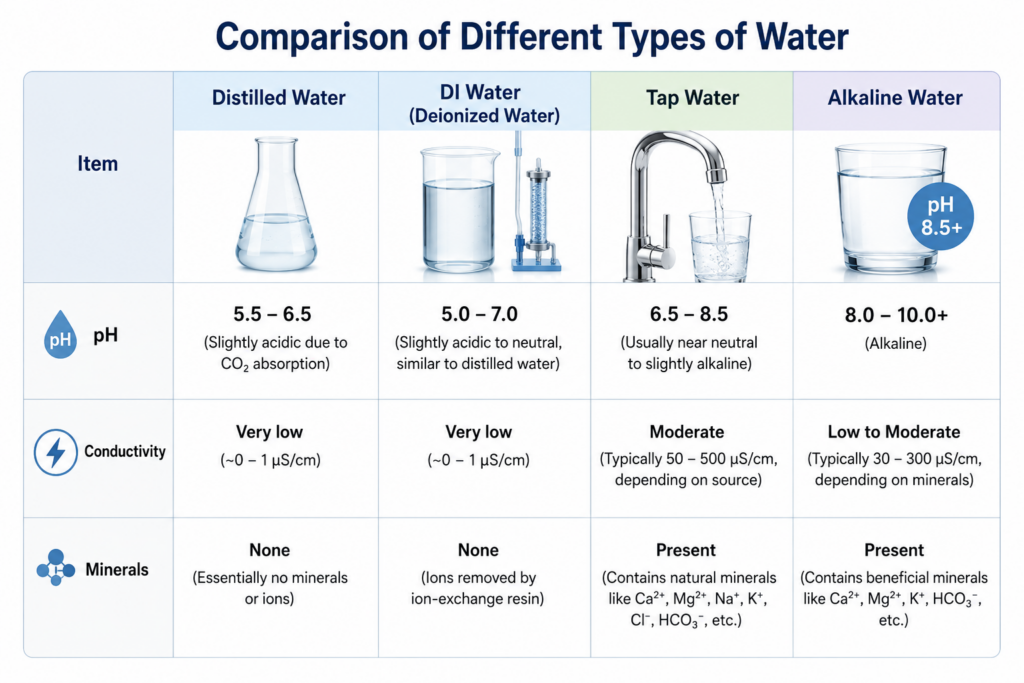
| Water Type | Typical pH Range |
| Distilled Water (Air Exposed) | 5.5–6.5 |
| Deionized Water | 5.5–6.5 |
| Municipal Tap Water | 7.0–8.0 |
| Bottled Drinking Water | 6.9–7.5 |
| Sparkling Water | 4.9–5.5 |
| Seawater | ~8.0 |
| Fresh Water (Rivers/Lakes) | 6.5–8.5 |
Although distilled water may appear slightly acidic, it remains safe for most applications.
Why Is Measuring the pH of Distilled Water So Difficult?
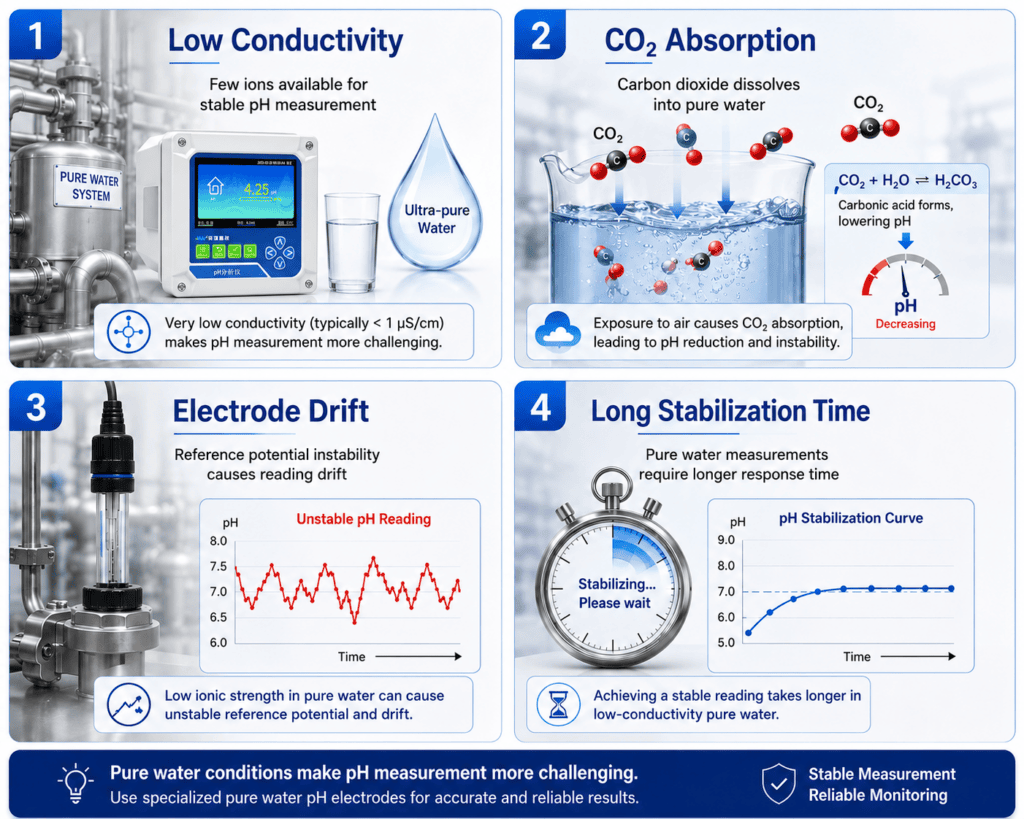
Many users see unstable pH readings in distilled water and assume their pH meter is malfunctioning.
In reality, pure water is one of the most difficult samples to measure accurately.
Distilled water has extremely low conductivity, typically between 0.5–5 μS/cm. Conventional pH electrodes are designed for solutions containing dissolved ions. In pure water, the lack of ionic strength causes unstable junction potentials and slow electrode stabilization.
Common symptoms include:
- Constant drifting readings
- Values changing during stirring
- Different readings between repeated measurements
- Long stabilization times
From Our Field Experience: Why Pure Water Readings Often Appear Unstable
Many users assume that unstable pH readings indicate a faulty instrument. In high-purity water applications, this is often not the case.
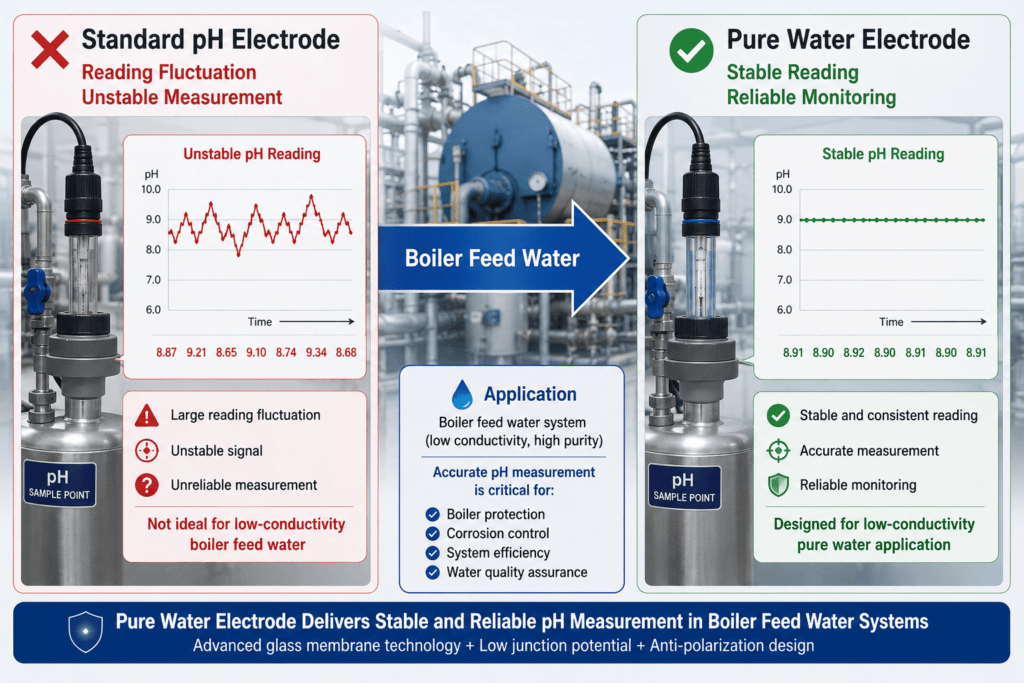
We once supported a thermal power plant that used an online pH monitoring system to measure boiler circulating water. The customer reported that the pH value continuously fluctuated and never stabilized. Their first assumption was that the pH controller had failed.
After troubleshooting, our engineers confirmed that the controller was functioning normally. Further investigation revealed that the customer had accidentally installed a standard industrial pH electrode instead of a pure-water pH electrode during routine maintenance.
A standard pH electrode typically contains a high-concentration 3 mol/L KCl reference electrolyte. In low-conductivity water, the localized release of electrolyte near the junction can significantly alter the ionic environment around the sensor tip. As a result, the measured pH value continuously drifts and fluctuates.
After replacing the sensor with a dedicated pure-water pH electrode featuring a large-porosity flowing junction design, the readings immediately became stable and repeatable.
This case highlights an important principle: when measuring distilled water, deionized water, or boiler feed water, electrode selection is just as important as calibration.
How to Measure the pH of Distilled Water Accurately
For reliable measurements, both proper technique and the correct sensor are required.
Recommended procedure:
- Calibrate the pH meter using fresh buffer solutions.
- Rinse the electrode with distilled water.
- Gently blot dry with lint-free tissue.
- Allow sufficient stabilization time.
- Record temperature together with pH.
Best practices:
- Minimize air exposure.
- Use closed sample containers when possible.
- Use specialized pure-water pH electrodes.
- Monitor conductivity alongside pH.
From Our Field Experience: Why Distilled Water Rarely Reads Exactly pH 7
Many users expect distilled water to measure exactly pH 7.0. In practice, this expectation often leads to confusion.
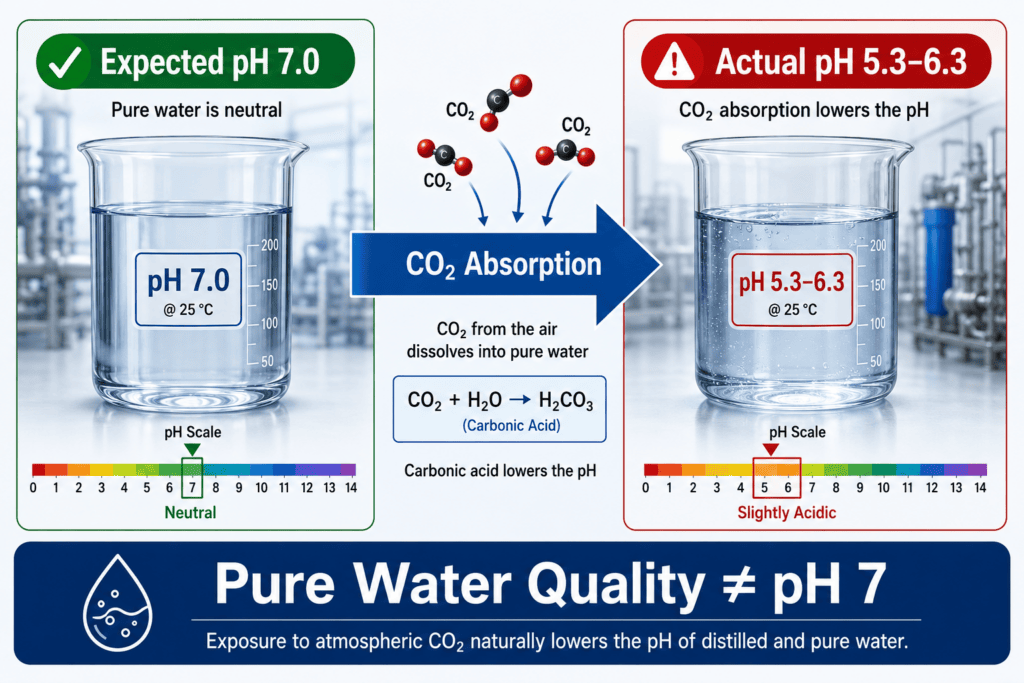
We once worked with a small biopharmaceutical company that had recently installed a pure-water generation system together with a complete water quality monitoring package. Shortly after commissioning, the operators noticed that the distilled water consistently measured around pH 6.0 rather than the expected pH 7.0.
The customer initially suspected problems with both the water purification system and the pH monitoring equipment.
After investigating the process, our engineers found that the distilled water generator itself operated within a sealed pipeline. However, the downstream storage tank was equipped with a sterile air breather to balance internal pressure. Although this design is standard practice, it allowed a small amount of atmospheric air to enter the tank.
Carbon dioxide from the air dissolved into the ultra-pure water and formed weak carbonic acid. As a result, the measured pH naturally stabilized between approximately 5.3 and 6.3.
The key lesson was that pH alone is not the primary indicator of pure-water quality. In high-purity water systems, resistivity or conductivity is often a more reliable purity indicator than pH.
While freshly distilled water in a completely sealed environment can theoretically remain at pH 7.0, even brief exposure to air will cause the pH to decrease. Achieving a stable pH close to 7.0 requires fully sealed storage and, in some applications, nitrogen blanketing to eliminate contact with atmospheric carbon dioxide.
This misunderstanding is surprisingly common in pharmaceutical, electronics, and laboratory water systems.
pH of Distilled Water in Drinking, Medical, and Industrial Applications
The same distilled water behaves differently depending on the application.
Drinking Water
Distilled water is safe to drink despite its slightly acidic pH. However, because most minerals have been removed, it often tastes flat compared to mineralized drinking water.
Medical and Laboratory Applications
Distilled water is commonly used in:
- Autoclaves
- CPAP machines
- Laboratory instruments
- Analytical testing
Its value comes from purity rather than pH.
Industrial Applications
Distilled and high-purity water are widely used in:
- Boiler feed systems
- Steam generation
- Electronics manufacturing
- Pharmaceutical production
- Humidification systems
- Precision cleaning processes
For industrial users, conductivity and resistivity are usually more important indicators than pH alone.
Wohuan Instrument provides online monitoring solutions for:
- pH
- Conductivity
- ORP
- Dissolved Oxygen
- Ammonia
- Nitrite
- Multi-parameter water quality monitoring systems
for water plants, wastewater treatment facilities, chemical plants, and industrial process applications.
How to Keep Distilled or DI Water Closer to Neutral pH
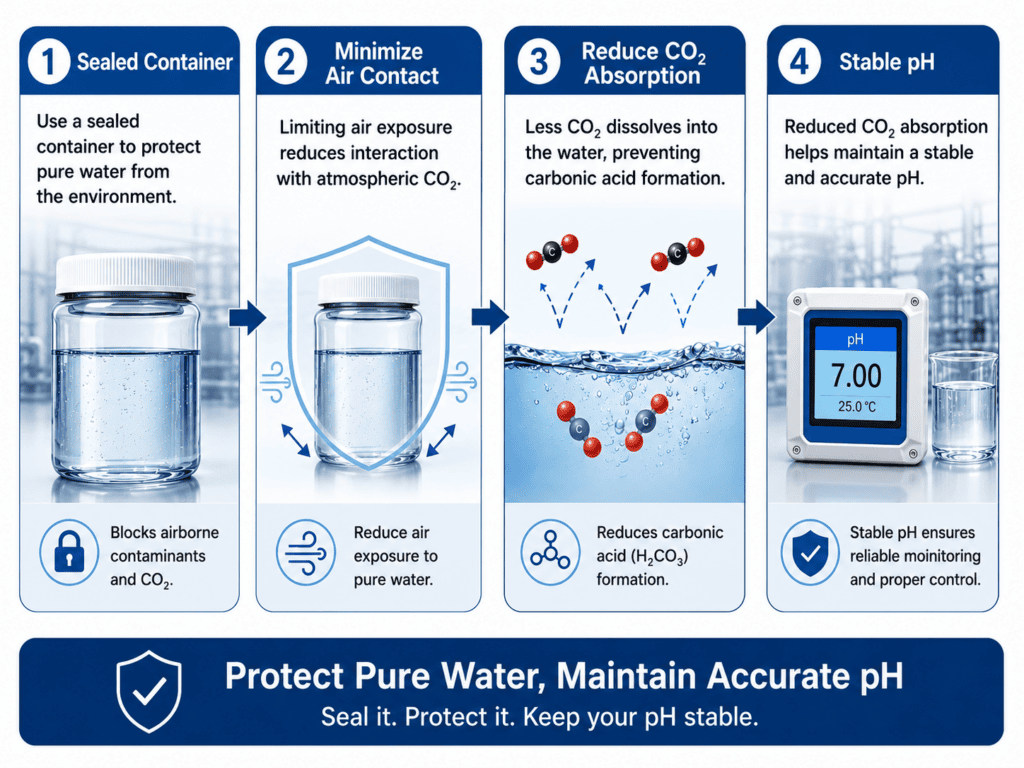
Although maintaining a perfect pH of 7.0 is difficult, proper storage practices can significantly reduce pH drift.
Recommended practices include:
- Store water in sealed containers.
- Minimize headspace above the liquid.
- Avoid frequent opening of storage tanks.
- Use CO₂-resistant containers when possible.
- Store in cool, dark environments.
In industrial systems, degassing equipment and closed-loop circulation can help maintain stable water quality.
For laboratory applications, preparing fresh distilled water shortly before use often provides the most reliable results.
Distilled Water, DI Water, RO Water, and Alkaline Water: What’s the Difference?
| Water Type | Production Method | Typical pH Behavior | Common Uses |
|---|---|---|---|
| Distilled Water | Boiling & Condensation | Drifts to 5.5–6.5 | Labs, Medical, Industrial |
| Deionized Water | Ion Exchange | Similar to Distilled Water | Electronics, Boilers |
| RO Water | Membrane Filtration | Slightly Acidic to Neutral | Drinking, Food Production |
| Alkaline Water | Mineral Addition or Electrolysis | 8.0–9.5 | Consumer Drinking Water |
Although these water types differ in treatment method, conductivity, resistivity, and contamination levels often provide more meaningful information than pH alone when evaluating water quality.
Frequently Asked Questions About the pH of Distilled Water
Why does distilled water often measure below pH 7?
Because carbon dioxide from the air dissolves into the water and forms weak carbonic acid.
Is distilled water acidic?
Technically yes, but only slightly. The acidity is weak and normally not harmful.
Why do pH readings drift in distilled water?
Low conductivity causes unstable junction potentials and slower electrode stabilization, especially when using conventional pH electrodes.
Can I use a standard pH electrode to measure distilled water?
It is possible, but results are often unstable. Dedicated pure-water pH electrodes provide significantly better performance.
Is pH the best indicator of pure-water quality?
No. In high-purity water systems, conductivity and resistivity are usually more important indicators than pH.
Why does stirring affect the reading?
In pure water, stirring changes local ion distribution and carbon dioxide exchange rates, causing visible pH fluctuations.
Conclusion
The pH of distilled water is more complicated than many people expect. Although freshly distilled water theoretically has a neutral pH of 7.0, exposure to air quickly causes carbon dioxide absorption and lowers the pH into the range of approximately 5.0 to 6.5.
For laboratory, pharmaceutical, power generation, and industrial applications, understanding the limitations of pure-water pH measurement is critical. As our field experience demonstrates, unstable readings are often caused by inappropriate sensor selection rather than instrument failure, and pH values below 7 do not necessarily indicate poor water quality.
When evaluating distilled water, always consider pH together with conductivity, resistivity, temperature, and storage conditions to obtain a complete picture of water quality.
About High-Purity Water pH Monitoring
Accurately measuring the pH of distilled water, deionized water, and other high-purity water systems is often more challenging than measuring wastewater or process water. Low conductivity, carbon dioxide absorption, storage conditions, and electrode selection can all influence measurement stability and accuracy.
As discussed in this guide, many apparent pH measurement problems are not caused by instrument failure. In practice, unstable readings are often related to improper electrode selection, while unexpected pH values frequently result from normal carbon dioxide absorption rather than poor water quality. Understanding these factors is essential for obtaining meaningful data in laboratory, pharmaceutical, power generation, and industrial water applications.
Wohuan Instrument specializes in online pH analyzers, pure-water pH electrodes, conductivity sensors, and integrated water quality monitoring solutions. Drawing on extensive experience in power plants, pharmaceutical facilities, water treatment systems, and industrial process applications, we help users improve measurement reliability and better understand the behavior of high-purity water systems.
Need Help Monitoring High-Purity Water?
Selecting the right pH sensor for distilled water, deionized water, boiler feed water, or pharmaceutical-grade water can significantly improve measurement stability and reduce troubleshooting time.
If you are evaluating online pH analyzers, pure-water pH electrodes, conductivity sensors, or complete water quality monitoring systems, our engineering team can help recommend suitable solutions based on your operating conditions.
Homepage:
https://wxinstrument.com/
Water Quality Monitoring Solutions:
https://wxinstrument.com/product-cate/water-quality-controllersensor/
Contact Us:
https://wxinstrument.com/contact/
Send us your application details, water quality parameters, and process requirements. Our engineers will be happy to recommend a suitable monitoring solution.