Introduction
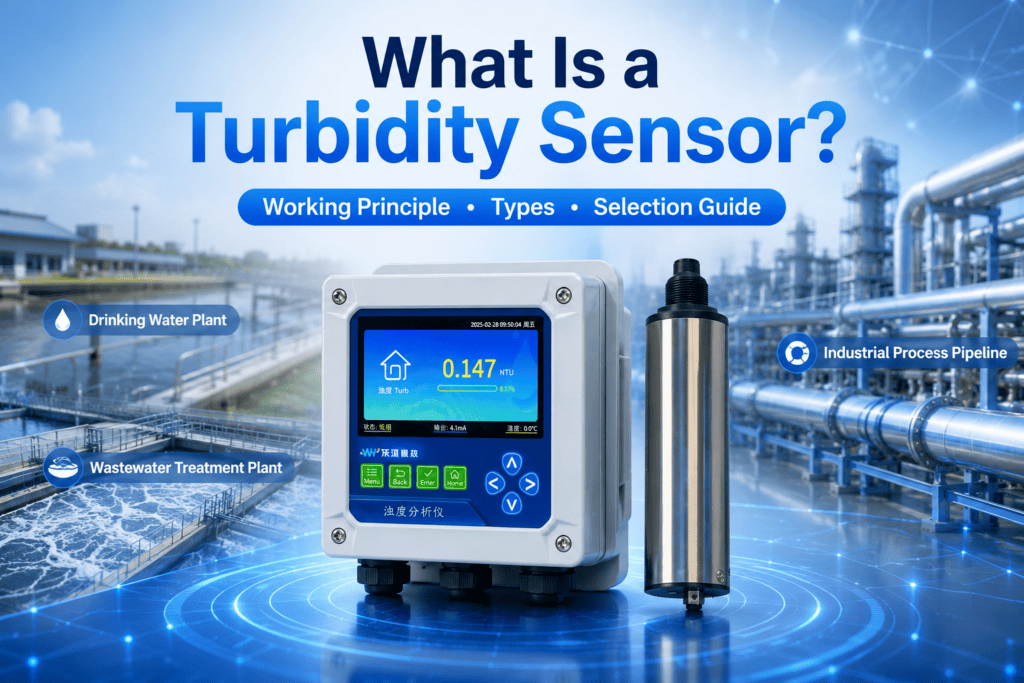
Suspended particles in water rarely announce themselves. A filter starts to break through, a process stream picks up sediment, or an effluent discharge drifts out of spec—and without continuous measurement, the first sign of trouble is often a failed compliance check.
A turbidity sensor closes that gap by turning particle concentration into a live, trackable number.
The sections below cover how these instruments work, how probes, transmitters, and monitors differ, the main sensor types, and how to match a sensor to your application.
Quick Answer
A turbidity sensor measures how much light suspended particles scatter in water, then reports that cloudiness as a value—usually in Nephelometric Turbidity Units (NTU).
To choose one, define your measurement range and accuracy needs, confirm the relevant water-quality standard for your region, and match the installation type (inline, submersible, or removable) and cleaning method to your process conditions.
The selection checklist further down breaks these factors into context-specific decisions.
What Is a Turbidity Sensor? Definition and Working Principle
A turbidity sensor is an analytical instrument that quantifies the cloudiness or haziness of a liquid caused by suspended particles. That cloudiness is a key indicator of water quality across drinking water, wastewater, and industrial process applications.
At its core, the device measures how much light is scattered or absorbed by particles in a water sample. Several technologies exist, but the most common relies on optical principles to deliver rapid, repeatable readings of particle concentration.
Optical Turbidity Sensor: How Light Scattering Measures Particles
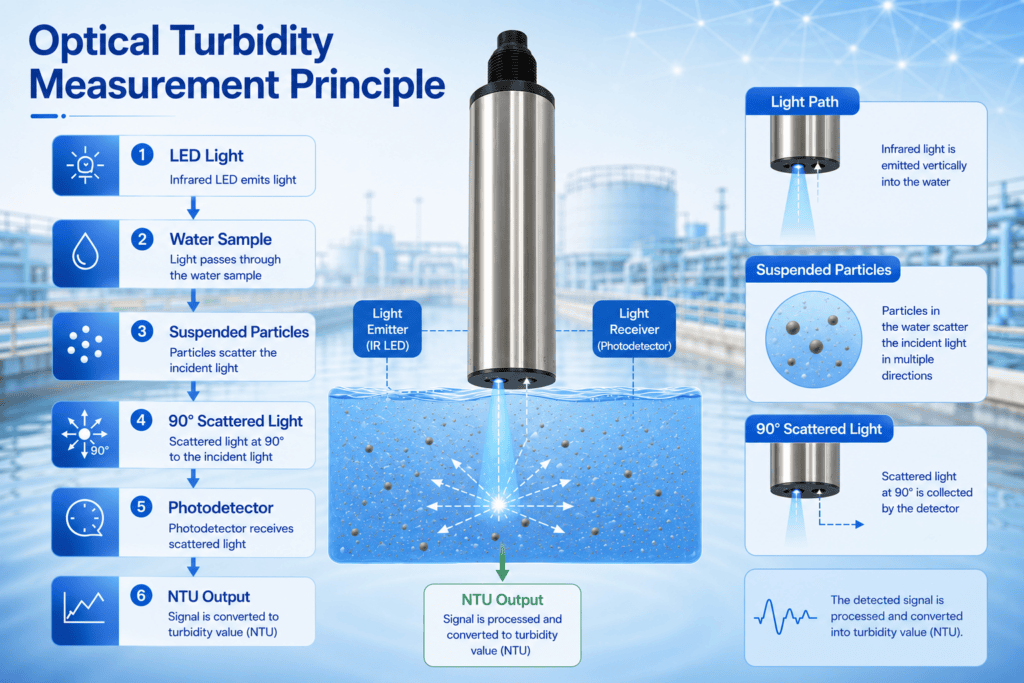
The optical turbidity sensor is the foundation of most modern water-quality monitors. It directs a beam of light through a water sample and measures the light scattered at a specific angle—typically 90 degrees, the basis of the nephelometric method.
The intensity of that scattered light is proportional to the concentration of suspended solids: more particles produce more scatter and a higher reading. Because the measurement is continuous and near-instantaneous, optical sensors suit both laboratory analysis and real-time process control.
Research into fiber-optic turbidity sensing for in situ water monitoring illustrates how optical designs continue to advance toward more sensitive, real-time field measurement.
Key Components of a Turbidity Sensor
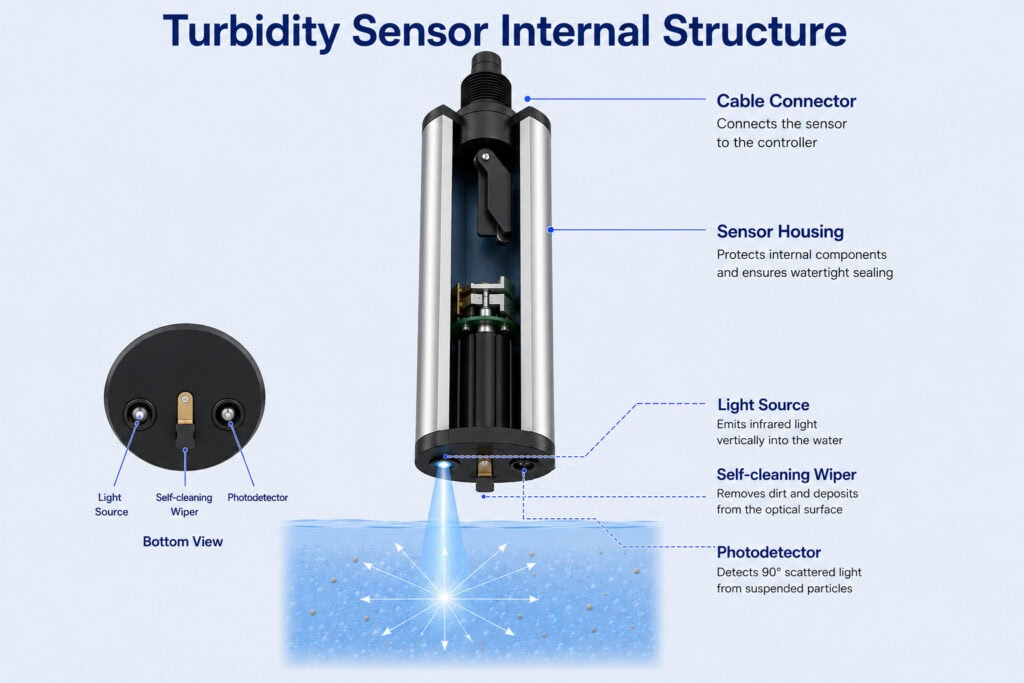
A typical turbidity probe combines a stable light source—often an LED—with a photodetector that captures the scattered light.
The housing matters just as much in practice: for industrial use, a rugged stainless-steel enclosure, sometimes removable for servicing, improves durability and maintenance access.
The cleaning system is another defining feature. Some advanced models include a self-wiping mechanism that clears the optical window of biofouling or sediment, preserving accuracy over long deployments.
Together, these component choices largely determine which sensor fits a given environment by translating the optical interaction with particles into a reliable, actionable data point.
Turbidity Probe, Transmitter, and Monitor: Key Differences
Function of a Turbidity Probe vs. Transmitter
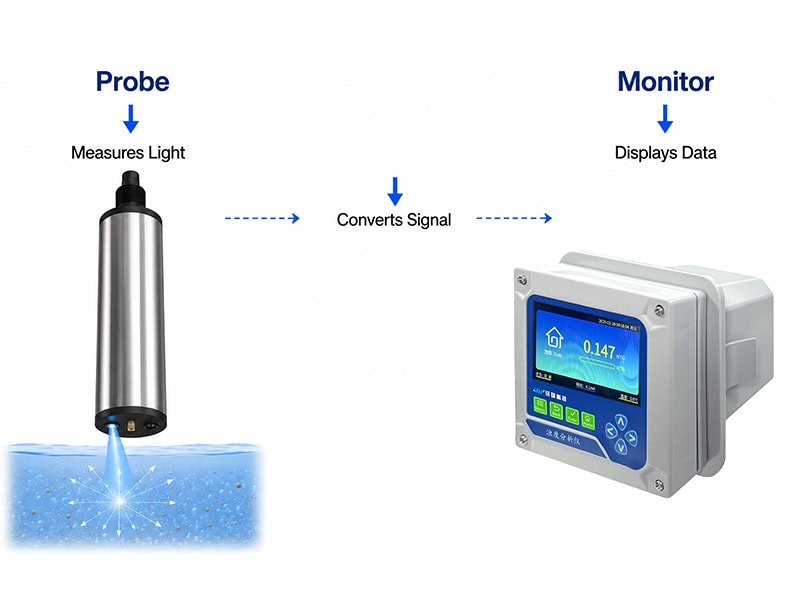
A turbidity probe is the sensing element that interacts directly with the sample. It houses the light source and detector and measures scattered-light intensity. Probes are built for specific mounting configurations—for example, inline units inserted directly into a process pipe.
A turbidity transmitter processes the raw signal from the probe and converts it into a standardized output, such as 4–20 mA or a digital protocol. This separation lets the probe sit in a harsh environment while the transmitter stays accessible for configuration and signal handling.
When specifying a system, decide whether you want an integrated probe-and-transmitter unit, which simplifies installation, or separate modules, which add flexibility for remote monitoring.
When to Use a Turbidity Monitor
A turbidity monitor is a complete system that combines a probe, transmitter, and display, usually with alarm and data-logging functions.
Choose a monitor when you need continuous, real-time visibility—for example, in a water treatment train or for effluent compliance.
Monitors let operators track trends and respond quickly when readings cross a threshold, and many include self-cleaning features valuable in fouling-prone streams.
For occasional spot checks, a simple probe with a handheld reader may be enough; for ongoing process control, a dedicated monitor supplies the alerts and recorded history you need.
Types of Turbidity Sensors: Inline, Submersible, and Optical
Inline Turbidity Sensor Design and Benefits
An inline turbidity sensor installs directly into a process pipe, eliminating sample extraction and enabling continuous measurement without interrupting flow.
Monitoring at the point of use catches sudden shifts in particle load immediately.
To sustain accuracy over long runs, many inline models include self-wiping mechanisms that keep the optical surface clear, reducing manual maintenance in demanding service.
Optical Turbidity Sensor: Technology and Accuracy
Optical turbidity sensors detect scattered light, but accuracy depends on more than the basic measurement.
Calibration against known standards and proper compensation for ambient light are both essential.
For high-precision needs, sensors with dual-angle detection—combining 90° and forward scatter—can help distinguish particle types and sizes.
Because optical components are sensitive to window fouling, regular cleaning or automatic wiping is critical to maintain measurement integrity over time.
Water Turbidity Sensor for Continuous Monitoring
A water turbidity sensor configured for continuous monitoring delivers an unbroken data stream—essential for process control in water treatment, industrial effluent, and environmental surveillance.
Unlike spot-sampling instruments, these sensors are deployed in the flow or immersed in tanks and open channels.
They connect to data loggers or control systems through analog or digital outputs, enabling automated alarms or dosing adjustments when turbidity exceeds a setpoint.
For long-term deployment, designs that resist biofouling—such as self-wiping optics or chemical cleaning ports—help preserve accuracy and minimize downtime.
How to Select the Right Turbidity Sensor for Your Application
Use the checklist below to narrow your options before requesting a quote.
| Selection Factor | What to Verify | Why It Matters |
|---|---|---|
| Measurement range | Covers normal operation and upset events | Avoids saturation or poor resolution |
| Accuracy and resolution | Sufficient for your control decisions | Reveals subtle particle-load changes |
| Standards compliance | Aligns with recognized water-quality benchmarks | Supports regulatory acceptance |
| Installation type | Inline, submersible, or removable | Affects access for cleaning and calibration |
| Cleaning method | Manual, self-wiping, or chemical port | Determines maintenance burden |
| Housing and materials | Corrosion and pressure resistance | Suits harsh or chemical environments |
Key Specifications: Range, Accuracy, and Compliance
Match the specification to your process. Inline units for low-range drinking-water monitoring differ sharply from those built for high-turbidity wastewater.
Confirm that detection limits span both normal conditions and likely upsets.
Accuracy drives process-control decisions—a high-precision optical design can reveal subtle particle-load changes a coarser instrument would miss.
Standards compliance matters just as much: a sensor aligned with recognized water-quality benchmarks produces data that regulators and consistency checks will accept.
Exact standard references vary by region, so verify which apply to your jurisdiction.
Factors to Consider: Maintenance, Installation, and Environment
Installation method and maintenance frequency shape total cost of ownership. A removable inline design allows quick extraction for cleaning and calibration without halting flow—valuable in continuous monitoring.
The choice between permanent, submersible, and inline configurations also affects routine service access.
Environmental factors—temperature extremes, pressure swings, and chemical exposure—can degrade optics and electronics over time, which is why stainless-steel housings are common in corrosive settings.
Before finalizing, review the manufacturer’s operating limits and recommended maintenance intervals, and consult technical support to tailor the choice to your site layout.
Common Applications in Water Quality Monitoring
Drinking Water Treatment: Monitoring Below 1 NTU
In drinking-water treatment, keeping turbidity very low is critical for disinfection effectiveness and regulatory compliance.
A low-range water turbidity sensor provides the resolution to detect minute changes below 1 NTU, while a turbidity monitor integrated into the treatment train gives operators continuous visibility into filter performance and immediate warning of breakthrough events.
To meet these conditions, the sensor’s optical geometry and light source must be optimized for scattering detection at very low particle concentrations—a requirement that distinguishes potable-water instruments from those used in other sectors.
Wastewater Effluent and Industrial Process Control
In wastewater effluent and many industrial processes, turbidity fluctuates widely, so real-time feedback is essential.
A robust inline water turbidity sensor handles higher particle loads without excessive fouling or signal drift. The same monitor platform can trigger alarms or automatic valve adjustments when setpoints are exceeded, supporting both compliance and process efficiency.
When specifying equipment for these uses, share your expected turbidity range, sample temperature, and application scenario with the supplier so the chosen instrument delivers reliable, maintenance-friendly operation.
Selecting Equipment for Continuous Industrial Monitoring
For distributors, engineering firms, and plant operators building continuous water-quality monitoring systems, matching sensors and controllers to real process conditions is what keeps data trustworthy and maintenance manageable.
If your project involves industrial process control or multi-parameter monitoring, you can review options for industrial water quality controllers and sensors or related online pH controllers and sensors, then share your required parameters, application scenario, and project type.
Describing your site conditions in an initial inquiry helps ensure the recommended instrument fits your system layout and service expectations.
These options suit advanced, continuous-monitoring deployments rather than casual spot checks.
Field Insights From Installation and Calibration
The most common installation mistake—and why it undermines reliability
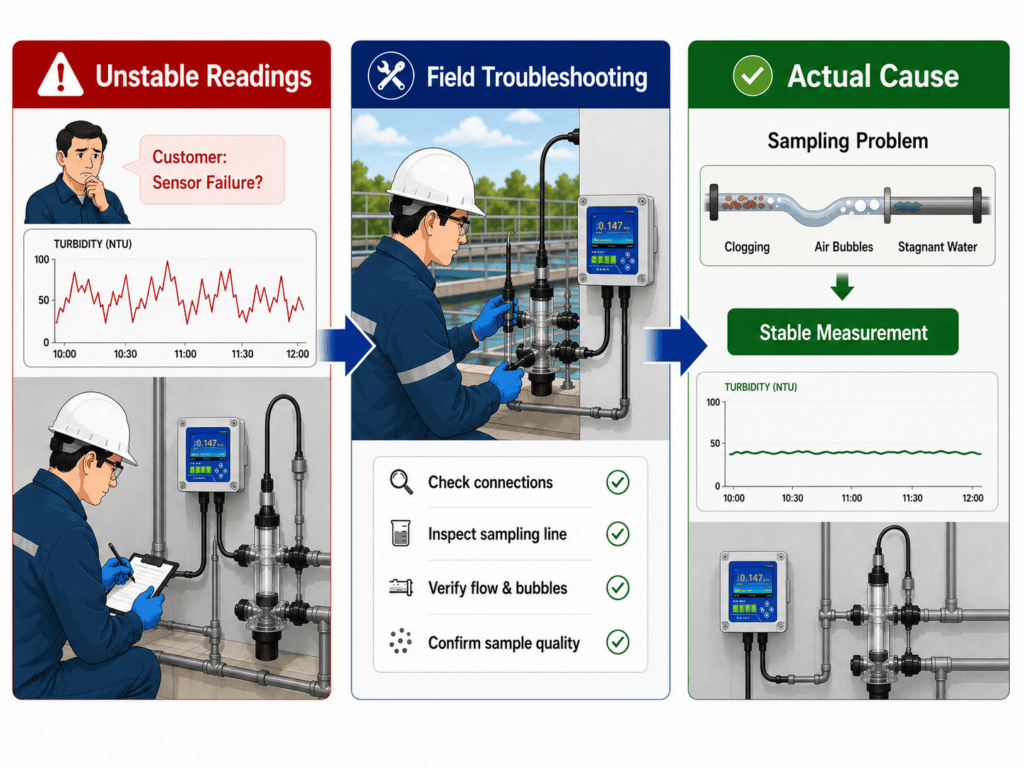
A common pitfall is placing an insertion sensor too close to a fitting.
At one municipal wastewater plant monitoring effluent at the secondary sedimentation tank, the DN200 outlet pipeline carried an insertion turbidimeter installed just 0.8 meters—about four pipe diameters (4D)—downstream of a 90° elbow, contrary to the operation manual.
That placement created a negative-pressure vortex right after the elbow, drawing return sludge and air bubbles onto the electrode and causing constant, erratic readings.
After reviewing the manual, the technical team relocated the electrode to at least 15 pipe diameters (15D) downstream of the elbow to avoid vortex interference.
Once reinstalled and powered on, the readings returned to stable, normal operation. The lesson: respecting straight-run distance is as important as choosing the right sensor.
How often to recalibrate an optical sensor in a wastewater stream
The calibration cycle should reflect electrode performance and actual operating conditions:
- General municipal wastewater with self-cleaning electrodes: quarterly calibration.
- Highly turbid, heavily contaminated industrial wastewater (such as chemical or food-processing streams) without self-cleaning and with infrequent manual maintenance: at least monthly.
- Stable, low-turbidity, low-load applications such as advanced treatment effluent: every six months to a year for benchmark verification.
Drift often comes from factors that manuals do not fully capture—gradual window fouling, biofilm growth, bubble adhesion, and temperature swings.
Tailoring model selection and a maintenance schedule to on-site conditions cuts manual maintenance costs and extends electrode service life.
Frequently Asked Questions About Turbidity Sensors
What is a turbidity sensor and how does it work?
A turbidity sensor is an analytical instrument that quantifies the cloudiness in a liquid caused by suspended particles.
It directs a light source into the sample and measures how much light those particles scatter.
The scattered-light intensity correlates directly with turbidity, usually expressed in Nephelometric Turbidity Units (NTU).
This optical principle makes the turbidity sensor a core tool for water-quality monitoring.
What is the difference between a turbidity probe and a turbidity transmitter?
A turbidity probe is the sensing element that houses the light source and detector and interacts directly with the sample to measure scattered light.
A turbidity transmitter is the electronic component that processes the probe’s signal and converts it into a standardized output such as 4–20 mA or a digital protocol.
The probe performs the physical measurement; the transmitter handles signal conditioning and communication.
Together they often form a complete turbidity monitor.
What are the main types of inline turbidity sensors?
Inline turbidity sensors range from standard units for direct process-pipe installation to specialty models with self-wiping mechanisms that resist fouling, often in stainless-steel housings for demanding service.
Their shared advantage is continuous, real-time measurement at the point of use, catching sudden changes in particle load without sample extraction.
How do I choose between an optical and a submersible turbidity sensor?
The choice depends on your process configuration and installation environment.
An optical turbidity sensor is typically engineered for inline installation in a process pipe, ideal for continuous monitoring in pressurized systems.
A submersible sensor is designed for immersion in an open tank or body of water.
Decide whether you need point-of-use measurement inside a pipe or flexible deployment in an open channel, then match the housing and cleaning method to the conditions.
Conclusion
A turbidity sensor earns its place by converting an invisible particle load into a number operators can act on before it becomes a compliance problem.
Start by defining your measurement range, accuracy needs, and applicable standards, then match the probe, transmitter, or full monitor to your installation and maintenance realities.
Pay equal attention to placement and calibration intervals—field experience shows both can make or break data quality.
For continuous industrial or multi-parameter monitoring, a detailed inquiry describing your site conditions is the fastest route to a sensor that performs reliably over the long term.
Need Help Choosing the Right Turbidity Sensor?
Selecting the right turbidity sensor is about much more than choosing a measurement range. Water quality, suspended solids, installation location, cleaning requirements, and communication protocols all affect long-term measurement accuracy and maintenance costs.
As the engineering examples in this guide demonstrate, many unstable turbidity readings are not caused by the sensor itself. Incorrect installation, unsuitable monitoring systems, and poor sampling conditions are often the real reasons behind measurement drift and frequent maintenance.
Whether you are monitoring drinking water, municipal wastewater, industrial wastewater, or environmental water, selecting the right turbidity monitoring solution can improve process control, reduce manual cleaning, and extend sensor service life.
At Wuxi Wohuan Instrument, we provide industrial turbidity sensors, online turbidity analyzers, multi-parameter water quality monitoring systems, and customized monitoring solutions for a wide range of industrial applications. Our engineers help customers select the most suitable solution based on real operating conditions rather than simply recommending products.
Explore Morehttps://wxinstrument.com/application/
Learn more about our Water Quality Monitoring Solutions to see how complete monitoring systems improve measurement reliability in different industries.
Browse our Industrial Water Quality Analyzers to compare turbidity analyzers, pH analyzers, dissolved oxygen meters, chlorine analyzers, and other online water quality instruments.
If you’re planning a new monitoring project or upgrading an existing system, our Engineering Team can recommend the most suitable solution based on your process conditions, installation method, and maintenance requirements.
Request a Free Consultation
Tell us about your application, including:
- Water type
- Turbidity range
- Installation method
- Pipe size or tank dimensions
- Cleaning requirements
- Communication protocol
Our engineers will recommend the most appropriate turbidity monitoring solution and provide technical support for your project.