Introduction
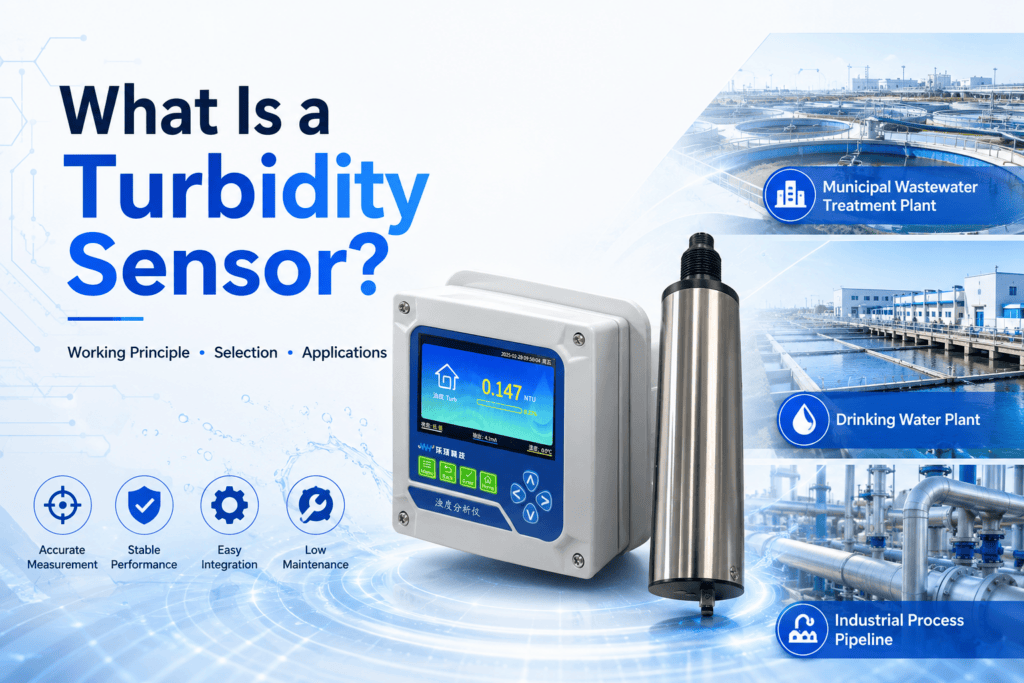
A turbidity sensor is one of the most important instruments used in modern water quality monitoring. Whether you operate a drinking water plant, wastewater treatment facility, or industrial process, turbidity is often one of the first indicators of changing water conditions.
In this guide, you’ll learn how turbidity sensors work, how optical turbidity measurement differs from other methods, and how to choose the right sensor for your application. We’ll also share real engineering experience showing why installation and sensor selection often have a greater impact on measurement accuracy than the sensor itself.
Over the years, our engineering team has supported municipal wastewater plants, industrial facilities, and environmental monitoring projects. Many of the problems customers initially blamed on the sensor were actually caused by installation or application issues.
By the end of this guide, you’ll understand how to select, install, and maintain a turbidity monitoring system that delivers reliable long-term performance.
Quick Answer
A turbidity sensor measures the cloudiness of water caused by suspended particles.
Most modern turbidity sensors are optical. They emit light into the water sample and measure the scattered light produced by suspended solids. The higher the particle concentration, the higher the turbidity value.
For most industrial applications, choosing the right turbidity sensor requires considering five key factors:
- Measurement range
- Required accuracy
- Installation method
- Cleaning system
- Process conditions
Selecting the right sensor for your application is often more important than selecting the highest specification.
What Is a Turbidity Sensor?
Definition of a Turbidity Sensor
A turbidity sensor is an analytical instrument used to measure the cloudiness or haziness of a liquid caused by suspended particles.
These particles may include:
- Silt
- Clay
- Organic matter
- Algae
- Biological solids
- Industrial process particles
Because turbidity changes quickly when water quality changes, continuous monitoring provides operators with an early warning before larger process problems occur.
Today, turbidity sensors are widely used in:
- Drinking water treatment plants
- Municipal wastewater treatment
- Industrial wastewater
- Food and beverage production
- Pharmaceutical water systems
- Environmental monitoring stations
Why Turbidity Monitoring Matters
Turbidity is much more than a visual appearance.
A sudden increase in turbidity can indicate:
- Filter breakthrough
- Process upset
- Equipment failure
- Sludge carryover
- Incoming contamination
By detecting these changes in real time, operators can respond much faster than relying on laboratory testing alone.
Continuous turbidity monitoring also improves process control, protects downstream equipment, and helps facilities maintain regulatory compliance.
How Turbidity Sensors Measure Water Clarity
Most industrial turbidity sensors use optical measurement technology.
A light source projects a beam through the water sample.
Suspended particles scatter the light in different directions.
A photodetector measures the intensity of the scattered light and converts it into a turbidity value.
The higher the concentration of suspended particles, the stronger the scattered light signal and the higher the measured turbidity.
Most online water quality monitoring systems follow the ISO 7027 nephelometric method, which uses an infrared light source with a detector positioned at a 90-degree angle.
This design reduces interference from water color and provides stable, repeatable measurements across a wide range of applications.
Why Clean Optical Windows Matter
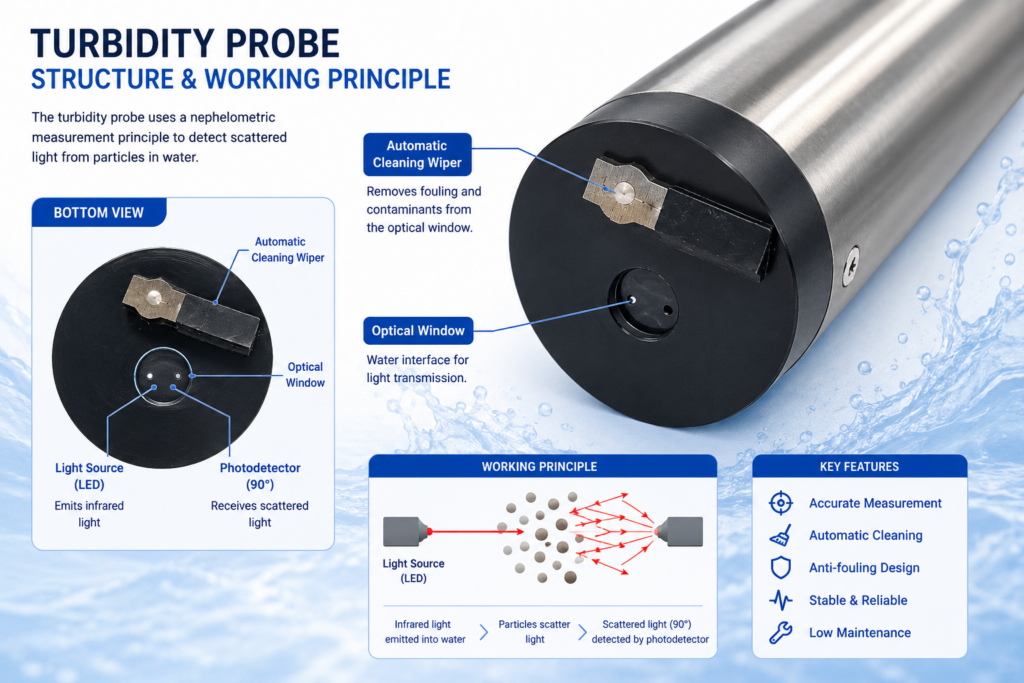
Even the most accurate optical design depends on clean optics.
When biofilm, sludge, or scale accumulates on the optical window, the sensor cannot distinguish between contamination on the window and particles suspended in the water.
The result is inaccurate turbidity readings.
For this reason, many industrial turbidity sensors include:
- Automatic cleaning wipers
- Air flushing systems
- Flow-through cleaning chambers
These features significantly reduce maintenance while improving long-term measurement stability.
Optical vs. Non-Optical Turbidity Measurement
Optical turbidity measurement has become the industry standard for continuous online monitoring.
Compared with traditional laboratory methods, optical sensors offer several advantages:
- Real-time measurement
- Continuous monitoring
- High repeatability
- Fast response
- Easy integration with PLC and SCADA systems
Most drinking water plants, wastewater treatment facilities, and industrial process systems now rely on optical turbidity sensors for daily operation.
Non-optical laboratory methods still have value for verification testing, but they cannot provide continuous process data.
When Should You Choose an Optical Turbidity Sensor?
Optical turbidity sensors are suitable for most applications requiring continuous monitoring.
Typical applications include:
- Drinking water filtration
- Wastewater treatment
- Industrial process water
- Cooling water
- Surface water monitoring
- Environmental monitoring
For very low turbidity applications, selecting a sensor with high resolution, excellent stability, and automatic cleaning is especially important because even small optical contamination can influence the measurement.
When a Product Specification Page Is Enough
If you already understand your application and simply need to compare measurement range, communication protocol, cleaning method, or installation type, reviewing detailed product specifications may be the fastest way to select a suitable sensor.
However, specifications alone rarely explain why sensors fail in the field.
Real-world performance depends on installation location, water conditions, maintenance practices, and correct sensor selection.
The following sections explain these practical considerations in more detail.
Turbidity Sensor vs. Turbidity Transmitter
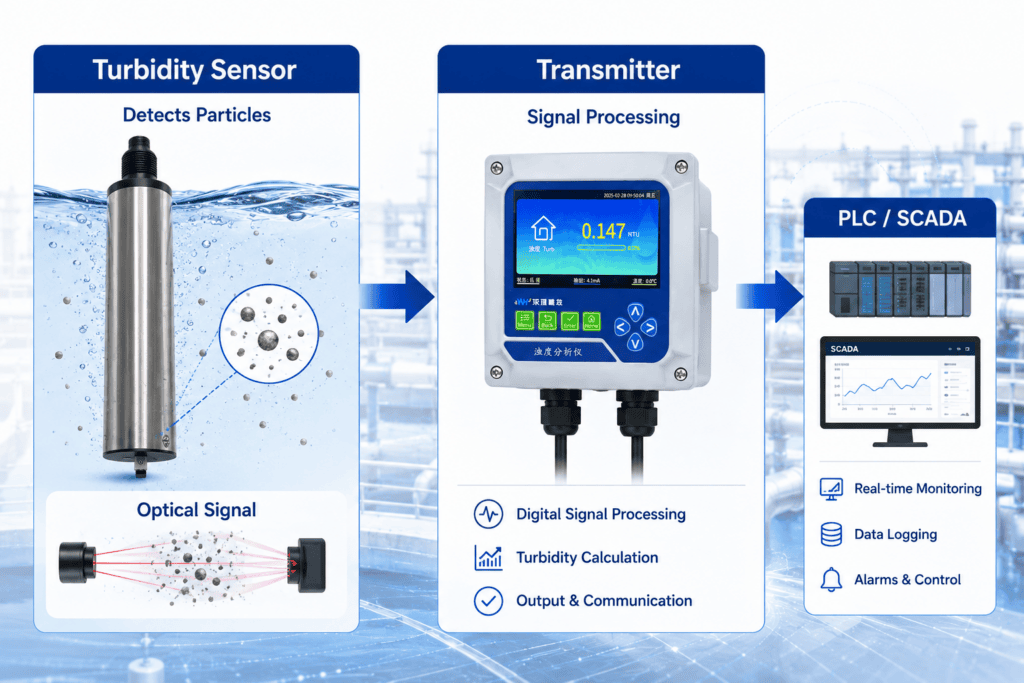
Many users use the terms turbidity sensor and turbidity transmitter interchangeably. In reality, they perform different functions within a water quality monitoring system.
Understanding this difference helps you select the right equipment and simplify future maintenance.
What Is a Turbidity Sensor?
A turbidity sensor is the component that directly contacts the water sample.
It contains the optical system, including the light source, optical window, and photodetector.
Its job is to detect suspended particles by measuring scattered light and converting that optical signal into an electrical signal.
Without the sensor, no turbidity measurement can be generated.
What Is a Turbidity Transmitter?
A turbidity transmitter receives the raw signal from the sensor and converts it into a format that operators and control systems can use.
Typical outputs include:
- 4–20 mA
- RS485 Modbus RTU
- Modbus TCP
- Relay outputs
- Digital display
Many transmitters also provide:
- Alarm functions
- Data logging
- Automatic cleaning control
- Sensor diagnostics
- Calibration settings
In most industrial projects, the transmitter acts as the communication center between the turbidity sensor and the PLC or SCADA system.
Integrated Systems vs. Separate Components
Modern turbidity monitoring systems are generally available in two configurations.
Integrated Systems
The sensor and transmitter are combined into one compact unit.
Advantages include:
- Easier installation
- Fewer cables
- Lower installation cost
- Compact design
These systems are commonly used in small water treatment plants and compact monitoring stations.
Separate Sensor and Transmitter
In larger industrial projects, the sensor and transmitter are often installed separately.
The sensor remains close to the process, while the transmitter is mounted inside a control cabinet.
Advantages include:
- Easier maintenance
- Better protection for electronics
- Longer communication distance
- Flexible installation
This design is common in municipal wastewater plants and industrial process control systems.
Choosing Turbidity Monitoring Equipment for Low-Turbidity Applications
Low-turbidity measurement is much more demanding than high-range wastewater monitoring.
When the water is already very clear, even a small amount of contamination on the optical window can noticeably affect the reading.
For drinking water filtration, ultrapure water, and filter outlet monitoring, operators should prioritize measurement stability rather than simply selecting the widest measuring range.
Key Specifications to Evaluate
When comparing low-turbidity sensors, pay attention to:
- Measurement range
- Resolution
- Accuracy
- Repeatability
- Calibration method
- Automatic cleaning capability
- Communication protocol
A sensor with stable optics and effective automatic cleaning usually delivers better long-term performance than one with a wider measuring range but frequent fouling.
Buyer Selection Matrix
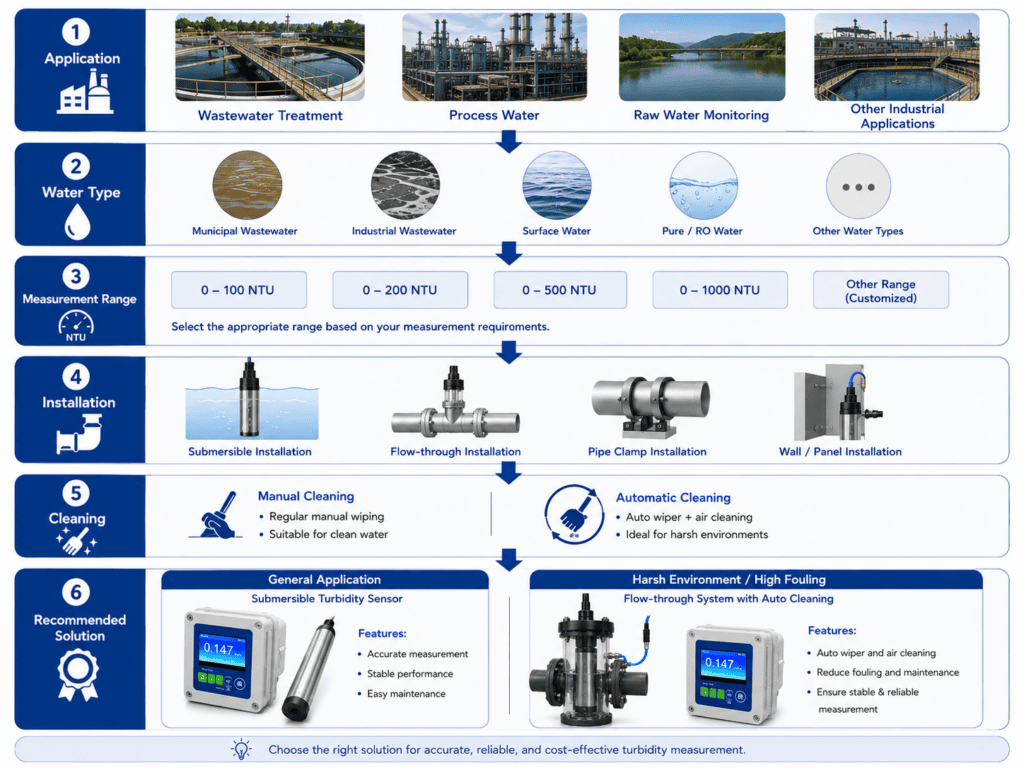
Before requesting a quotation, evaluate the following factors.
| Selection Factor | What to Check | Why It Matters |
|---|---|---|
| Measurement Range | Covers normal and abnormal operating conditions | Prevents signal saturation |
| Resolution | Suitable for low-turbidity monitoring | Detects small process changes |
| Accuracy | Matches process requirements | Improves operational decisions |
| Installation Type | Inline, submersible, or flow-through | Affects maintenance and accessibility |
| Cleaning Method | Manual, automatic wiper, or air flushing | Reduces maintenance workload |
| Communication | 4–20 mA, RS485, Modbus | Compatible with existing PLC or SCADA |
The best sensor is not always the one with the highest specification.
It is the one that matches the actual process conditions.
From Our Field Experience:
Choosing the Right Monitoring System Reduced Maintenance by More Than 90%
Selecting the correct turbidity sensor involves more than comparing technical specifications.
The operating environment and maintenance requirements are equally important.
We once worked with a coal chemical wastewater treatment plant that continuously monitored mixed industrial wastewater and biological treatment effluent.
The facility originally used a simple submersible turbidity sensor based on a single 90-degree scattered-light optical design.
The sensor had no reference light path and no automatic cleaning mechanism.
Operators manually lifted the sensor from the tank every day to clean the optical window.
After only a few hours of operation, microorganisms, biofilm, and light flocculated sludge began accumulating on the optical surface.
If the sensor was not cleaned within approximately eight hours, the readings gradually drifted and no longer represented the actual turbidity.
Our engineers visited the site and evaluated both the wastewater characteristics and the maintenance workload.
Instead of simply replacing the sensor, we recommended upgrading the entire monitoring solution.
The new system included:
- A flow-through turbidity monitoring chamber
- A turbidity sensor equipped with an automatic cleaning wiper
- High-pressure air flushing for the flow cell
- A self-cleaning pre-filter to remove large sludge particles before they reached the sensor
After the upgrade, the maintenance interval increased from once per day to once per month.
The calibration interval was extended from once every week to once every quarter.
At the same time, measurement stability improved significantly and sensor service life increased.
This project demonstrates that choosing the right monitoring system often has a much greater impact than simply selecting a different sensor. Proper system design can dramatically reduce maintenance costs while improving long-term measurement reliability.
Common Applications of Turbidity Sensors
Turbidity sensors are widely used across the water treatment industry because they provide continuous feedback on suspended particle concentration.
Typical applications include:
Drinking Water Treatment
Low-range turbidity monitoring helps verify filter performance and detect filter breakthrough before water quality is affected.
Municipal Wastewater Treatment
Online turbidity monitoring continuously measures secondary clarifier effluent and discharge water quality.
Operators can quickly identify sludge carryover and treatment process changes.
Industrial Wastewater
Industrial wastewater often contains suspended solids, biofilm, fibers, pigments, or chemical precipitates.
Continuous turbidity monitoring helps improve process stability while reducing environmental compliance risks.
Environmental Monitoring
Rivers, lakes, reservoirs, and surface water monitoring stations use turbidity sensors to detect pollution events and monitor long-term water quality trends.
Continuous monitoring provides much more useful information than occasional manual sampling.
Common Turbidity Sensor Problems and How to Solve Them
Even the best turbidity sensor cannot deliver reliable measurements if it is installed incorrectly or maintained improperly.
When measurement problems occur, many users immediately suspect the sensor itself. However, our field experience shows that installation conditions, hydraulic flow, and sensor contamination are much more common causes.
Below are some of the most common problems encountered in industrial water monitoring.
Problem 1: Unstable or Fluctuating Readings
Possible causes include:
- Installation in turbulent flow
- Air bubbles passing across the optical window
- Poor sampling conditions
- Pump vibration
- Excessive flow velocity
Recommended solutions:
- Install the sensor in a straight pipe section.
- Avoid locations immediately after pumps, elbows, and valves.
- Remove trapped air from the flow cell.
- Maintain a stable sample flow.
Problem 2: Reading Drift
If the turbidity value slowly increases or decreases over time while the actual water quality remains unchanged, the cause is usually optical contamination rather than calibration.
Common causes include:
- Biofilm
- Sludge deposits
- Scale
- Iron deposits
- Organic fouling
Routine cleaning and preventive maintenance are far more effective than frequent recalibration.
Problem 3: Calibration Does Not Solve the Problem
Many operators attempt recalibration whenever measurements become unstable.
However, calibration cannot correct installation errors or poor sampling conditions.
If calibration repeatedly fails, inspect:
- Installation location
- Sample flow
- Optical window cleanliness
- Flow cell condition
- Sensor alignment
Only recalibrate after confirming that the installation is correct.
From Our Field Experience:
Why a Calibrated Turbidity Sensor Still Produced Unstable Readings
Many users assume unstable turbidity readings indicate sensor failure.
In reality, incorrect installation is often the real problem.
We once supported a municipal wastewater treatment plant that installed one of our online turbidity sensors to monitor the secondary clarifier effluent through a DN200 pipeline.
Soon after commissioning, the turbidity readings fluctuated continuously.
The customer believed the sensor had failed or that calibration was incorrect.
Our engineers first verified the sensor using calibration standards.
The instrument performed exactly as expected.
We then inspected the installation.
The insertion sensor had been installed only 0.8 meters downstream of a 90-degree elbow, approximately 4 pipe diameters (4D) from the bend.
This location created a strong turbulent flow and negative-pressure vortex.
The turbulence continuously carried return sludge and air bubbles onto the optical window, causing unstable light scattering and rapidly changing turbidity values.
After reviewing the installation against our engineering guidelines, we recommended relocating the sensor to a straight pipe section at least 15 pipe diameters (15D) downstream of the elbow.
Once the installation was corrected, the readings immediately stabilized and accurately reflected the actual effluent quality.
This project demonstrated an important lesson: installation location is just as important as sensor accuracy. Even the best turbidity sensor cannot produce reliable measurements inside a turbulent flow zone.
Frequently Asked Questions
What does a turbidity sensor measure?
A turbidity sensor measures the amount of suspended particles in water by detecting scattered light. The result is usually displayed in NTU or FNU.
Where are turbidity sensors commonly used?
Typical applications include:
- Drinking water treatment
- Municipal wastewater plants
- Industrial wastewater
- Food and beverage production
- Pharmaceutical water systems
- Environmental monitoring
Why do turbidity sensors become inaccurate?
The most common reasons include:
- Incorrect installation
- Optical fouling
- Air bubbles
- Poor sampling conditions
- Lack of routine maintenance
How often should a turbidity sensor be calibrated?
Calibration frequency depends on the application.
Clean drinking water systems may require calibration only every few months, while heavily polluted wastewater applications should verify calibration more frequently as part of routine maintenance.
How can maintenance frequency be reduced?
Selecting the correct monitoring system is usually more effective than increasing cleaning frequency.
Automatic cleaning wipers, flow-through chambers, air flushing systems, and self-cleaning filters can significantly reduce maintenance while improving long-term measurement stability.
Conclusion
Choosing the right turbidity sensor is about much more than measurement range.
Installation location, process conditions, cleaning method, and maintenance strategy all have a direct impact on long-term performance.
As the field examples in this guide demonstrate, many measurement problems are not caused by the sensor itself.
Correct installation and selecting the appropriate monitoring solution often solve issues that calibration alone cannot.
Understanding these practical considerations helps improve measurement reliability, reduce maintenance costs, and extend sensor service life.
About Turbidity Monitoring Solutions
Reliable turbidity monitoring requires more than selecting a sensor with the highest specifications. Successful projects depend on proper system design, installation, sampling conditions, and long-term maintenance planning.
Wuxi Wohuan Instrument provides industrial turbidity sensors, online turbidity analyzers, multi-parameter water quality monitoring systems, and customized monitoring solutions for drinking water plants, municipal wastewater treatment facilities, industrial process water, and environmental monitoring projects. Our engineering team works closely with customers to recommend practical solutions based on real operating conditions rather than simply selecting products from a catalog.
Need Help Choosing the Right Turbidity Sensor?
Choosing the right turbidity sensor is only the first step toward reliable water quality monitoring. As the engineering examples in this guide demonstrate, long-term measurement accuracy depends on much more than the sensor itself. Installation location, hydraulic conditions, optical design, cleaning method, and application matching all have a direct impact on measurement stability and maintenance costs.
Whether you are monitoring drinking water, municipal wastewater, industrial process water, or environmental water, selecting the correct turbidity monitoring solution can improve process control, reduce manual maintenance, and extend sensor service life.
At Wuxi Wohuan Instrument, we help customers solve real-world monitoring challenges by providing industrial turbidity sensors, online turbidity analyzers, and complete water quality monitoring systems. Instead of simply recommending products, our engineers evaluate your application, operating conditions, and maintenance requirements to recommend the most suitable solution.
Explore Related Solutions
If you would like to learn more, you can explore our Water Quality Monitoring Solutions to see how different industries implement continuous online monitoring.
You can also browse our Industrial Water Quality Analyzers to compare turbidity analyzers with pH, dissolved oxygen, conductivity, residual chlorine, and other online water quality instruments.
If you are planning a new monitoring project or upgrading an existing system, our Engineering Team can help you select the right turbidity monitoring solution based on your actual operating conditions.
Request a Free Consultation
Tell us about your project, including:
- Water application
- Turbidity measurement range
- Installation method
- Pipeline size or tank dimensions
- Cleaning requirements
- Communication protocol
Our engineers will recommend the most suitable turbidity monitoring solution and provide practical installation and commissioning advice based on your application.