Introduction
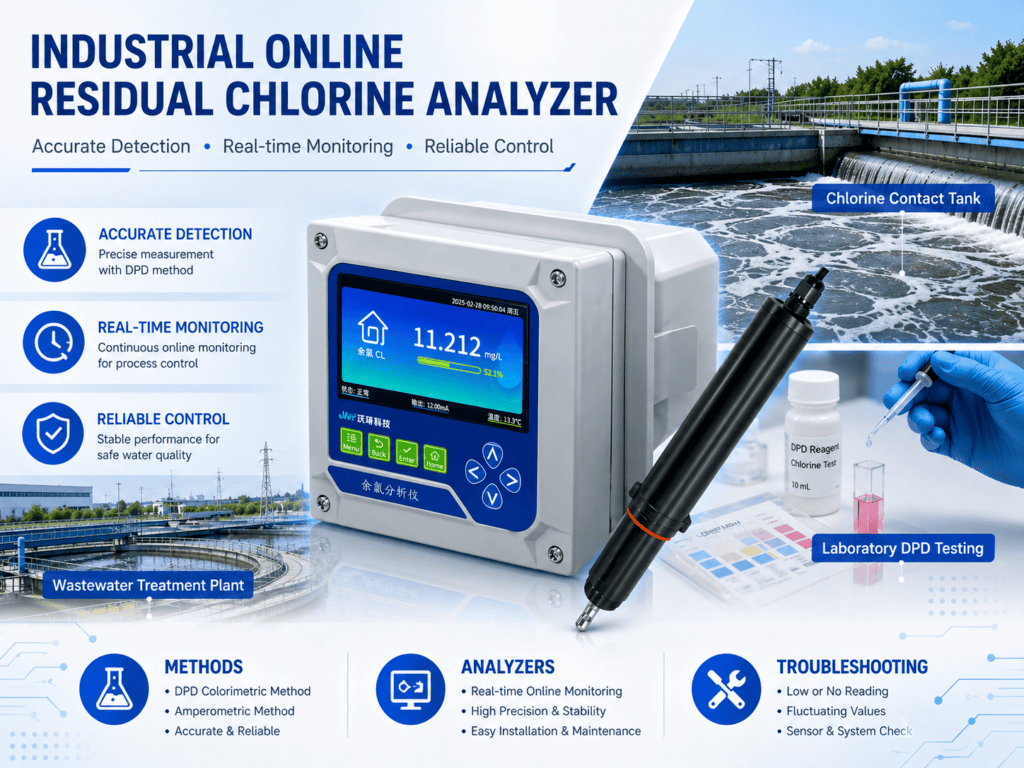
Wastewater disinfection requires a careful balance. Operators must add enough chlorine to remove harmful microorganisms, but excessive chlorine can increase chemical costs and affect discharge compliance.
Accurate residual chlorine testing is the key to maintaining this balance.
This guide explains how residual chlorine is measured in wastewater, compares different analyzer technologies, and shares practical troubleshooting methods based on real industrial applications.
With the right testing method, analyzer selection, and maintenance strategy, wastewater plants can improve disinfection control, reduce operating costs, and maintain stable compliance.
Quick Answer: What Is Residual Chlorine Testing in Wastewater?
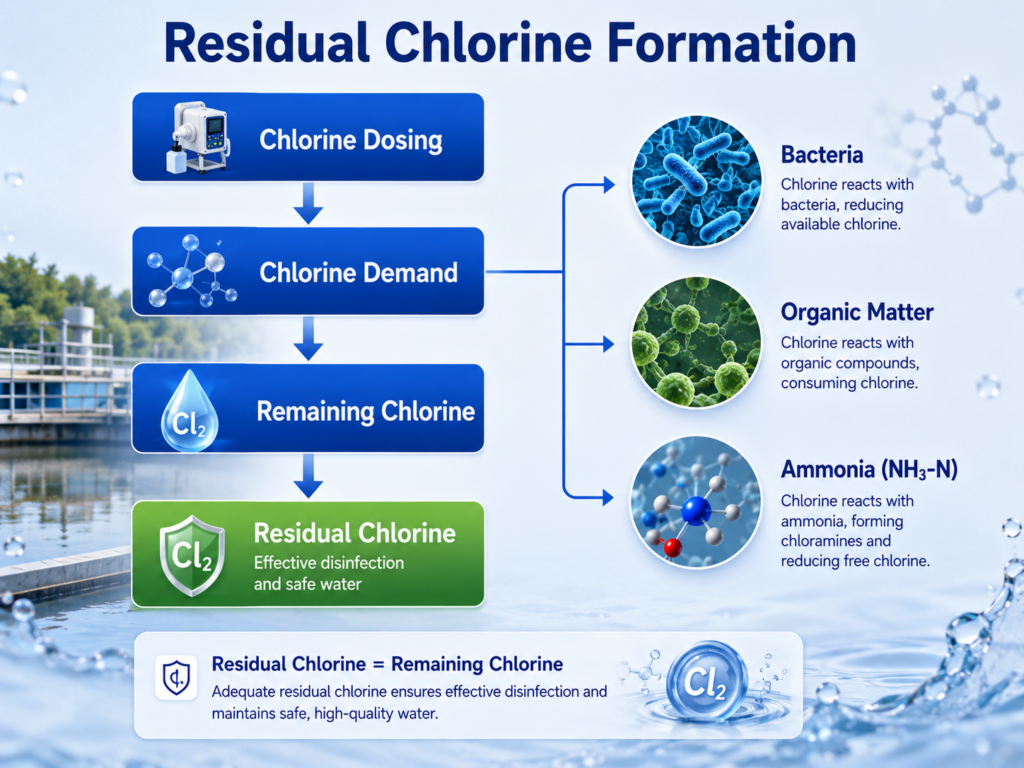
Residual chlorine is the amount of chlorine remaining in water after the disinfection process.
It represents the chlorine still available to control microorganisms after the initial chlorine demand has been satisfied.
In wastewater treatment, residual chlorine is usually measured in two ways:
- DPD colorimetric testing for laboratory or manual verification
- Online residual chlorine analyzers for continuous monitoring
DPD testing is widely used because it is simple and accepted for compliance checks.
Online chlorine analyzers provide real-time data, allowing operators to adjust chemical dosing faster and avoid over-chlorination or insufficient disinfection.
What Is Residual Chlorine and Why Does It Matter in Wastewater?
Definition of Residual Chlorine
During wastewater disinfection, chlorine reacts with organic matter, ammonia, and other substances in the water.
After these reactions occur, the remaining measurable chlorine is called residual chlorine.
Residual chlorine can include:
- Free chlorine: active disinfecting chlorine available for pathogen control
- Combined chlorine: chlorine that has reacted with nitrogen compounds to form chloramines
- Total chlorine: the sum of free chlorine and combined chlorine
Understanding the difference is important because not all residual chlorine provides the same disinfection effect.
Why Residual Chlorine Monitoring Is Important
The purpose of chlorine monitoring is not simply to measure a number.
It helps operators answer three important questions:
Is the wastewater properly disinfected?
If chlorine residual is too low, microorganisms may survive and the effluent may fail discharge requirements.
Is chlorine being overdosed?
Excess chlorine increases chemical consumption and may negatively affect receiving water environments.
Is the treatment process stable?
Continuous chlorine monitoring helps operators identify changes quickly and adjust dosing before problems occur.
A reliable residual chlorine monitoring system provides real-time data for process control instead of relying only on delayed laboratory testing.
How to Perform Residual Chlorine Testing in Wastewater
Accurate measurement starts before the analyzer.
Poor sampling practices can create incorrect results even when the instrument works properly.
Sample Collection Best Practices
When collecting wastewater samples:
Use clean containers
Use clean glass or plastic containers.
Avoid metal containers because chlorine can react with metal surfaces and affect the result.
Avoid chlorine loss during sampling
Residual chlorine decreases quickly after sampling.
Avoid:
- Direct sunlight
- Long storage time
- Excessive air exposure
Measure the sample as soon as possible after collection.
Record important conditions
For better interpretation, record:
- Water temperature
- pH value
- Sampling time
- Chlorine concentration
pH has a strong influence on chlorine chemistry and measurement response.
DPD Method for Residual Chlorine Testing
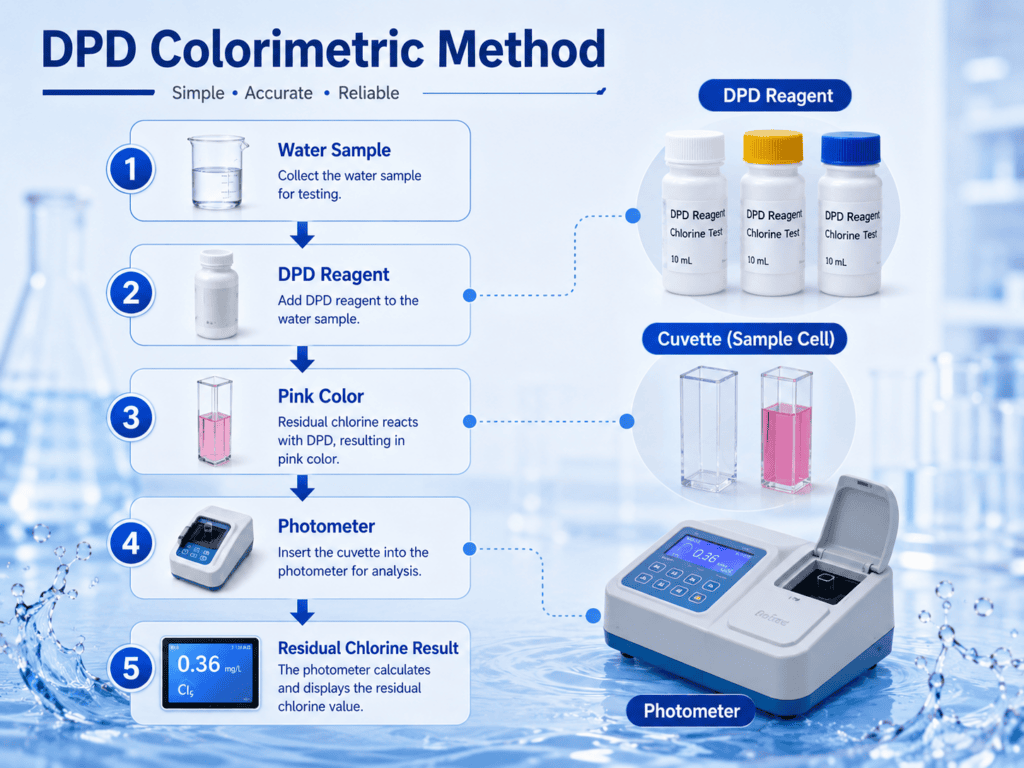
The DPD method is one of the most common ways to measure chlorine residual.
It works by adding DPD reagent to the water sample.
The chlorine reacts with the reagent and produces a pink color.
The color intensity is proportional to the chlorine concentration.
A photometer or comparator then converts the color intensity into a chlorine reading.
Free Chlorine vs Total Chlorine Testing
The DPD method can measure different chlorine forms.
For free chlorine:
Only the DPD reagent is added.
This measures active chlorine available for disinfection.
For total chlorine:
Potassium iodide is added to release combined chlorine so the complete chlorine residual can react.
This allows operators to measure:
Total chlorine = Free chlorine + Combined chlorine
Advantages and Limitations of DPD Testing
Advantages:
- Simple operation
- Low equipment cost
- Widely accepted for verification testing
Limitations:
- Requires manual sampling
- Results depend on operator skill
- Chlorine may change during sample handling
- Cannot provide continuous process data
For wastewater plants requiring automatic control, online monitoring is usually a better solution.
Online Residual Chlorine Analyzer for Continuous Monitoring
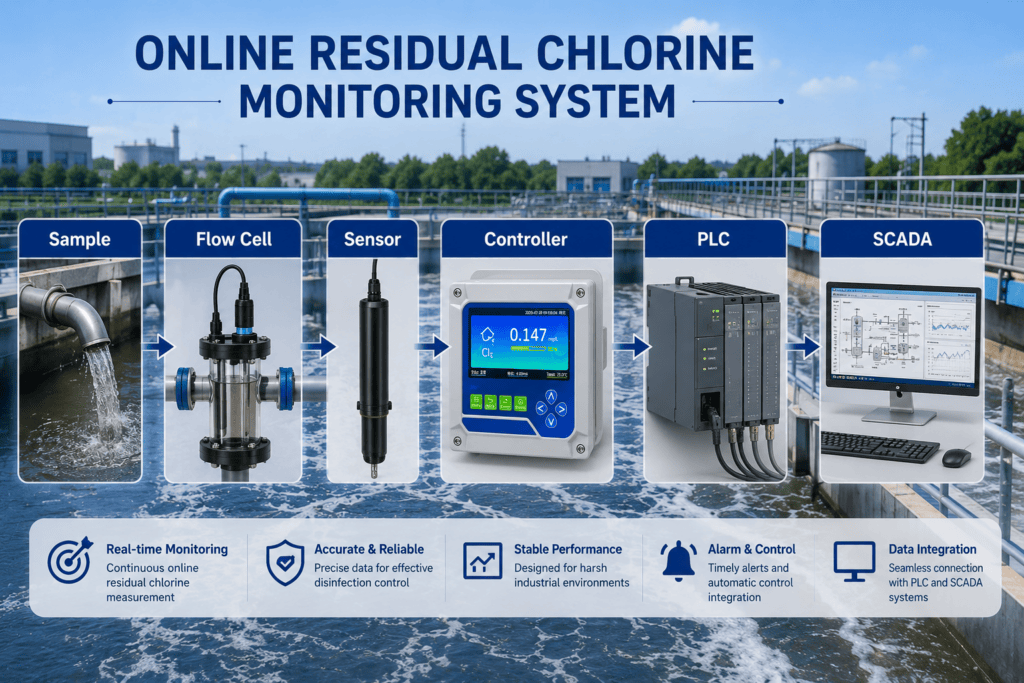
An online residual chlorine analyzer measures chlorine continuously from a flowing sample.
Compared with manual DPD testing, it provides:
- Real-time measurement
- Automatic data recording
- Faster process adjustment
- Reduced manual testing workload
A complete online system usually includes:
- Chlorine sensor
- Flow cell
- Sample conditioning system
- Controller
- Communication output
The analyzer can connect with PLC or SCADA systems to support automatic chlorine dosing control.
Amperometric Residual Chlorine Analyzer
Amperometric analyzers use an electrochemical sensor to measure chlorine concentration.
The chlorine reaction at the electrode generates an electrical current.
The analyzer converts this current into a chlorine value.
Advantages:
- Continuous measurement
- Low reagent consumption
- Suitable for automatic control
However, performance depends on:
- Water quality
- Flow stability
- Sensor cleanliness
- Calibration frequency
For wastewater applications, correct sensor selection and maintenance are essential because organic matter and suspended solids can affect long-term stability.
Comparing Residual Chlorine Analyzer Types
Choosing the right residual chlorine analyzer is just as important as selecting the correct disinfection process.
The best analyzer depends on your water quality, maintenance capability, and monitoring objectives.
For most wastewater treatment plants, the decision comes down to two technologies:
- Amperometric analyzers
- Colorimetric (DPD-based) analyzers
Each has different strengths and limitations.
Amperometric Residual Chlorine Analyzers
Amperometric analyzers use an electrochemical sensor to continuously measure chlorine concentration.
As chlorine reacts at the electrode surface, it generates a small electrical current proportional to the chlorine residual.
Because they provide continuous data without frequent reagent consumption, amperometric analyzers are widely used for real-time process control.
Advantages
- Continuous online monitoring
- Fast response
- Low operating cost
- Easy integration with PLC and SCADA systems
- Suitable for automatic dosing control
Limitations
Performance depends on:
- Stable sample flow
- Proper pH conditions
- Clean sensor surfaces
- Regular calibration
For heavily polluted wastewater, sensor fouling can increase maintenance if the wrong sensor type is selected.
Colorimetric (DPD-Based) Analyzers
Colorimetric analyzers automate the traditional DPD method.
The analyzer injects reagent, develops color automatically, and calculates chlorine concentration using an optical detector.
This technology provides excellent sensitivity at low chlorine concentrations.
It is often selected when regulatory reporting requires standardized laboratory methods.
Advantages
- High accuracy
- Excellent low-level sensitivity
- Well-established testing method
- Suitable for compliance verification
Limitations
- Reagent consumption
- Higher operating cost
- Optical cell maintenance
- Possible interference from sample color or oxidizing substances
Which Residual Chlorine Analyzer Should You Choose?
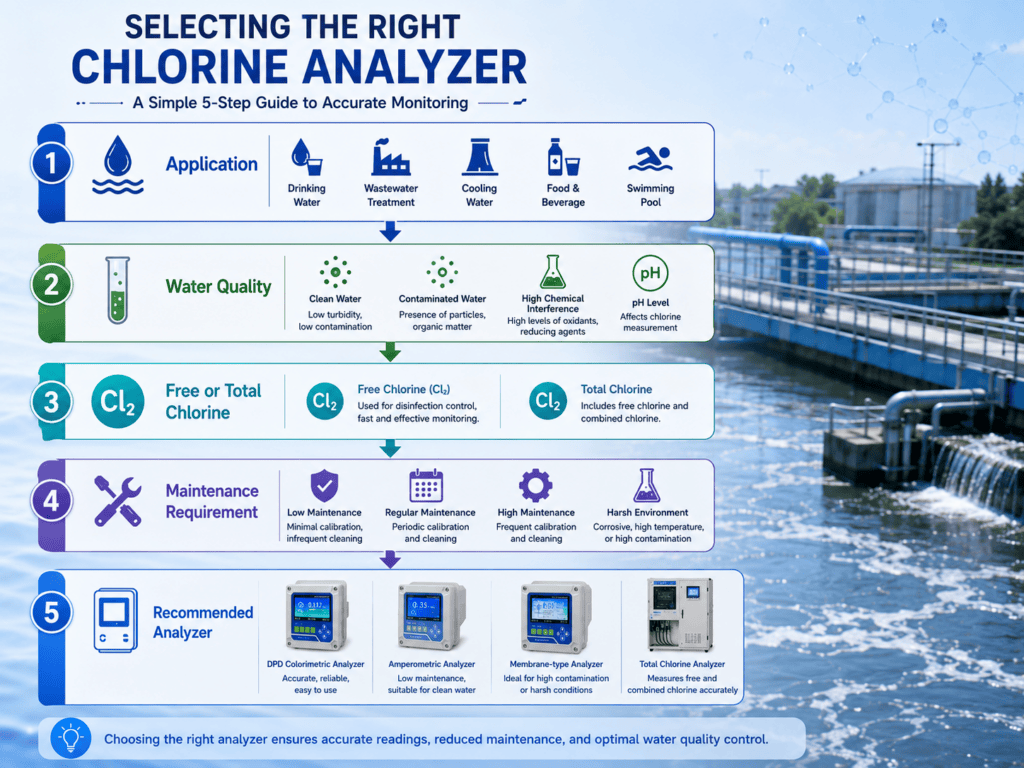
There is no universal solution.
Selecting the right analyzer depends on the application rather than the instrument alone.
The following checklist can simplify the decision.
| Selection Factor | Recommendation |
|---|---|
| Continuous process control | Amperometric analyzer |
| Regulatory compliance testing | Colorimetric analyzer |
| Low maintenance requirement | Membrane-free amperometric sensor |
| Complex wastewater matrix | Evaluate interference before selection |
| Automatic dosing control | Online analyzer with PLC integration |
The most expensive analyzer is not always the best choice.
Choosing a sensor designed for the actual water conditions usually delivers better long-term performance than selecting the highest specification.
From Our Field Experience:
Why an Online Residual Chlorine Analyzer Did Not Match DPD Test Results
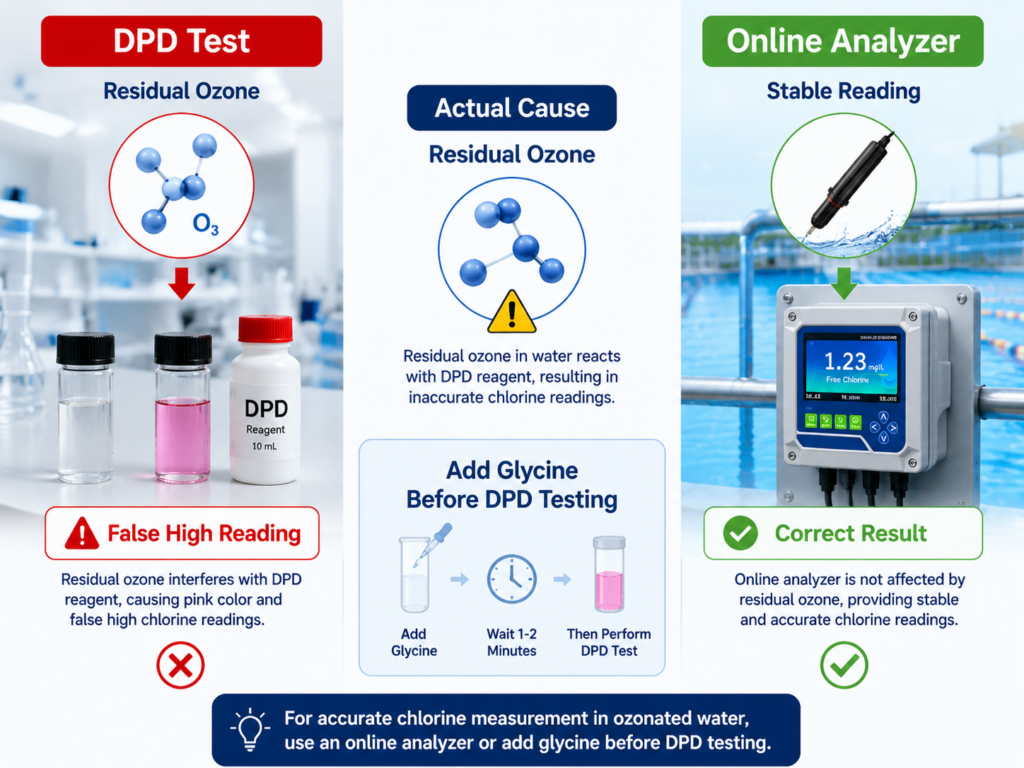
Many operators assume that differences between an online residual chlorine analyzer and laboratory DPD testing indicate analyzer failure.
Our experience shows that the laboratory procedure itself can sometimes be the real source of the problem.
We once supported an indoor heated swimming pool that continuously monitored circulating pool water using an online residual chlorine analyzer.
The customer noticed that the online readings consistently differed from manually collected DPD test results.
Their first assumption was that the analyzer had failed or that the sensor calibration was incorrect.
Our engineers first checked the installation, verified the measuring range, and recalibrated the analyzer.
Everything operated normally.
We then investigated the water treatment process.
The swimming pool used an ozone generator operating intermittently throughout the day, together with a slow-release chlorine disinfectant.
The oxidation-reduction potential (ORP) remained unusually high, indicating that residual ozone and combined oxidants were still present in the sample.
To verify the cause, our engineers performed a comparison test.
Two water samples were collected at the same time.
One sample was tested immediately using the standard DPD procedure.
The second sample was first treated with glycine, which removes residual ozone before DPD analysis.
The difference was immediately obvious.
The untreated sample produced a significantly higher DPD result because the residual ozone also oxidized the DPD reagent, creating a false high chlorine reading.
After confirming the cause, we recommended updating the customer’s laboratory testing procedure.
The revised procedure required technicians to:
- Collect samples in sealed containers.
- Protect samples from sunlight.
- Keep samples cool before testing.
- Add glycine before DPD analysis whenever ozone treatment was used.
- Standardize laboratory operating procedures.
After implementing the new testing procedure, the laboratory DPD results closely matched the online analyzer, eliminating unnecessary recalibration and improving confidence in the monitoring system.
This project demonstrated an important lesson: when online analyzer readings differ from laboratory results, the problem is not always the analyzer. Sample handling procedures and oxidant interference should always be investigated before replacing equipment or adjusting calibration.
Common Testing Mistakes That Affect Accuracy
Even high-quality analyzers can produce inaccurate results if testing procedures are incorrect.
The most common mistakes include:
Delayed Sample Testing
Residual chlorine decreases rapidly after sampling.
Always analyze samples immediately whenever possible.
Using Expired DPD Reagents
Old reagents may produce weak color development and lower readings.
Always verify reagent expiration dates.
Ignoring Sample pH
Sample pH affects chlorine chemistry and analyzer response.
Large pH changes may explain unexpected measurement differences.
Comparing Different Chlorine Forms
Free chlorine and total chlorine are different measurements.
Before comparing laboratory and online data, confirm that both methods measure the same chlorine parameter.
A free chlorine analyzer cannot be directly compared with a total chlorine laboratory result.
Why Routine Verification Is Still Necessary
Continuous monitoring greatly improves process control.
However, online analyzers should still be verified periodically using independent reference methods.
A practical maintenance strategy includes:
- Routine sensor cleaning
- Scheduled calibration
- Periodic laboratory DPD verification
- Inspection of sampling lines and flow cells
This combination provides both continuous process control and long-term measurement confidence.
Common Residual Chlorine Monitoring Problems and Troubleshooting
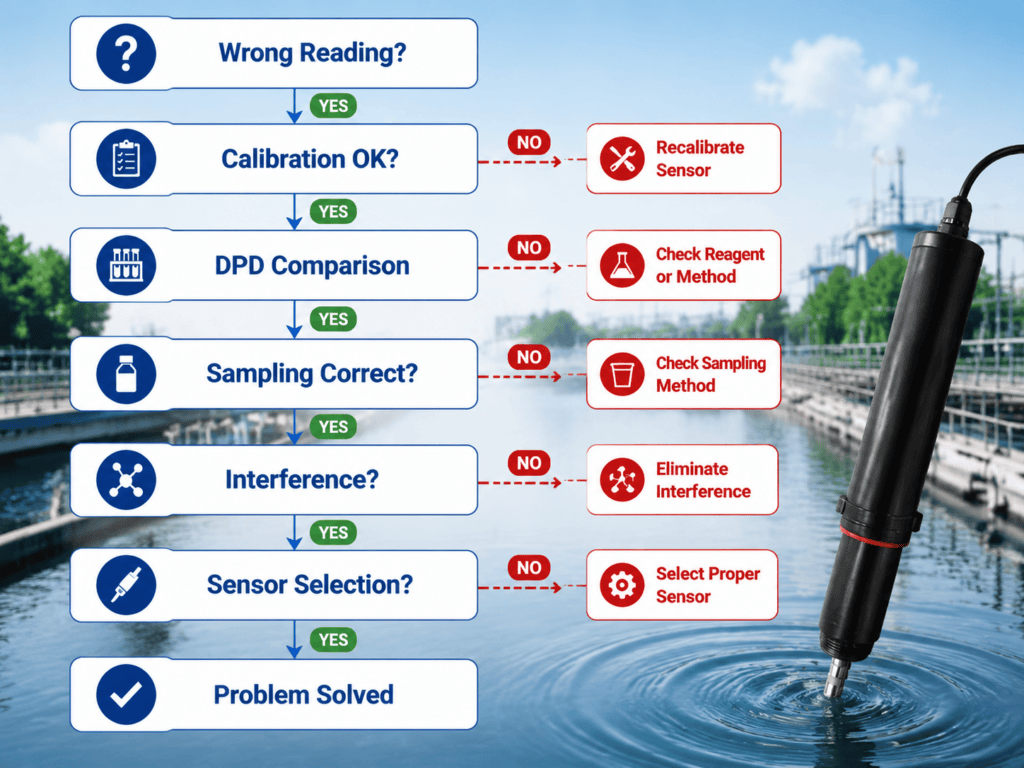
Even the most advanced residual chlorine analyzer cannot deliver reliable results if the sampling system, sensor selection, or maintenance routine is incorrect.
In our field experience, most measurement problems are caused by application or installation issues rather than analyzer failure.
The following troubleshooting guide covers the most common causes of inaccurate residual chlorine readings.
Problem 1: Measurement Drift
If the chlorine reading slowly changes while the actual process remains stable, the cause is usually sensor contamination or aging.
Possible causes include:
- Electrode fouling
- Biofilm formation
- Organic deposits
- Sensor aging
- Calibration interval exceeded
Regular cleaning and scheduled calibration usually restore measurement accuracy.
Problem 2: Low or Zero Reading
A chlorine analyzer that suddenly reports extremely low values does not always indicate insufficient chlorine.
Possible causes include:
- Blocked sample flow
- Sensor contamination
- Air trapped inside the flow cell
- Electrical connection problems
- Chlorine consumed before reaching the analyzer
Always inspect the sampling system before adjusting the chlorine dosing pump.
Problem 3: High Readings
Unexpectedly high readings may result from:
- Other oxidizing chemicals
- Sample contamination
- Calibration errors
- Incorrect laboratory comparison methods
Whenever online and laboratory results differ significantly, verify that both methods are measuring the same chlorine parameter under the same sampling conditions.
Problem 4: Unstable Readings
If readings continuously fluctuate, inspect:
- Sample flow stability
- Air bubbles
- Pump pulsation
- Sensor contamination
- pH fluctuations
Most unstable readings originate from hydraulic or sampling problems rather than electronic failure.
From Our Field Experience:
Choosing the Right Residual Chlorine Sensor Extended Service Life from 30 Days to 18 Months
Selecting the correct residual chlorine sensor is often more important than selecting the analyzer itself.
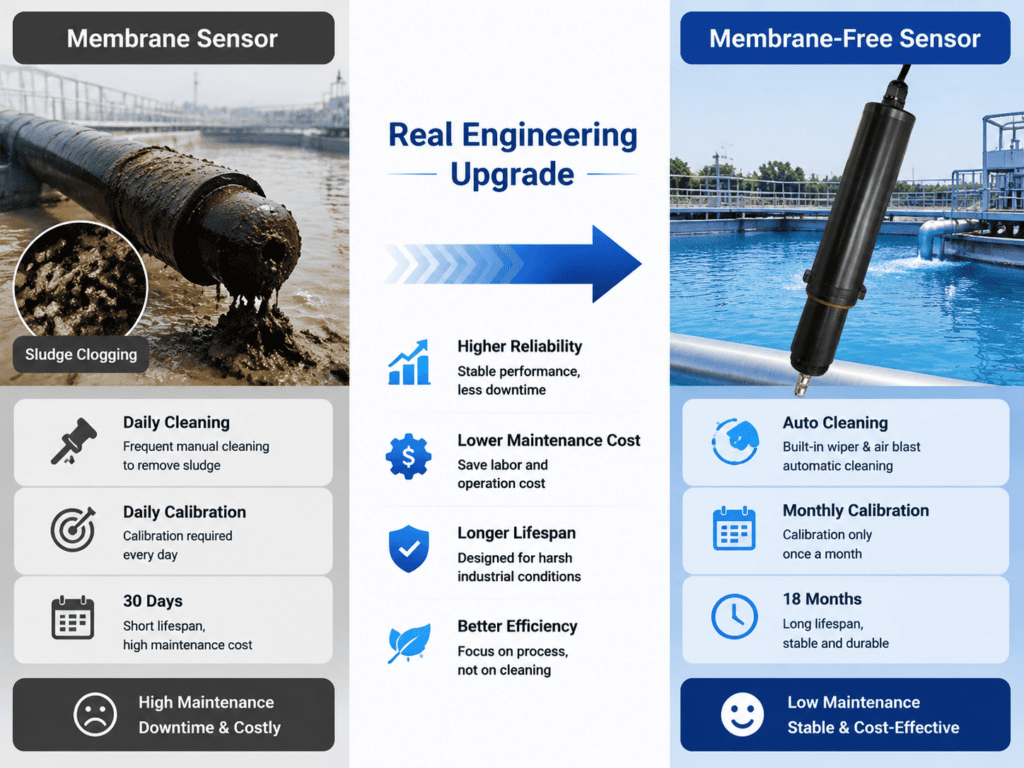
We once supported a municipal wastewater treatment plant that monitored final effluent using a membrane-type free chlorine sensor installed in a simple flow cell without any pretreatment.
During operation, the chlorine reading drifted every day.
Operators had to recalibrate the analyzer every 24 hours.
The sensor also required daily cleaning because sludge and organic matter quickly accumulated on the membrane surface.
Even with frequent maintenance, the sensor failed in less than 30 days.
The customer believed the analyzer quality was poor and requested replacement.
Our engineers first tested the sensor using standard chlorine solutions.
The sensor performed normally.
The investigation showed that the problem was not the analyzer—it was the sensor selection.
The membrane-type sensor had been designed primarily for relatively clean water applications such as swimming pools and drinking water.
It was not suitable for wastewater containing suspended solids and heavy organic contamination.
After evaluating the operating conditions, we recommended replacing the membrane sensor with a membrane-free constant-potential residual chlorine sensor designed specifically for wastewater applications.
At the same time, we upgraded the sampling system with an automatic cleaning device.
The results were significant.
- Calibration interval increased from daily to once per month.
- Sensor service life increased from less than 30 days to approximately 18 months.
- Daily manual cleaning was eliminated.
- Routine maintenance was reduced to a simple monthly inspection.
The wastewater treatment plant greatly reduced maintenance costs while improving measurement reliability and long-term operational stability.
This project demonstrates that selecting the right sensor technology for the application often has a greater impact on long-term performance than replacing the analyzer itself.
Free Chlorine vs. Total Chlorine in Wastewater
Residual chlorine may refer to either free chlorine or total chlorine, depending on the monitoring objective.
Understanding the difference is essential for selecting the correct analyzer.
Free chlorine is the active disinfectant available to destroy microorganisms.
Combined chlorine has already reacted with ammonia or nitrogen compounds to form chloramines.
Total chlorine is the sum of free chlorine and combined chlorine.
Many wastewater treatment plants monitor free chlorine for process control while measuring total chlorine for regulatory reporting.
Before selecting an analyzer, always confirm which chlorine parameter is required by your discharge permit.
Frequently Asked Questions
What is residual chlorine?
Residual chlorine is the chlorine remaining in water after the initial disinfection reaction. It indicates whether sufficient disinfectant remains available for continued microbial control.
Which testing method is best for wastewater?
The answer depends on the application.
Manual DPD testing is suitable for laboratory verification, while online amperometric analyzers provide continuous monitoring for process control.
Many facilities combine both methods.
Why doesn’t my online analyzer match laboratory DPD results?
Possible causes include:
- Incorrect sampling procedure
- Oxidizing interference
- Different chlorine forms
- Sample handling errors
- Analyzer calibration issues
Always verify the testing procedure before replacing the analyzer.
Why does my chlorine sensor require frequent calibration?
Frequent calibration usually indicates:
- Sensor contamination
- Incorrect sensor selection
- Poor sample quality
- Inadequate maintenance
Selecting the correct sensor often reduces calibration frequency significantly.
How often should a residual chlorine analyzer be maintained?
Maintenance depends on water quality.
Clean water applications may require only periodic inspection, while wastewater systems should follow a preventive maintenance schedule that includes cleaning, calibration verification, and sampling system inspection.
Conclusion
Reliable residual chlorine testing in wastewater depends on more than selecting an accurate analyzer.
Proper sampling, correct sensor selection, regular maintenance, and standardized testing procedures all contribute to long-term measurement reliability.
As the engineering examples in this guide demonstrate, many measurement problems are not caused by analyzer failure.
Correct application design and selecting the right monitoring technology often solve issues that repeated calibration cannot.
About Residual Chlorine Monitoring Solutions
Accurate residual chlorine monitoring plays an important role in wastewater treatment, drinking water production, industrial process control, and public health protection. Achieving reliable measurements requires the right combination of analyzer technology, sensor selection, sampling design, and routine maintenance.
Wuxi Wohuan Instrument provides industrial residual chlorine analyzers, membrane-free and membrane-type chlorine sensors, multi-parameter water quality analyzers, and complete online water quality monitoring systems. With practical experience across municipal wastewater, industrial wastewater, drinking water, and swimming pool applications, our engineering team helps customers improve measurement reliability while reducing maintenance costs and extending sensor service life.
Need Help Choosing the Right Residual Chlorine Monitoring Solution?
Selecting the right residual chlorine analyzer depends on much more than the measurement range. Water quality, chlorine type, sampling method, maintenance requirements, and process conditions all influence long-term performance.
Whether you are designing a new wastewater treatment project or upgrading an existing monitoring system, choosing the right solution can improve process control while reducing operating costs.
Explore Related Solutions
Learn more about our Water Quality Monitoring Solutions for municipal and industrial applications.
Browse our Industrial Water Quality Analyzers to compare residual chlorine analyzers with pH, dissolved oxygen, conductivity, turbidity, and other online monitoring instruments.
If you need help selecting equipment, our Engineering Team can recommend a solution based on your specific application and operating conditions.
Request a Free Consultation
Tell us about your project, including:
- Water application
- Chlorine type
- Measurement range
- Sampling method
- Installation environment
- Communication requirements
Our engineers will recommend the most suitable residual chlorine monitoring solution for your project.