Introduction
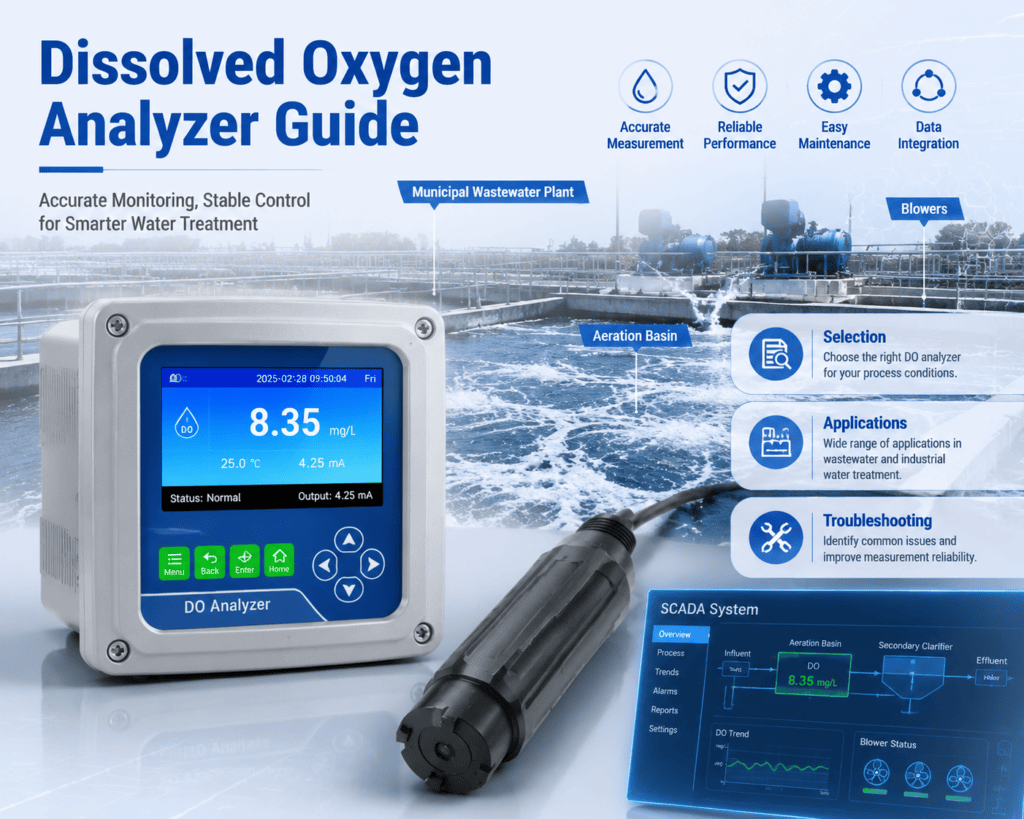
Selecting the right dissolved oxygen analyzer is essential for efficient wastewater treatment. Accurate dissolved oxygen (DO) measurement helps operators optimize aeration, reduce energy consumption, improve biological treatment efficiency, and maintain stable effluent quality.
This guide explains how dissolved oxygen analyzers work, compares different sensor technologies, and provides practical buying advice based on real wastewater applications. Drawing on our engineering experience from municipal wastewater treatment projects, we’ll also share common mistakes and proven solutions that help reduce maintenance costs and improve measurement reliability.
By the end of this guide, you’ll know how to choose the right dissolved oxygen analyzer, avoid common purchasing mistakes, and build a more reliable DO monitoring system.
Quick Answer
A dissolved oxygen analyzer continuously measures the amount of oxygen dissolved in water. In wastewater treatment plants, it is primarily used to control aeration in biological treatment processes.
Maintaining the correct DO concentration helps microorganisms remove pollutants efficiently while preventing unnecessary energy consumption.
Today’s industrial DO analyzers mainly use three measurement technologies:
- Optical (Fluorescence) Sensors
- Polarographic Sensors
- Galvanic Sensors
Among them, optical dissolved oxygen analyzers have become the preferred solution for most municipal wastewater plants because they require less maintenance, provide better long-term stability, and significantly reduce operating costs.
What Is a Dissolved Oxygen Analyzer?
A dissolved oxygen analyzer continuously measures dissolved oxygen concentration in water and converts the measurement into a digital signal for display, data logging, and automatic process control.
Unlike portable DO meters, online analyzers provide 24/7 continuous monitoring, allowing operators to adjust aeration equipment in real time instead of relying on periodic manual testing.
Modern analyzers are widely used in:
- Municipal wastewater treatment plants
- Industrial wastewater treatment
- Drinking water treatment
- Aquaculture
- Food and beverage production
- Power plants
- Environmental monitoring stations
Continuous DO monitoring improves treatment stability while reducing labor requirements.
Why Dissolved Oxygen Monitoring Matters
Dissolved oxygen is one of the most important control parameters in biological wastewater treatment.
If DO is too low, microorganisms cannot efficiently remove organic pollutants, leading to poor treatment performance.
If DO is too high, aeration blowers consume unnecessary electricity, increasing operating costs without improving treatment efficiency.
Because aeration typically accounts for 40–60% of the total energy consumption in a wastewater treatment plant, accurate DO monitoring directly affects operating expenses.
A reliable dissolved oxygen analyzer helps operators:
- Optimize aeration control
- Reduce blower energy consumption
- Improve biological treatment efficiency
- Stabilize effluent quality
- Reduce operating costs
How Does a Dissolved Oxygen Analyzer Work?
Industrial dissolved oxygen analyzers measure oxygen using one of three sensor technologies.
Although each technology is different, the goal is the same—continuously monitor dissolved oxygen and provide accurate data for process control.
Optical (Fluorescence) Dissolved Oxygen Sensors
Optical sensors use fluorescent material coated on the sensor cap.
A blue LED excites the fluorescent layer, while dissolved oxygen reduces the fluorescence lifetime.
The analyzer calculates oxygen concentration by measuring this change.
Because no oxygen is consumed during measurement, optical sensors provide stable readings with very little maintenance.
Advantages
- No electrolyte
- No replaceable membrane
- Minimal maintenance
- Excellent long-term stability
- Low calibration frequency
- Ideal for wastewater treatment
Polarographic Dissolved Oxygen Sensors
Polarographic sensors measure oxygen using an electrochemical reaction between the cathode and anode.
A small polarization voltage must be applied before measurement.
The sensor consumes oxygen during operation, making stable sample flow more important.
Advantages
- Proven technology
- Good measurement accuracy
- Suitable for many industrial applications
Limitations
- Membrane replacement required
- Electrolyte replacement required
- Frequent maintenance
- Longer response time than optical sensors
Galvanic Dissolved Oxygen Sensors
Galvanic sensors also use electrochemical measurement but generate their own internal voltage.
Unlike polarographic sensors, they do not require polarization before operation.
These sensors are commonly used in portable instruments and some industrial applications.
Advantages
- No warm-up time
- Simple operating principle
- Lower initial purchase cost
Limitations
- Electrolyte consumption
- Membrane replacement
- Higher maintenance than optical sensors
- Shorter service life under harsh wastewater conditions
Optical vs. Electrochemical DO Sensors
Many buyers focus only on purchase price.
However, the lowest purchase price rarely results in the lowest lifetime operating cost.
| Feature | Optical Sensor | Polarographic | Galvanic |
|---|---|---|---|
| Electrolyte | No | Yes | Yes |
| Membrane | No | Yes | Yes |
| Routine Maintenance | Very Low | High | Medium |
| Calibration Frequency | Low | High | Medium |
| Wastewater Performance | Excellent | Moderate | Moderate |
| Operating Cost | Lowest | Higher | Higher |
For municipal wastewater treatment plants, optical dissolved oxygen analyzers generally provide the best balance between measurement stability, maintenance workload, and long-term operating cost.
Why Choosing the Right Sensor Technology Matters
Selecting the correct dissolved oxygen analyzer is not simply about comparing specifications.
The wastewater itself determines which sensor technology performs best.
High suspended solids, biological sludge, oil contamination, and sulfide compounds create demanding conditions that can significantly shorten the life of traditional electrochemical sensors.
Understanding your water quality before purchasing often saves far more money than selecting the lowest-priced analyzer.
How to Choose the Right Dissolved Oxygen Analyzer
Choosing a dissolved oxygen analyzer is about much more than comparing technical specifications.
The right analyzer depends on your treatment process, water quality, maintenance capability, and automation requirements.
Before making a purchase, evaluate the following factors.
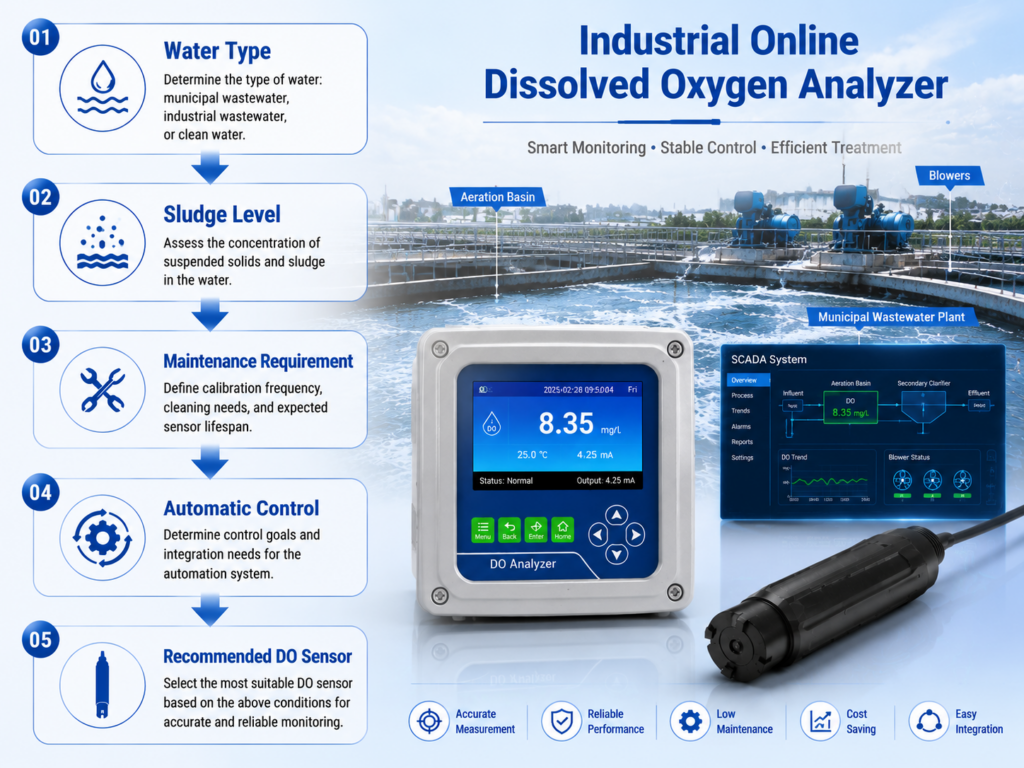
1. Understand Your Water Conditions
Different applications require different sensor technologies.
Before selecting a DO analyzer, determine:
- Municipal wastewater or industrial wastewater?
- Activated sludge or clean water?
- High suspended solids?
- Oil contamination?
- Sulfide or chemical interference?
Harsh wastewater environments usually require more durable, low-maintenance sensors.
2. Select the Right Sensor Technology
Each DO sensor technology has strengths and limitations.
Optical (Fluorescence)
Best for:
- Municipal wastewater
- Industrial wastewater
- Biological treatment
- Automatic aeration control
Advantages:
- No electrolyte replacement
- No membrane replacement
- Excellent long-term stability
- Very low maintenance
Polarographic
Best for:
- Stable industrial processes
- Applications with regular maintenance
Advantages:
- Mature technology
- Good accuracy
- Moderate purchase cost
However, membrane replacement and electrolyte maintenance increase operating costs.
Galvanic
Best for:
- Portable measurement
- Small industrial systems
Advantages:
- Simple operation
- Fast startup
However, service life is generally shorter under heavily polluted wastewater conditions.
3. Consider Maintenance Costs, Not Just Purchase Price
Many buyers compare only the initial equipment price.
In reality, long-term maintenance often represents the largest operating cost.
Consider:
- Calibration frequency
- Sensor cleaning
- Membrane replacement
- Electrolyte replacement
- Spare parts cost
- Expected service life
A sensor with a slightly higher purchase price may reduce maintenance costs significantly over several years.
4. Verify Automation Compatibility
Modern wastewater treatment plants increasingly rely on automatic process control.
Choose analyzers that support:
- PLC
- SCADA
- DCS
- Modbus RTU
- 4–20 mA outputs
Reliable communication improves aeration control and simplifies plant operation.
From Our Field Experience:
Upgrading to Fluorescence DO Sensors Reduced Maintenance Costs and Energy Consumption
Many wastewater treatment plants continue using electrochemical dissolved oxygen sensors simply because they have always used them.
However, older sensor technology is not always the best choice for today’s operating conditions.
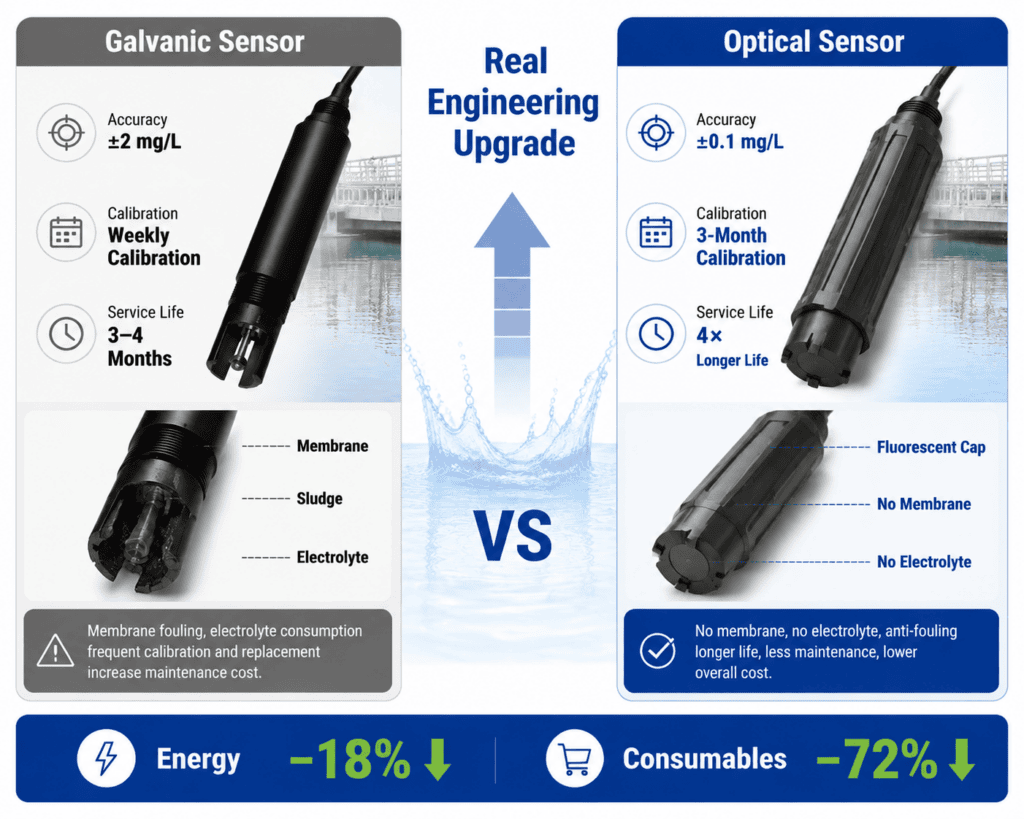
We supported several municipal wastewater treatment plants where dissolved oxygen was monitored in biological aeration tanks containing heavy sludge, sulfides, oil contamination, and large amounts of suspended solids.
The plants originally used galvanic dissolved oxygen sensors.
Although the analyzers worked, operators faced constant maintenance problems.
The membrane surface quickly became covered with sludge and biofilm, requiring cleaning every three to five days.
Internal corrosion shortened sensor life to only three to four months, while dissolved oxygen readings fluctuated by as much as ±2 mg/L, making stable blower control almost impossible.
After reviewing the operating conditions, our engineers recommended replacing the galvanic sensors with optical fluorescence dissolved oxygen analyzers.
Because fluorescence sensors do not use electrolyte or replaceable membranes, they are much less affected by sludge accumulation and require far less routine maintenance.
The improvement was significant.
- Measurement fluctuation decreased from ±2 mg/L to ±0.1 mg/L.
- Calibration frequency changed from once every week to once every three months.
- Calibration labor was reduced by approximately 90%.
- Overall sensor service life increased by four times.
- Annual consumable costs decreased by 72%.
- Blower energy consumption decreased by 18% through more stable automatic aeration control.
This project demonstrated that selecting the correct measurement technology often produces greater long-term savings than choosing the lowest purchase price.
Best Installation Practices
Even the best dissolved oxygen analyzer cannot provide reliable measurements if it is installed incorrectly.
A properly selected measurement location is just as important as selecting the right sensor.
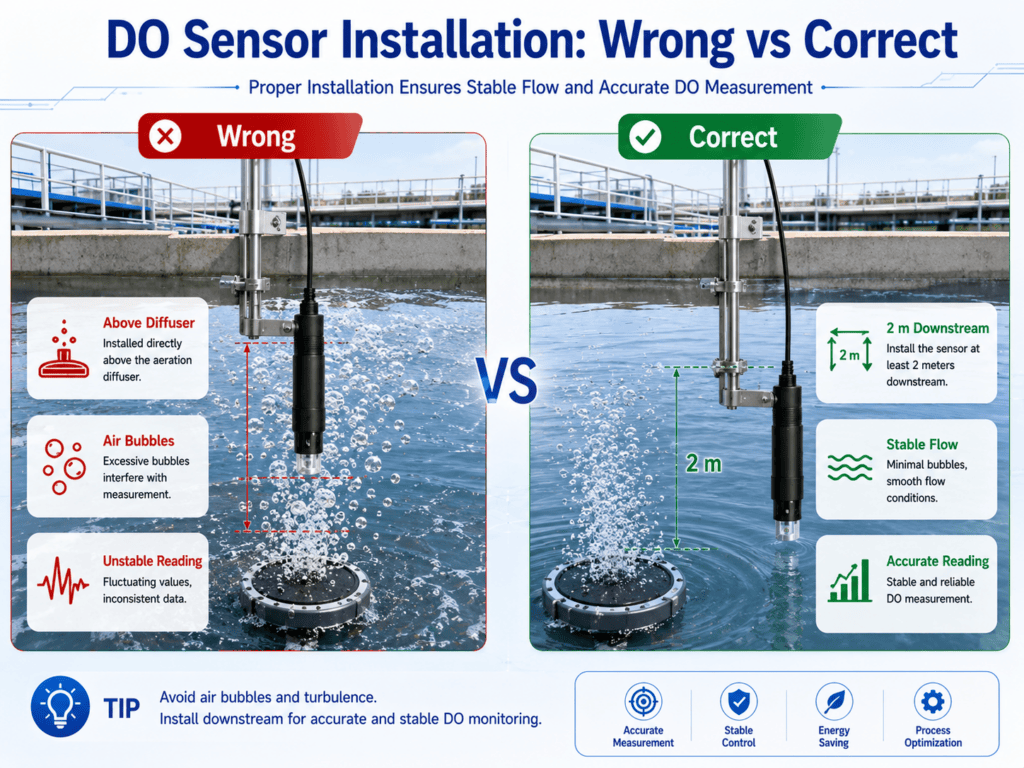
When installing a dissolved oxygen analyzer:
- Choose an area with representative water conditions.
- Avoid dead zones with little water movement.
- Keep the sensor away from excessive turbulence.
- Ensure sufficient water velocity across the sensor surface.
- Allow easy access for routine maintenance.
Correct installation improves both measurement accuracy and sensor life.
Common Buying Mistakes
Many purchasing problems can be avoided by asking the right questions before ordering equipment.
The most common mistakes include:
Choosing Based Only on Price
A lower purchase price often leads to higher maintenance costs over time.
Always evaluate the total cost of ownership.
Ignoring Water Quality
A sensor designed for clean water may perform poorly in activated sludge or industrial wastewater.
Match the sensor technology to the actual process conditions.
Overlooking Maintenance Requirements
Maintenance intervals directly affect labor costs and plant reliability.
Choosing a lower-maintenance analyzer often produces better long-term value than selecting the lowest-priced option.
Forgetting Future Automation
If the treatment plant plans to upgrade its control system later, choose an analyzer that already supports standard industrial communication protocols.
This avoids unnecessary replacement costs during future expansion.
Troubleshooting Common Dissolved Oxygen Analyzer Problems
Even the best dissolved oxygen analyzer can produce unstable readings if the installation or maintenance is incorrect.
In our experience, most DO measurement problems are caused by process conditions rather than sensor failure.
The following checklist can help identify the root cause before replacing the sensor.
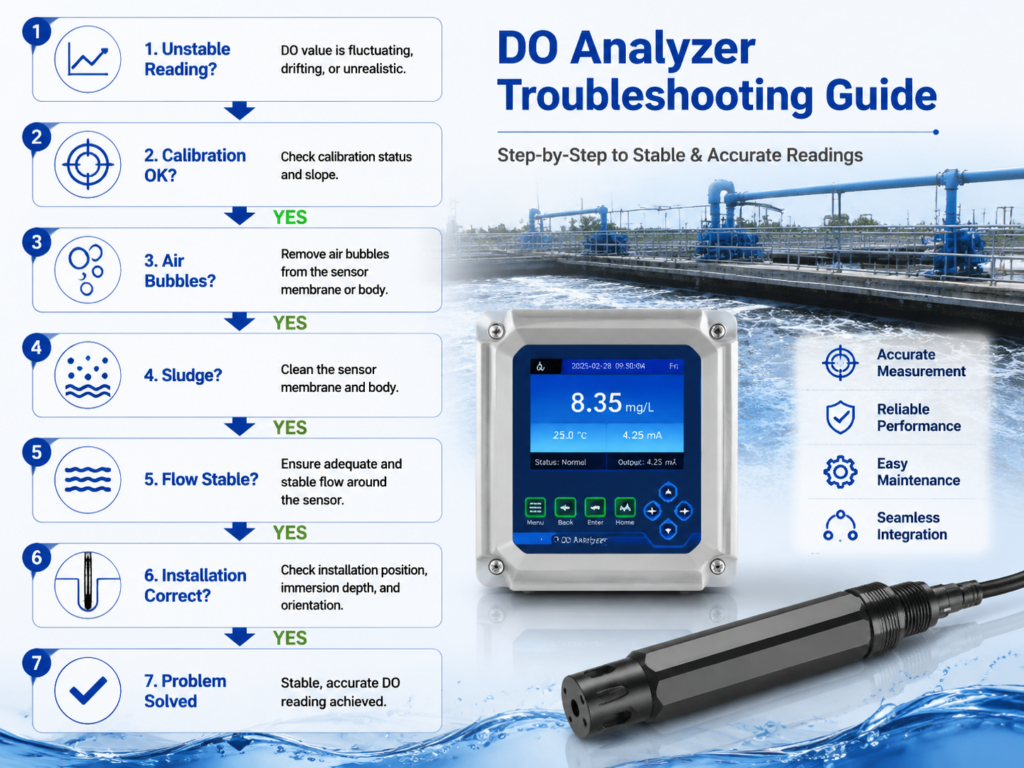
Problem 1: DO Readings Fluctuate Continuously
Possible causes include:
- Air bubbles striking the sensor
- Unstable water flow
- Poor installation location
- Sludge accumulation
- Heavy biological fouling
Always inspect the installation environment before replacing the analyzer.
Problem 2: Slow Sensor Response
A slow response usually indicates:
- Sensor contamination
- Aging sensing cap or membrane
- Low water velocity
- Incorrect maintenance
Cleaning or replacing worn components often restores performance.
Problem 3: Measurement Drift
Long-term drift may result from:
- Calibration overdue
- Sensor aging
- Contaminated sensing surface
- Process changes
Regular preventive maintenance greatly improves long-term stability.
Problem 4: Frequent Calibration
If calibration is required every few days, investigate:
- Incorrect sensor technology
- Harsh wastewater conditions
- Sensor contamination
- Installation problems
Frequent calibration is often a symptom rather than the real problem.
From Our Field Experience:
The DO Sensor Was Fine—The Installation Location Was the Real Problem
One municipal wastewater treatment plant contacted us because its optical dissolved oxygen analyzer showed continuous fluctuations of ±1.8 mg/L.
The unstable readings caused the aeration blowers to start and stop unpredictably, making automatic aeration control impossible.
The customer believed the fluorescence sensor had failed and planned to purchase a replacement.
Our engineers first checked the analyzer itself.
The sensor passed calibration, the sensing cap was in good condition, and the controller operated normally.
The analyzer was not the problem.
The investigation then focused on the installation.
We found that the sensor had been installed directly in front of the aeration diffuser.
Large air bubbles continuously struck the sensing surface while sludge accumulated around the probe because of insufficient water movement.
These conditions prevented the sensor from measuring representative dissolved oxygen values.
Instead of replacing the analyzer, we recommended:
- Moving the sensor approximately 2 meters downstream from the diffuser.
- Repositioning the mounting bracket away from concentrated air bubbles.
- Installing a guide tube to maintain a flow velocity of 0.6–1.0 m/s.
- Adding an automatic freshwater spray cleaning device to reduce sludge accumulation.
After these changes:
- Reading fluctuation decreased from ±1.8 mg/L to ±0.15 mg/L.
- Aeration blower energy consumption decreased by 19%.
- Manual cleaning frequency was reduced by 75%.
- Calibration became much less frequent.
- Automatic aeration control operated smoothly again.
This project highlights an important lesson: before replacing a dissolved oxygen sensor, always verify the installation location. Proper hydraulic conditions are just as important as sensor accuracy.
Frequently Asked Questions
What is the best dissolved oxygen analyzer for wastewater?
For most municipal and industrial wastewater treatment plants, optical fluorescence dissolved oxygen analyzers are the preferred choice because they require minimal maintenance, provide stable long-term measurements, and reduce operating costs.
What is the difference between optical and electrochemical DO sensors?
Optical sensors measure oxygen using fluorescence and do not consume oxygen during measurement.
Electrochemical sensors rely on chemical reactions and usually require electrolyte or membrane replacement.
Optical sensors generally require less maintenance and provide better long-term stability.
How often should a dissolved oxygen analyzer be calibrated?
Calibration frequency depends on the application and sensor type.
Modern optical sensors often require calibration only every few months, while electrochemical sensors usually require more frequent verification.
Always follow the manufacturer’s maintenance recommendations.
Why does my dissolved oxygen reading fluctuate?
Common causes include:
- Incorrect installation location
- Air bubbles
- Sludge buildup
- Poor water circulation
- Sensor contamination
Most unstable readings are caused by installation or process conditions rather than instrument failure.
What should I consider before purchasing a dissolved oxygen analyzer?
Important factors include:
- Water quality
- Sensor technology
- Maintenance requirements
- Automation compatibility
- Long-term operating cost
Selecting the right analyzer for the actual application usually provides greater value than simply choosing the lowest purchase price.
Conclusion
Selecting the right dissolved oxygen analyzer is essential for improving wastewater treatment efficiency, reducing energy consumption, and maintaining stable biological processes.
As the engineering examples in this guide demonstrate, long-term performance depends not only on the analyzer itself but also on choosing the correct sensor technology, installing it in the right location, and following a preventive maintenance program.
A well-designed dissolved oxygen monitoring system delivers more stable measurements, lower operating costs, and more reliable process control throughout the life of the plant.
About Dissolved Oxygen Monitoring Solutions
Accurate dissolved oxygen monitoring is critical for wastewater treatment, industrial process control, aquaculture, and environmental monitoring. Achieving reliable measurements requires more than selecting a sensor—it also depends on proper installation, application-specific sensor selection, and long-term maintenance planning.
Wuxi Wohuan Instrument provides industrial dissolved oxygen analyzers, optical fluorescence DO sensors, electrochemical DO sensors, multi-parameter water quality analyzers, and complete online monitoring systems. With practical experience across municipal wastewater, industrial wastewater, drinking water, and environmental monitoring projects, our engineering team helps customers improve measurement reliability while reducing maintenance costs and energy consumption.
Need Help Choosing the Right Dissolved Oxygen Analyzer?
Every wastewater treatment process is different.
Choosing the correct dissolved oxygen analyzer depends on water quality, biological process requirements, maintenance capability, and automation goals.
Explore Related Solutions
Learn more about our Online Water Quality Monitoring Solutions for municipal and industrial wastewater treatment.
Compare our Dissolved Oxygen Analyzers, pH Analyzers, ORP Analyzers, Conductivity Meters, and Turbidity Meters to build a complete online monitoring system.
If you are unsure which DO sensor technology is best for your application, our engineering team can recommend the most suitable solution based on your operating conditions.
Request a Free Consultation
Contact us with the following information:
- Application
- Water type
- Measuring range
- Tank depth
- Installation method
- Communication requirements
Our engineers will recommend the most suitable dissolved oxygen analyzer and provide professional technical support for your project.