Introduction
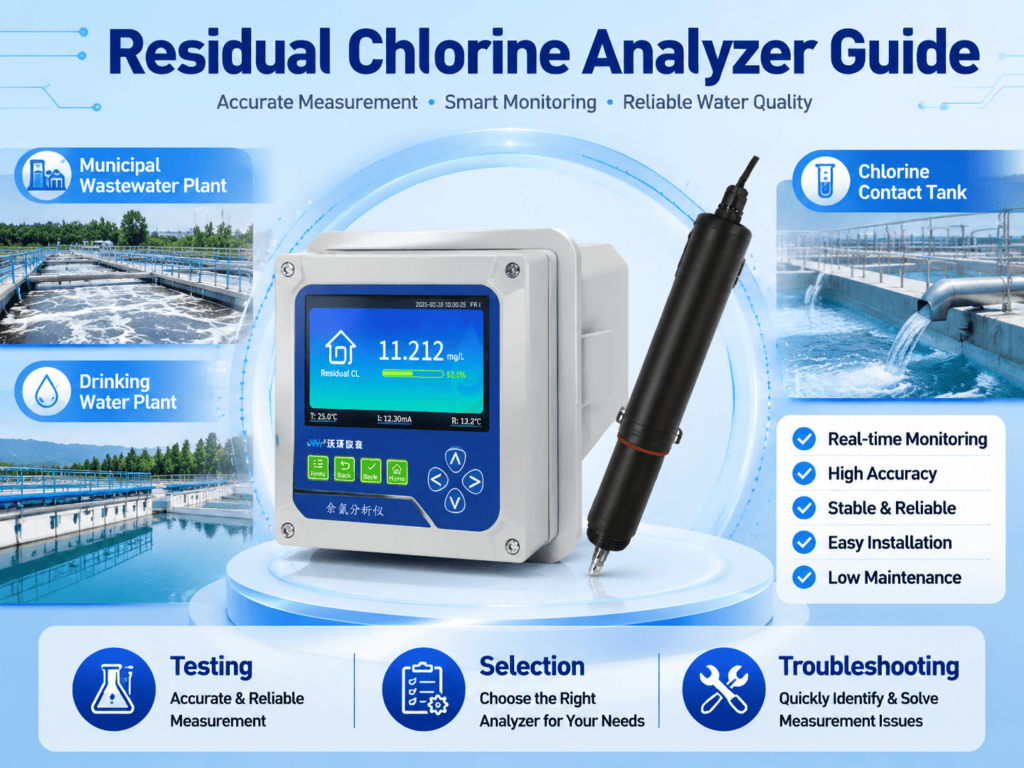
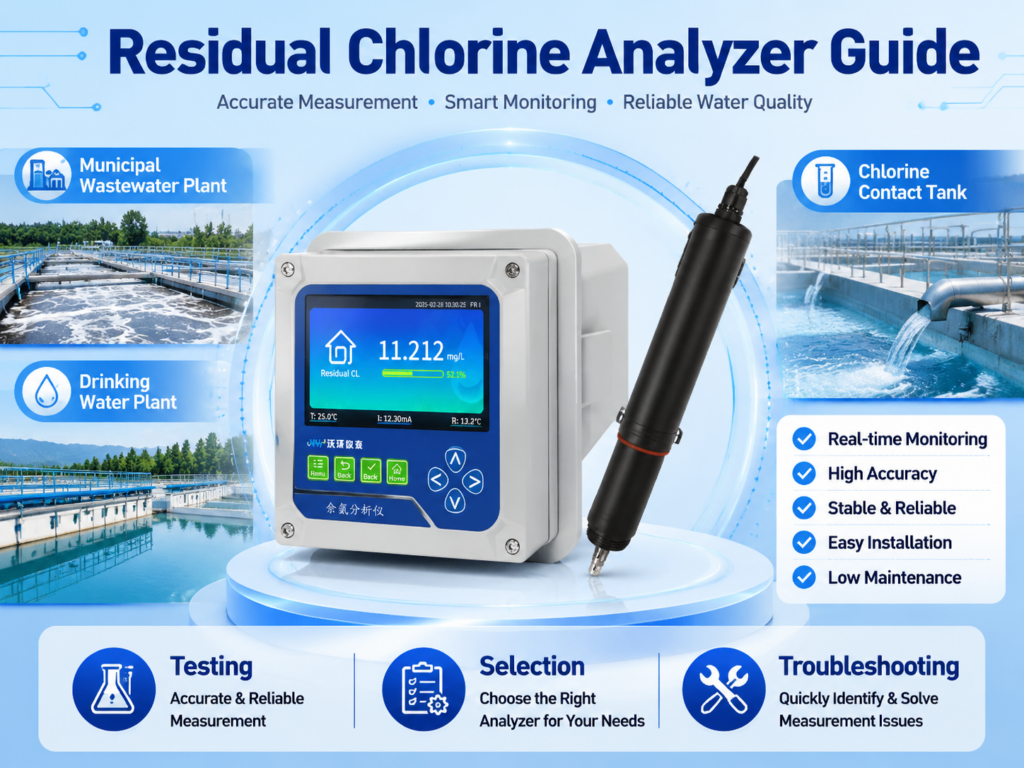
Choosing the right residual chlorine analyzer is essential for maintaining safe drinking water, stable industrial processes, and compliant wastewater discharge. This guide explains how residual chlorine testing works, compares the most common analyzer technologies, and provides practical selection advice for different applications.
Drawing on real engineering experience from municipal water and wastewater projects, we’ll also share common mistakes, troubleshooting methods, and practical recommendations that help operators improve measurement accuracy while reducing maintenance costs.
By the end of this guide, you’ll know how to choose the right analyzer, understand the strengths of each testing method, and avoid the problems that frequently occur in real-world installations.
Quick Answer
A residual chlorine analyzer measures the amount of chlorine remaining in water after the disinfection process. This remaining chlorine confirms that enough disinfectant is available to continue protecting the water while avoiding excessive chemical dosing.
The two most common testing methods are:
- DPD colorimetric analysis, which measures chlorine through a chemical color reaction.
- Amperometric analysis, which continuously measures chlorine using an electrochemical sensor.
For laboratory verification or field inspections, portable DPD testers are widely used.
For continuous process control in drinking water plants, wastewater treatment facilities, and industrial systems, online residual chlorine analyzers provide real-time monitoring and automatic process control.
What Is Residual Chlorine?
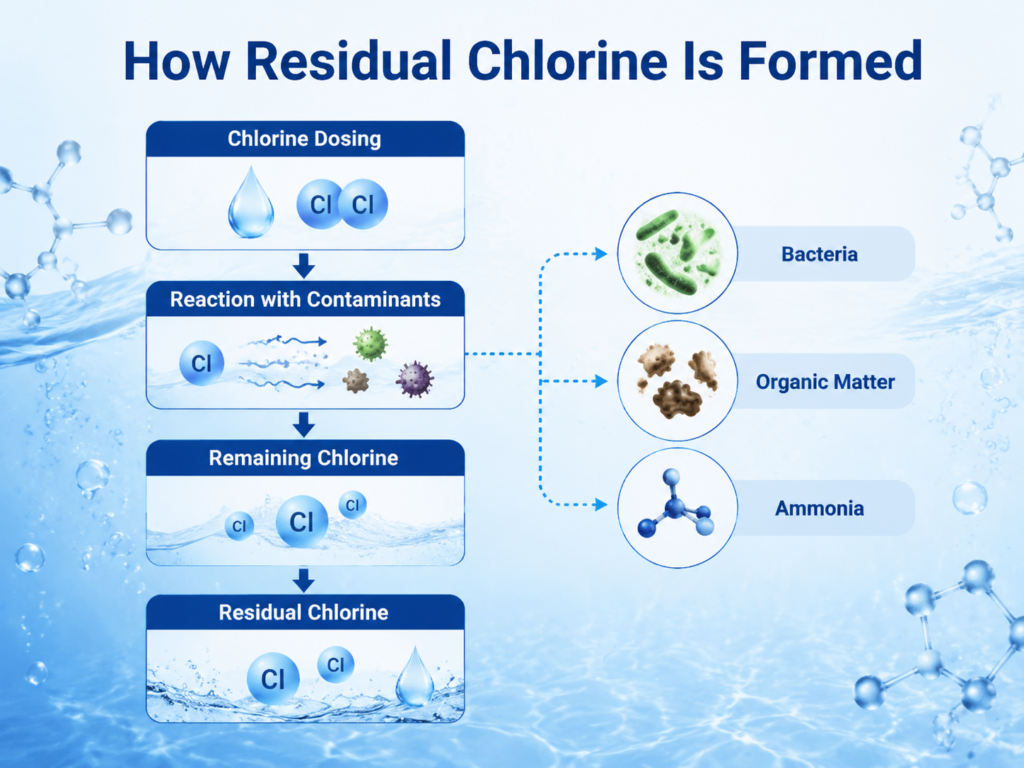
Residual chlorine is the measurable chlorine that remains in water after chlorine has reacted with microorganisms, organic matter, and other contaminants.
Rather than indicating how much chlorine was added, residual chlorine shows how much disinfectant is still available to protect the water.
Residual chlorine is generally divided into three categories:
- Free Chlorine – active disinfectant available for pathogen control.
- Combined Chlorine – chlorine that has reacted with ammonia to form chloramines.
- Total Chlorine – the sum of free chlorine and combined chlorine.
Understanding these differences is important because different applications require different monitoring targets.
Why Is Residual Chlorine Testing Important?
Adding chlorine alone does not guarantee safe water.
Without continuous monitoring, operators cannot determine whether the chlorine dosage is too low, too high, or changing unexpectedly.
Reliable residual chlorine testing helps operators answer several important questions.
Is disinfection effective?
If residual chlorine is too low, bacteria and viruses may survive the treatment process, increasing public health risks.
Is chlorine being overdosed?
Adding excessive chlorine increases operating costs and may create unwanted disinfection by-products or exceed discharge limits.
Is the treatment process operating normally?
Real-time chlorine monitoring allows operators to detect process changes immediately instead of waiting for laboratory results.
This improves dosing efficiency and reduces the risk of regulatory violations.
Typical Applications of Residual Chlorine Monitoring
Residual chlorine analyzers are widely used across the water industry.
Each application has different monitoring objectives and operating conditions.
Drinking Water Treatment
Water utilities monitor free chlorine throughout the distribution system to ensure that disinfectant remains available until the water reaches consumers.
Continuous monitoring helps utilities maintain water quality while minimizing chemical consumption.
Municipal Wastewater Treatment
Wastewater plants monitor residual chlorine after disinfection to ensure that treated effluent meets environmental discharge requirements.
Online analyzers also provide automatic feedback for chlorine dosing systems, helping reduce chemical waste and improve compliance.
Industrial Process Water
Many industries use chlorine to control biological growth in cooling water, process water, and recycled water systems.
Continuous chlorine monitoring improves process stability while reducing maintenance costs caused by biological fouling.
Swimming Pools and Recreational Water
Swimming pools rely on residual chlorine monitoring to maintain safe water quality and provide a comfortable swimming environment.
Continuous monitoring helps prevent under-chlorination while avoiding excessive chlorine levels that may irritate swimmers.
Main Methods for Residual Chlorine Testing
Several analytical methods are available for measuring chlorine residual.
The most common technologies used today are the DPD colorimetric method and the amperometric method.
Each technology offers different advantages depending on the application.
DPD Colorimetric Method
The DPD (N,N-diethyl-p-phenylenediamine) method remains one of the most widely accepted chlorine testing techniques.
After adding DPD reagent to the sample, chlorine reacts with the reagent and produces a pink color.
The darker the color, the higher the chlorine concentration.
A portable photometer or laboratory analyzer converts this color intensity into a chlorine reading.
Advantages
- High analytical accuracy
- Easy to verify visually
- Widely accepted for laboratory testing
- Suitable for compliance verification
Limitations
- Manual sampling required
- Reagent consumption
- Results depend on correct sample handling
- Cannot provide continuous online monitoring
Amperometric Method
Amperometric analyzers measure chlorine using an electrochemical sensor.
When chlorine reaches the electrode surface, it generates a small electrical current proportional to the chlorine concentration.
The analyzer converts this electrical signal into a real-time chlorine reading.
Because measurements are continuous, amperometric analyzers are widely used for automated chlorine dosing systems.
Advantages
- Continuous online monitoring
- Fast response time
- No manual testing during operation
- Easy integration with PLC and SCADA systems
- Suitable for automatic process control
Limitations
- Sensor performance depends on water quality
- Periodic cleaning and calibration are required
- Fouling may occur in heavily contaminated wastewater
For most continuous monitoring applications, amperometric analyzers provide a better balance between automation, operating cost, and process control than manual testing.
DPD vs. Amperometric: Which Residual Chlorine Analyzer Should You Choose?
Choosing the right residual chlorine analyzer depends on how the measurement will be used rather than which technology is newer.
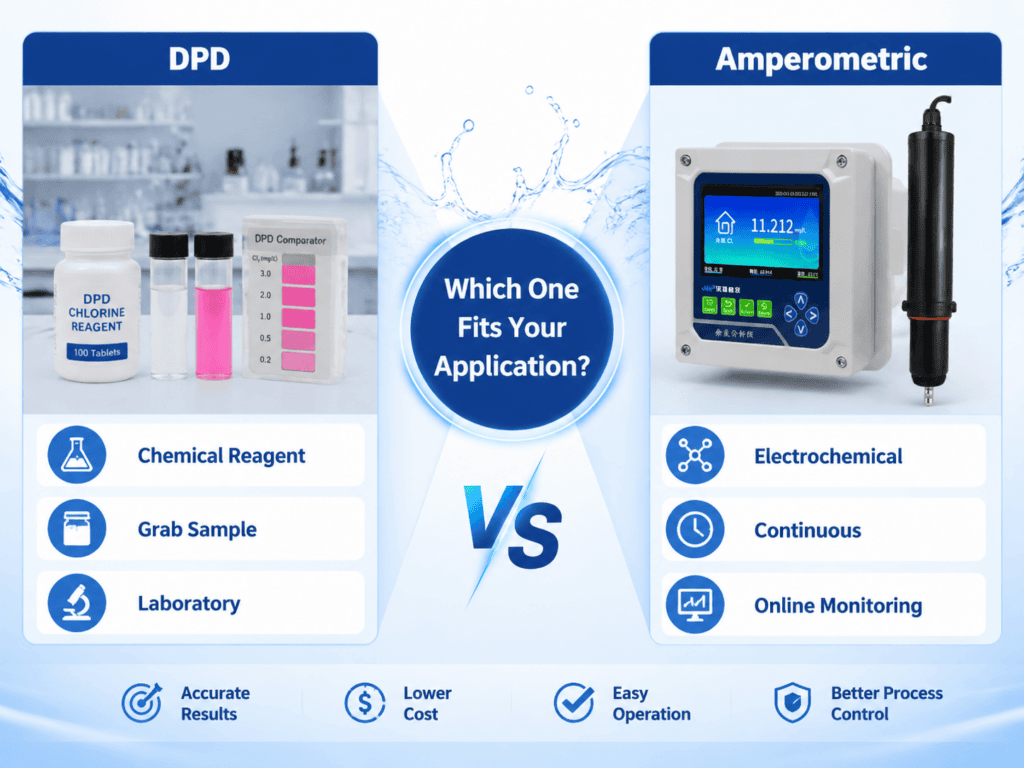
For most water treatment facilities, the decision comes down to two questions:
- Do you need continuous process control or occasional verification?
- Does your water contain significant interference from suspended solids, organic matter, or other chemicals?
Understanding these requirements makes analyzer selection much easier.
DPD Colorimetric Analyzer
DPD analyzers measure chlorine through a chemical color reaction.
The analyzer automatically adds DPD reagent to the water sample, develops a pink color, and calculates the chlorine concentration using an optical detector.
Because the measurement is based on a standardized chemical reaction, DPD analyzers are widely accepted for compliance testing and laboratory verification.
Best Applications
- Drinking water laboratories
- Compliance monitoring
- Verification testing
- Low-concentration chlorine measurement
Advantages
- High measurement accuracy
- Excellent low-level sensitivity
- Standardized testing method
- Reliable laboratory comparison
Considerations
- Requires reagent replacement
- Higher operating cost
- More maintenance than non-reagent systems
Amperometric Residual Chlorine Analyzer
Amperometric analyzers continuously measure chlorine using an electrochemical sensor.
Instead of using chemical reagents, the sensor converts chlorine concentration directly into an electrical signal.
Because measurements are updated continuously, this technology is ideal for automatic dosing control.
Best Applications
- Municipal water treatment
- Wastewater treatment
- Industrial process water
- Continuous online monitoring
Advantages
- Real-time monitoring
- Fast response
- Lower operating cost
- Easy PLC and SCADA integration
- Suitable for automatic dosing control
Considerations
Performance depends on:
- Stable sample flow
- Proper maintenance
- Sensor cleanliness
- Correct sensor selection
Which Residual Chlorine Analyzer Is Best for Your Application?
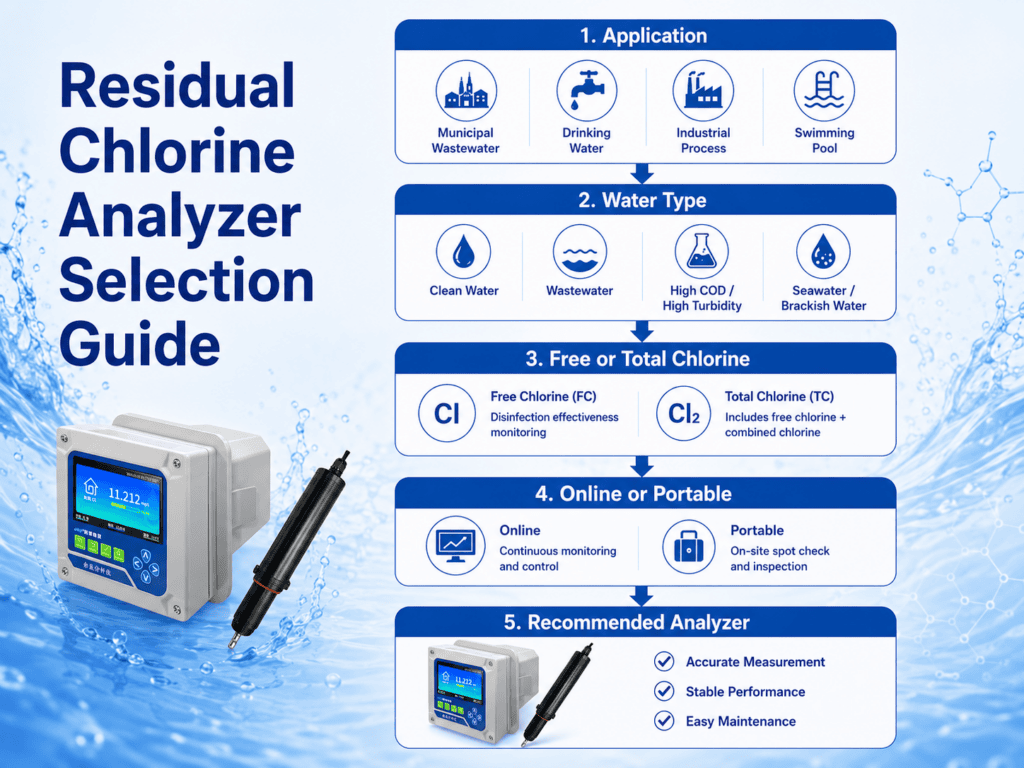
No single analyzer is suitable for every project.
Instead, match the analyzer technology to your water quality and operating requirements.
| Application | Recommended Analyzer | Main Reason |
|---|---|---|
| Drinking water distribution | Online amperometric | Continuous free chlorine monitoring |
| Municipal wastewater | Reagent-based or wastewater-specific amperometric | Better handling of wastewater interference |
| Industrial process water | Online amperometric | Continuous process control |
| Laboratory verification | Portable DPD analyzer | Standard chemical confirmation |
| Temporary field inspection | Portable DPD analyzer | Flexible spot testing |
When selecting an analyzer, don’t focus only on accuracy.
Maintenance requirements, operating cost, and long-term reliability are equally important.
Online Chlorine Monitoring System vs. Portable Analyzer
Portable analyzers remain useful for field verification.
However, they cannot replace continuous online monitoring in modern treatment plants.
Portable analyzers require operators to:
- Collect samples manually
- Perform periodic testing
- Record results manually
This approach provides only a snapshot of water quality.
By contrast, an online residual chlorine monitoring system continuously measures chlorine concentration and immediately detects process changes.
Operators receive real-time alarms whenever chlorine levels move outside the acceptable range.
For facilities operating around the clock, continuous monitoring provides much greater process control than periodic manual testing.
From Our Field Experience:
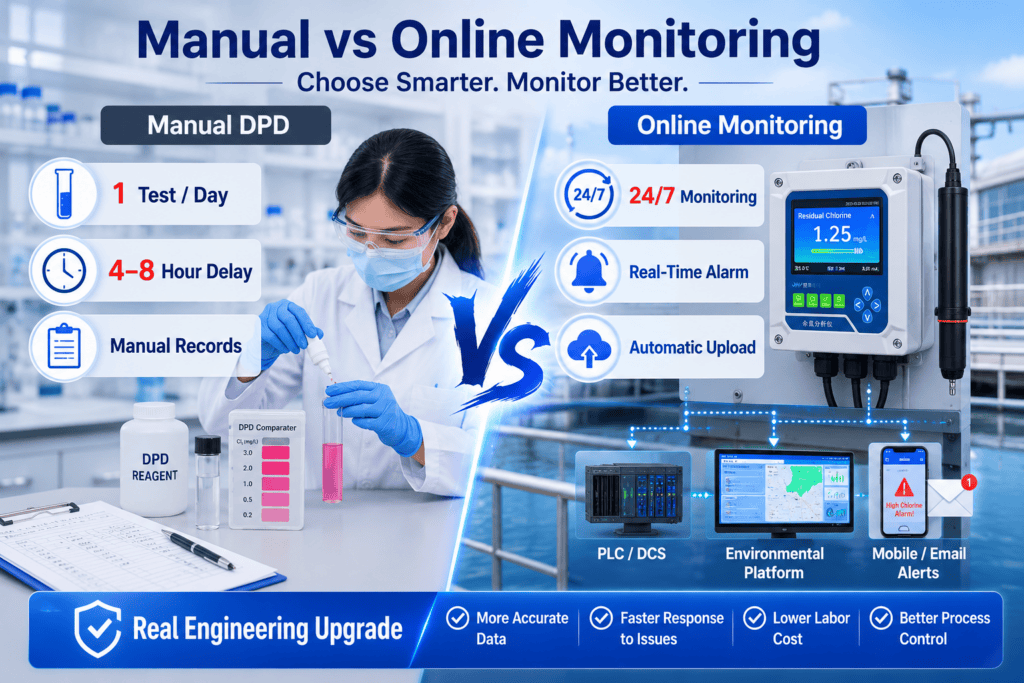
Why Municipal Wastewater Plants Are Replacing Manual DPD Testing with Online Monitoring
For many years, most municipal wastewater treatment plants relied on manual DPD testing because environmental regulations only required one reported result per day.
Operators were familiar with laboratory testing and were concerned that online analyzers might not provide reliable measurements.
As environmental regulations became stricter, this approach became increasingly difficult.
Laboratory results typically lagged behind the actual treatment process by 4 to 8 hours, making it impossible to respond quickly when chlorine residual changed unexpectedly.
Many plants also needed to upload continuous monitoring data directly to environmental supervision platforms, making manual testing insufficient for compliance.
Our engineering team has helped multiple municipal wastewater treatment plants upgrade from manual testing to 24-hour online residual chlorine monitoring systems.
After commissioning, chlorine residual was monitored continuously and automatically uploaded to the regulatory platform in real time.
The monitoring system was integrated with the automatic chemical dosing system, allowing chlorine dosage to adjust immediately according to actual residual chlorine levels.
The improvements were significant:
- 24/7 continuous monitoring instead of one manual test per day.
- More than 25% reduction in chlorine consumption.
- Alarm response time reduced from 4–8 hours to less than 5 minutes.
- Automatic environmental data reporting without manual record keeping.
This project demonstrates that online residual chlorine monitoring is no longer simply a convenience. It has become an essential tool for regulatory compliance, process optimization, and reducing operating costs.
Buyer Selection Checklist
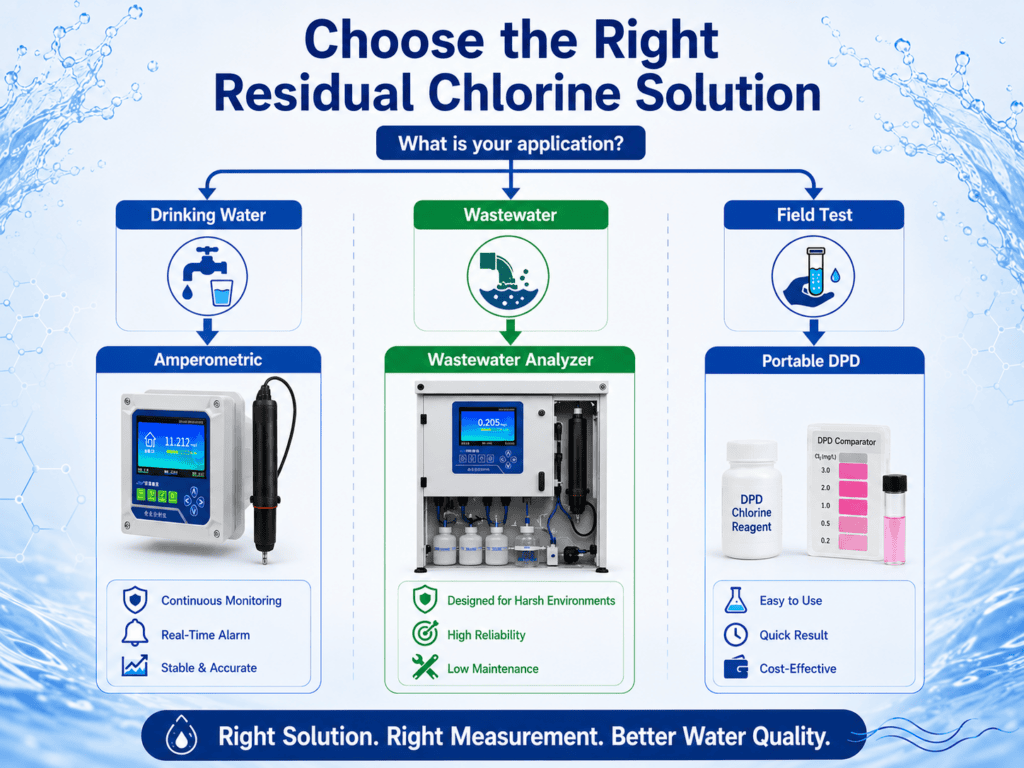
Before purchasing a residual chlorine analyzer, confirm the following information:
Water Type
Is the application:
- Drinking water?
- Municipal wastewater?
- Industrial wastewater?
- Swimming pool water?
- Process water?
Different water qualities require different analyzer technologies.
Chlorine Type
Determine whether the process requires monitoring:
- Free chlorine
- Total chlorine
- Combined chlorine
Selecting the wrong measurement parameter may produce misleading results.
Measurement Range
Choose an analyzer with a range appropriate for the expected chlorine concentration.
A wider range is not always better.
Higher sensitivity is often more important for low-level monitoring.
Maintenance Requirements
Consider:
- Available maintenance personnel
- Cleaning frequency
- Calibration interval
- Reagent replacement
- Automatic cleaning options
Lower maintenance often results in lower lifetime operating costs.
System Integration
Modern analyzers should support communication with:
- PLC
- SCADA
- DCS
- Environmental monitoring platforms
Good communication capability simplifies automation and regulatory reporting.
Challenges of Residual Chlorine Testing in Wastewater
Wastewater is much more difficult to monitor than drinking water.
Suspended solids, organic matter, changing temperatures, and unstable flow conditions can all affect chlorine measurements. Choosing the right analyzer is only part of the solution. Proper sampling, maintenance, and installation are equally important.
The most common challenges include:
- High suspended solids
- Organic contamination
- Variable sample flow
- Chemical interference
- Sensor fouling
A residual chlorine analyzer designed specifically for wastewater usually delivers better long-term stability than a standard drinking water analyzer.
Installation, Calibration, and Maintenance
Even a high-quality analyzer cannot produce reliable results if the sampling system is poorly maintained.
A preventive maintenance program should include:
- Routine sensor cleaning
- Scheduled calibration
- Flow cell inspection
- Sampling pump maintenance
- Sample pipeline cleaning
Many measurement problems originate from the sampling system rather than the analyzer itself.
From Our Field Experience:
Why a Dirty Sampling Line Caused Unstable Chlorine Readings
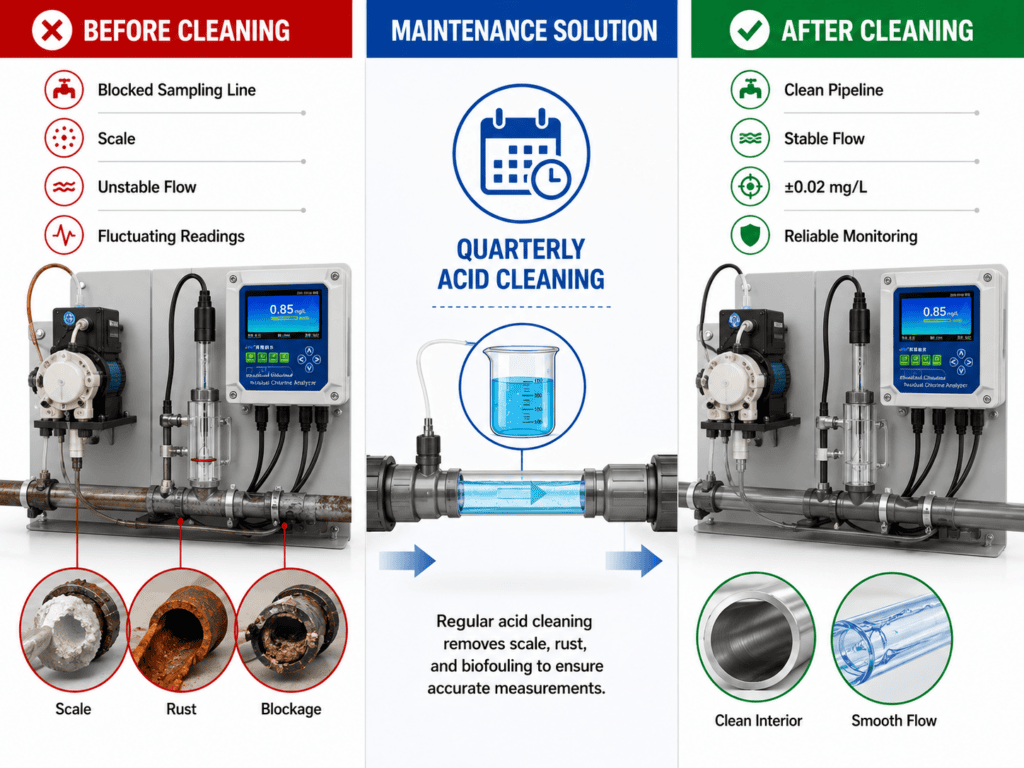
Many operators believe unstable chlorine readings are caused by sensor failure or electrical interference.
In one municipal drinking water treatment plant, the online residual chlorine analyzer produced constantly fluctuating readings. The unstable signal caused the chlorine dosing system to respond incorrectly, making chlorine control difficult.
The customer initially suspected electrical interference or an installation problem.
Our engineers first checked the installation, electrical connections, sensor calibration, and electrode condition. Everything operated normally.
The investigation then focused on the sampling system.
We discovered that the sampling pipeline was heavily coated with calcium and magnesium scale, reducing the internal pipe diameter by more than 50%. At the same time, rust and mineral deposits partially blocked the sampling pump impeller, causing unstable sample flow.
Because amperometric chlorine analyzers require a stable flow rate, the fluctuating sample flow directly caused unstable measurement results.
Instead of replacing the analyzer, we recommended introducing a preventive maintenance program that included quarterly circulation cleaning with diluted hydrochloric acid to remove scale from both the sampling pipeline and the pump.
The improvement was immediate:
- Measurement fluctuation reduced to less than ±0.02 mg/L
- Stable chlorine dosing
- More than 90% reduction in customer complaints
- Significantly lower maintenance workload
This project demonstrated an important engineering lesson: before replacing an analyzer, always inspect the sampling system. Stable sample flow is essential for accurate chlorine measurement.
Frequently Asked Questions
What is residual chlorine?
Residual chlorine is the chlorine remaining in water after disinfection. It confirms that sufficient disinfectant is still available to maintain water safety.
Which method is better, DPD or amperometric?
Neither method is universally better.
DPD testing is ideal for laboratory verification, while amperometric analyzers provide continuous online monitoring for automatic process control.
Many facilities use both methods together.
Why do online chlorine analyzers sometimes disagree with laboratory results?
Possible causes include:
- Different sampling procedures
- Sample contamination
- Temperature differences
- Chemical interference
- Calibration drift
Always verify the sampling method before replacing the analyzer.
How often should a residual chlorine analyzer be calibrated?
Calibration frequency depends on water quality.
Clean drinking water systems may require only periodic verification, while wastewater applications generally need more frequent inspection because of sensor fouling.
What should I consider before purchasing a residual chlorine analyzer?
Key selection factors include:
- Water application
- Chlorine type
- Measuring range
- Maintenance requirements
- Communication protocol
- Process automation requirements
Choosing the correct analyzer usually reduces operating costs over the long term.
Conclusion
Selecting the right residual chlorine analyzer involves much more than comparing technical specifications.
Water quality, analyzer technology, installation quality, sampling conditions, and routine maintenance all influence long-term measurement accuracy.
As the engineering examples in this guide demonstrate, many monitoring problems are not caused by analyzer failure. Proper system design and preventive maintenance often solve issues that repeated calibration cannot.
Understanding these practical considerations helps improve process control, reduce maintenance costs, and ensure long-term regulatory compliance.
About Residual Chlorine Monitoring Solutions
Reliable residual chlorine monitoring depends on more than choosing a sensor. Successful projects require the right analyzer technology, sampling design, installation method, and maintenance strategy.
Wuxi Wohuan Instrument provides industrial residual chlorine analyzers, membrane and membrane-free chlorine sensors, multi-parameter water quality analyzers, and complete online monitoring systems for drinking water, municipal wastewater, industrial process water, and swimming pool applications. Our engineering team recommends solutions based on actual operating conditions to help customers improve measurement reliability while reducing long-term operating costs.
Need Help Choosing the Right Residual Chlorine Analyzer?
Selecting the right residual chlorine analyzer depends on your application, water quality, chlorine type, maintenance requirements, and process conditions.
Whether you are upgrading an existing monitoring system or designing a new project, choosing the right solution can improve process control while reducing operating costs and maintenance time.
Explore Related Solutions
Learn more about our Water Quality Monitoring Solutions for municipal and industrial water treatment applications.
Browse our Industrial Water Quality Analyzers to compare residual chlorine analyzers, pH analyzers, conductivity meters, dissolved oxygen analyzers, turbidity meters, and other online water quality instruments.
If you need technical advice, our Engineering Team can recommend the most suitable monitoring solution based on your process requirements.
Request a Free Consultation
Please tell us:
- Your application
- Water type
- Chlorine type
- Measuring range
- Installation method
- Communication requirements
Our engineers will recommend the most suitable residual chlorine monitoring solution and provide professional technical support for your project.