Introduction
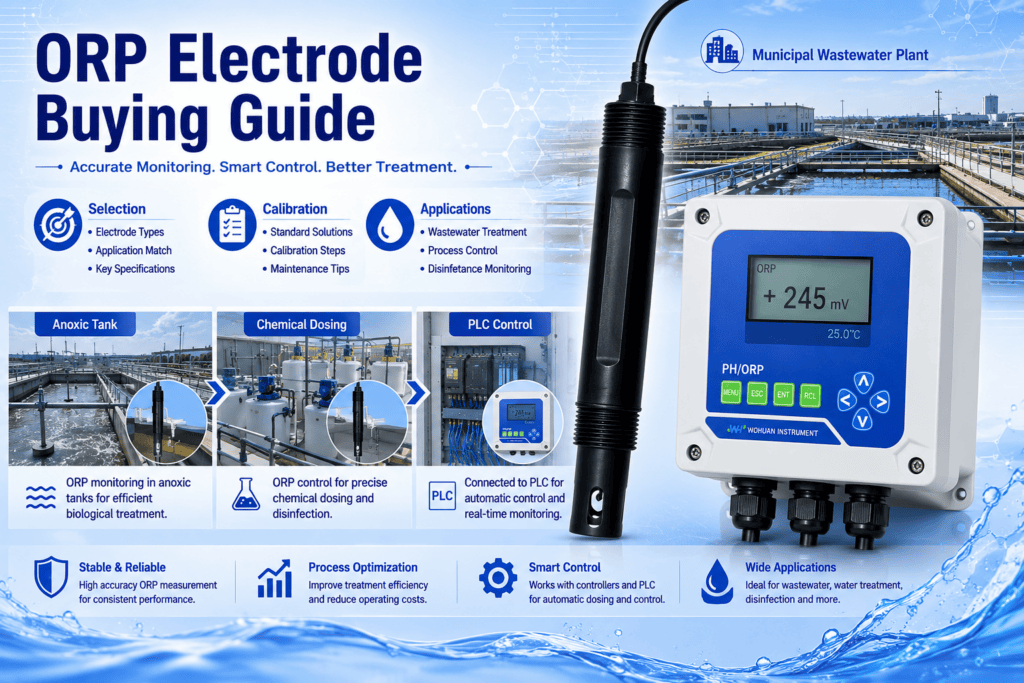
Choosing the right ORP electrode is essential for stable oxidation-reduction control in water treatment, wastewater treatment, chemical processing, and industrial disinfection. The correct ORP sensor helps operators optimize chemical dosing, improve process stability, and reduce operating costs.
In this guide, you’ll learn how an ORP electrode works, how it differs from a pH electrode, how to select the right sensor for your application, and how to avoid common installation and maintenance mistakes. Based on our field experience from municipal wastewater projects, we’ll also share real engineering cases that demonstrate how proper ORP monitoring improves process performance while reducing chemical consumption.
By the end of this guide, you’ll understand how to choose the right ORP electrode and keep it operating accurately over the long term.
Quick Answer
An ORP electrode (Oxidation-Reduction Potential electrode) measures the tendency of a liquid to either gain or lose electrons. The measurement is expressed in millivolts (mV) and reflects the oxidation or reduction condition of the process.
Unlike pH, which measures hydrogen ion concentration, ORP measures the overall oxidation-reduction capacity of the solution.
Industrial ORP electrodes are widely used for:
- Municipal wastewater treatment
- Drinking water disinfection
- Chemical dosing control
- Electroplating
- Food and beverage processing
- Swimming pools
- Pharmaceutical water treatment
Continuous ORP monitoring allows operators to automate dosing, improve treatment efficiency, and reduce unnecessary chemical consumption.
What Is an ORP Electrode?
An ORP electrode is an electrochemical sensor that continuously measures oxidation-reduction potential in liquids.
A complete ORP sensor consists of:
- A platinum or gold sensing element
- A reference electrode
- Electrolyte
- Reference junction
- Protective sensor body
The sensing element detects electron transfer occurring in the water, while the reference electrode provides a stable reference potential. The analyzer calculates the voltage difference between the two electrodes and displays the ORP value in millivolts.
Unlike laboratory measurements, industrial ORP electrodes are designed for continuous operation in demanding environments and can be integrated with PLC, SCADA, or DCS control systems.
How Does an ORP Electrode Work?
An ORP electrode does not measure a specific chemical concentration.
Instead, it measures the overall balance between oxidizing and reducing substances present in the water.
When strong oxidizing chemicals such as chlorine, ozone, or hydrogen peroxide are present, the ORP value increases.
When reducing substances such as sulfides or organic matter dominate, the ORP value decreases.
Typical ORP values include:
- +650 to +900 mV – Strong oxidation and effective disinfection
- +200 to +500 mV – Mild oxidation conditions
- 0 mV – Balanced oxidation and reduction
- Negative ORP values – Reducing conditions commonly found in anoxic biological treatment
Because ORP responds immediately to process changes, it is widely used as a real-time control parameter in automated treatment systems.
ORP vs. pH: What’s the Difference?
Although ORP and pH electrodes look similar, they measure completely different process parameters.
| ORP | pH |
|---|---|
| Measures oxidation-reduction potential | Measures hydrogen ion concentration |
| Unit: mV | Unit: pH |
| Indicates oxidation or reduction strength | Indicates acidity or alkalinity |
| Controls oxidation and disinfection processes | Controls acid-base reactions |
Many treatment systems monitor both parameters simultaneously.
For example:
- pH determines whether the chemical environment is suitable.
- ORP confirms whether oxidation or disinfection is actually occurring.
Using both measurements together provides much better process control than relying on either parameter alone.
Why Is ORP Monitoring Important?
Many industrial treatment processes depend on oxidation-reduction reactions.
Without continuous ORP monitoring, operators often rely on fixed dosing schedules or manual experience, making process control inconsistent.
A properly installed online ORP electrode helps operators:
- Optimize chemical dosing
- Improve biological treatment efficiency
- Reduce operating costs
- Prevent over-dosing and under-dosing
- Improve regulatory compliance
- Enable automatic process control
Because ORP responds immediately to changes in water chemistry, operators can react much faster than they can with periodic laboratory testing.
Typical Applications of ORP Electrodes
ORP electrodes are used across many industries where oxidation-reduction reactions are critical.
Municipal Wastewater Treatment
ORP monitoring helps control denitrification, biological treatment, and disinfection.
Operators can optimize carbon source dosing, improve nitrogen removal, and reduce chemical consumption.
Drinking Water Treatment
ORP confirms that sufficient oxidation capacity is available during chlorine or ozone disinfection while preventing excessive chemical dosing.
Chemical Processing
Many oxidation and reduction reactions depend on maintaining a stable ORP range.
Continuous monitoring improves product consistency while reducing raw material waste.
Swimming Pools
ORP monitoring provides continuous feedback for automatic chlorine dosing, helping maintain safe swimming conditions while reducing disinfectant consumption.
Food and Beverage Processing
ORP is widely used to verify cleaning and sanitation effectiveness during production.
Continuous monitoring helps maintain hygiene standards and improve process consistency.
How to Choose the Right ORP Electrode
Choosing the right ORP electrode is not simply about measurement range or connector type.
Long-term performance depends on matching the sensor to your actual process conditions.
Before selecting an ORP electrode, consider the following factors.
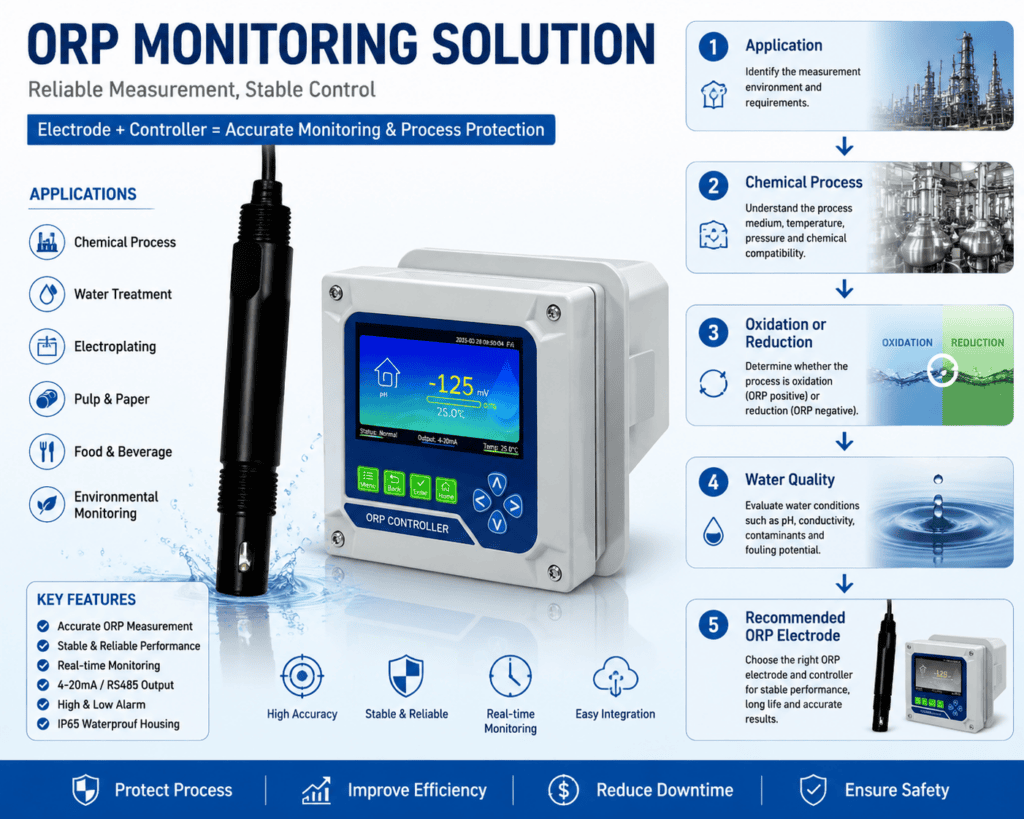
1. Understand Your Process
Different industries require different ORP control strategies.
Ask yourself:
- Is the process oxidation or reduction?
- Is ORP used for dosing control or monitoring?
- Does the process contain suspended solids?
- Is the water highly corrosive?
- Is biological sludge present?
Understanding the application is the first step toward selecting the right sensor.
2. Select the Right Electrode Material
Industrial ORP electrodes generally use either platinum or gold sensing elements.
Platinum ORP Electrodes
Platinum is the most widely used sensing material.
It responds well to chlorine, ozone, hydrogen peroxide, and most wastewater oxidation processes.
Typical applications include:
- Municipal wastewater
- Drinking water
- Swimming pools
- Chemical dosing
- Food processing
Gold ORP Electrodes
Gold electrodes perform better in solutions containing strong reducing agents or cyanide compounds.
They are commonly used in:
- Electroplating
- Mining
- Precious metal recovery
- Special chemical processes
For most water treatment applications, platinum electrodes remain the preferred choice because they offer better versatility and lower overall cost.
3. Consider Installation Conditions
Even the best ORP electrode cannot produce reliable measurements if the installation point is incorrect.
Before installation, confirm:
- Adequate water circulation
- No sludge accumulation
- Easy maintenance access
- Stable representative flow
- Minimal air bubble interference
A proper installation location improves both measurement stability and sensor life.
4. Evaluate Maintenance Requirements
Maintenance requirements directly affect operating costs.
Before purchasing an ORP electrode, consider:
- Cleaning frequency
- Calibration interval
- Chemical compatibility
- Expected service life
- Electrode replacement cost
Choosing a lower-maintenance sensor often reduces total ownership cost over several years.
From Our Field Experience:
How Online ORP Monitoring Reduced Chemical Consumption and Improved Compliance
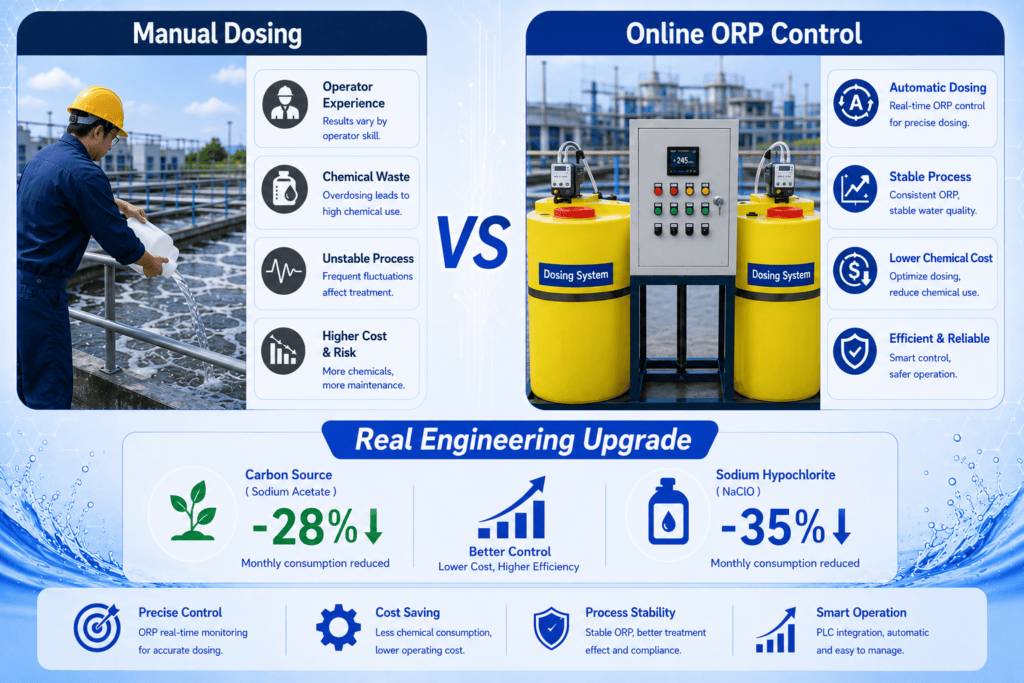
Many municipal wastewater treatment plants traditionally relied on experienced operators to control biological treatment and chemical dosing.
Carbon source addition and disinfection were often adjusted according to water appearance, operator experience, and fixed dosing schedules instead of real-time process data.
This created several operational problems.
During denitrification, sodium acetate was frequently overdosed, increasing operating costs, while insufficient dosing caused unstable nitrogen removal and repeated total nitrogen exceedances.
The same issue occurred during disinfection.
Because sodium hypochlorite was injected according to fixed schedules, daily changes in water quality were ignored. Some periods received excessive chlorine, increasing chemical costs and residual chlorine levels, while others received insufficient disinfection.
Our engineering team helped several municipal wastewater treatment plants upgrade to online ORP monitoring systems.
By continuously monitoring oxidation-reduction potential, operators could immediately determine whether denitrification in the anoxic tank was complete and whether sufficient oxidation capacity remained in the disinfection process.
The improvements were significant.
- Sodium acetate consumption decreased by 28%.
- Sodium hypochlorite consumption decreased by 35%.
- Total nitrogen and fecal coliform compliance increased from 76% to 99.8%.
- Monthly exceedance events dropped from 8–12 cases to only 0–1 case.
Rather than relying on operator experience, the plant began using real-time ORP data to control chemical dosing automatically.
This project demonstrates that an online ORP electrode is not simply another measuring instrument. It is a practical process-control tool that helps wastewater treatment plants reduce chemical costs while significantly improving compliance.
Common ORP Electrode Selection Mistakes
Many purchasing problems can be avoided by understanding the operating environment before selecting an electrode.
The most common mistakes include:
Choosing Only by Price
A lower purchase price may lead to higher maintenance costs and shorter service life.
Always compare the total cost of ownership, not just the initial equipment cost.
Selecting the Wrong Electrode Material
Platinum and gold electrodes are designed for different chemical environments.
Choosing the wrong sensing material can reduce measurement stability and shorten sensor life.
Ignoring Process Conditions
Temperature, suspended solids, sulfides, flow velocity, and chemical composition all affect ORP measurement performance.
Always select an electrode designed for your actual application.
Overlooking Maintenance Requirements
Some applications require routine cleaning because sludge, oil, or chemical deposits can cover the sensing surface.
Understanding maintenance requirements before purchasing helps reduce future operating costs.
Focusing Only on the Electrode
A complete ORP monitoring system also depends on proper installation, controller configuration, sampling conditions, and routine maintenance.
The best sensor cannot compensate for poor process design.
ORP Electrode Cleaning, Calibration, and Maintenance
Routine maintenance is essential for keeping an ORP electrode accurate and responsive.
Unlike many operators assume, ORP electrodes do not usually fail suddenly. Most measurement problems develop gradually because the sensing surface becomes contaminated or the installation environment changes.
A simple preventive maintenance routine can significantly extend sensor life and improve measurement stability.
Routine Cleaning
The cleaning method depends on the process conditions.
For municipal wastewater applications, remove sludge and biofilm using clean water and a soft cloth.
If sulfide deposits or mineral scale are present, soak the sensing tip in diluted hydrochloric acid for several minutes, then rinse thoroughly with clean water.
Never polish the platinum sensing ring with abrasive materials, as scratching the surface may permanently affect measurement performance.
Calibration
Unlike pH electrodes, ORP electrodes normally require verification rather than frequent calibration.
If the electrode responds normally in a standard ORP solution, calibration is usually unnecessary.
However, calibration should always be checked:
- After sensor cleaning
- After long shutdown periods
- If readings become unstable
- During scheduled preventive maintenance
Following a routine inspection schedule is more effective than waiting for measurement problems to appear.
Storage
If an ORP electrode will not be used for an extended period:
- Clean the sensing surface.
- Rinse with clean water.
- Install the protective cap.
- Store in accordance with the manufacturer’s recommendations.
Proper storage helps protect both the platinum sensing surface and the reference junction.
Troubleshooting Common ORP Electrode Problems
Most unstable ORP readings are not caused by electronic failure.
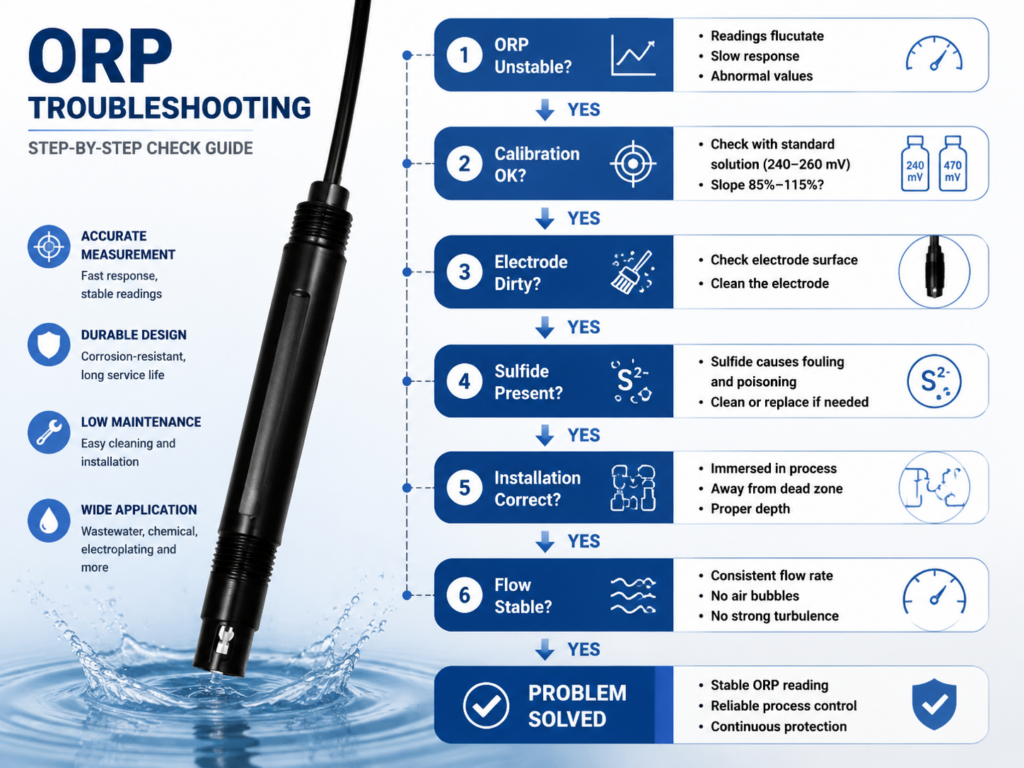
Before replacing an ORP electrode, inspect the entire measurement system.
Common symptoms and possible causes include:
| Problem | Possible Cause |
|---|---|
| Slow response | Fouled platinum surface |
| Constant low ORP | Sulfide contamination or poor installation |
| Reading drift | Dirty reference junction or aging sensor |
| Unstable readings | Poor water circulation, sludge buildup, air bubbles |
| Frequent cleaning | High suspended solids or incorrect installation |
In many cases, cleaning the electrode or improving the installation location restores normal operation.
From Our Field Experience:
The ORP Electrode Was Not Faulty—Poor Installation and Sulfide Fouling Were the Real Causes
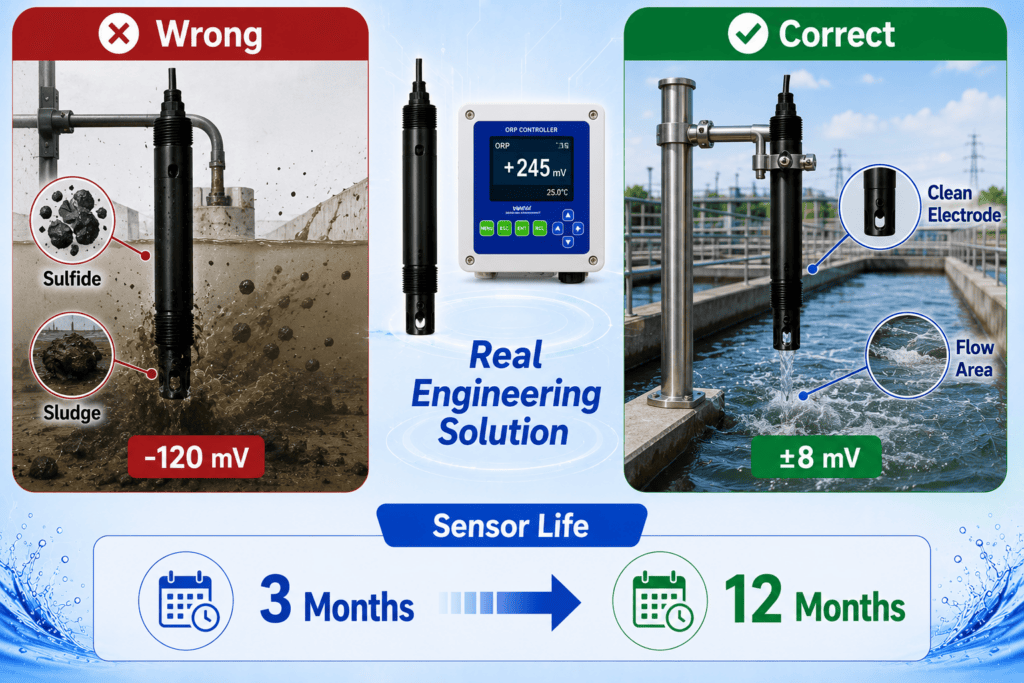
One municipal wastewater treatment plant contacted us because the ORP value remained below −120 mV, even though the biological process normally operated between −50 and −100 mV.
When influent conditions changed, the ORP reading responded very slowly, sometimes taking 20 to 30 minutes before showing any noticeable change.
The customer believed the platinum ORP electrode had failed and planned to replace the entire sensor.
Our engineers first tested the electrode.
Calibration results were normal, electrical inspection showed no fault, and the sensor itself remained functional.
The investigation then moved to the process conditions.
We discovered that the platinum sensing ring and reference junction were covered with a thick layer of black sulfide sludge.
At the same time, the installation tube had been positioned directly inside a sludge accumulation zone where almost no water movement existed.
Hydrogen sulfide continuously coated the platinum surface, while stagnant water prevented the sensor from contacting representative process water.
Instead of replacing the electrode, we recommended:
- Weekly cleaning using diluted hydrochloric acid to remove sulfide deposits.
- Rinsing the platinum sensing ring thoroughly after cleaning.
- Raising the installation position to approximately 1.2 meters below the water surface.
- Relocating the sensor away from sludge accumulation into an area with continuous water circulation.
After the improvements:
- ORP drift decreased to within ±8 mV.
- Sensor service life increased from 3 months to 12 months.
- Electrode replacement costs were reduced by approximately 75%.
This project highlights an important engineering lesson: unstable ORP readings are often caused by installation conditions and electrode fouling rather than sensor failure. Before replacing an ORP electrode, always inspect the sensing surface, reference junction, and installation location.
Frequently Asked Questions
What is the normal ORP range?
The appropriate ORP value depends on the application.
For example, municipal wastewater denitrification commonly operates under negative ORP conditions, while drinking water disinfection usually requires positive ORP values.
Always follow the process requirements rather than targeting a universal ORP value.
How often should an ORP electrode be cleaned?
Cleaning frequency depends on water quality.
Municipal wastewater applications usually require more frequent inspection because sludge and sulfide deposits can accumulate on the sensing surface.
Preventive cleaning generally produces more stable measurements than waiting until readings become abnormal.
How long does an industrial ORP electrode last?
Service life depends on the process environment, maintenance, and installation.
With proper cleaning and correct installation, many industrial ORP electrodes operate reliably for one year or longer.
Why is my ORP reading unstable?
Common causes include:
- Sulfide contamination
- Sludge accumulation
- Poor water circulation
- Incorrect installation location
- Dirty reference junction
Most unstable readings are caused by process conditions rather than sensor failure.
Can an ORP electrode measure pH?
No.
Although ORP and pH electrodes have similar appearances, they measure different parameters.
An ORP electrode measures oxidation-reduction potential, while a pH electrode measures hydrogen ion concentration.
Conclusion
Selecting the right ORP electrode is essential for reliable oxidation-reduction monitoring and automatic process control.
As the engineering examples in this guide demonstrate, long-term performance depends not only on sensor quality but also on selecting the correct electrode, installing it in the right location, and following a preventive maintenance program.
A properly selected and maintained ORP monitoring system improves process stability, reduces chemical consumption, lowers maintenance costs, and helps facilities achieve consistent regulatory compliance.
About ORP Monitoring Solutions
Reliable ORP monitoring is widely used in municipal wastewater treatment, drinking water disinfection, chemical processing, electroplating, and industrial water treatment. Achieving stable ORP measurements requires the right electrode material, proper installation, and application-specific engineering support.
Wuxi Wohuan Instrument provides industrial ORP electrodes, ORP analyzers, multi-parameter water quality analyzers, and complete online monitoring systems. With extensive field experience across municipal and industrial water treatment projects, our engineering team helps customers improve process control while reducing chemical consumption, maintenance costs, and equipment downtime.
Need Help Choosing the Right ORP Electrode?
Selecting the right ORP electrode depends on your process chemistry, installation conditions, maintenance capability, and automation requirements.
Whether you are upgrading an existing monitoring system or designing a new treatment project, choosing the right sensor can improve process control while reducing operating costs.
Explore Related Solutions
Explore our Industrial ORP Analyzers and Online Water Quality Monitoring Solutions for wastewater, drinking water, and industrial process applications.
You can also compare our pH Electrodes, Dissolved Oxygen Analyzers, Conductivity Meters, and Residual Chlorine Analyzers to build a complete online monitoring system.
If you’re unsure which ORP electrode is right for your application, our engineering team can recommend the best solution based on your operating conditions.
Request a Free Consultation
Please provide:
- Application
- Water quality
- Process purpose
- Installation method
- Temperature
- Communication requirements
Our engineers will recommend the most suitable ORP electrode and monitoring solution for your project.