Introduction
Residual chlorine monitoring plays a critical role in maintaining water safety, process stability, and efficient disinfection control.
After chlorination, a certain amount of chlorine must remain in water to prevent microbial regrowth throughout storage and distribution systems. However, maintaining the correct chlorine level is a continuous challenge.
If residual chlorine is too low:
- Disinfection performance may decrease.
- Microorganisms can grow in pipelines or storage tanks.
- Water quality risks may increase.
If residual chlorine is too high:
- Chemical consumption increases.
- Operating costs rise.
- Excess chlorine may affect equipment and water quality.
For many facilities, the challenge is not simply measuring residual chlorine.
The key challenge is obtaining continuous, reliable, and actionable data that helps operators maintain stable chlorine control.
Traditional testing methods, such as manual sampling and portable chlorine meters, can provide useful verification results. However, they only capture chlorine conditions at specific moments and may miss rapid changes between measurements.
As water treatment systems become more automated, many facilities are moving toward inline residual chlorine analyzers that provide continuous monitoring, automatic data recording, and integration with chlorine dosing systems.
This guide explains the differences between inline and portable residual chlorine analyzers, how to choose the right monitoring solution, and real application experience from industrial water treatment projects.
Quick Answer: Inline or Portable Residual Chlorine Analyzer?
The choice between an inline residual chlorine analyzer and a portable chlorine meter depends on your monitoring requirements.
Choose an inline residual chlorine analyzer when you need:
- 24/7 continuous monitoring
- Automatic chlorine dosing control
- Real-time data recording
- PLC or SCADA integration
- Stable process management
Choose a portable residual chlorine meter when you need:
- Field inspection
- Temporary measurements
- Laboratory verification
- Multiple sampling points
Portable meters are useful for checking water quality conditions, but they cannot replace continuous monitoring when a system requires automatic control and long-term data management.
For drinking water plants, industrial cooling water systems, and process applications, inline monitoring is usually the better choice when chlorine control directly affects safety, equipment protection, or operating costs.
What Is a Residual Chlorine Analyzer and Why Does It Matter?
A residual chlorine analyzer is an instrument designed to continuously or periodically measure chlorine concentration remaining in treated water.
Unlike manual chemical testing, an online analyzer provides continuous measurement data that helps operators understand chlorine changes over time.
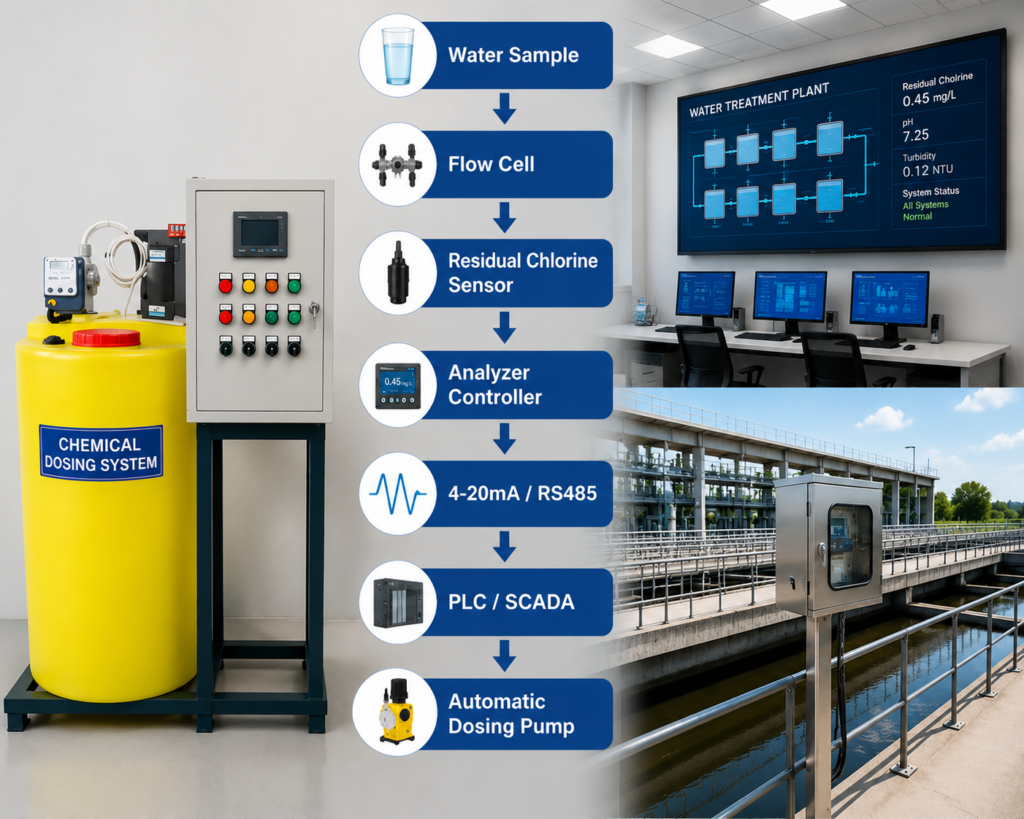
A complete residual chlorine monitoring system usually includes:
- Residual chlorine sensor
- Sampling system or flow cell
- Analyzer controller
- Communication module
- Automatic dosing equipment
The analyzer measures chlorine concentration and sends the data to the control system.
Based on real-time measurements, the system can automatically adjust chlorine dosing to maintain the target range.
Why Continuous Monitoring of Residual Chlorine Is Critical
Residual chlorine levels are not constant.
They can change due to:
- Water flow variation
- Temperature changes
- Organic matter concentration
- Microbial activity
- Chlorine demand fluctuations
- Pipeline conditions
A manual measurement only represents the chlorine level at a specific moment.
For example, if operators test chlorine twice per day, significant changes may occur between measurements without being detected.
This creates several risks:
- Temporary chlorine deficiency
- Excess chemical dosing
- Unstable disinfection performance
- Increased operating costs
Continuous residual chlorine monitoring provides operators with real-time visibility.
It allows facilities to:
- Detect chlorine changes quickly.
- Adjust chemical dosing more accurately.
- Maintain stable water quality.
- Reduce unnecessary chemical consumption.
For automated water treatment systems, residual chlorine monitoring is not only a measurement process. It is an important part of the control system.
Common Applications of Residual Chlorine Analyzers
Residual chlorine analyzers are used in many industries where stable disinfection control is required.
Different applications have different monitoring goals.
Drinking Water Treatment
In municipal water systems, residual chlorine monitoring ensures that treated water maintains effective disinfection throughout the distribution network.
Common monitoring points include:
- Finished water outlet
- Storage tanks
- Distribution pipelines
The main objectives are:
- Maintaining safe chlorine levels
- Meeting regulatory requirements
- Reducing chemical waste
Wastewater Treatment and Water Reuse
Residual chlorine monitoring is also important in wastewater reuse systems.
After disinfection, treated water may require controlled chlorine levels before reuse or discharge.
Continuous monitoring helps operators maintain:
- Stable disinfection performance
- Reliable reuse water quality
- Accurate chemical dosing
Industrial Process Water
Industrial facilities often require chlorine monitoring to control microbial growth and protect equipment.
Applications include:
- Cooling water systems
- Heat exchanger protection
- Process water treatment
- Food and beverage production
In these applications, excessive chlorine can increase corrosion risks, while insufficient chlorine may lead to biological growth.
Therefore, precise chlorine control is essential.
From Our Field Experience:
How a Food and Beverage Plant Improved Cooling Water Control with an Inline Residual Chlorine Analyzer
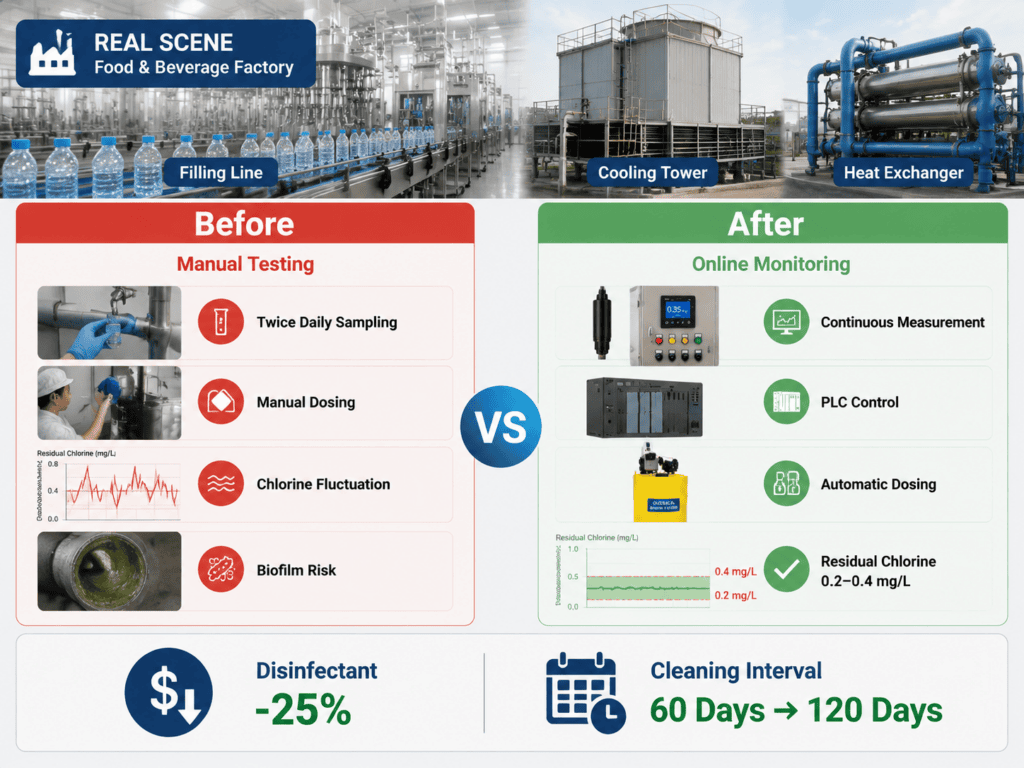
Residual chlorine monitoring is not only important for drinking water safety. In industrial applications, it also helps control microbial growth and maintain equipment reliability.
We worked with a large food and beverage processing plant where the cooling water system supplied the filling line and refrigeration heat exchangers.
The main purpose of residual chlorine monitoring was to:
- Control bacteria and algae growth.
- Prevent biological slime formation on heat exchanger surfaces.
- Maintain heat transfer efficiency.
- Avoid excessive chlorine that could accelerate pipeline corrosion.
Before the upgrade, operators performed manual sampling twice per day and used test strips for chlorine measurement.
Chemical dosing was adjusted manually based on operator experience.
However, manual testing created several challenges.
Because measurements were only taken at fixed intervals, chlorine fluctuations could not be detected immediately.
When chlorine levels were too low:
- Biological films could form.
- Heat exchanger efficiency could decrease.
- Microbial contamination risks could increase.
When chlorine levels were too high:
- Chemical consumption increased.
- Equipment corrosion risks became higher.
The plant installed an inline residual chlorine analyzer and connected the measurement signal to the PLC system for automatic dosing control.
After implementation:
- Residual chlorine was continuously controlled within 0.2–0.4 mg/L.
- Disinfectant consumption decreased by approximately 25%.
- Heat exchanger cleaning intervals increased from 60 days to 120 days.
- Cooling system operation became more stable and met food industry hygiene requirements.
This project demonstrated that online residual chlorine monitoring helps industrial users achieve more precise chemical control while reducing maintenance costs.
Inline vs Portable Residual Chlorine Analyzer
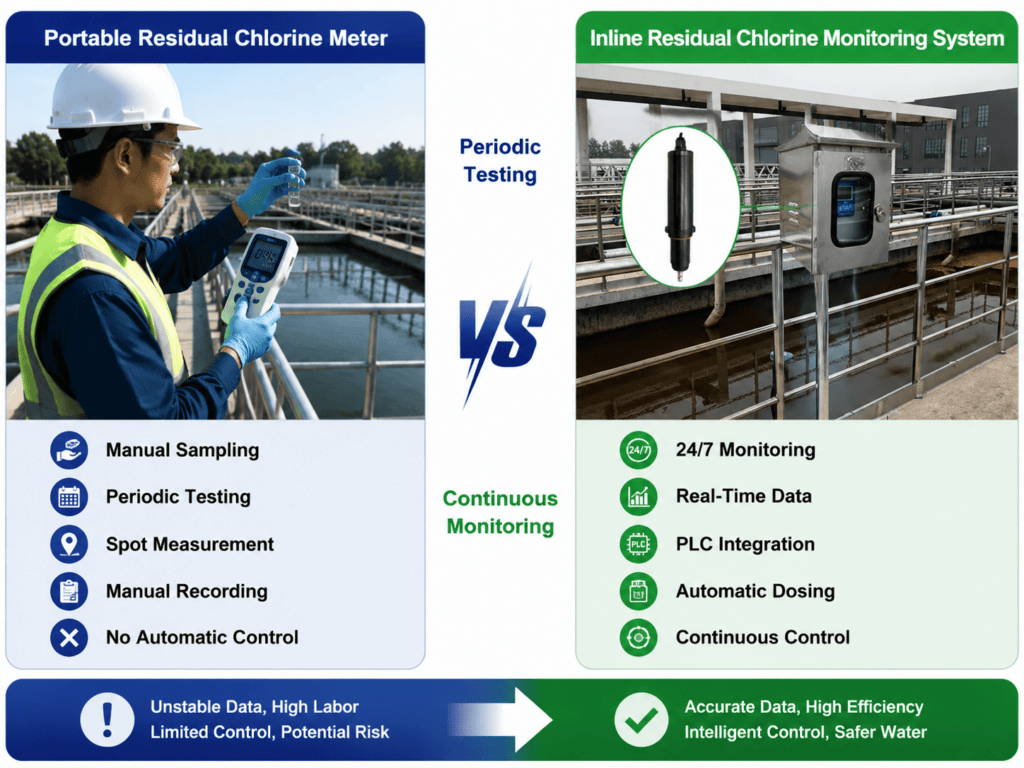
Choosing between an inline residual chlorine analyzer and a portable chlorine meter depends on the monitoring objective.
Both methods can measure residual chlorine, but they serve different purposes.
A portable meter is mainly used for field inspection and verification, while an inline residual chlorine analyzer is designed for continuous monitoring and automatic process control.
The key difference is:
Portable testing tells you the chlorine level at one specific moment.
Inline monitoring shows how chlorine concentration changes over time and enables automatic control.
Inline Residual Chlorine Analyzer
An inline residual chlorine analyzer is installed directly into a water monitoring system and continuously measures chlorine concentration.
It is commonly integrated with:
- Sampling systems
- Flow cells
- Controllers
- PLC systems
- Automatic dosing pumps
The analyzer continuously collects chlorine data and provides real-time feedback for process adjustment.
Advantages of Inline Chlorine Monitoring
1. 24/7 Continuous Measurement
The biggest advantage of an inline analyzer is continuous monitoring.
Unlike manual sampling, which only provides periodic data, inline systems continuously track chlorine changes.
This helps operators:
- Detect abnormal chlorine fluctuations quickly.
- Prevent insufficient disinfection.
- Avoid excessive chlorine dosing.
- Maintain stable water quality.
For applications with strict process control requirements, continuous measurement is essential.
2. Automatic Chlorine Dosing Control
Inline residual chlorine analyzers can connect directly with automatic dosing systems.
The control process works as follows:
Water sample measurement
↓
Residual chlorine analyzer
↓
Controller output
↓
Dosing pump adjustment
↓
Maintain target chlorine concentration
This closed-loop control method improves chemical dosing accuracy.
Compared with manual adjustment, automatic control can reduce:
- Chemical waste
- Operator workload
- Process fluctuations
3. Data Recording and Remote Monitoring
Modern residual chlorine monitoring systems can integrate with:
- PLC
- SCADA
- Industrial networks
- Remote monitoring platforms
This allows users to:
- Store historical data.
- Analyze chlorine trends.
- Set alarm limits.
- Monitor operation remotely.
For industrial facilities, continuous data records also help with process optimization and compliance management.
Portable Residual Chlorine Meter
Portable residual chlorine meters are handheld instruments used for manual testing.
They are commonly applied in:
- Field inspection
- Routine sampling
- Laboratory comparison
- Temporary monitoring points
Operators collect water samples and measure chlorine concentration manually.
Advantages of Portable Chlorine Meters
1. Flexible Measurement Locations
Portable meters can be used at different locations without fixed installation.
They are suitable for:
- Pipeline inspection
- Storage tank testing
- Multiple sampling points
- Emergency measurements
2. Lower Initial Investment
Compared with a complete online monitoring system, portable meters require less equipment investment.
They are suitable when:
- Measurement frequency is low.
- Automatic control is not required.
- Testing is mainly for verification.
3. Simple Operation
Portable testing usually involves:
- Collecting a water sample.
- Adding testing reagent.
- Measuring chlorine concentration.
- Recording the result.
For small-scale applications, portable instruments remain a practical solution.
Inline vs Portable Residual Chlorine Analyzer Comparison
| Feature | Inline Residual Chlorine Analyzer | Portable Residual Chlorine Meter |
|---|---|---|
| Measurement Method | Continuous monitoring | Manual sampling |
| Data Frequency | 24/7 real-time measurement | Individual measurements |
| Automatic Dosing | Supported | Not available |
| PLC/SCADA Integration | Available | Usually unavailable |
| Data Storage | Automatic | Manual recording |
| Labor Requirement | Low | Higher |
| Installation | Fixed system | Flexible use |
| Best Application | Continuous process control | Inspection and verification |
When Should You Choose an Inline Residual Chlorine Analyzer?
An inline analyzer is recommended when:
- Water quality must be monitored continuously.
- Chlorine dosing requires automatic adjustment.
- Data recording is required.
- Process changes frequently.
- Manual testing cannot provide enough information.
Typical applications include:
- Municipal water supply
- Industrial cooling water
- Food processing water systems
- Water reuse systems
- Large swimming pool systems
When Is a Portable Residual Chlorine Meter Suitable?
Portable meters are suitable when:
- Testing frequency is low.
- Operators only need spot checks.
- Multiple locations require temporary measurement.
- The system does not require automatic control.
For example:
A maintenance team may use a portable chlorine meter to verify different points in a distribution network, while an inline analyzer continuously monitors the main process line.
How a Chlorine Monitoring System Integrates with Plant Automation
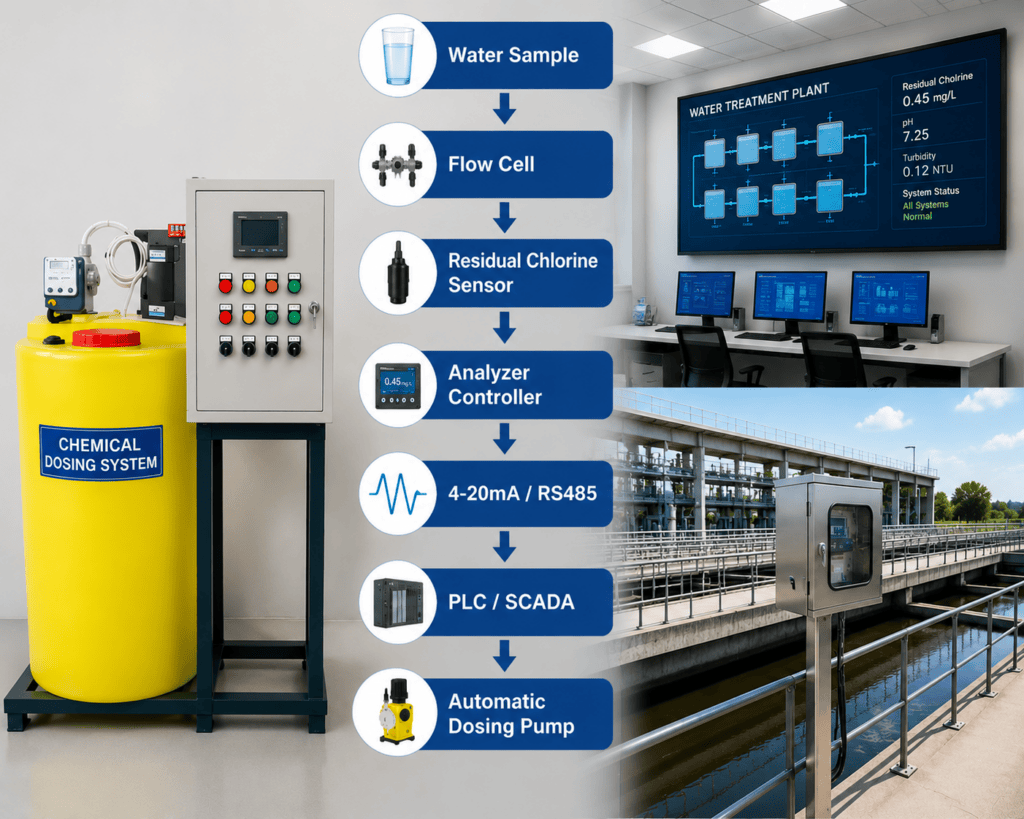
For industrial applications, the value of an inline residual chlorine analyzer is not only measurement accuracy.
The real advantage comes from integration with the entire control system.
A complete chlorine monitoring system typically includes:
- Residual chlorine sensor
- Flow cell or sampling assembly
- Display controller
- Signal output module
- PLC communication
- Automatic dosing equipment
The monitoring process works like this:
Water sample
↓
Residual chlorine sensor measurement
↓
Analyzer calculates chlorine concentration
↓
4–20 mA / RS485 signal transmission
↓
PLC receives data
↓
Dosing pump adjusts chemical addition
↓
Stable chlorine control
This closed-loop system allows facilities to move from manual adjustment to automatic process management.
From Our Field Experience:
Why an Industrial Park Upgraded from Portable Testing to Continuous Residual Chlorine Monitoring
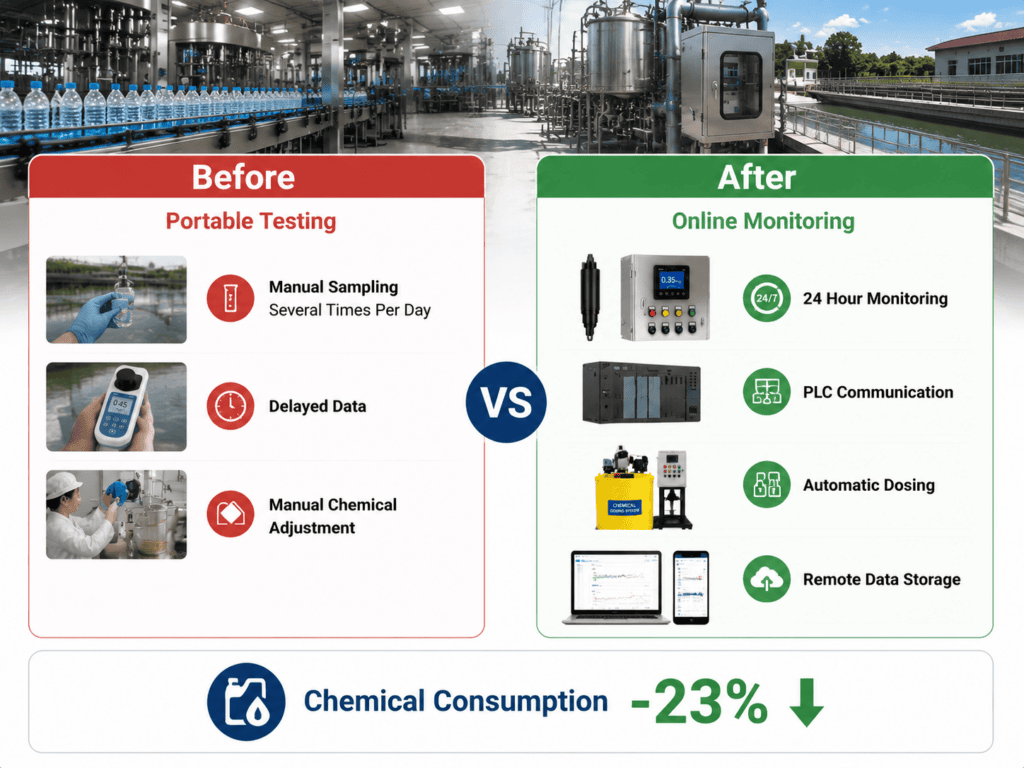
Portable chlorine meters are useful for routine inspection, but they cannot replace continuous monitoring when a system requires automatic control and long-term data management.
We worked with an industrial park centralized cooling water operation company responsible for industrial circulating cooling water management.
The system required:
- 24-hour continuous chlorine monitoring.
- Automatic dosing control through analyzer signals.
- Long-term data storage.
- Remote monitoring capability.
Before the upgrade, operators relied on portable instruments for several manual inspections every day.
However, this method created several limitations:
- Measurement intervals were too long to capture sudden chlorine changes.
- Manual records could not provide continuous operating data.
- Chemical dosing depended heavily on operator experience.
- Temporary chlorine shortage or excessive chlorine levels were difficult to detect quickly.
The company upgraded to a complete online residual chlorine monitoring system, including:
- Online residual chlorine sensor.
- Flow cell assembly.
- Secondary display controller.
- 4–20 mA signal output module.
- Automatic dosing pump integration.
- PLC communication system.
After installation:
- The system achieved continuous 24-hour data collection.
- Disinfectant consumption decreased by approximately 23%.
- Manual sampling frequency was significantly reduced.
- Residual chlorine concentration remained stable within the target range.
- Biological growth was effectively controlled, improving cooling system reliability.
This project demonstrated that for industrial cooling water systems, continuous online residual chlorine monitoring provides better process control than periodic portable testing.
How to Choose the Right Residual Chlorine Analyzer
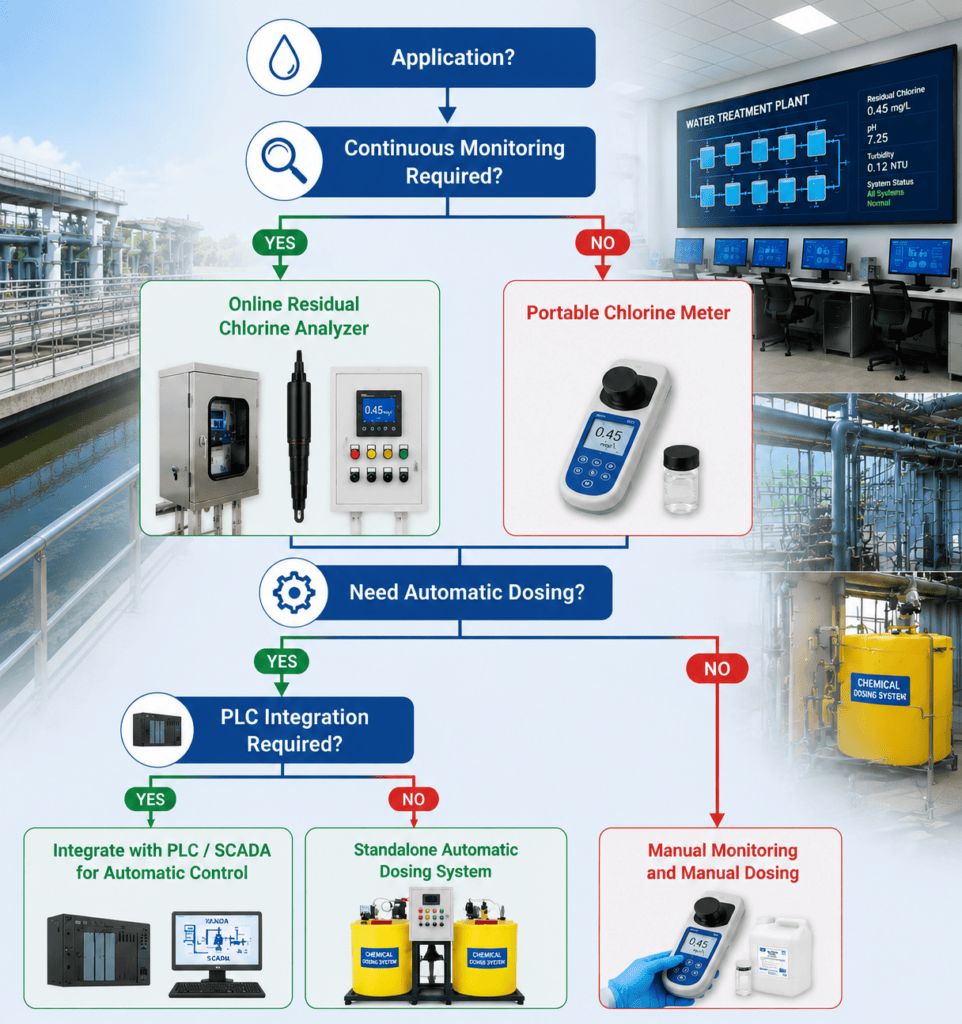
Selecting the right residual chlorine analyzer requires more than comparing product specifications.
The best solution depends on:
- Application requirements
- Water quality conditions
- Monitoring objectives
- Installation environment
- Automation requirements
- Maintenance expectations
A suitable analyzer should not only provide accurate chlorine measurement but also integrate effectively with the overall water treatment process.
Key Factors to Consider When Selecting a Residual Chlorine Analyzer
1. Measurement Application
The first step is identifying where the analyzer will be used.
Different applications have different requirements.
Drinking Water
Main requirements:
- Stable chlorine measurement
- Regulatory compliance
- Continuous safety monitoring
- Reliable data recording
Typical locations:
- Finished water outlet
- Storage tanks
- Distribution networks
Industrial Cooling Water
Main requirements:
- Microbial control
- Chemical dosing optimization
- Equipment protection
Important considerations:
- Variable water conditions
- Continuous operation
- Automatic dosing control
Food and Beverage Water Systems
Main requirements:
- Hygiene control
- Stable disinfection
- Prevention of microbial contamination
The monitoring system must balance:
- Effective sterilization
- Chemical consumption
- Equipment protection
2. Sensor Technology and Measurement Method
Different residual chlorine analyzers use different measurement technologies.
The selected technology should match the application conditions.
Important considerations include:
- Water quality stability
- Maintenance requirements
- Required accuracy
- Operating environment
For applications requiring continuous monitoring and automatic control, online sensor systems are usually preferred.
3. Installation Conditions
Installation quality directly affects measurement reliability.
Important factors include:
Sampling Method
The analyzer requires a representative water sample.
Poor sampling conditions may cause:
- Incorrect readings
- Slow response
- Measurement instability
Flow Stability
Stable sample flow helps maintain consistent sensor conditions.
Large flow fluctuations may result in:
- Signal variation
- Unstable measurement
- Incorrect chlorine values
Air Bubble Interference
Air bubbles contacting the sensor surface may affect measurement signals.
Proper installation should avoid:
- Excessive turbulence
- Bubble accumulation
- Unstable flow conditions
4. Communication and Automation Requirements
For industrial applications, communication capability is an important selection factor.
Common options include:
- 4–20 mA output
- RS485 communication
- Modbus protocol
- PLC integration
- SCADA monitoring
If the analyzer will control chlorine dosing automatically, communication compatibility should be confirmed before selection.
5. Maintenance Requirements
Different applications require different maintenance strategies.
Before choosing an analyzer, consider:
- Cleaning frequency
- Calibration requirements
- Sensor replacement cycle
- Operator workload
For facilities requiring minimum maintenance, a complete system design including proper installation and sampling conditions is often more important than the analyzer itself.
Residual Chlorine Analyzer Installation and Calibration Guide
Proper installation and calibration are essential for reliable chlorine measurement.
Even a high-quality analyzer may provide unstable readings if installation conditions are incorrect.
Installation Recommendations
Before installation, confirm:
- Correct measurement location
- Stable water flow
- Proper sensor immersion
- Easy maintenance access
- Reliable sample conditions
Avoid installation locations with:
- Strong turbulence
- Air bubbles
- Dead zones
- Unrepresentative water samples
Calibration Recommendations
Regular calibration helps maintain measurement accuracy.
Common calibration steps include:
Zero Calibration
Used to verify the analyzer response when chlorine concentration is zero.
Span Calibration
Used to compare analyzer readings against a known chlorine concentration.
Laboratory Verification
Many facilities compare online analyzer results with laboratory DPD measurements.
When differences occur, check:
- Sampling conditions
- Testing method
- Calibration status
- Installation environment
before replacing the sensor.
Residual Chlorine Analyzer Maintenance Checklist
Regular maintenance helps improve reliability and extend service life.
Recommended inspection items include:
Sensor Condition
Check:
- Sensor surface contamination
- Response stability
- Physical damage
Sampling System
Check:
- Flow rate
- Tubing condition
- Filters
- Pumps
- Air bubbles
System Communication
Check:
- Signal output
- PLC connection
- Alarm functions
- Data recording
A complete monitoring system requires both a reliable analyzer and a stable operating environment.
Common Residual Chlorine Analyzer Problems and Troubleshooting
Problem 1: Residual Chlorine Reading Is Unstable
Possible causes:
- Unstable sample flow
- Air bubbles
- Sensor contamination
- Incorrect installation
- Calibration problems
Recommended actions:
- Check sampling conditions.
- Inspect sensor status.
- Verify calibration.
- Confirm installation location.
Problem 2: Online Reading Does Not Match Laboratory Results
Possible causes:
- Different sampling locations
- Different testing times
- Laboratory testing errors
- Analyzer calibration deviation
Recommended solution:
Compare both measurements under the same conditions before making adjustments.
Problem 3: Residual Chlorine Value Is Too Low
Possible causes:
- Insufficient chlorine dosing
- Sensor contamination
- Sampling problems
- Incorrect installation
Recommended actions:
- Check dosing system.
- Verify water flow.
- Clean sensor.
- Confirm calibration.
Frequently Asked Questions
What is the difference between an inline and portable residual chlorine analyzer?
An inline residual chlorine analyzer provides continuous measurement and can connect with automatic dosing systems.
A portable residual chlorine meter is designed for manual sampling and field verification.
When should I choose an online residual chlorine analyzer?
An online analyzer is recommended when you need:
- Continuous monitoring
- Automatic dosing control
- Data recording
- Remote monitoring
It is commonly used in drinking water plants, industrial cooling water, and process water applications.
Can portable chlorine meters replace online analyzers?
Portable meters are useful for inspection and verification.
However, they cannot replace online analyzers when continuous monitoring and automatic process control are required.
How can I improve residual chlorine measurement stability?
Measurement stability depends on:
- Correct analyzer selection
- Proper installation
- Stable sampling conditions
- Regular maintenance
Many measurement problems are caused by installation or sampling conditions rather than analyzer failure.
Conclusion
Choosing the right residual chlorine analyzer depends on your monitoring goals, application requirements, and operating environment.
Portable residual chlorine meters are suitable for:
- Field inspection
- Manual verification
- Temporary measurements
Inline residual chlorine analyzers are better suited for:
- Continuous monitoring
- Automatic dosing control
- Industrial process management
- Long-term data recording
For modern water treatment systems, reliable chlorine monitoring requires more than accurate measurement.
A complete solution should include the right analyzer, suitable installation conditions, stable sampling, proper communication, and effective maintenance strategies.
Residual Chlorine Monitoring Solutions
Reliable residual chlorine monitoring depends on more than selecting the right analyzer.
Successful projects require suitable measurement technology, sampling conditions, installation methods, and maintenance strategies.
Wuxi Wohuan Instrument provides complete residual chlorine monitoring solutions, including:
- Online residual chlorine analyzers
- Portable residual chlorine meters
- Residual chlorine sensors
- Flow cell sampling systems
- Automatic dosing control systems
- Online water quality monitoring systems
Our solutions are designed for:
- Drinking water treatment
- Industrial cooling water
- Food and beverage processing
- Industrial water treatment
- Water reuse applications
Based on actual operating conditions, water quality characteristics, and process requirements, our engineering team helps customers select suitable residual chlorine monitoring solutions to improve measurement reliability, optimize chlorine dosing control, and reduce long-term operation and maintenance costs.
Need Help Choosing the Right Residual Chlorine Analyzer?
Selecting the right residual chlorine analyzer depends on more than measurement range.
The most suitable solution should consider:
- Application or industry
- Water type
- Residual chlorine measurement range
- Installation method
- Sampling conditions
- Communication requirements
- Maintenance expectations
Whether you are upgrading an existing chlorine monitoring system or planning a new water quality monitoring project, our engineering team can help evaluate your application and recommend a suitable solution.
Explore Related Solutions
Learn more about water quality monitoring solutions for municipal and industrial applications.
Explore our:
- Online Residual Chlorine Analyzers
- Portable Residual Chlorine Meters
- pH Analyzers
- ORP Analyzers
- Dissolved Oxygen Analyzers
- Conductivity Analyzers
- Turbidity Analyzers
- Multi-Parameter Water Quality Monitoring Systems
Our engineering team can provide technical recommendations based on your process conditions, installation environment, and monitoring requirements.
Request a Free Consultation
Please provide the following information:
- Application or industry
- Water type
- Residual chlorine measurement range
- Installation method
- Sampling conditions
- Communication requirements
- Maintenance expectations
Our engineering team will recommend the most suitable residual chlorine monitoring solution for your project and provide professional technical support for reliable long-term operation.