Introduction
Residual chlorine is one of the most important parameters in water disinfection processes.
After chlorine is added to water, part of the chlorine reacts with microorganisms, organic matter, and other substances. The remaining available chlorine is called residual chlorine.
Maintaining the correct residual chlorine level is essential for balancing two goals:
- Ensuring effective disinfection.
- Avoiding excessive chlorine consumption and unnecessary chemical exposure.
If residual chlorine is too low:
- Bacteria and microorganisms may grow again.
- Water safety risks may increase.
- Disinfection performance may become unstable.
If residual chlorine is too high:
- Chemical consumption increases.
- Operating costs rise.
- Excess chlorine may affect equipment and downstream processes.
For many water treatment facilities, the challenge is not only measuring chlorine concentration.
The real challenge is achieving stable, continuous, and reliable chlorine monitoring that supports better process control.
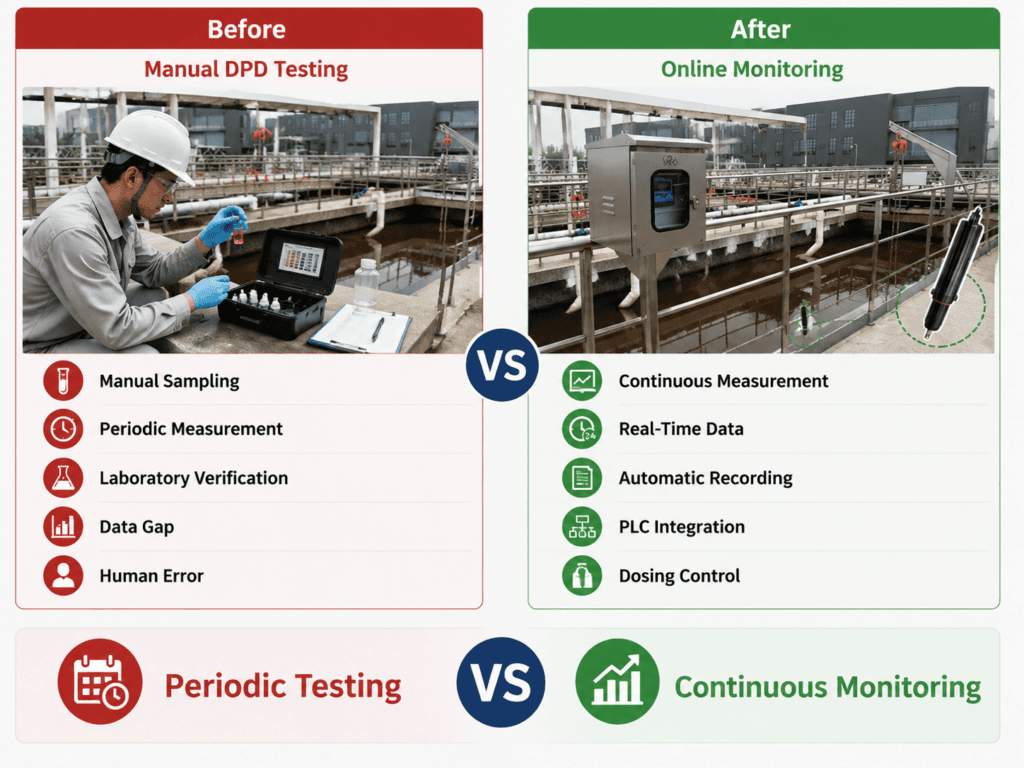
Traditional testing methods, such as DPD colorimetric testing, are still widely used for laboratory verification. However, manual testing only provides individual measurement points and cannot capture rapid chlorine changes between sampling intervals.
With increasing requirements for automation, data recording, and accurate chemical dosing, many facilities are adopting online residual chlorine analyzers and integrated chlorine monitoring systems.
This article explains what residual chlorine is, how it is measured, different types of chlorine analyzers, and how to select the right monitoring solution based on real engineering experience.
What Is Residual Chlorine?
Residual chlorine refers to the amount of chlorine remaining in water after the disinfection process.
During chlorination, chlorine reacts with microorganisms and contaminants to achieve disinfection. After these reactions, a certain amount of active chlorine remains in the water.
This remaining chlorine provides continuous protection against microbial growth during storage and transportation.
Residual chlorine is commonly divided into:
Free Residual Chlorine
Free chlorine mainly includes:
- Hypochlorous acid (HOCl)
- Hypochlorite ions (OCl⁻)
It provides strong disinfection capability and is the main parameter monitored in drinking water and many industrial applications.
Combined Residual Chlorine
Combined chlorine forms when chlorine reacts with:
- Ammonia
- Organic nitrogen compounds
- Other substances in water
Although combined chlorine still has some disinfecting ability, excessive levels may affect water quality and treatment performance.
Why Residual Chlorine Monitoring Matters
Residual chlorine concentration changes continuously depending on water conditions.
Factors affecting chlorine levels include:
- Water temperature
- pH value
- Organic matter concentration
- Microbial activity
- Flow conditions
- Chlorine dosage
Because these factors change over time, a single manual measurement cannot fully represent actual water conditions.
For example:
A facility may perform a chlorine test in the morning and obtain a normal result.
However, several hours later:
- Water demand may increase.
- Organic load may change.
- Chlorine consumption may rise.
Without continuous monitoring, operators may not discover the abnormal condition until the next manual test.
Benefits of Continuous Residual Chlorine Monitoring
A continuous chlorine monitoring system provides several advantages.
Real-Time Water Quality Information
Online residual chlorine analyzers continuously collect measurement data.
Operators can observe:
- Chlorine concentration trends.
- Sudden changes.
- Long-term operation patterns.
This improves response speed when abnormal conditions occur.
More Accurate Chemical Dosing
Residual chlorine monitoring can be connected with automatic dosing systems.
The control process becomes:
Water measurement
↓
Residual chlorine analyzer
↓
Controller
↓
Dosing pump adjustment
↓
Maintain target chlorine level
This helps avoid:
- Under-dosing
- Over-dosing
- Manual adjustment errors
Reduced Manual Testing Workload
Manual testing requires:
- Sample collection
- Reagent preparation
- Laboratory analysis
- Data recording
For facilities operating continuously, frequent manual testing increases labor requirements.
Online monitoring reduces routine testing workload while providing more complete operational data.
Residual Chlorine vs Free Chlorine: What Is the Difference?
Although the terms are often used together, they are not exactly the same.
Residual chlorine refers to the total remaining chlorine after disinfection.
Free chlorine refers specifically to the active chlorine available for disinfection.
In many drinking water and industrial applications, free chlorine is the main measurement target because it directly reflects current disinfection capability.
However, the appropriate measurement method depends on:
- Water quality
- Treatment process
- Regulatory requirements
- Application purpose
When Continuous Monitoring Makes Sense
Not every application requires a permanent online analyzer.
The decision depends on the importance of chlorine control.
Continuous monitoring is recommended when:
1. Chlorine Levels Directly Affect Safety
Examples:
- Drinking water treatment
- Water reuse systems
- Food processing water
In these applications, chlorine changes must be detected quickly.
2. Chemical Dosing Requires Automatic Control
When chlorine dosage is controlled automatically, the system requires continuous feedback.
Without real-time measurement, dosing systems cannot respond accurately to changing water conditions.
3. Water Conditions Change Frequently
Applications with unstable water quality often require continuous monitoring.
Examples:
- Industrial wastewater
- Cooling water systems
- Process water
Why Manual Testing Has Limitations
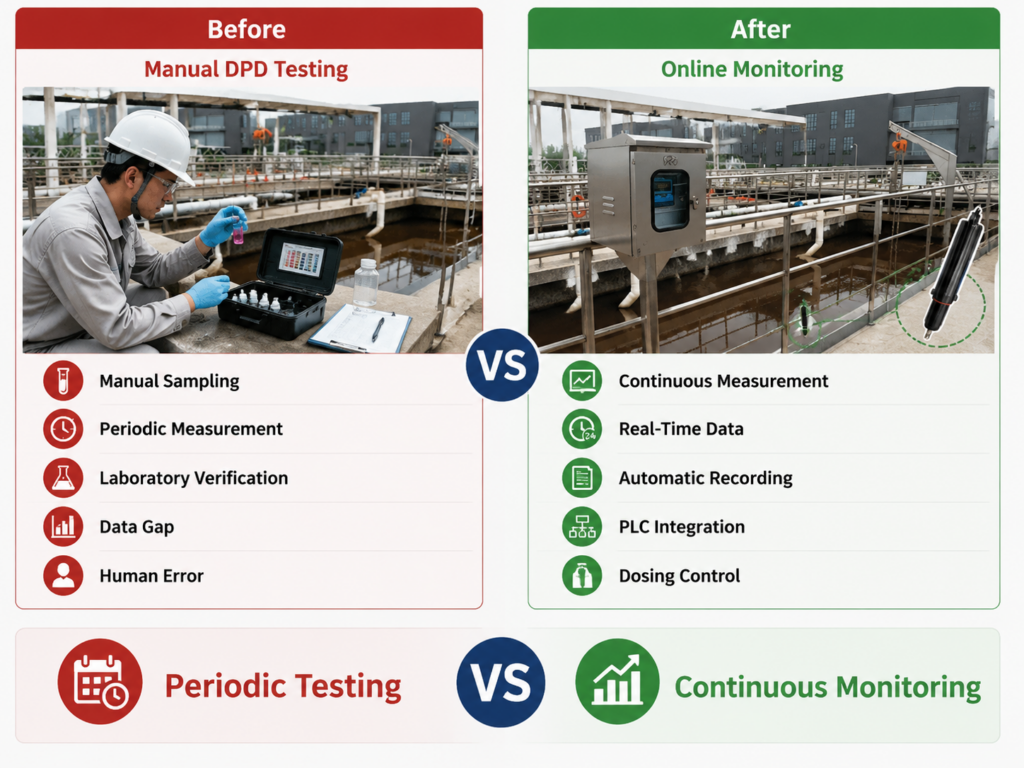
Manual methods such as DPD testing remain useful because they are simple and widely accepted.
However, they have limitations.
Measurement Frequency Is Limited
Manual testing only provides data at specific times.
Changes between tests may be missed.
Human Operation Affects Results
Manual testing involves:
- Sampling
- Reagent handling
- Color comparison
- Recording
Operator experience and testing conditions may influence results.
Cannot Directly Control Chemical Dosing
Manual testing provides information after sampling.
It cannot immediately adjust chlorine dosing.
For automated systems, online monitoring provides faster feedback.
How to Test Residual Chlorine in Wastewater
Residual chlorine testing in wastewater applications is more challenging than drinking water because wastewater often contains:
- Suspended solids
- Organic matter
- Variable chemical composition
- Potential sensor interference
Common testing methods include:
DPD Colorimetric Testing
DPD testing is one of the most common chlorine measurement methods.
The basic process:
- Collect water sample.
- Add DPD reagent.
- Develop color reaction.
- Compare chlorine concentration.
Advantages:
- Simple operation.
- Low equipment cost.
- Suitable for laboratory verification.
Limitations:
- Requires manual sampling.
- Cannot provide continuous data.
- Results depend on sampling conditions.
Online Residual Chlorine Analyzer
Online analyzers automatically measure chlorine concentration at regular intervals.
Typical systems include:
- Residual chlorine sensor
- Flow cell
- Controller
- Communication module
Advantages:
- Continuous monitoring.
- Automatic data recording.
- PLC/SCADA integration.
- Supports automatic dosing control.
From Our Field Experience:
The Chlorine Analyzer Was Accurate — The Sampling System Was the Real Problem
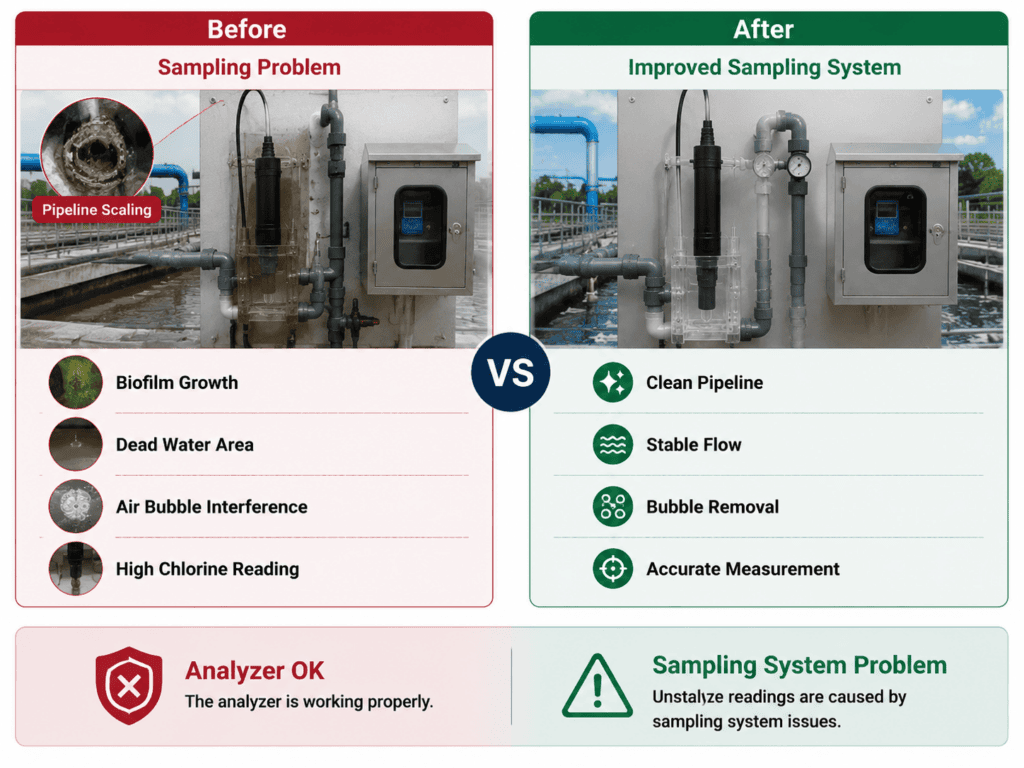
In wastewater applications, unstable residual chlorine readings are not always caused by analyzer failure.
We worked with a chemical enterprise wastewater treatment plant that monitored disinfected effluent before discharge.
The customer used an online residual chlorine analyzer together with:
- On-site DPD manual comparison.
- Laboratory verification testing.
However, the results showed a significant difference.
The manual and laboratory test results remained stable and within the required range, while the online analyzer continuously showed higher chlorine values.
Because the online data could not be trusted, operators frequently adjusted chlorine dosing based on incorrect readings, affecting discharge stability.
Our engineers performed a complete inspection and found that the analyzer itself was working correctly.
The actual problem came from the sampling system.
The wastewater contained suspended solids and organic matter. Over time:
- Deposits formed inside pipelines and the flow cell.
- Biofilm growth interfered with sensor measurement.
- Multiple pipe bends and dead zones slowed sample renewal.
- Small air bubbles entered the system and affected the signal.
The improvement included:
- Cleaning the sampling pipeline.
- Optimizing pipe routing.
- Removing dead water areas.
- Eliminating air bubble interference.
- Establishing regular maintenance procedures.
After adjustment:
- Online readings became consistent with manual and laboratory results.
- Frequent manual verification was no longer required.
- Chlorine dosing control became more stable.
This project demonstrated an important lesson:
Before replacing a residual chlorine analyzer, always check the complete measurement system, including sampling conditions and installation design.
Different Types of Chlorine Residual Analyzers
Choosing the right residual chlorine analyzer depends on the application requirements, water quality conditions, monitoring objectives, and automation needs.
Different measurement methods have different advantages.
The main categories include:
- Online residual chlorine analyzers
- Portable residual chlorine meters
- Amperometric residual chlorine analyzers
- Colorimetric residual chlorine analyzers
Understanding the differences helps users select the most suitable solution for their process.
Online Residual Chlorine Analyzer
An online residual chlorine analyzer is designed for continuous chlorine monitoring in water treatment processes.
The system is usually installed at a fixed monitoring point and continuously measures chlorine concentration.
A typical online monitoring system includes:
- Residual chlorine sensor
- Flow cell or sampling system
- Analyzer controller
- Signal output module
- PLC/SCADA communication
- Automatic dosing system
The analyzer continuously collects chlorine data and provides real-time feedback for process control.
Advantages of Online Residual Chlorine Monitoring
Continuous Measurement
The biggest advantage of an online analyzer is continuous monitoring.
Instead of checking chlorine levels several times per day, the system provides ongoing measurement data.
This helps operators:
- Detect chlorine changes quickly.
- Maintain stable disinfection.
- Reduce monitoring gaps.
- Improve process visibility.
Automatic Process Control
Online residual chlorine analyzers can be integrated with dosing systems.
The analyzer provides measurement feedback, and the control system adjusts chemical addition automatically.
This is especially valuable in applications where chlorine concentration directly affects:
- Product quality
- Equipment protection
- Regulatory compliance
- Operating costs
Remote Monitoring and Data Management
Modern online chlorine monitoring systems can support:
- 4–20 mA output
- RS485 communication
- Modbus protocol
- PLC integration
- SCADA systems
Operators can:
- Review historical data.
- Set alarm limits.
- Analyze chlorine trends.
- Monitor equipment remotely.
Portable Residual Chlorine Meter
Portable residual chlorine meters are handheld instruments mainly used for manual inspection and verification.
They are commonly applied in:
- Field testing
- Laboratory comparison
- Temporary monitoring locations
- Routine maintenance checks
The operator collects a water sample and performs measurement manually.
Advantages of Portable Chlorine Meters
Flexible Measurement Locations
Portable instruments can be used at different locations without fixed installation.
They are suitable for:
- Pipeline inspections
- Storage tank checks
- Multiple sampling points
- Emergency testing
Lower Initial Cost
Compared with a complete online monitoring system, portable meters require less investment.
They are practical when:
- Testing frequency is low.
- Automatic control is not required.
- Measurements are only needed occasionally.
Easy Operation
Portable testing usually follows a simple process:
- Collect water sample.
- Add reagent.
- Perform measurement.
- Record the result.
For basic inspection purposes, portable meters remain useful tools.
Amperometric Residual Chlorine Analyzer
Amperometric analyzers measure chlorine concentration through an electrochemical reaction.
The sensor detects chlorine-related current changes and converts them into concentration values.
Advantages:
- Fast response.
- Suitable for continuous measurement.
- Commonly used in industrial applications.
However, amperometric systems may require attention to:
- Sensor cleaning.
- Calibration.
- Membrane condition.
- Electrolyte maintenance.
Water quality conditions can also affect long-term stability.
Applications should be evaluated carefully when the water contains:
- High suspended solids.
- Organic contamination.
- Strong chemical interference.
Colorimetric Residual Chlorine Analyzer
Colorimetric analyzers measure chlorine concentration by adding chemical reagents and detecting color changes.
This method is similar to laboratory DPD testing but can be automated.
Advantages:
- Good measurement repeatability.
- Less affected by some electrochemical interference.
- Suitable for applications requiring chemical comparison methods.
Limitations include:
- Reagent consumption.
- More maintenance requirements.
- Additional chemical management.
Colorimetric systems are often used where high measurement reliability is required and reagent maintenance is acceptable.
Online Analyzer vs Portable Meter vs Different Measurement Methods
| Type | Main Application | Advantages | Limitations |
|---|---|---|---|
| Online Residual Chlorine Analyzer | Continuous process monitoring | Real-time data, automation, PLC integration | Higher initial investment |
| Portable Chlorine Meter | Field inspection | Flexible, low cost | Manual testing only |
| Amperometric Analyzer | Industrial continuous monitoring | Fast response, direct measurement | Requires maintenance under complex water conditions |
| Colorimetric Analyzer | Automated chemical analysis | Stable measurement method | Requires reagents |
How Chlorine Monitoring Systems Work
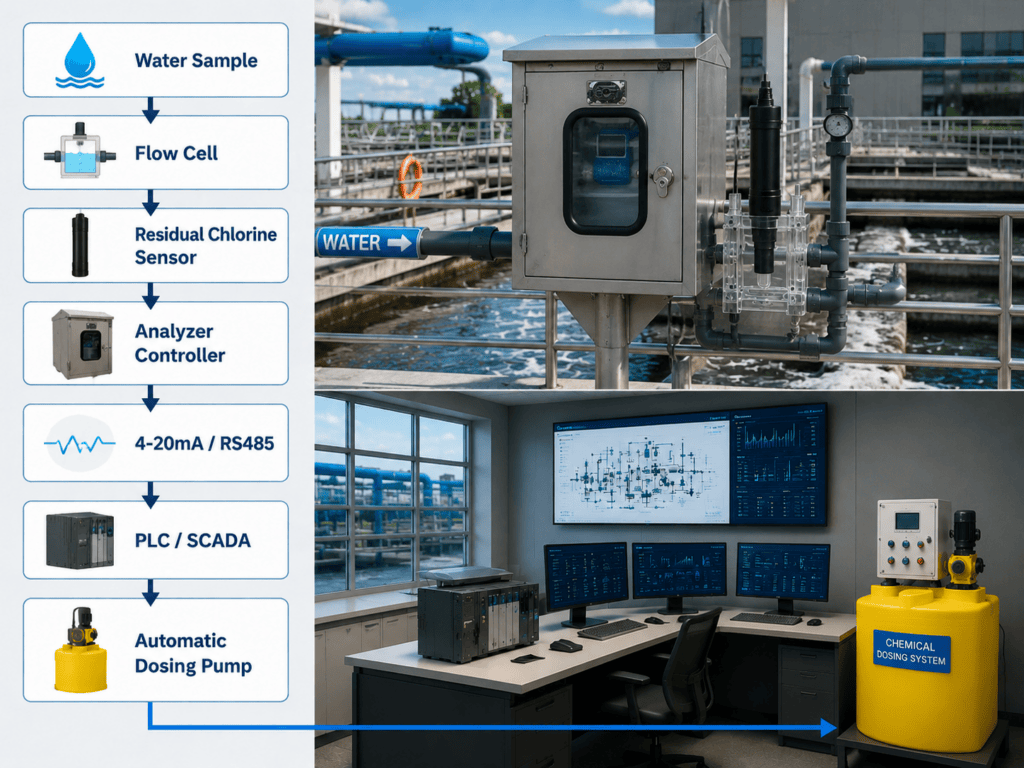
A complete chlorine monitoring system is more than a sensor.
It includes measurement, control, communication, and dosing components.
The working process:
Step 1: Water Sampling
The system collects a representative water sample.
Sampling quality directly affects measurement accuracy.
Important factors include:
- Stable flow.
- No air bubbles.
- Representative sampling point.
Step 2: Chlorine Measurement
The residual chlorine sensor measures the chlorine concentration.
The analyzer converts the sensor signal into a readable value.
Step 3: Data Transmission
The controller sends measurement data through communication interfaces.
Common communication methods include:
- 4–20 mA
- RS485
- Modbus
Step 4: Automatic Control
The PLC system compares the measured chlorine value with the target range.
If chlorine concentration is too low:
→ Increase dosing
If chlorine concentration is too high:
→ Reduce dosing
This creates a closed-loop control system.
How to Choose a Chlorine Monitoring System for Your Application
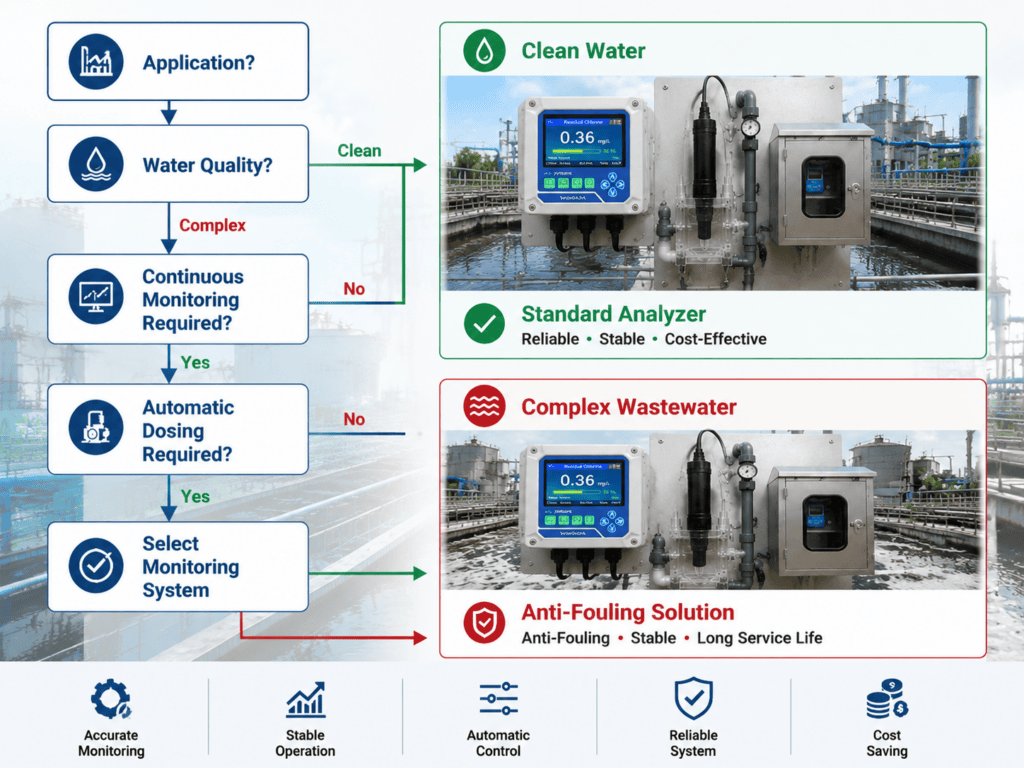
Choosing a chlorine monitoring system requires evaluating the complete application.
The right solution depends on:
- Water characteristics
- Monitoring purpose
- Required automation level
- Maintenance capability
- Installation environment
1. Drinking Water Applications
Main requirements:
- Stable measurement
- High reliability
- Regulatory compliance
- Continuous monitoring
Typical applications:
- Water treatment plants
- Distribution networks
- Storage tanks
2. Wastewater Applications
Wastewater monitoring usually has more challenges because water conditions can vary significantly.
Important considerations:
- Suspended solids
- Organic matter
- Turbidity
- Chemical interference
The system may require:
- Anti-fouling design
- Stable sampling system
- Regular maintenance strategy
3. Industrial Water Applications
Industrial applications often require chlorine monitoring for:
- Cooling water
- Process water
- Equipment protection
- Microbial control
The system should consider:
- Chemical compatibility
- Automation requirements
- Long-term stability
From Our Field Experience:
Selecting a Residual Chlorine Monitoring System for Complex Industrial Wastewater
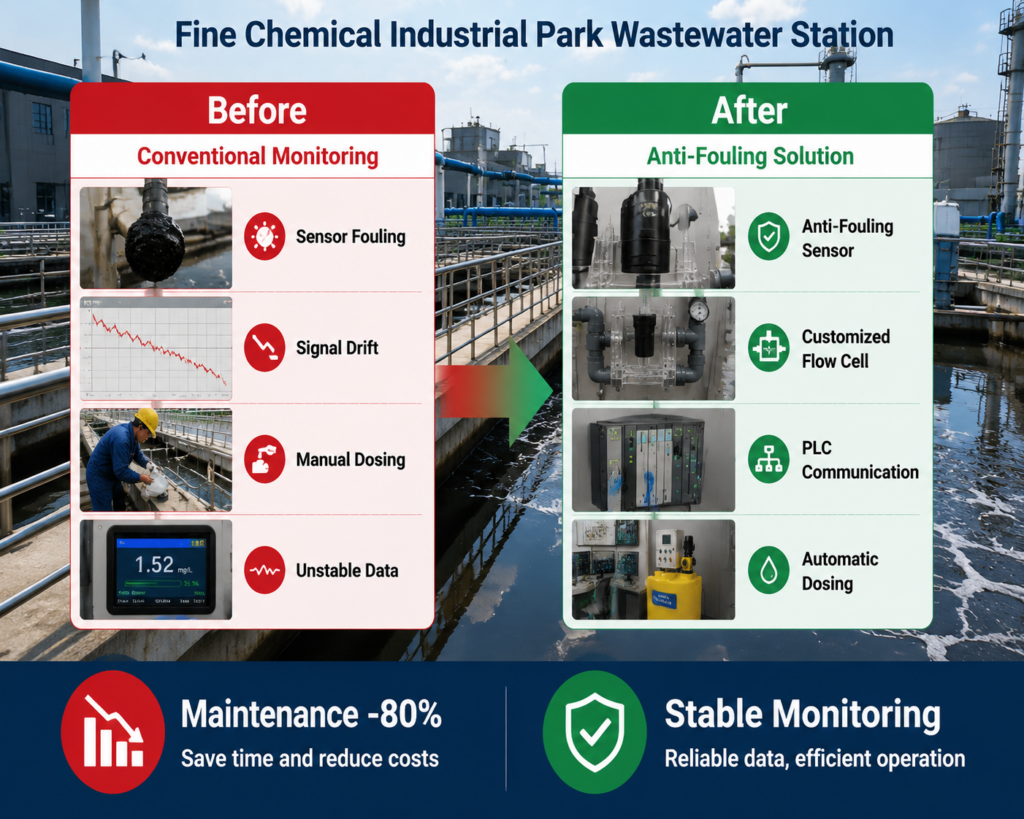
Industrial wastewater applications often require more than standard chlorine measurement.
We worked with a fine chemical industrial park wastewater treatment facility where residual chlorine monitoring was used for disinfected effluent before discharge and plant water reuse.
The wastewater had complex characteristics:
- High organic content.
- High turbidity.
- Suspended impurities.
- Large water quality fluctuations.
These conditions created high requirements for analyzer stability and contamination resistance.
Before the upgrade, the facility used a conventional online residual chlorine analyzer combined with manual DPD testing.
However, several problems occurred:
- Sensor contamination happened frequently.
- Measurement drift developed quickly.
- Chlorine readings fluctuated significantly.
- Automatic dosing control could not be achieved.
Because the chlorine data was unreliable, operators had to manually adjust chemical dosing based on experience.
This caused:
- Excessive chlorine consumption.
- Insufficient disinfection risks.
- Higher operating uncertainty.
To solve these problems, we provided a complete residual chlorine monitoring solution including:
- Anti-fouling online residual chlorine analyzer.
- Customized flow cell system.
- Automatic dosing integration.
- PLC communication.
The upgraded system provided:
- Better contamination resistance for complex wastewater.
- More stable sample flow conditions.
- Reduced interference from suspended materials.
- Automatic closed-loop chlorine dosing control.
After implementation:
- Manual maintenance workload decreased by more than 80%.
- Chemical consumption was reduced through more accurate dosing.
- Measurement data remained stable without abnormal fluctuations.
- Effluent quality met environmental monitoring requirements with a 100% qualified rate.
This project demonstrated that complex industrial wastewater requires not only an accurate residual chlorine analyzer, but also a complete monitoring system designed for actual water conditions.
Residual Chlorine Analyzer Installation, Calibration, and Maintenance Guide
A reliable residual chlorine monitoring system depends not only on the analyzer itself but also on correct installation, sampling conditions, calibration, and maintenance.
In many practical applications, measurement problems are not caused by the sensor technology itself.
They are often related to:
- Incorrect installation location.
- Unstable sample flow.
- Air bubble interference.
- Poor maintenance practices.
- Improper calibration.
A complete monitoring strategy should consider the entire measurement process.
Residual Chlorine Analyzer Installation Guidelines
Proper installation is the foundation of stable chlorine measurement.
Before installing an online residual chlorine analyzer, several factors should be evaluated.
1. Select a Representative Sampling Point
The measurement point should represent the actual water condition.
A suitable location should have:
- Stable water quality.
- Continuous water flow.
- Good mixing conditions.
- Easy maintenance access.
Avoid locations with:
- Dead zones.
- Stagnant water.
- Excessive turbulence.
- Unrepresentative water samples.
An incorrect sampling point may cause inaccurate readings even when the analyzer is functioning normally.
2. Maintain Stable Sample Flow
Stable flow conditions are important for consistent measurement.
Problems caused by unstable flow include:
- Signal fluctuation.
- Slow response.
- Measurement deviation.
A properly designed flow cell or sampling system helps maintain:
- Constant flow rate.
- Stable contact between water and sensor.
- Reduced measurement interference.
3. Prevent Air Bubble Interference
Air bubbles can affect chlorine measurement stability.
Common causes include:
- Improper pipe routing.
- Excessive turbulence.
- Pump suction problems.
- Poor venting design.
Recommended solutions:
- Install bubble removal devices.
- Avoid sharp pipe bends.
- Maintain stable pressure conditions.
- Ensure the sensor surface remains fully contacted by water.
Residual Chlorine Analyzer Calibration
Regular calibration ensures measurement accuracy.
Calibration frequency depends on:
- Water quality.
- Measurement method.
- Operating environment.
- Required accuracy.
Zero Calibration
Zero calibration verifies analyzer response when chlorine concentration is zero.
It helps confirm:
- Sensor baseline stability.
- Signal accuracy.
- Instrument condition.
Span Calibration
Span calibration compares analyzer readings with a known chlorine concentration.
It helps correct measurement deviation and maintain reliable results.
Laboratory Verification
Many facilities compare online analyzer readings with laboratory DPD measurements.
However, differences do not always indicate analyzer failure.
Before replacing equipment, check:
- Sampling conditions.
- Sample transportation time.
- Testing method.
- Calibration status.
Residual Chlorine Analyzer Maintenance Tips
Regular maintenance improves measurement reliability and extends service life.
1. Clean the Sensor Regularly
Contamination can affect sensor response.
Common contaminants include:
- Suspended solids.
- Organic deposits.
- Biofilm.
- Scale.
Cleaning frequency depends on water quality.
Applications with high contamination levels usually require more frequent inspection.
2. Inspect the Sampling System
The sampling system is one of the most important parts of online chlorine monitoring.
Regular checks should include:
- Flow rate.
- Pipeline condition.
- Filter status.
- Pump operation.
- Air bubble presence.
A clean and stable sampling system helps the analyzer provide reliable data.
3. Check Communication and Control Functions
For systems connected with automation, verify:
- 4–20 mA signal output.
- RS485 communication.
- PLC data transmission.
- Alarm functions.
- Automatic dosing response.
A monitoring system is only effective when measurement data can be correctly transmitted and used for control.
Common Residual Chlorine Analyzer Problems and Troubleshooting
Problem 1: Residual Chlorine Reading Is Too High
Possible causes:
- Sampling system contamination.
- Air bubbles.
- Incorrect calibration.
- Flow cell deposits.
- Sensor interference.
Recommended checks:
- Verify calibration.
- Inspect sampling pipeline.
- Check for air bubbles.
- Clean sensor and flow cell.
- Compare with laboratory results.
Problem 2: Residual Chlorine Reading Is Unstable
Possible causes:
- Unstable sample flow.
- Sensor contamination.
- Poor installation location.
- Water quality fluctuations.
Recommended actions:
- Confirm stable sampling conditions.
- Clean the sensor.
- Remove air bubbles.
- Check installation design.
Problem 3: Online Data Does Not Match Laboratory Results
Possible causes:
- Different sampling locations.
- Different sampling times.
- Chlorine decay during transportation.
- Sampling system problems.
Recommended solution:
Compare measurements under the same conditions.
Check the complete system before replacing the analyzer.
Problem 4: Frequent Calibration Required
Possible causes:
- Severe contamination.
- Incorrect sensor selection.
- Poor installation.
- Unstable water conditions.
Possible improvements:
- Select a more suitable sensor design.
- Improve sampling conditions.
- Add regular maintenance procedures.
Frequently Asked Questions
What is residual chlorine?
Residual chlorine is the chlorine remaining in water after the disinfection process.
It provides continued protection against microbial growth.
Why is residual chlorine monitoring important?
Residual chlorine monitoring helps maintain effective disinfection while preventing excessive chemical consumption.
Continuous monitoring allows faster response to water quality changes.
What is the difference between an online and portable residual chlorine analyzer?
An online residual chlorine analyzer provides continuous monitoring and supports automatic control.
A portable chlorine meter is mainly used for manual inspection and verification.
Which residual chlorine analyzer is suitable for wastewater?
For wastewater applications, the analyzer should be selected based on:
- Water contamination level.
- Suspended solids.
- Organic content.
- Maintenance requirements.
Complex wastewater may require anti-fouling designs and customized sampling systems.
How often should a residual chlorine analyzer be calibrated?
Calibration frequency depends on:
- Water quality.
- Sensor technology.
- Operating conditions.
Stable applications usually require less frequent calibration than highly variable industrial wastewater.
Conclusion
Residual chlorine monitoring is essential for maintaining safe water quality and stable disinfection control.
Different measurement methods serve different purposes:
- DPD testing is suitable for laboratory verification.
- Portable chlorine meters are useful for field inspection.
- Online residual chlorine analyzers provide continuous monitoring and automatic control.
For drinking water, wastewater, and industrial applications, selecting the right monitoring system requires considering:
- Water quality conditions.
- Monitoring requirements.
- Installation environment.
- Automation needs.
- Maintenance expectations.
A reliable residual chlorine monitoring solution is not only about choosing an analyzer.
It requires the combination of:
- Suitable measurement technology.
- Proper sampling design.
- Correct installation.
- Stable communication.
- Effective maintenance strategy.
Residual Chlorine Monitoring Solutions
Reliable residual chlorine monitoring depends on more than selecting the right analyzer.
Successful projects require suitable measurement technology, sampling conditions, installation methods, and maintenance strategies.
Wuxi Wohuan Instrument provides complete residual chlorine monitoring solutions, including:
- Online residual chlorine analyzers
- Portable residual chlorine meters
- Residual chlorine sensors
- Flow cell sampling systems
- Automatic dosing control systems
- Online water quality monitoring systems
Our solutions are designed for:
- Drinking water treatment
- Industrial wastewater
- Chemical processing
- Food and beverage applications
- Industrial cooling water
- Water reuse systems
Based on actual water conditions, monitoring requirements, and operating environments, our engineering team helps customers select suitable residual chlorine monitoring solutions to improve measurement stability, optimize chemical dosing control, and reduce long-term operation and maintenance costs.
Need Help Choosing the Right Residual Chlorine Analyzer?
Selecting the right residual chlorine analyzer depends on more than measurement range.
The most suitable solution should consider:
- Application or industry
- Water type
- Residual chlorine measurement range
- Installation method
- Sampling conditions
- Communication requirements
- Maintenance expectations
Whether you are upgrading an existing chlorine monitoring system or planning a new project, our engineering team can help evaluate your application and recommend a suitable monitoring solution.
Explore Related Solutions
Learn more about water quality monitoring solutions for municipal and industrial applications.
Explore our:
- Online Residual Chlorine Analyzers
- Portable Residual Chlorine Meters
- pH Analyzers
- ORP Analyzers
- Dissolved Oxygen Analyzers
- Conductivity Analyzers
- Turbidity Analyzers
- Multi-Parameter Water Quality Monitoring Systems
Our engineering team can provide technical recommendations based on your water conditions, installation environment, and process requirements.
Request a Free Consultation
Please provide the following information:
- Application or industry
- Water type
- Residual chlorine measurement range
- Installation method
- Sampling conditions
- Communication requirements
- Maintenance expectations
Our engineering team will recommend the most suitable residual chlorine monitoring solution for your project and provide professional technical support for reliable long-term operation.