Introduction
Turbidity is one of the most widely used indicators for evaluating water quality.
It reflects the amount of suspended particles, colloids, and other light-scattering substances present in water. In many applications, turbidity measurement provides important information about filtration performance, treatment efficiency, and water quality changes.
However, choosing the right turbidity measurement instrument is not always simple.
Many engineers and operators face questions such as:
- Should I use a portable turbidity tester or an online turbidity analyzer?
- When is continuous NTU monitoring necessary?
- What is the difference between a turbidity analyzer and a turbidity transmitter?
- Why do turbidity readings become unstable after installation?
The answer depends on the application requirements.
A portable turbidity tester may be sufficient for occasional field inspection, while an online turbidity analyzer is more suitable for continuous monitoring, automatic control, and compliance management.
In industrial water treatment applications, the instrument selection directly affects:
- Measurement reliability.
- Maintenance workload.
- Process control performance.
- Operating costs.
This guide explains the differences between turbidity analyzers, testers, and transmitters, how NTU measurement works, and how to select the right solution based on actual engineering experience.
What Is Turbidity and Why NTU Measurement Matters
Turbidity describes the cloudiness or haziness of water caused by suspended particles that scatter light.
These particles may include:
- Suspended solids.
- Clay particles.
- Organic matter.
- Microorganisms.
- Colloidal substances.
Unlike parameters such as pH or conductivity, turbidity does not measure a dissolved substance concentration.
Instead, it evaluates how much suspended material affects light transmission through water.
What Does NTU Mean?
NTU stands for Nephelometric Turbidity Unit.
It is the standard unit commonly used for turbidity measurement.
The measurement principle is based on detecting scattered light.
When light passes through a water sample:
- Clear water allows most light to pass through.
- Suspended particles scatter light.
- More scattered light indicates higher turbidity.
A turbidity instrument converts this scattered light signal into an NTU value.
Why Turbidity Monitoring Is Important
Turbidity monitoring plays an important role in many water treatment processes.
Different industries use turbidity measurement for different purposes.
Drinking Water Treatment
In drinking water plants, turbidity monitoring helps verify filtration and treatment performance.
High turbidity may indicate:
- Filter failure.
- Incomplete treatment.
- Particle breakthrough.
Continuous turbidity monitoring helps operators quickly identify abnormal conditions and maintain water quality.
Wastewater Treatment
In wastewater applications, turbidity measurement is often used to evaluate:
- Biological treatment performance.
- Clarification efficiency.
- Final discharge quality.
Changes in turbidity can indicate:
- Poor sedimentation.
- Sludge carryover.
- Process instability.
For discharge monitoring, continuous turbidity data also helps maintain environmental compliance records.
Industrial Water Treatment
Industrial facilities use turbidity monitoring to protect processes and improve operational stability.
Common applications include:
- Process water.
- Cooling water.
- Water reuse systems.
- Filtration systems.
Stable turbidity measurement helps operators:
- Detect contamination events.
- Optimize treatment processes.
- Reduce unnecessary chemical consumption.
How Turbidity Measurement Works
Most modern turbidity instruments use optical measurement technology.
The basic principle is:
- A light source sends light into the water sample.
- Suspended particles scatter the light.
- A detector measures scattered light intensity.
- The instrument converts the signal into an NTU value.
The accuracy of turbidity measurement depends on several factors:
- Optical design.
- Sensor cleanliness.
- Sample condition.
- Installation environment.
Optical Components in Turbidity Measurement
A typical turbidity sensor includes:
Light Source
Provides a stable light beam for measurement.
Detector
Measures scattered light from particles in the water.
Measurement Chamber or Optical Window
Allows light interaction with the sample.
Contamination on optical surfaces can directly affect measurement accuracy.
Why Installation Conditions Affect Turbidity Accuracy
Even a high-quality turbidity analyzer may provide unstable results if installation conditions are incorrect.
Common causes include:
- Air bubbles.
- Poor sample flow.
- Sensor fouling.
- Unrepresentative sampling points.
- Excessive vibration.
Therefore, selecting the correct instrument is only the first step.
Proper installation and maintenance are equally important.
Turbidity Analyzer vs Tester vs Transmitter
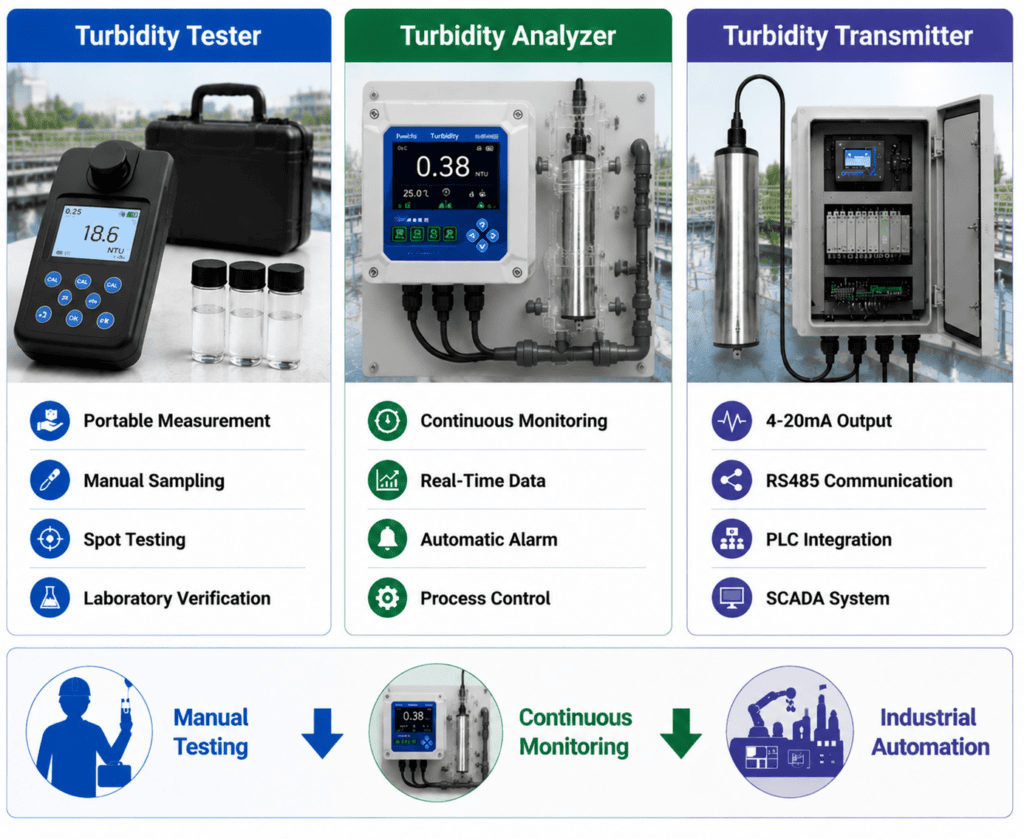
Although these three instruments all measure turbidity, their purposes are different.
The correct choice depends on monitoring requirements.
Turbidity Tester
A turbidity tester is usually a portable device designed for manual measurement.
It is commonly used for:
- Field inspection.
- Laboratory verification.
- Temporary testing.
The operator collects a water sample and measures turbidity manually.
Advantages of Turbidity Testers
- Easy to operate.
- Low initial cost.
- Flexible measurement locations.
- Suitable for spot checks.
Limitations of Turbidity Testers
Because measurements are performed manually:
- Data frequency is limited.
- Continuous changes may be missed.
- Automatic control is not possible.
- Historical records require manual management.
Portable testers are suitable when turbidity monitoring is mainly for verification rather than process control.
Turbidity Analyzer
A turbidity analyzer is designed for continuous or automatic turbidity monitoring.
It is commonly installed in:
- Water treatment plants.
- Industrial wastewater systems.
- Process monitoring applications.
The analyzer continuously measures NTU values and provides real-time data.
Advantages of Turbidity Analyzers
A turbidity analyzer provides:
- Continuous monitoring.
- Automatic data recording.
- Alarm functions.
- PLC/SCADA integration.
- Process control capability.
It is the preferred solution when turbidity directly affects:
- Production processes.
- Environmental compliance.
- Automatic treatment control.
Turbidity Transmitter
A turbidity transmitter focuses on signal transmission and integration.
It typically works together with:
- Turbidity sensors.
- Controllers.
- PLC systems.
- SCADA platforms.
Its main role is converting measurement signals into communication outputs such as:
- 4–20 mA.
- RS485.
- Modbus.
This allows turbidity data to be integrated into industrial automation systems.
From Our Field Experience:
Turbidity Reading Drift Was Caused by Optical Window Fouling, Not Sensor Failure
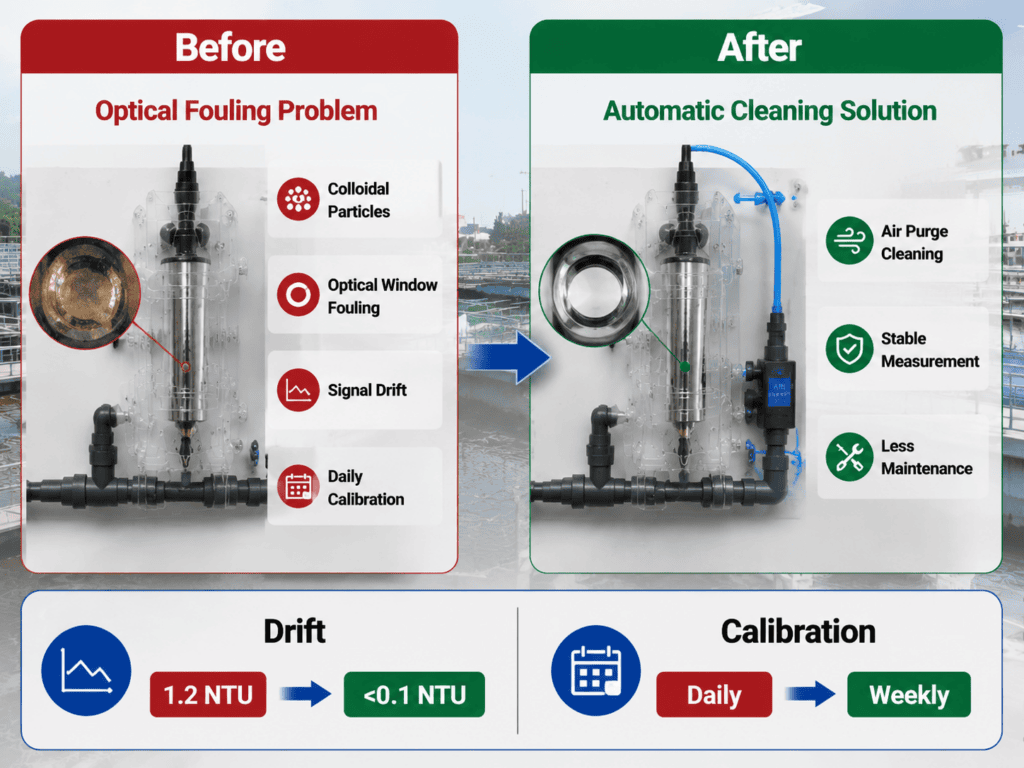
In industrial wastewater applications, unstable turbidity readings are not always caused by instrument accuracy problems.
We worked with a fine chemical company where an online turbidity analyzer was installed to monitor industrial wastewater reuse water.
During operation, the turbidity reading gradually increased after several hours, and operators needed to recalibrate the instrument multiple times every day.
Initially, the customer suspected that the turbidity analyzer itself was inaccurate.
However, after inspection, our engineers found that the sensor was working normally.
The actual problem was caused by optical window fouling.
The wastewater contained trace colloidal suspended particles that continuously attached to the sensor optical glass window.
As deposits accumulated:
- Light scattering conditions changed.
- Measurement signals gradually drifted.
- Turbidity values increased incorrectly.
The original system also lacked an automatic cleaning function.
Before improvement:
- Turbidity drift reached up to 1.2 NTU.
- Daily calibration was required.
The improvement included:
- Installing an automatic air purge cleaning system.
- Optimizing maintenance procedures.
After modification:
- Daily turbidity drift was reduced to less than 0.1 NTU.
- Calibration frequency was reduced from once per day to once per week.
This project demonstrated that in wastewater applications, contamination control and cleaning design are just as important as turbidity analyzer accuracy.
Turbidity Tester: When Portable Measurement Makes Sense
Portable turbidity testers remain widely used because they provide a simple and flexible method for checking water quality.
They are commonly used when operators need quick verification rather than continuous process monitoring.
Typical applications include:
- Laboratory comparison testing.
- Field inspections.
- Temporary monitoring points.
- Equipment commissioning.
- Routine maintenance checks.
For example, an operator may use a portable turbidity tester to confirm whether a filtration system is operating normally or to verify online instrument readings.
Advantages of Turbidity Testers
Flexible Measurement Locations
The biggest advantage of portable turbidity testers is mobility.
Operators can collect samples from different locations without installing fixed equipment.
This is useful for:
- Multiple sampling points.
- Remote locations.
- Temporary projects.
- Emergency inspections.
Lower Initial Investment
Compared with a complete online turbidity monitoring system, portable testers require less initial investment.
They are suitable when:
- Measurement frequency is low.
- Continuous monitoring is unnecessary.
- Manual inspection is acceptable.
Simple Operation
Most portable turbidity measurements involve:
- Collecting a water sample.
- Placing the sample into a measurement container.
- Measuring turbidity.
- Recording the result.
For basic water quality verification, portable testing remains an effective solution.
Turbidity Analyzer: When Continuous Monitoring Is Required
A turbidity analyzer is designed for applications where turbidity changes need to be monitored continuously.
Unlike portable testers, online turbidity analyzers provide real-time measurement data without requiring manual sampling.
They are commonly used in:
- Municipal water treatment.
- Industrial wastewater.
- Water reuse systems.
- Filtration monitoring.
- Environmental discharge monitoring.
Advantages of Online Turbidity Monitoring
1. Continuous 24/7 Measurement
Water quality can change rapidly due to:
- Production fluctuations.
- Rainfall events.
- Process changes.
- Treatment instability.
Manual testing may miss these short-term changes.
An online turbidity analyzer provides continuous data, allowing operators to identify abnormal conditions quickly.
2. Automatic Alarm and Process Control
Online turbidity systems can trigger alarms when NTU values exceed preset limits.
They can also connect with:
- PLC systems.
- SCADA platforms.
- Automatic dosing equipment.
This enables faster response and improves process control.
3. Historical Data Recording
Continuous monitoring provides complete turbidity records.
This helps facilities:
- Analyze long-term trends.
- Identify process problems.
- Support environmental compliance.
- Optimize treatment operation.
Turbidity Transmitter: Integration into Industrial Control Systems
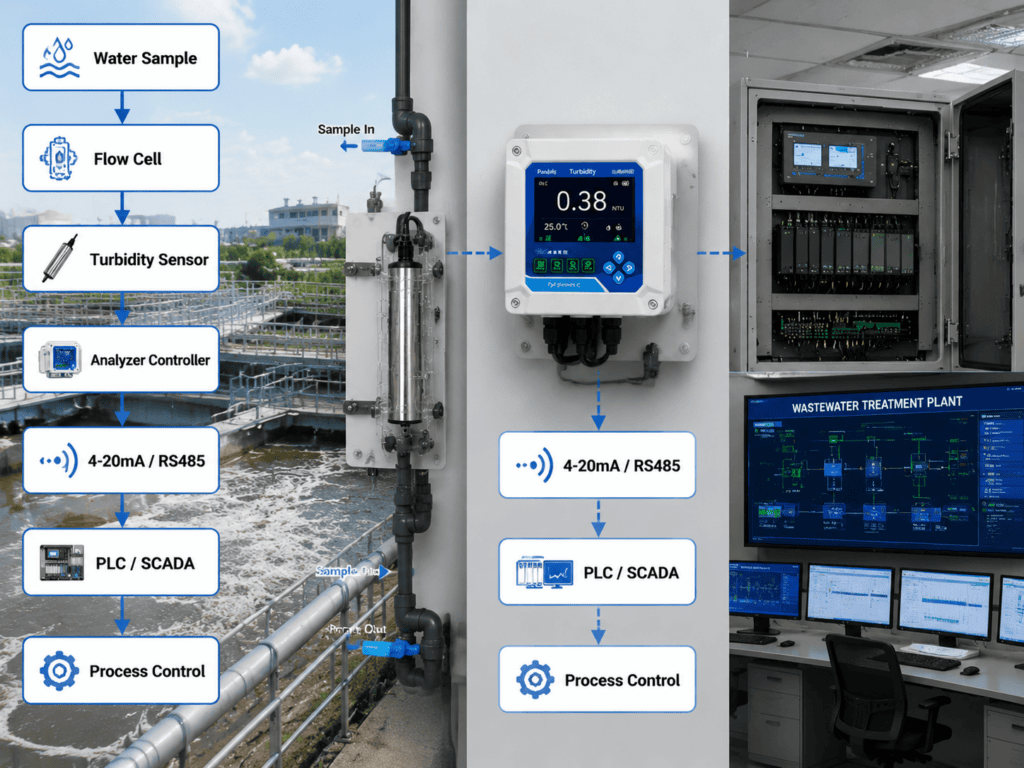
A turbidity transmitter is mainly used to transmit turbidity measurement signals into automation systems.
It is commonly integrated with:
- Turbidity sensors.
- Controllers.
- PLC systems.
- SCADA systems.
The transmitter converts measurement signals into standard outputs:
- 4–20 mA.
- RS485.
- Modbus communication.
This allows turbidity information to become part of the overall process control system.
How to Choose the Right Turbidity Instrument
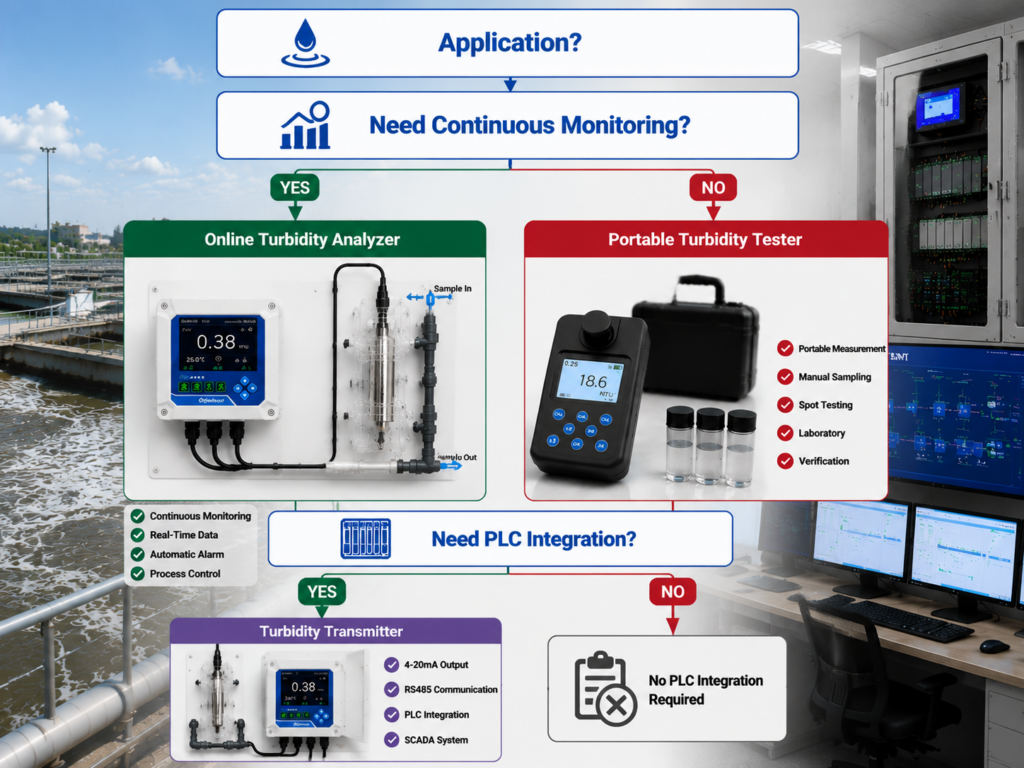
Choosing between a turbidity tester, analyzer, or transmitter depends on several factors.
The most important questions are:
- Do you need continuous monitoring?
- Is turbidity related to process control?
- Do you need automatic alarms?
- Is data recording required?
- Will the system connect to PLC or SCADA?
Selection Guide: Tester vs Analyzer vs Transmitter
| Requirement | Recommended Solution |
|---|---|
| Occasional water quality checks | Turbidity Tester |
| Laboratory verification | Turbidity Tester |
| 24/7 turbidity monitoring | Turbidity Analyzer |
| Automatic alarm | Turbidity Analyzer |
| Process control integration | Turbidity Transmitter |
| PLC/SCADA connection | Analyzer + Transmitter System |
| Environmental compliance monitoring | Online Turbidity Monitoring System |
Application-Specific Considerations: Field Testing vs Continuous Monitoring
Different industries have different turbidity monitoring requirements.
The correct instrument depends on:
- Water quality characteristics.
- Required measurement frequency.
- Process importance.
- Maintenance capability.
Drinking Water Applications
Drinking water facilities usually require stable turbidity monitoring because turbidity directly reflects filtration performance.
Typical monitoring points:
- Filter outlet.
- Clear water tank.
- Distribution system.
Important requirements:
- High measurement stability.
- Reliable data recording.
- Continuous monitoring capability.
Wastewater Applications
Wastewater treatment creates more challenging measurement conditions.
Common issues include:
- Suspended solids.
- Sludge carryover.
- Organic contamination.
- Rapid water quality changes.
For these applications, operators should consider:
- Anti-fouling design.
- Automatic cleaning systems.
- Stable sampling conditions.
Industrial Process Water Applications
Industrial facilities may use turbidity monitoring to protect production processes.
Examples:
- Cooling water.
- Process water.
- Water reuse systems.
- Filtration systems.
In these applications, turbidity measurement helps:
- Detect contamination events.
- Protect equipment.
- Maintain stable operation.
From Our Field Experience:
Why an Industrial Park Upgraded from Portable Turbidity Testing to Online Monitoring
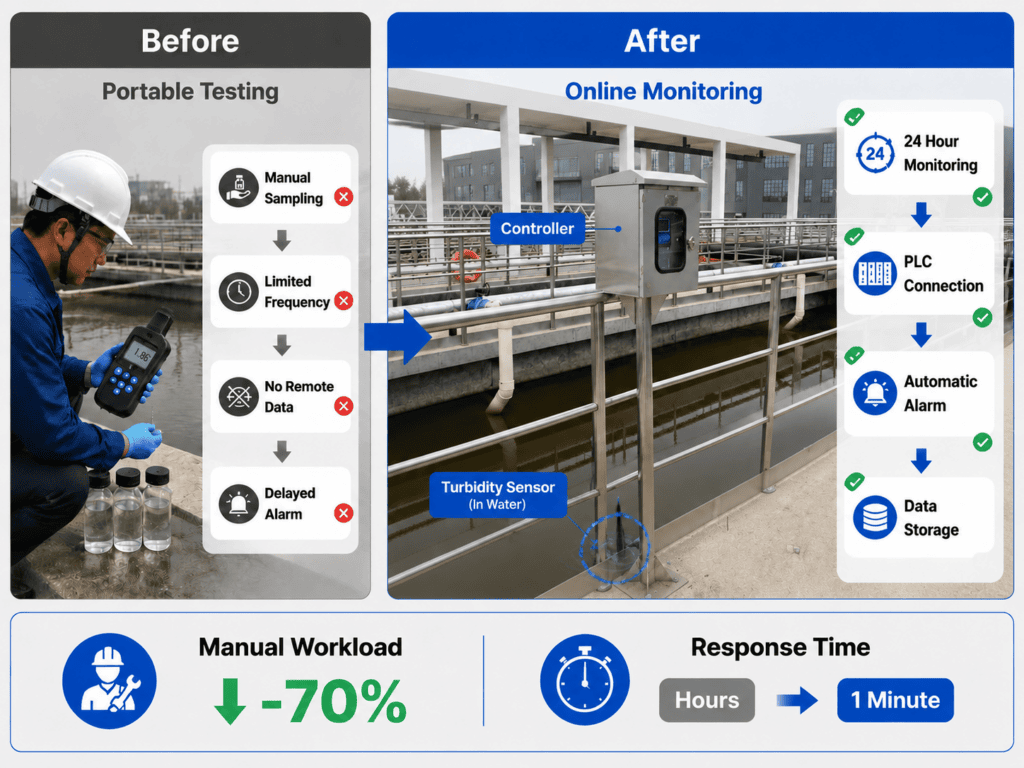
Portable turbidity testers are useful for routine inspection, but they cannot replace continuous monitoring when turbidity data is required for process control and compliance management.
We worked with an industrial park centralized wastewater treatment facility monitoring biological treatment effluent and discharge water.
Before the upgrade, operators performed manual sampling approximately four times per day using portable turbidity instruments.
Although this method provided basic water quality information, several limitations appeared:
- Short-term turbidity spikes could not be captured.
- Night-time abnormalities were discovered too late.
- Manual records could contain missing or incorrect information.
- Data could not be transferred to the central control system.
- Continuous environmental monitoring records were unavailable.
The facility required:
- 24-hour continuous turbidity monitoring.
- PLC integration.
- Automatic alarm functions.
- Historical data storage.
- Connection with treatment control systems.
The upgrade included an online turbidity monitoring system integrated with the plant control platform.
After implementation:
- Manual sampling workload decreased by 70%.
- Abnormal turbidity events were detected within 1 minute instead of several hours.
- Manual recording errors were eliminated.
- Turbidity fluctuation range became narrower.
- Chemical consumption decreased by approximately 9%.
- Complete continuous monitoring records supported environmental inspections.
This project demonstrated that when turbidity data is required for automatic control and compliance management, an online turbidity analyzer provides significantly greater value than periodic portable testing.
Calibration and Maintenance Practices for Accurate Turbidity Analysis
A turbidity instrument can only provide reliable NTU measurements when the entire measurement system remains stable.
Although modern turbidity analyzers are designed for long-term operation, measurement accuracy can still be affected by:
- Optical window contamination.
- Sample cell deposits.
- Incorrect calibration.
- Air bubbles.
- Unstable sample conditions.
Regular calibration and maintenance are essential for maintaining reliable turbidity monitoring.
Turbidity Analyzer Calibration
Calibration ensures that the turbidity analyzer provides accurate NTU measurement values.
The calibration frequency depends on:
- Water quality conditions.
- Measurement range.
- Sensor design.
- Application requirements.
Applications with clean water may require less frequent calibration, while wastewater applications may require more frequent inspection.
Zero Calibration
Zero calibration verifies the instrument response under low turbidity conditions.
It helps confirm:
- Sensor baseline stability.
- Optical system condition.
- Measurement accuracy.
Standard Calibration
Standard calibration uses a known turbidity standard solution to adjust the analyzer response.
This ensures that the measured NTU value matches the reference value.
Common calibration steps include:
- Prepare standard solution.
- Clean the optical surface.
- Perform calibration procedure.
- Verify measurement accuracy.
Turbidity Sensor Cleaning
Cleaning is one of the most important maintenance tasks for online turbidity monitoring.
Because turbidity measurement depends on optical detection, contamination on the optical surface can directly affect measurement results.
Common contaminants include:
- Suspended solids.
- Sludge particles.
- Organic deposits.
- Biofilm.
- Mineral scaling.
Recommended maintenance methods:
- Manual cleaning.
- Automatic air cleaning.
- Automatic water flushing.
- Chemical cleaning when required.
Sample Cell and Flow System Maintenance
For flow-through turbidity analyzers, the sampling system is equally important as the sensor.
Problems inside the sampling system can cause:
- Incorrect readings.
- Slow response.
- Measurement drift.
Regular inspection should include:
Sample Pipeline
Check:
- Blockage.
- Deposits.
- Flow stability.
- Leakage.
Measurement Chamber
Check:
- Internal contamination.
- Bubble accumulation.
- Particle buildup.
Flow Conditions
Confirm:
- Stable sample flow.
- Representative sample quality.
- No excessive turbulence.
Common Turbidity Measurement Problems and Troubleshooting
Problem 1: Turbidity Reading Gradually Increases
Possible causes:
- Optical window fouling.
- Suspended solids accumulation.
- Biofilm growth.
- Incorrect cleaning frequency.
Solutions:
- Clean the optical surface.
- Check automatic cleaning function.
- Improve maintenance frequency.
- Verify calibration.
Problem 2: Turbidity Reading Fluctuates Significantly
Possible causes:
- Air bubbles.
- Unstable flow.
- Poor installation location.
- Rapid process changes.
Solutions:
- Remove air bubbles.
- Stabilize sample flow.
- Check installation conditions.
- Confirm sampling point suitability.
Problem 3: Online Turbidity Value Does Not Match Laboratory Results
Possible causes:
- Different sampling locations.
- Different sampling times.
- Poor sample handling.
- Sensor contamination.
Recommended troubleshooting:
- Compare measurements under the same conditions.
- Check sensor cleanliness.
- Verify calibration.
- Inspect sampling system.
Problem 4: Frequent Calibration Is Required
Possible causes:
- High contamination water.
- Incorrect instrument selection.
- Missing automatic cleaning.
- Poor installation conditions.
Possible improvements:
- Select a suitable turbidity analyzer for the application.
- Add automatic cleaning.
- Improve sampling design.
- Establish a regular maintenance schedule.
Matching Instrument to Monitoring Program
The best turbidity instrument depends on the monitoring objective.
Use a Turbidity Tester When:
- Only occasional measurement is required.
- Operators need field verification.
- There is no need for automatic control.
- The application is temporary.
Examples:
- Laboratory verification.
- Maintenance inspection.
- Equipment commissioning.
Use a Turbidity Analyzer When:
- Continuous monitoring is required.
- Water quality changes frequently.
- Process control depends on turbidity data.
- Historical records are required.
Examples:
- Drinking water treatment.
- Wastewater discharge monitoring.
- Industrial water reuse.
Use a Turbidity Transmitter When:
- Integration with automation systems is required.
- Turbidity data must be sent to PLC or SCADA.
- Remote monitoring is needed.
Examples:
- Industrial control systems.
- Centralized water management platforms.
Frequently Asked Questions
What is the difference between a turbidity analyzer and a turbidity tester?
A turbidity tester is mainly used for manual spot measurements.
A turbidity analyzer provides continuous monitoring and is suitable for automatic process control.
When should I use an online turbidity analyzer?
An online turbidity analyzer is recommended when:
- Continuous monitoring is required.
- Water quality changes rapidly.
- Automatic alarms are needed.
- Data recording is important.
Can a portable turbidity tester replace an online analyzer?
In most cases, no.
Portable testers are suitable for verification and inspection, but they cannot provide:
- Continuous data.
- Automatic alarms.
- PLC integration.
- Real-time process control.
Why does my turbidity reading keep increasing over time?
Common causes include:
- Optical window contamination.
- Sample cell fouling.
- Suspended particle accumulation.
- Lack of automatic cleaning.
Before replacing the instrument, check the complete measurement system.
How can turbidity measurement accuracy be improved?
Improvement depends on:
- Correct instrument selection.
- Proper installation.
- Stable sample conditions.
- Regular calibration.
- Effective cleaning strategy.
Conclusion
Choosing between a turbidity analyzer, turbidity tester, and turbidity transmitter depends on the actual monitoring requirements.
A turbidity tester is suitable for:
- Manual inspection.
- Field verification.
- Temporary measurements.
A turbidity analyzer is suitable for:
- Continuous NTU monitoring.
- Process control.
- Compliance management.
A turbidity transmitter is suitable for:
- Industrial automation.
- PLC/SCADA integration.
- Remote monitoring.
For modern water treatment applications, accurate turbidity measurement requires more than selecting the correct instrument.
A reliable solution should include:
- Appropriate measurement technology.
- Correct installation location.
- Stable sampling conditions.
- Proper calibration.
- Effective cleaning and maintenance.
By matching the turbidity instrument with the actual application requirements, users can improve measurement reliability, reduce maintenance workload, and achieve better process control.
Turbidity Monitoring Solutions
Reliable turbidity monitoring requires a complete solution rather than only an individual instrument.
Wuxi Wohuan Instrument provides complete turbidity monitoring solutions, including:
- Online turbidity analyzers
- Portable turbidity testers
- Turbidity transmitters
- Optical turbidity sensors
- Flow cell sampling systems
- Automatic cleaning solutions
- Water quality monitoring systems
Our solutions are designed for:
- Drinking water treatment.
- Industrial wastewater.
- Water reuse systems.
- Process water monitoring.
- Environmental discharge monitoring.
Based on actual water conditions, monitoring objectives, and installation requirements, our engineering team helps customers select suitable turbidity monitoring solutions to improve measurement stability and reduce long-term operation costs.
Need Help Choosing the Right Turbidity Instrument?
Selecting a turbidity instrument depends on more than the NTU measurement range.
The suitable solution should consider:
- Application type
- Water quality characteristics
- Required measurement frequency
- Continuous monitoring requirements
- Automation integration needs
- Maintenance expectations
Whether you need a portable turbidity tester for inspection or an online turbidity analyzer for continuous monitoring, our engineering team can help evaluate your application and recommend the right solution.
Explore Related Solutions
Explore more water quality monitoring solutions for industrial and municipal applications:
- Online Turbidity Analyzer
- Portable Turbidity Tester
- pH Analyzer
- ORP Analyzer
- Residual Chlorine Analyzer
- Dissolved Oxygen Analyzer
- Conductivity Analyzer
- Multi-Parameter Water Quality Monitoring System
Our engineers can provide technical recommendations based on your process conditions, installation environment, and monitoring requirements.
Request a Free Consultation
Please provide:
- Application or industry
- Water type
- Expected turbidity range
- Installation method
- Sampling conditions
- Communication requirements
- Maintenance expectations
Our engineering team will recommend the most suitable turbidity monitoring solution and provide technical support for reliable long-term operation.