Introduction
In chemical manufacturing, pH measurement plays a critical role in controlling reaction direction, reaction efficiency, and final product quality.
However, many chemical processes involve extremely challenging conditions, including hydrofluoric acid (HF), strong acids, strong alkalis, high salt concentrations, organic solvents, and explosion-proof environments.
Under these conditions, conventional pH electrodes often experience glass membrane corrosion, reference poisoning, signal drift, and shortened service life, creating significant challenges for continuous process monitoring.
Industrial HF-resistant glass pH meters are specially designed for chemical applications containing fluoride-based media, enabling stable and reliable online pH measurement in harsh reaction environments.
Why HF Environments Are Challenging for pH Measurement
Hydrofluoric acid damages conventional glass electrodes
Most conventional pH glass membranes are based on silicate glass materials.
When exposed to hydrofluoric acid, HF reacts with the glass structure and gradually damages the sensing surface, causing:
- Reduced sensitivity
- Slow response
- Measurement drift
- Complete electrode failure in severe cases
Because the glass membrane is the core sensing component, once chemical corrosion occurs, calibration cannot restore normal performance.
Chemical processes require continuous monitoring
Many chemical reactions require accurate endpoint control.
For example, in fluoride-related chemical production, lithium battery material manufacturing, and inorganic chemical synthesis, pH directly affects:
- Reaction completion
- Product purity
- Raw material utilization
- Production stability
Manual sampling methods cannot always provide real-time feedback, making online pH monitoring essential for automated process control.
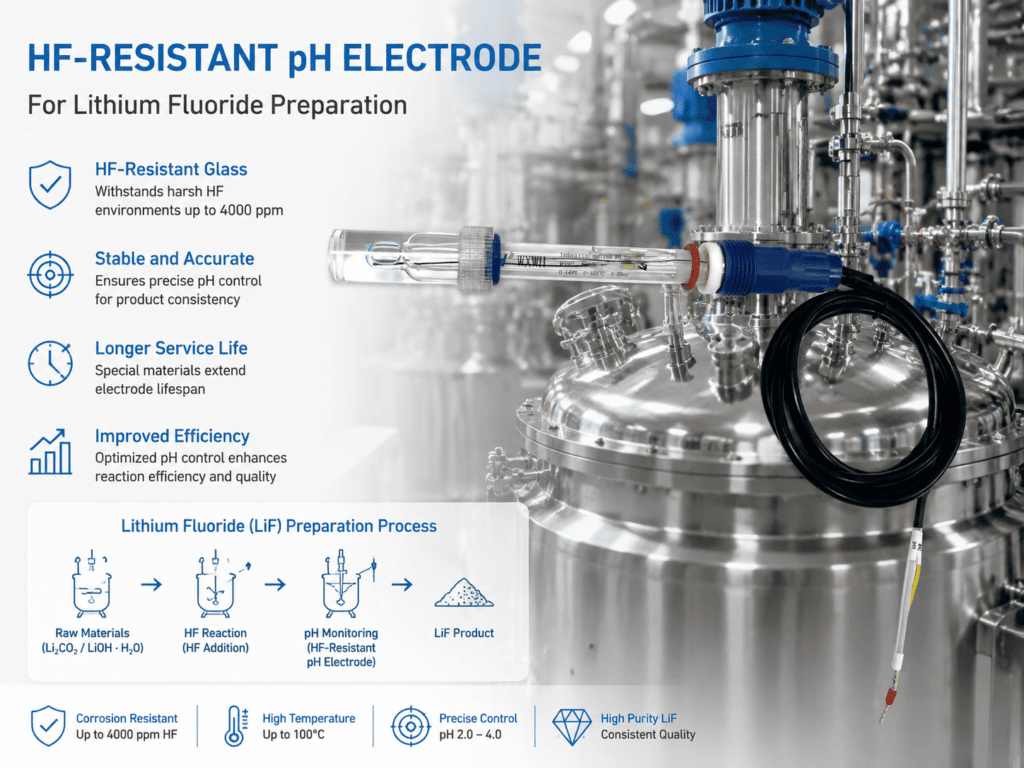
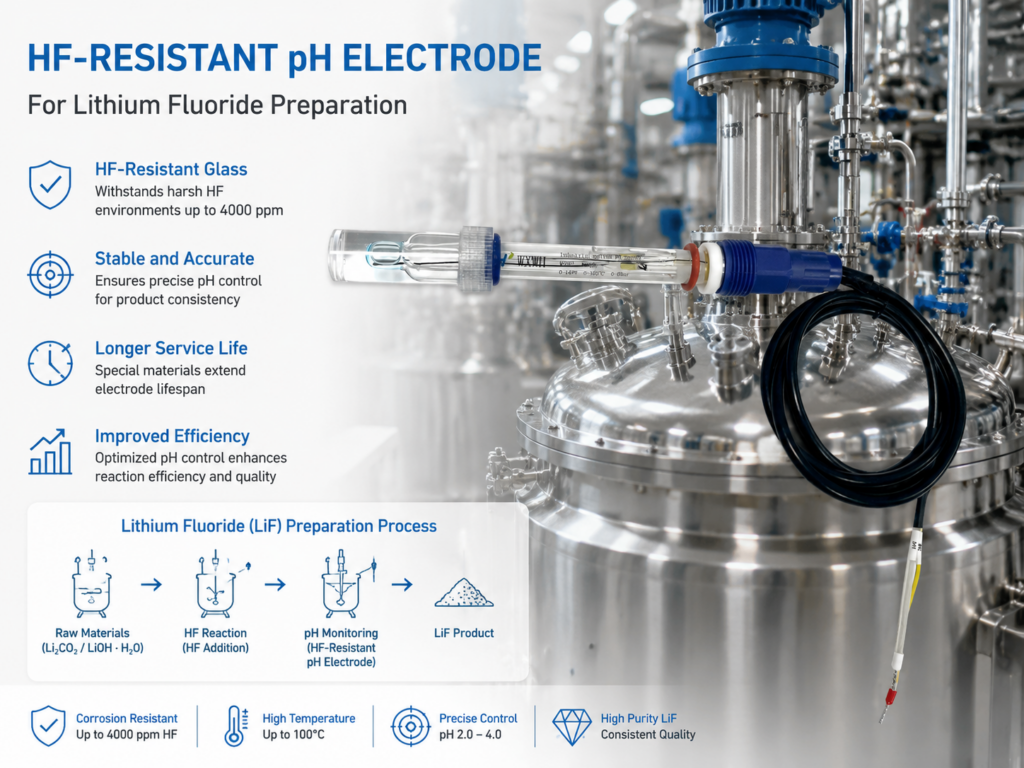
HF-Resistant pH Electrode Application in Lithium Fluoride Production
Reaction process challenges
A lithium battery material manufacturer uses hydrofluoric acid during lithium fluoride production.
During the neutralization reaction between lithium compounds and HF, the reaction endpoint requires precise pH control, typically within the range of:
pH 6.0–7.2
Traditional pH electrodes installed in this process experienced frequent failures because the glass membrane could not withstand long-term HF exposure.
The unstable measurement affected reaction endpoint judgment and increased maintenance frequency.
Direct online measurement solution
To solve this problem, the customer adopted an HF-resistant glass pH electrode designed specifically for fluoride-containing chemical media.
The sensor was installed directly on the reaction pipeline and connected to the plant control system.
The system provided:
- Real-time pH monitoring
- Automatic alarm when values exceeded limits
- Continuous feedback for process adjustment
This eliminated frequent electrode replacement and improved reaction control stability.
How HF-Resistant Glass Technology Improves Reliability
Special glass formulation increases corrosion resistance
Unlike ordinary silicate glass, HF-resistant glass uses a specially developed composition containing modified metal oxides.
These components improve chemical stability and reduce direct attack from hydrofluoric acid.
The result is a sensing membrane capable of maintaining measurement performance in fluoride-containing environments.
Structural design improves long-term operation
Besides the sensing glass, industrial HF-resistant pH electrodes also require optimized structural protection.
Key design considerations include:
- Chemical-resistant glass membrane for HF environments
- Double junction reference system to reduce contamination
- Corrosion-resistant sealing materials for long-term operation
- Suitable installation structures for pipelines and reaction vessels
A reliable HF-resistant pH system depends on both material selection and mechanical design.
Field Results: Extending Electrode Service Life
In conventional HF applications, standard pH electrodes may fail within a short period because of glass corrosion.
After adopting HF-resistant glass pH electrodes, the customer achieved:
- Electrode service life extended from approximately 2 weeks to more than 1 year
- Measurement accuracy maintained within ±0.02 pH
- Reduced replacement frequency and maintenance workload
For chemical manufacturers, improving electrode reliability means fewer process interruptions and more stable production conditions.
Selecting the Right pH Meter for Chemical Applications
Consider the complete process conditions
HF concentration is only one factor affecting electrode selection.
Engineers should also evaluate:
- Chemical composition
- Operating temperature
- Pressure conditions
- Salt concentration
- Installation location
- Cleaning requirements
Choosing a pH electrode based only on measurement range or price often leads to premature failure.
From replacing electrodes to adapting sensors
Traditional approaches often attempt to protect electrodes by changing the process environment, such as:
- Frequent replacement
- Additional sampling systems
- External protection devices
Modern HF-resistant pH measurement focuses on designing sensors that directly adapt to the actual chemical process.
This approach simplifies maintenance and improves long-term operational reliability.
Conclusion: Reliable pH Measurement in Harsh Chemical Processes
In chemical manufacturing, online pH monitoring is not only a measurement task but also an important part of process reliability.
Strong acids, alkalis, and fluoride-containing media create severe challenges for conventional pH electrodes. Without suitable materials and structural design, even accurate instruments may fail quickly in real industrial conditions.
HF-resistant glass pH meters provide a practical solution by improving corrosion resistance, extending service life, and enabling continuous monitoring in demanding chemical processes.
With the rapid development of industries such as lithium battery materials, fine chemicals, and advanced manufacturing, the demand for reliable chemical-resistant pH measurement will continue to increase.
Based on long-term experience in industrial process monitoring, Wohuan provides customized pH measurement solutions for challenging applications, helping customers achieve more stable and efficient chemical production.