Introduction
Water quality monitoring requires not only accurate measurement technology but also a clear understanding of what the data represents and how it should be used.
An online turbidity meter provides continuous measurement of water clarity by detecting suspended particles that scatter light inside a water sample.
Unlike traditional grab sampling and laboratory analysis, an online turbidity meter continuously monitors the process line, allowing operators to detect water quality changes immediately instead of waiting for the next manual test result.
Turbidity is one of the most widely used indicators of water quality.
It reflects the presence of:
- Suspended solids.
- Organic matter.
- Colloidal particles.
- Microorganisms.
- Other light-scattering substances.
Different industries rely on turbidity monitoring for different purposes:
- Drinking water plants monitor turbidity to verify filtration performance.
- Wastewater facilities use turbidity data to evaluate treatment efficiency and discharge stability.
- Food and beverage manufacturers monitor clarity to maintain product appearance.
- Power plants use turbidity monitoring to protect critical water systems.
However, selecting an online turbidity meter is not simply about choosing an instrument with the correct measurement range.
Engineers also need to consider:
- Water characteristics.
- Suspended solids concentration.
- Optical fouling risks.
- Sampling conditions.
- Communication requirements.
- Maintenance requirements.
A suitable turbidity monitoring system should combine:
- Correct sensor selection.
- Stable sampling conditions.
- Reliable signal transmission.
- Effective maintenance strategy.
This guide explains:
- What an online turbidity meter is.
- How inline turbidity sensors work.
- How turbidity is measured.
- Common measurement problems.
- How to choose the right turbidity monitoring solution.
Quick Answer: What Is an Online Turbidity Meter?
An online turbidity meter is an instrument that continuously measures water clarity by detecting the light scattered by suspended particles.
The basic measurement process is:
Water sample
↓
LED light source emits light
↓
Suspended particles scatter light
↓
Optical detector measures scattered light
↓
Signal converted into turbidity value
↓
Output to PLC / SCADA / monitoring system
Most online turbidity meters use a nephelometric measurement principle, where the detector measures scattered light at approximately 90 degrees from the original light beam.
The complete system usually includes:
- Inline turbidity sensor.
- Turbidity transmitter.
- Turbidity analyzer or controller.
- Data logging system.
The system can provide:
- Real-time turbidity monitoring.
- Alarm functions.
- Historical data recording.
- Process control integration.
Common output signals include:
- 4–20 mA.
- RS485.
- Modbus.
- Digital communication protocols.
By connecting turbidity data with automation systems, operators can respond faster to:
- Filtration problems.
- Treatment fluctuations.
- Sudden contamination events.
- Process abnormalities.
What Is an Online Turbidity Meter and How Does It Work?
An online turbidity meter continuously measures the cloudiness of a liquid caused by suspended particles.
Unlike laboratory turbidity testing, which only provides information at the sampling time, online monitoring provides continuous process data.
This difference is especially important for applications where water quality can change quickly.
Examples include:
Drinking Water Treatment
A sudden turbidity increase may indicate:
- Filter failure.
- Particle breakthrough.
- Treatment system instability.
Continuous monitoring allows operators to identify problems immediately.
Wastewater Treatment
Wastewater quality can change significantly due to:
- Production fluctuations.
- Organic load changes.
- Treatment process instability.
Online turbidity monitoring helps operators evaluate:
- Clarification performance.
- Final discharge quality.
- Treatment efficiency.
Industrial Process Water
Industrial facilities use turbidity monitoring to protect equipment and maintain stable operation.
Typical applications include:
- Boiler water systems.
- Cooling water.
- Water reuse systems.
- Filtration systems.
A continuous turbidity signal provides earlier warning than periodic laboratory testing.
Components of an Online Turbidity System
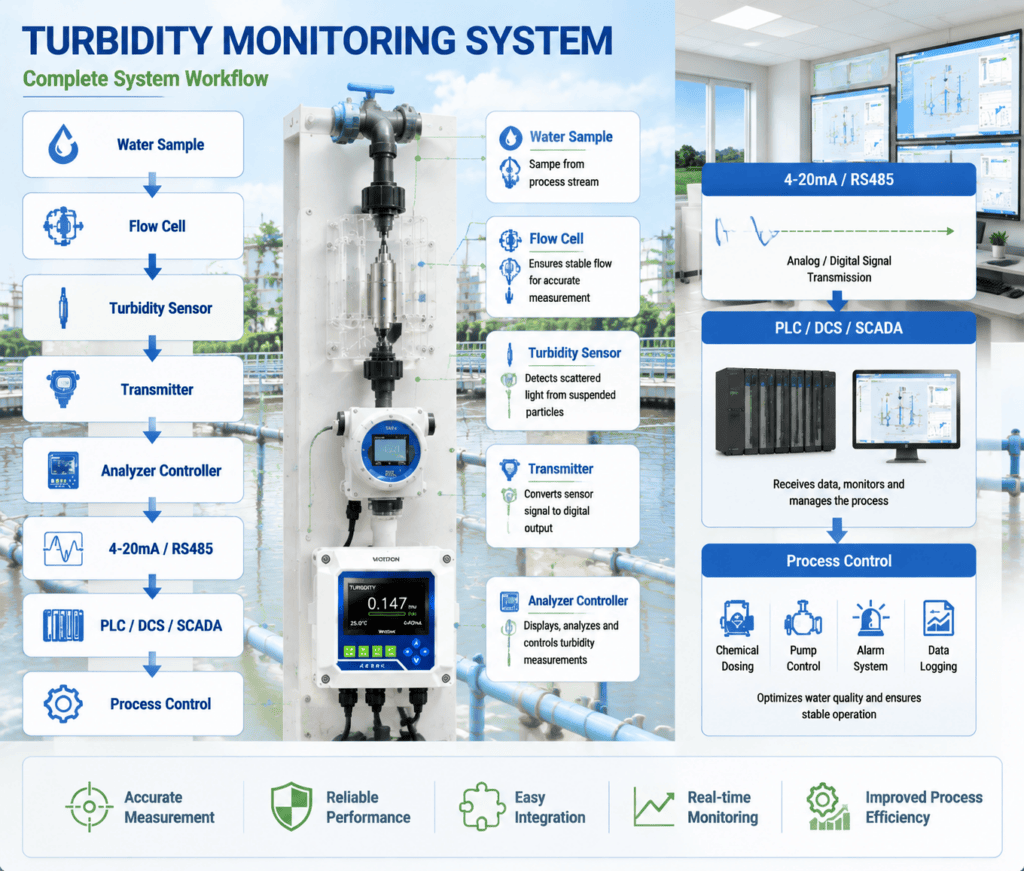
A complete online turbidity monitoring system consists of several components working together.
Each component has a specific role in converting water quality changes into usable process data.
1. Inline Turbidity Sensor
The turbidity sensor is the core measurement component installed in:
- Pipes.
- Tanks.
- Flow cells.
- Sampling systems.
Its main function is to detect scattered light caused by suspended particles.
The sensor includes:
- Light source.
- Optical window.
- Photodetector.
- Measurement chamber.
The sensor generates the raw optical signal and sends it to the transmitter or analyzer.
Different sensors are designed for different water conditions.
For example:
Low Turbidity Applications
Suitable for:
- Drinking water.
- Filtered water.
- High-purity process water.
Requirements:
- High sensitivity.
- Low detection limit.
- Strong repeatability.
High Turbidity Applications
Suitable for:
- Wastewater.
- Industrial discharge.
- High-solids process water.
Requirements:
- Fouling resistance.
- Wider measurement range.
- Easy maintenance.
2. Turbidity Transmitter
The turbidity transmitter converts the sensor signal into a standardized output.
Its functions include:
- Signal processing.
- Displaying turbidity values.
- Communication with external systems.
Common outputs include:
- 4–20 mA.
- RS485.
- Modbus.
The transmitter allows integration with:
- PLC systems.
- DCS platforms.
- SCADA systems.
This enables:
- Remote monitoring.
- Automatic alarms.
- Process control.
3. Turbidity Analyzer
The turbidity analyzer processes sensor signals and provides readable measurement results.
In industrial applications, the analyzer often acts as the central control unit.
Typical functions include:
- Turbidity display.
- Calibration management.
- Alarm setting.
- Diagnostic functions.
- Communication management.
A reliable turbidity analyzer helps operators understand water quality trends and make timely decisions.
4. Data Logging System
Continuous turbidity monitoring creates valuable historical data.
Data logging allows users to:
- Review water quality trends.
- Analyze process changes.
- Support environmental reporting.
- Investigate abnormal events.
Many systems store data through:
- Turbidity transmitters.
- PLC systems.
- SCADA platforms.
- Cloud monitoring systems.
Historical turbidity records are especially valuable for:
- Wastewater compliance.
- Process optimization.
- Equipment troubleshooting.
Field Experience:
Why an Industrial Park Upgraded from Manual Turbidity Testing to Online Monitoring
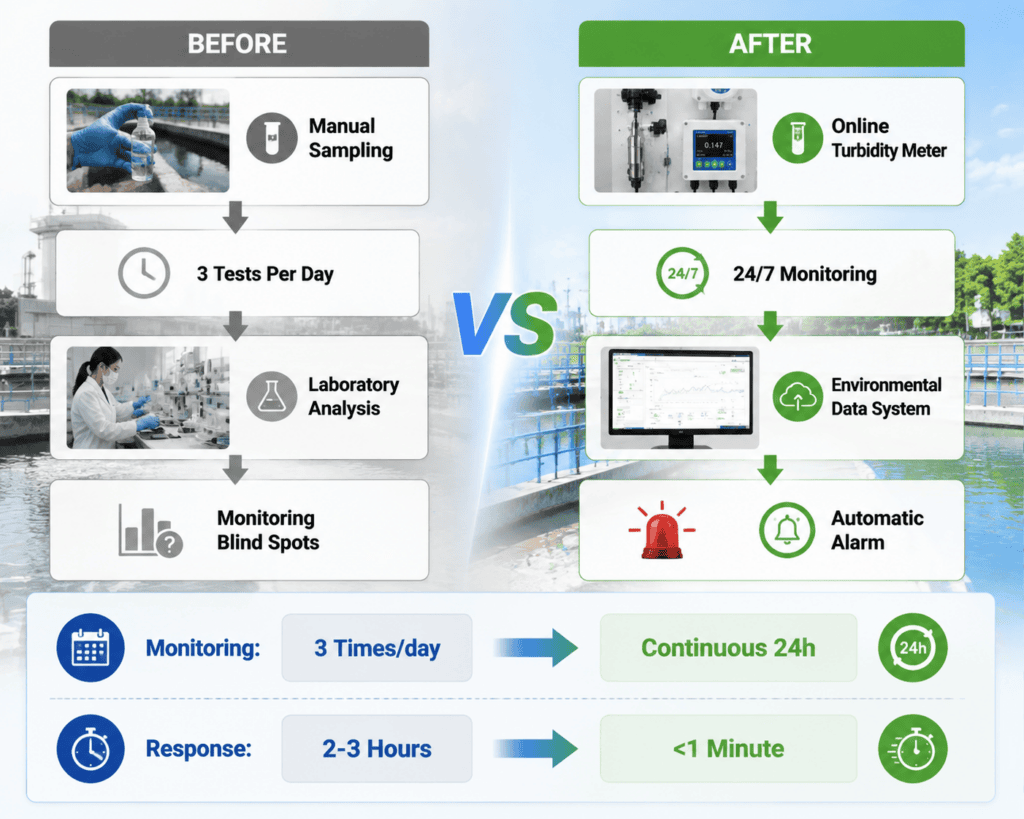
For wastewater discharge monitoring, periodic laboratory testing may not provide enough protection against sudden water quality changes.
We worked with a comprehensive industrial park wastewater treatment facility where turbidity monitoring was applied to the final discharge water.
Before the upgrade, operators used:
- Three manual sampling operations per day.
- Laboratory spectrophotometric turbidity testing.
Although this method provided basic water quality information, several limitations existed:
- Low sampling frequency created monitoring blind spots.
- Short-term discharge fluctuations could not be detected immediately.
- Manual laboratory testing required significant time.
- Continuous historical turbidity data was unavailable.
For wastewater discharge applications, sudden changes may occur due to:
- Upstream production fluctuations.
- Abnormal wastewater loading.
- Treatment process changes.
The customer required:
- 24-hour continuous turbidity monitoring.
- Real-time data transmission to an environmental data acquisition system.
- Automatic turbidity alarms.
- Historical data storage for compliance records.
The facility was upgraded with an online turbidity meter system.
Results After Implementation
After installation:
- Monitoring changed from three manual tests per day to continuous 24-hour monitoring.
- Sampling and laboratory workload decreased by 70%.
- Abnormal turbidity conditions were detected within 1 minute instead of 2–3 hours.
- Historical turbidity data was automatically stored for environmental management.
The system also helped operators identify upstream production fluctuations earlier and adjust wastewater treatment processes in advance.
As a result:
- Effluent quality became more stable.
- Treatment adjustment became faster.
- Environmental compliance risks were reduced.
This project demonstrated that an online turbidity meter provides significant advantages when continuous monitoring, rapid response, and traceable data records are required.
The Measurement Principle: How an Inline Turbidity Sensor Works
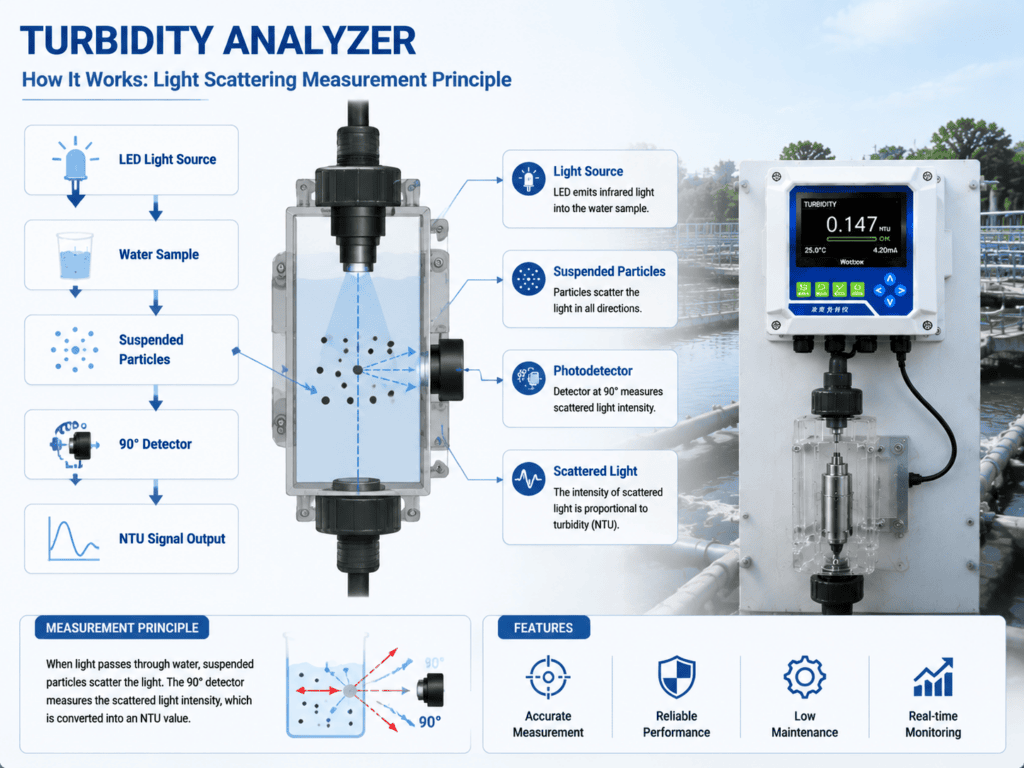
The core component of an online turbidity meter is the inline turbidity sensor, which converts suspended particles in water into measurable optical signals.
Unlike parameters such as pH or conductivity, turbidity is not measured by detecting dissolved ions.
Instead, it is measured by analyzing how particles interact with light.
The basic measurement process is:
LED Light Source

↓

Water Sample

↓

Suspended Particles Scatter Light

↓

Photodetector Measures Scattered Light

↓

Turbidity Value (NTU/FNU)
Light Scattering Measurement Principle
Most inline turbidity sensors use the nephelometric measurement principle.
The sensor works through the following steps:
Step 1: Light Emission
A stable LED light source sends a beam of light into the water sample.
The stability of the light source directly affects:
- Measurement accuracy.
- Long-term repeatability.
- Signal stability.
Step 2: Particle Light Scattering
When suspended particles exist in the water:
- Some light passes through the sample.
- Some light is absorbed.
- Some light is scattered in different directions.
The amount of scattered light depends on:
- Particle concentration.
- Particle size.
- Particle characteristics.
More particles usually produce stronger scattered light.
Step 3: Optical Detection
A photodetector measures the scattered light intensity.
In most turbidity sensors:
- The detector is positioned approximately 90 degrees from the incoming light beam.
- This reduces the influence of direct light transmission.
- It improves measurement sensitivity.
The stronger the detected scattered light:
↓
The higher the turbidity value.
Step 4: Signal Processing
The optical signal is converted into a standardized turbidity reading.
The final data can be transmitted to:
- Turbidity transmitter.
- PLC.
- DCS.
- SCADA.
- Data logging system.
This allows operators to monitor water quality continuously.
Factors Affecting Inline Turbidity Sensor Accuracy
Although turbidity measurement technology is well established, real-world accuracy depends on more than the sensor itself.
The complete measurement environment must be considered.
1. Optical Window Cleanliness
The optical window is one of the most important factors affecting measurement stability.
During long-term operation, contaminants may accumulate on the optical surface:
- Suspended solids.
- Mineral deposits.
- Biological film.
- Chemical precipitation.
These deposits can change the light scattering path and cause:
- Measurement drift.
- False high readings.
- Frequent calibration.
For challenging applications, sensors with:
- Automatic cleaning.
- Fouling-resistant design.
- Easy maintenance structure.
can significantly improve stability.
2. Sample Flow Stability
Stable sample flow is essential for reliable turbidity measurement.
Poor flow conditions may cause:
- Particle accumulation.
- Air bubbles.
- Unstable readings.
Common problems include:
- Flow rate too low.
- Excessive turbulence.
- Poor pipeline design.
- Dead zones inside the sampling system.
A properly designed flow cell helps maintain:
- Representative samples.
- Stable optical conditions.
- Repeatable measurements.
3. Installation Location
The installation position directly affects measurement reliability.
Avoid installing turbidity sensors in:
- Areas with stagnant water.
- Locations with excessive bubbles.
- Poorly mixed zones.
- Areas where sediment accumulates.
A suitable installation point should provide:
- Representative water conditions.
- Stable flow.
- Easy maintenance access.
How to Measure Turbidity and Troubleshoot Common Issues with Inline Turbidity Sensors
Knowing how to measure turbidity reliably requires more than simply installing a sensor.
A complete measurement process should include:
- Correct sensor selection.
- Proper installation.
- Initial verification.
- Regular maintenance.
Many turbidity measurement problems are caused by the application environment rather than the instrument itself.
Step-by-Step Measurement Procedure
Step 1: Define the Measurement Purpose
Before selecting an online turbidity meter, determine:
- What water is being measured?
- What turbidity range is expected?
- Is continuous monitoring required?
- Is automation control needed?
Different applications require different sensor designs.
Examples:
Drinking Water
Focus:
- Low turbidity detection.
- Regulatory compliance.
- High sensitivity.
Wastewater
Focus:
- Fouling resistance.
- Wider measurement range.
- Stable operation in dirty environments.
Industrial Process Water
Focus:
- Equipment protection.
- Process stability.
- Integration with control systems.
Step 2: Select the Correct Turbidity Sensor
Sensor selection should match the actual water condition.
For clean water:
Choose:
- Low-range turbidity sensor.
- High-resolution optical design.
For wastewater or high-solids applications:
Choose:
- Wide-range turbidity sensor.
- Fouling-resistant construction.
- Automatic cleaning options.
Using an unsuitable sensor can lead to:
- Poor sensitivity.
- Frequent maintenance.
- Unstable readings.
Step 3: Install the Sensor Correctly
Proper installation is critical.
Important considerations include:
- Stable flow conditions.
- Representative sampling point.
- Avoiding air bubbles.
- Easy maintenance access.
Incorrect installation may cause measurement problems even when the sensor itself is working normally.
Step 4: Connect the Transmitter and Control System
The turbidity sensor sends raw optical signals to the transmitter.
The transmitter then converts the signal into usable outputs.
Common communication methods include:
- 4–20 mA.
- RS485.
- Modbus.
Integration with PLC/DCS allows:
- Remote monitoring.
- Alarm management.
- Automatic process adjustment.
Step 5: Verify Measurement Accuracy
After installation, the system should be verified.
Recommended methods:
- Compare with a reference standard.
- Compare with laboratory grab samples.
- Confirm correct calibration.
This ensures the complete measurement chain is working correctly.
Best Practices for Accurate Results
1. Match Sensor Range to the Application
Selecting the correct measurement range improves accuracy.
Low Turbidity Applications
Examples:
- Drinking water.
- Filter outlet.
- High-purity process water.
Requirements:
- High sensitivity.
- Stable low NTU measurement.
High Turbidity Applications
Examples:
- Wastewater.
- Industrial discharge.
- High-solids process water.
Requirements:
- Fouling resistance.
- Wide measurement range.
- Easy cleaning.
2. Use Pre-Calibrated Sensors
Pre-calibrated sensors can reduce:
- Installation errors.
- Field calibration time.
- Commissioning difficulty.
They are especially useful for projects requiring faster deployment.
3. Use Reliable Turbidity Monitoring Systems
A complete monitoring system should include:
- Reliable turbidity sensor.
- Suitable transmitter.
- Data logging.
- Communication interface.
Centralized monitoring improves:
- Process visibility.
- Alarm response.
- Historical analysis.
4. Perform Periodic Verification
Even high-quality turbidity sensors require routine checks.
Recommended maintenance includes:
- Cleaning optical surfaces.
- Checking calibration.
- Inspecting flow conditions.
- Reviewing historical trends.
Regular verification helps prevent unexpected measurement failures.
Common Problems and Solutions
| Problem | Typical Cause | Practical Solution |
|---|---|---|
| Reading drifts upward over time | Optical window contamination, biofilm, particle buildup | Clean optics, improve maintenance, use fouling-resistant sensor |
| Erratic signal | Air bubbles, unstable flow, excessive suspended solids | Improve sampling conditions, remove bubbles |
| No output after installation | Wiring or transmitter configuration error | Check connections and signal settings |
| Cannot resolve low turbidity values | Wrong sensor range selection | Use low-range turbidity sensor |
Follow These Steps to Improve Turbidity Measurement Reliability
A stable online turbidity measurement system requires:
- Correct sensor selection.
- Proper installation.
- Stable sample conditions.
- Regular maintenance.
- Reliable data integration.
When these factors are properly managed, an inline turbidity sensor becomes a reliable tool for:
- Early warning.
- Process optimization.
- Water quality control.
Field Experience:
Online Turbidity Meter Instability in Food Wastewater Was Caused by Air Bubbles and Biofilm Fouling
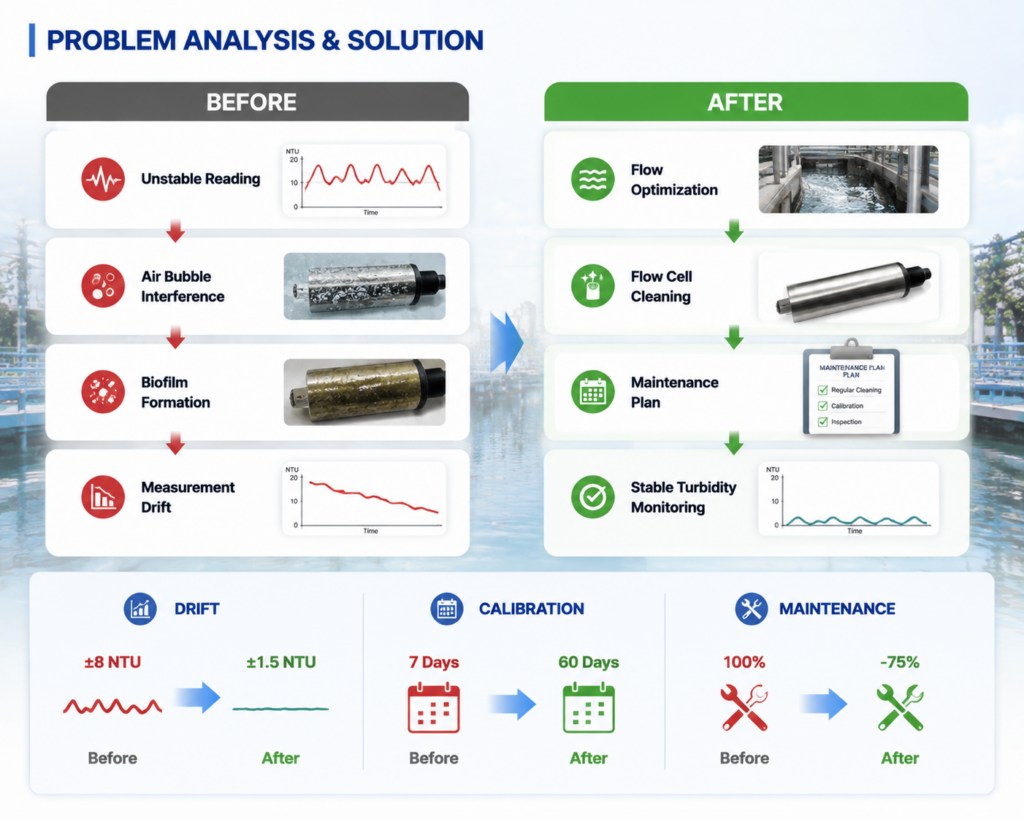
In real wastewater applications, unstable turbidity readings are not always caused by instrument accuracy problems.
Many customers initially assume that:
- The turbidity meter is defective.
- The sensor has aged.
- The analyzer needs to be replaced.
However, after years of field service experience, we found that measurement instability is often related to the sampling environment and installation conditions.
Case Study: Food Wastewater Treatment Plant
We worked with a food wastewater treatment plant where an online turbidity meter was installed to monitor biological treatment effluent at the final discharge point.
The customer used a flow-cell type online turbidity meter for continuous monitoring.
During operation, several problems appeared:
- The turbidity meter frequently triggered abnormal alarms.
- Online turbidity readings fluctuated significantly.
- Measured values remained higher than laboratory test results.
- Manual calibration was required every week.
Because the instrument data was inconsistent with laboratory verification, the customer initially suspected that the turbidity meter itself was inaccurate.
Root Cause Analysis
After a detailed inspection, our engineers found that the problem was not caused by the optical sensor itself.
The actual causes were related to the wastewater characteristics and sampling system.
1. Air Bubble Interference
The biological treatment effluent contained small air bubbles.
These bubbles entered the flow cell and affected the optical measurement.
Because turbidity measurement is based on light scattering:
- Suspended particles scatter light.
- Air bubbles also scatter light.
The sensor could not completely distinguish between particle scattering and bubble interference.
As a result:
- The turbidity signal became unstable.
- Readings fluctuated.
- False high turbidity alarms occurred.
2. Biofilm Formation Inside the Flow Cell
During continuous operation, biological slime gradually formed on the inner wall of the flow cell.
The deposits affected:
- Optical transmission conditions.
- Light scattering path.
- Measurement repeatability.
Over time, this caused:
- Increased measurement drift.
- More frequent cleaning.
- Shorter calibration intervals.
Improvement Measures
To solve the problem, the system was optimized instead of simply replacing the instrument.
The improvement included:
Optimize Sampling Conditions
- Reduce bubble interference.
- Improve sample flow stability.
- Ensure representative water conditions.
Improve Flow Cell Maintenance
- Remove biological deposits.
- Clean optical surfaces regularly.
- Establish a suitable cleaning schedule.
Adjust Maintenance Strategy
Based on actual wastewater conditions:
- Increase inspection effectiveness.
- Extend maintenance intervals based on operating data.
- Reduce unnecessary calibration.
Results After Improvement
After the modification:
| Parameter | Before | After |
|---|---|---|
| Turbidity drift | ±8 NTU | ±1.5 NTU |
| Calibration interval | Every 7 days | Every 60 days |
| Flow cell cleaning | Every 3 days | Every 30 days |
| Maintenance workload | — | Reduced by 75% |
The online turbidity meter achieved much more stable operation.
This case demonstrated that reliable turbidity monitoring depends not only on the sensor itself, but also on:
- Sampling design.
- Bubble control.
- Flow cell condition.
- Optical cleanliness.
- Maintenance strategy.
How to Choose the Right Online Turbidity Meter for Your Application
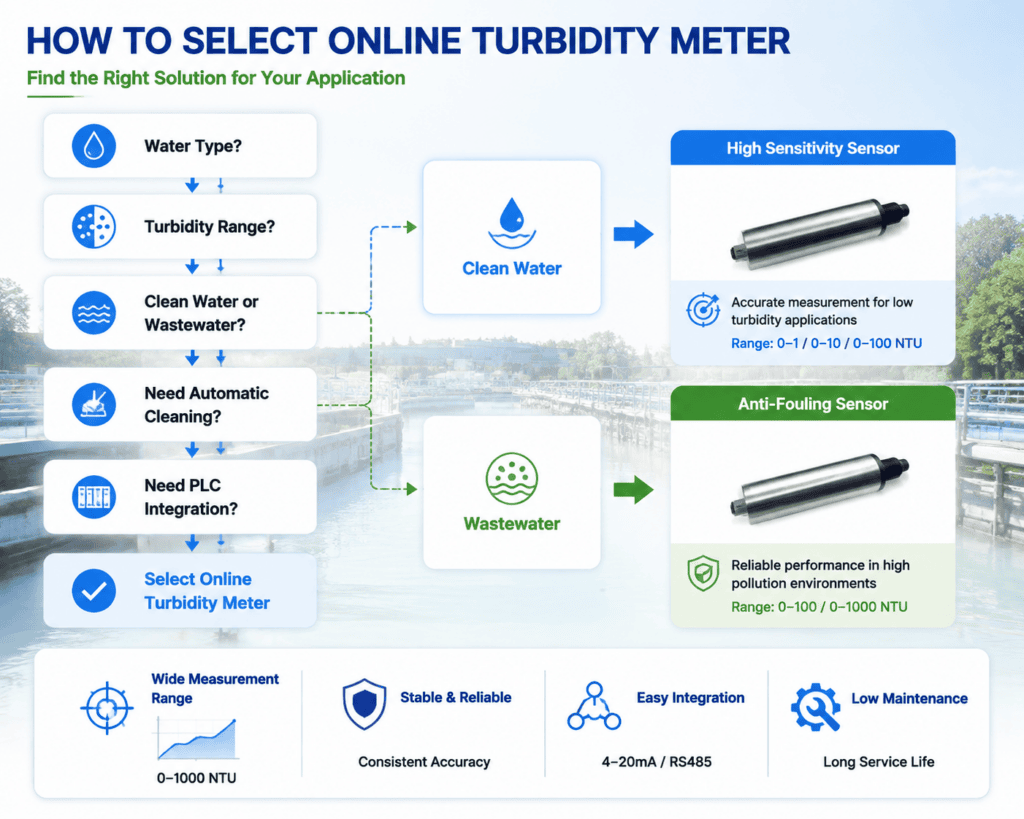
Selecting an online turbidity meter requires understanding the actual application conditions.
A suitable instrument should match:
- Water characteristics.
- Expected turbidity range.
- Installation environment.
- Communication requirements.
- Maintenance requirements.
Choosing the wrong sensor type may result in:
- Poor measurement resolution.
- Frequent cleaning.
- Unstable readings.
- Increased operating costs.
Key Specifications to Compare
1. Measurement Range
The measurement range should match the actual turbidity level.
Low Turbidity Applications
Examples:
- Drinking water.
- Filtered water.
- Condensate water.
- High-purity process water.
Recommended features:
- High sensitivity.
- Low NTU detection capability.
- Stable optical performance.
High Turbidity Applications
Examples:
- Wastewater.
- Industrial discharge.
- High-solids process water.
Recommended features:
- Wide measurement range.
- Fouling-resistant design.
- Easy cleaning capability.
2. Sensor Design and Fouling Resistance
For difficult applications, sensor design is critical.
Industrial wastewater may contain:
- Suspended solids.
- Organic matter.
- Chemical precipitation.
- Biological deposits.
In these conditions, choose sensors with:
- Fouling-resistant optical structures.
- Automatic cleaning options.
- Easy maintenance design.
3. Communication and Integration Capability
Modern online turbidity meters are often integrated into automation systems.
Before selection, confirm compatibility with:
- PLC systems.
- DCS platforms.
- SCADA systems.
- Environmental data acquisition systems.
Common outputs include:
- 4–20 mA.
- RS485.
- Modbus.
These functions enable:
- Remote monitoring.
- Automatic alarms.
- Historical data storage.
4. Calibration and Maintenance Requirements
Maintenance requirements depend heavily on water quality.
For clean water applications:
- Longer calibration intervals are possible.
- Less frequent cleaning is required.
For wastewater applications:
- More attention is needed for:
- Optical cleaning.
- Flow conditions.
- Sensor inspection.
A suitable turbidity meter should balance:
- Measurement stability.
- Maintenance frequency.
- Operating cost.
Selection Matrix for Different Industries
| Application | Typical Requirement | Recommended Solution | Key Consideration |
|---|---|---|---|
| Drinking Water | Low turbidity, high accuracy | Low-range turbidity sensor | Resolution and compliance |
| Wastewater Discharge | Variable turbidity, contamination risk | Wide-range online turbidity meter | Fouling resistance and cleaning |
| Food & Beverage | Product clarity monitoring | High-resolution turbidity system | Stability and repeatability |
| Industrial Process Water | Application dependent | Customized turbidity solution | Integration and reliability |
| Power Plant Water | Low turbidity protection | Sensitive online turbidity meter | Early warning capability |
FAQ About Online Turbidity Meters
What is an online turbidity meter?
An online turbidity meter is a continuous monitoring instrument that measures water clarity by detecting light scattered by suspended particles.
It provides real-time turbidity data for:
- Water treatment.
- Wastewater monitoring.
- Industrial process control.
How does an inline turbidity sensor work?
An inline turbidity sensor sends light into a water sample and measures the scattered light caused by suspended particles.
The optical signal is converted into a turbidity value.
Why does my online turbidity meter show unstable readings?
Common causes include:
- Air bubbles in the flow cell.
- Optical window contamination.
- Biofilm buildup.
- Unstable sample flow.
- Incorrect installation.
Before replacing the sensor, check the complete measurement system.
How often should an online turbidity meter be calibrated?
Calibration frequency depends on:
- Water quality.
- Sensor design.
- Operating environment.
Clean water systems may require less frequent calibration, while wastewater applications require more regular inspection.
What is the difference between a turbidity meter and a turbidity analyzer?
A turbidity meter generally refers to an instrument used for turbidity measurement.
An online turbidity analyzer usually includes:
- Continuous measurement capability.
- Signal processing.
- Communication functions.
- Process integration.
Conclusion
An online turbidity meter transforms turbidity measurement from periodic testing into continuous water quality monitoring.
The measurement principle is simple:
Light emission
↓
Particle scattering
↓
Optical detection
↓
Turbidity value output
However, reliable measurement requires more than the instrument itself.
A successful turbidity monitoring system depends on:
- Selecting the correct sensor range.
- Matching the sensor to the water matrix.
- Maintaining clean optical surfaces.
- Ensuring stable sampling conditions.
- Integrating reliable communication systems.
For industrial applications, online turbidity monitoring provides important advantages:
- Faster abnormal condition detection.
- Reduced manual sampling workload.
- Continuous historical data.
- Better process control.
By choosing the right online turbidity meter and designing the complete monitoring system correctly, users can improve water quality management, reduce maintenance costs, and achieve more stable operation.
Turbidity Monitoring Solutions
Reliable turbidity monitoring requires a complete solution rather than only a measurement device.
Wuxi Wohuan Instrument provides complete online turbidity monitoring solutions, including:
- Online turbidity meters
- Inline turbidity sensors
- Turbidity transmitters
- Turbidity analyzers
- Flow cell sampling systems
- Automatic cleaning solutions
- Industrial water quality monitoring systems
Our solutions are designed for:
- Industrial wastewater.
- Drinking water treatment.
- Food and beverage production.
- Power plant water systems.
- Process water monitoring.
Based on:
- Water characteristics.
- Turbidity range.
- Installation conditions.
- Control requirements.
Our engineering team helps customers select suitable turbidity monitoring solutions for reliable long-term operation.
Need Help Choosing the Right Online Turbidity Meter?
Choosing the correct online turbidity meter depends on more than the measurement range.
A suitable solution should consider:
- Application type.
- Water characteristics.
- Required accuracy.
- Installation environment.
- Communication requirements.
- Maintenance expectations.
Whether you need an online turbidity meter for wastewater discharge monitoring, industrial process control, or clean water applications, our engineering team can provide technical recommendations.
Explore Related Solutions
Explore more industrial water quality monitoring solutions:
- Online Turbidity Meter
- Residual Chlorine Analyzer
- pH Controller and Sensor
- ORP Sensor
- Dissolved Oxygen Sensor
- Conductivity Analyzer
- Multi-Parameter Water Quality Analyzer
Request a Free Consultation
Please provide:
- Application or industry.
- Water type.
- Expected turbidity range.
- Installation method.
- Sampling conditions.
- Communication requirements.
- Maintenance requirements.
Our technical team will recommend the most suitable online turbidity monitoring solution and provide configuration advice.