Introduction
Why do pH glass electrodes drift, respond slowly, or fail much earlier than expected? Many engineers assume the problem is calibration, but real-world experience often tells a different story. Over the years, we have supported wastewater treatment plants, municipal water facilities, and industrial process applications, helping customers solve a wide range of pH measurement challenges.
In this guide, you’ll learn how a pH glass electrode works, what affects its performance, how to maintain it properly, and how to avoid the most common mistakes that lead to inaccurate measurements and unnecessary replacement costs.
What Is a pH Glass Electrode and Why Does It Matter?
A pH glass electrode is the most widely used sensor for measuring hydrogen ion activity in liquids. It converts chemical information into an electrical signal that can be displayed as a pH value.
Although pH measurement technology has existed for more than 100 years, the glass electrode remains the industry standard because of its accuracy, stability, and broad compatibility with water treatment and industrial processes.
Today, pH glass electrodes are used in:
- Municipal wastewater treatment plants
- Drinking water treatment systems
- Chemical manufacturing
- Food and beverage production
- Environmental monitoring stations
- Pharmaceutical processes
Without reliable pH measurement, operators cannot accurately control chemical dosing, maintain process stability, or meet discharge regulations.
How Does a pH Glass Electrode Work?
The sensing element of a pH electrode is a thin glass membrane.
When the electrode is immersed in a solution, hydrogen ions interact with the hydrated layer that forms on the glass surface.
This interaction creates a voltage difference between the internal reference solution and the external process liquid.
The pH transmitter measures this voltage and converts it into a pH value.
At 25°C, the theoretical response is approximately:
59.16 mV per pH unit
The relationship follows the Nernst Equation and forms the foundation of modern pH measurement technology.
Main Components of a pH Glass Electrode
A typical industrial glass pH electrode consists of four key components.
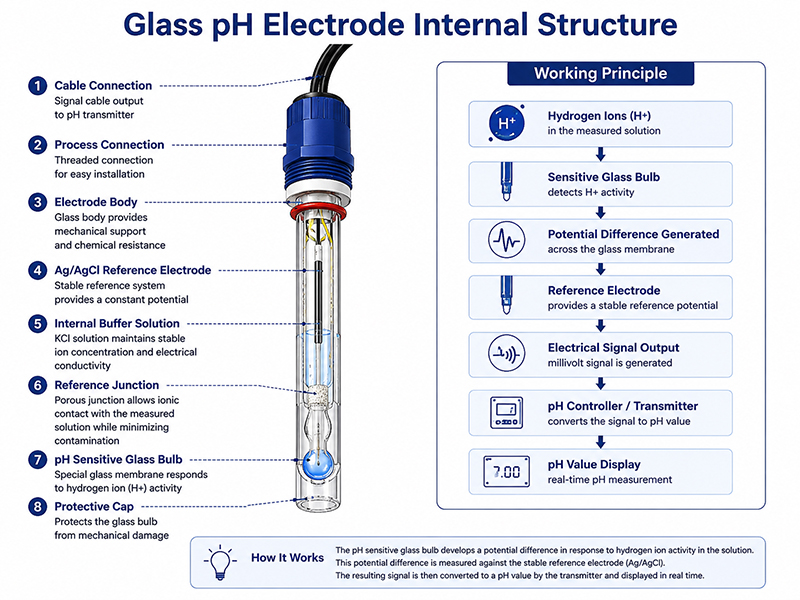
Glass Membrane
The glass bulb acts as the sensing element and responds to hydrogen ion activity.
Typical thickness:
0.1–0.2 mm
Internal Reference System
An Ag/AgCl electrode and stable electrolyte provide a constant reference potential.
Liquid Junction
The junction allows ionic contact between the reference electrolyte and the process liquid.
This is often the first area affected by contamination.
Protective Housing
Industrial electrodes commonly use:
- Epoxy
- PPS (Ryton)
- PVDF
These materials help withstand harsh industrial environments.
Performance Range and Limitations
Most standard industrial pH glass electrodes operate effectively within:
pH 1–13
However, performance changes at extreme pH values.
| pH Range | Typical Performance |
| pH 2–10 | Best Accuracy |
| pH < 1 | Acid Error Possible |
| pH > 12 | Alkaline Error Possible |
Temperature, ionic strength, contamination, and glass composition can all influence performance.
Under normal conditions, industrial pH electrodes achieve:
±0.01–0.02 pH accuracy
and
6–18 months service life
depending on the application.
Why Do pH Glass Electrodes Drift?
Even high-quality pH sensors experience gradual drift over time.
Common causes include:
- Junction fouling
- Glass membrane aging
- Contamination buildup
- Improper installation
- Dehydration
- Calibration neglect
Most industrial sensors require regular calibration to maintain accuracy.
From Our Field Experience: Sensor Drift Is Often an Installation Problem
One of the most common questions we receive is:
“Why does my pH electrode keep drifting even after calibration?”
Many operators assume the sensor is defective.
In reality, improper installation is often the real cause.
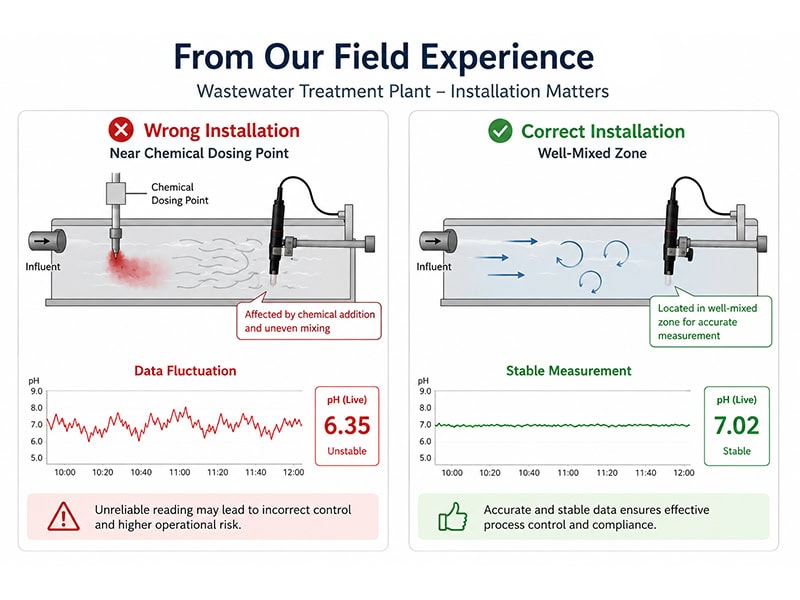
For example, we once supported a municipal wastewater treatment plant that reported severe pH drift. The customer initially believed the electrode had failed and planned to replace it.
After reviewing the installation conditions, our engineers discovered that the sensor had been installed directly beside the acid and alkali dosing point inside the neutralization tank.
Whenever chemicals were injected, the electrode measured the local concentration around the dosing point rather than the actual pH of the mixed process water.
The result was unstable readings and continuous drift.
After relocating the sensor to a properly mixed area of the tank according to our installation recommendations, the measurements immediately became stable.
This case highlights an important lesson:
Before replacing a drifting pH electrode, always verify the installation location first.
Calibration Best Practices
Even the best pH electrode will eventually lose accuracy without proper calibration.
Recommended Calibration Method
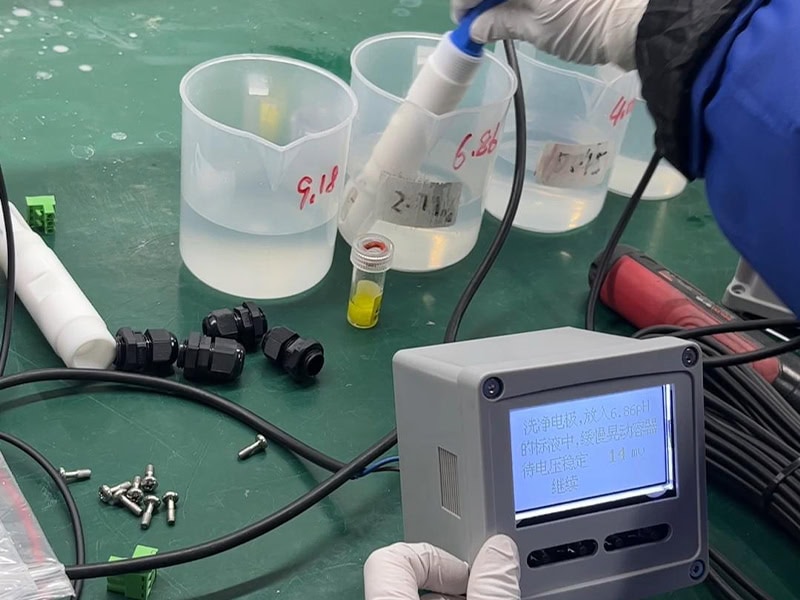
For most industrial applications, three-point calibration is recommended.
Use:
- pH 4.00
- pH 6.86 (or pH 7.00)
- pH 9.18 (or pH 10.01)
This method verifies sensor performance across acidic, neutral, and alkaline ranges.
Calibration Tips
- Use fresh buffer solutions
- Avoid contaminated containers
- Rinse between buffers
- Allow readings to stabilize
- Verify slope after calibration
A healthy electrode should typically achieve:
95–105% slope
relative to the theoretical value.
Proper Maintenance Extends Electrode Life
Routine maintenance is one of the easiest ways to improve sensor performance.
Weekly Cleaning
Different fouling types require different cleaning methods.
| Fouling Type | Recommended Cleaning |
| Carbonate Scale | Mild Acid |
| Oil & Grease | Detergent |
| Biological Film | Pepsin-HCl Solution |
Storage Guidelines
Never store a pH glass electrode dry.
Always keep the sensing bulb hydrated using:
- Storage solution
- Reference electrolyte
- Manufacturer-recommended soaking solution
Avoid long-term storage in distilled water.
Common Causes of Unstable pH Readings
Many users immediately suspect sensor failure when readings become unstable.
However, process conditions often play a much larger role.
Common causes include:
- Excessive flow velocity
- Air bubbles
- Electrode contamination
- Sensor aging
- Poor installation location
From Our Field Experience: Air Bubbles Can Cause Serious Measurement Errors
One process condition that operators frequently overlook is the presence of air bubbles.
We encountered this issue while supporting a wastewater treatment plant using online pH monitoring in an aeration basin.
The operators reported unstable measurements and suspected the electrode was contaminated.
After inspection, our engineers discovered that large quantities of air bubbles generated by the aeration system were continuously passing through the measurement area.
Some bubbles attached directly to the glass membrane and reference junction.
When air bubbles cover part of the sensing surface, they prevent proper contact between the process liquid and the electrode.
This can result in:
- Unstable readings
- Delayed response
- Abnormal membrane potential
- Apparent measurement drift
After adjusting the installation position to reduce bubble interference, the readings became significantly more stable without replacing the sensor.
This experience demonstrates that installation conditions are just as important as electrode selection.
Industrial Applications of pH Glass Electrodes
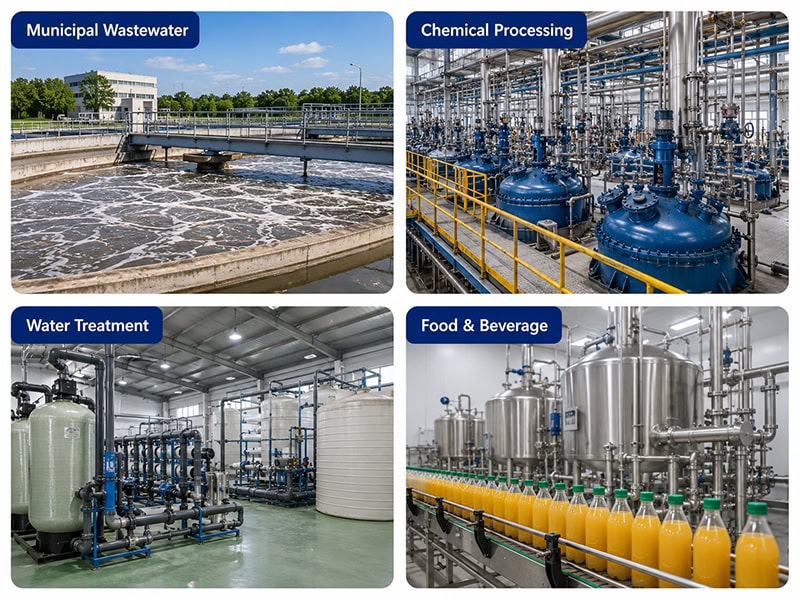
Wastewater Treatment
pH control is essential for:
- Neutralization tanks
- Chemical dosing systems
- Effluent discharge compliance
Municipal Water Treatment
Water plants rely on pH monitoring to maintain:
- Treatment efficiency
- Corrosion control
- Drinking water quality
Chemical Manufacturing
Accurate pH measurement helps optimize:
- Reaction control
- Product quality
- Chemical consumption
Food and Beverage Production
pH monitoring helps ensure:
- Product consistency
- Fermentation control
- Food safety
How Long Does a pH Glass Electrode Last?
Typical service life varies by application.
| Application | Typical Lifespan |
| Municipal Water | 12–18 Months |
| Wastewater Treatment | 6–12 Months |
| Chemical Process | Process Dependent |
| High Contamination Media | Often Less Than 12 Months |
Proper maintenance can significantly extend electrode life.
Conclusion
The pH glass electrode remains the most reliable and widely used technology for industrial pH measurement. However, measurement accuracy depends on more than the sensor itself.
Proper installation, routine calibration, regular cleaning, and suitable operating conditions all play critical roles in long-term performance.
As our field experience has shown, many pH measurement problems are caused by installation issues or process conditions rather than sensor failure. Understanding these factors can help reduce downtime, improve measurement reliability, and extend electrode service life.
About Industrial pH Glass Electrodes
Accurate pH measurement is essential for wastewater treatment, municipal water systems, chemical processing, and industrial process control. However, long-term performance depends not only on the electrode itself, but also on proper selection, installation, calibration, and maintenance.
Wohuan Instrument specializes in industrial pH glass electrodes, online pH analyzers, built-in ATC pH sensors, and water quality monitoring systems. With extensive field experience across wastewater treatment and industrial applications, we help customers improve measurement stability and reduce maintenance costs.
Need Help Selecting the Right pH Glass Electrode?
The right pH glass electrode depends on your process conditions, installation environment, and long-term monitoring requirements. Choosing the correct sensor can improve measurement accuracy, reduce maintenance, and extend service life.
If you are evaluating industrial pH glass electrodes, online pH analyzers, or water quality monitoring solutions, our engineering team can help identify suitable options for your application.
Explore More
Homepage:
https://wxinstrument.com/
Industrial pH Sensors:
https://wxinstrument.com/product-cate/online-ph-meter/
Contact Us:
https://wxinstrument.com/contact/
Request a Quote, Download Our Catalog, or Contact Our Engineers Today to Discuss Your Project Requirements.