Introduction
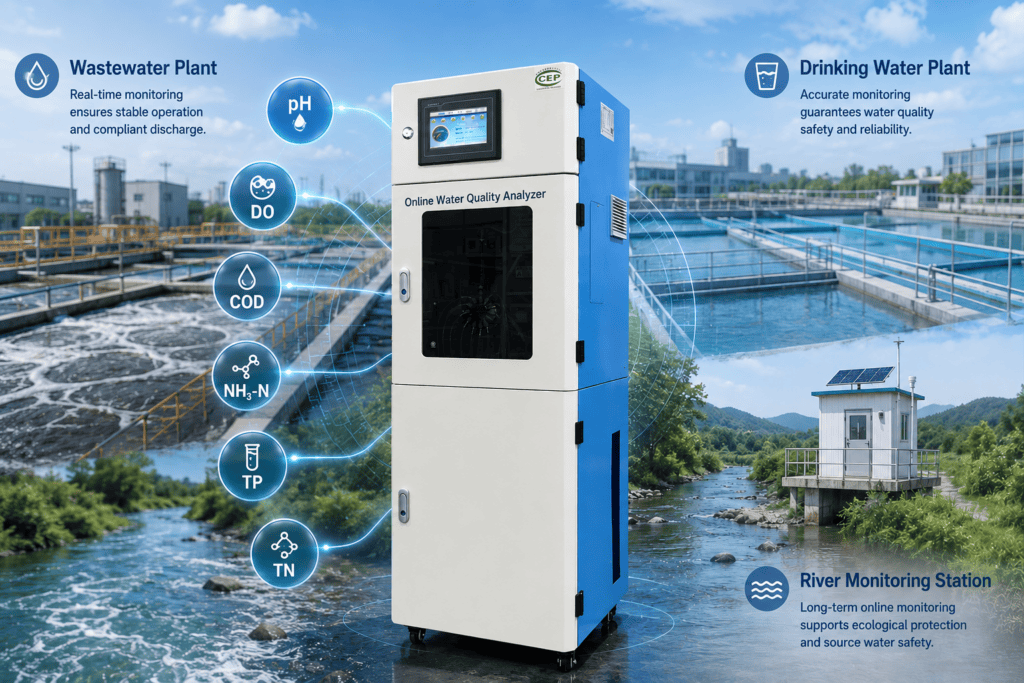
Water monitoring systems have changed the way utilities, industries, and environmental agencies manage water quality. Instead of waiting hours or days for laboratory results, operators can now access real-time data and respond immediately to changing conditions.
In this guide, you’ll learn how water monitoring systems work, what components they include, and how they help improve water quality management. You’ll also discover how real-time monitoring reduces operating costs, improves compliance, and supports smarter decision-making.
Over the years, our engineering team has helped wastewater treatment plants, industrial facilities, and water utilities implement online monitoring systems that significantly improved operational efficiency and data visibility.
By the end of this article, you’ll understand how to select, implement, and benefit from a modern water monitoring system.
What Is a Water Monitoring System?
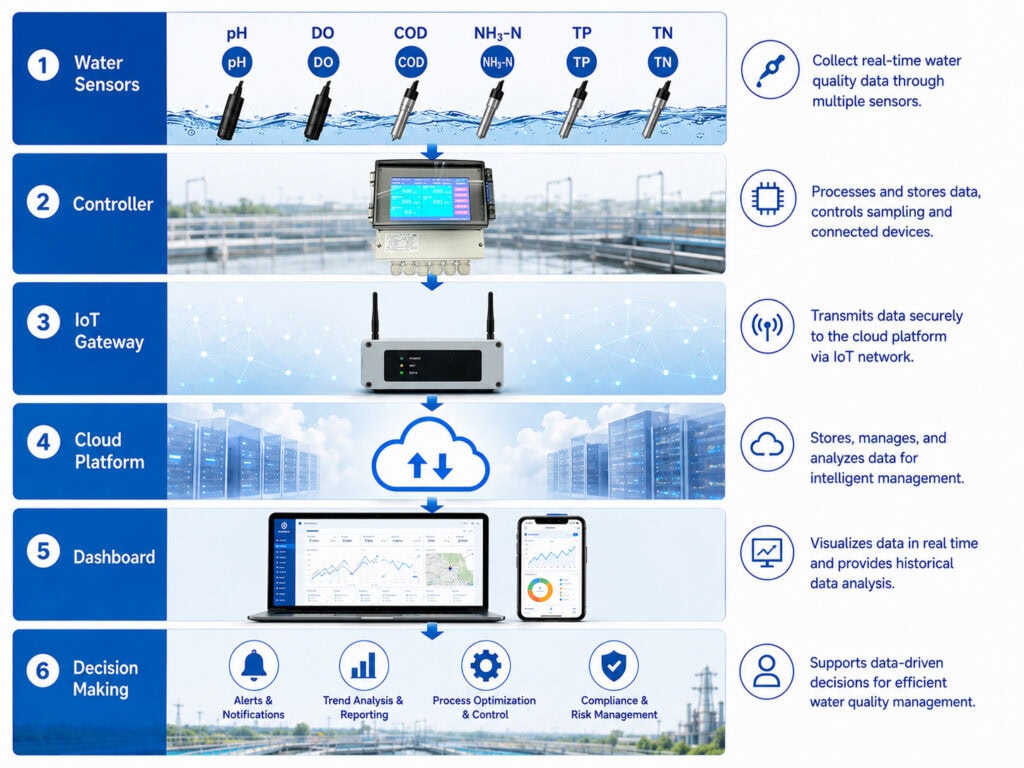
A water monitoring system is a combination of sensors, analyzers, controllers, communication devices, and software that continuously measures water quality and water quantity.
These systems collect data automatically and provide operators with real-time visibility into changing water conditions.
Instead of relying on occasional manual sampling, operators can monitor critical parameters 24 hours a day.
Modern systems are widely used in:
- Drinking water treatment plants
- Wastewater treatment facilities
- Rivers and lakes
- Industrial process systems
- Pharmaceutical water systems
- Power plants
The goal is simple: detect problems early, improve operational control, and ensure water quality remains within required limits.
Main Types of Water Monitoring Systems
Most projects fall into one or more of the following categories.
Water Quality Monitoring Systems
These systems focus on measuring chemical and physical water parameters.
Common measurements include:
- pH
- Dissolved oxygen
- Turbidity
- Conductivity
- Ammonia nitrogen
- Total phosphorus
- Total nitrogen
- Residual chlorine
Water quality monitoring is widely used in drinking water production, wastewater treatment, and industrial process control.
Water Quantity Monitoring Systems
These systems focus on measuring:
- Flow rate
- Water level
- Pressure
- Consumption
They help operators understand how water moves through pipelines, reservoirs, treatment plants, and distribution networks.
Leak Detection Systems
Leak detection systems help utilities and industrial facilities identify water losses before they become major problems.
Continuous monitoring allows operators to:
- Reduce water waste
- Lower operating costs
- Protect infrastructure
- Improve system efficiency
Core Components of a Water Monitoring System
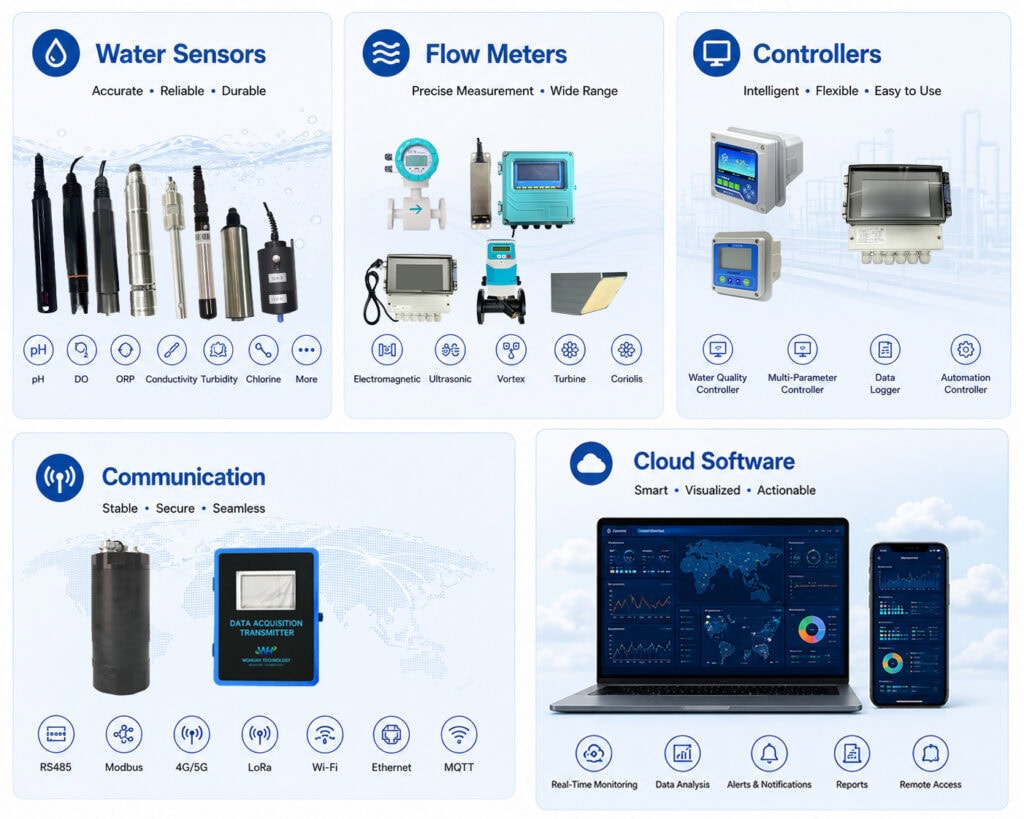
Every monitoring system contains several layers that work together to transform raw measurements into useful information.
Water Quality Sensors and Probes
Sensors are the foundation of any water monitoring system.
They continuously measure water conditions and convert those measurements into electrical signals.
Common sensor types include:
- pH sensors
- ORP sensors
- Dissolved oxygen sensors
- Conductivity sensors
- Turbidity sensors
- Ammonia analyzers
- COD analyzers
- Total phosphorus analyzers
- Total nitrogen analyzers
Different applications require different sensor combinations.
For example, a wastewater treatment plant may monitor pH, dissolved oxygen, ammonia nitrogen, total phosphorus, and COD simultaneously.
Flow, Level, and Pressure Instruments
Water quality alone does not provide a complete picture.
Many projects also require:
- Electromagnetic flow meters
- Ultrasonic flow meters
- Radar level meters
- Pressure transmitters
These instruments help operators understand how water moves through the system.
Controllers and Transmitters
Controllers receive signals from sensors and convert them into useful process data.
Modern controllers can:
- Display measurements locally
- Store historical data
- Trigger alarms
- Control pumps and dosing systems
- Transmit data to SCADA platforms
They act as the communication hub of the monitoring system.
Data Acquisition and Communication
Data becomes more valuable when it is available remotely.
Most modern water monitoring systems use:
- Modbus RTU
- Modbus TCP
- Ethernet
- 4G communication
- NB-IoT
- LoRaWAN
These technologies allow operators to access data from virtually anywhere.
Software and Visualization Platforms
Software transforms raw measurements into actionable information.
Operators can:
- View real-time trends
- Receive alarm notifications
- Generate reports
- Analyze historical performance
- Track regulatory compliance
Many systems now include cloud-based dashboards accessible from computers, tablets, and smartphones.
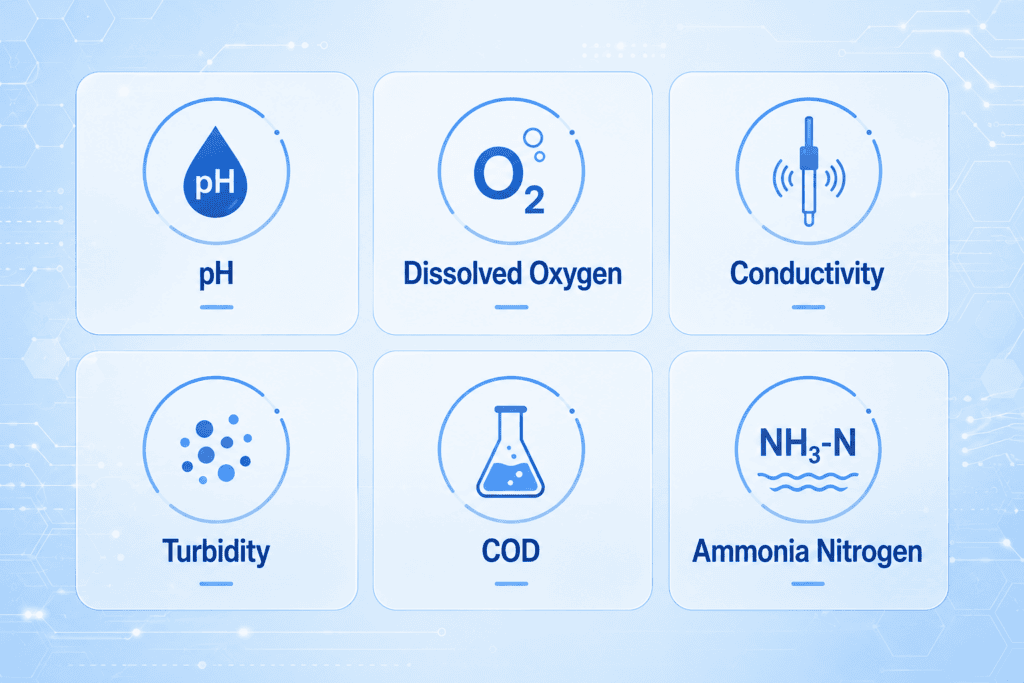
Key Water Quality Parameters
Different applications require different monitoring strategies.
However, several parameters appear in most projects.
pH and ORP
pH is one of the most important water quality indicators.
It affects:
- Chemical reactions
- Corrosion rates
- Disinfection efficiency
- Biological treatment performance
ORP measurements help operators evaluate oxidation and disinfection processes.
Dissolved Oxygen
Dissolved oxygen plays a critical role in wastewater treatment and aquaculture.
Maintaining the correct oxygen concentration improves biological activity and reduces energy consumption.
Wastewater treatment plants commonly maintain dissolved oxygen levels between 2 and 4 mg/L.
Conductivity and TDS
Conductivity measures the concentration of dissolved ions in water.
Applications include:
- Boiler feedwater monitoring
- Pure water systems
- Cooling water systems
- Industrial process control
Conductivity often provides an early warning of contamination or process changes.
Turbidity
Turbidity indicates the concentration of suspended particles in water.
High turbidity can indicate:
- Filter breakthrough
- Process upsets
- Contamination events
Continuous turbidity monitoring helps operators respond quickly before water quality deteriorates.
Nutrients and Organic Matter
Many wastewater treatment facilities continuously monitor:
- Ammonia nitrogen
- Total nitrogen
- Total phosphorus
- COD
- TOC
These parameters help operators optimize treatment efficiency and maintain discharge compliance.
Types of Water Monitoring Systems
Modern monitoring systems can be deployed in different ways depending on project requirements.
Fixed Online Monitoring Stations
These systems operate continuously and are commonly installed in:
- Water treatment plants
- Wastewater facilities
- Industrial sites
- Environmental monitoring stations
They provide the highest level of automation and data availability.
Portable Monitoring Systems
Portable instruments are designed for field inspections and temporary measurements.
They are commonly used for:
- Site surveys
- Verification testing
- Emergency response
- Environmental investigations
Remote Monitoring Platforms
Remote systems combine sensors, communication networks, and cloud software.
Operators can access real-time measurements without visiting the site.
This approach reduces labor costs and improves response speed.
IoT-Based Water Monitoring Systems
IoT technology has made water monitoring more accessible than ever.
Modern systems can transmit data automatically and provide instant alerts when abnormal conditions occur.
This allows operators to make faster and more informed decisions.
From Manual Sampling to Real-Time Water Quality Monitoring
For decades, many facilities relied on manual sampling and laboratory testing.
Operators collected water samples, transported them to a laboratory, and waited hours or even days for results.
While this approach provided useful information, it created a significant delay between a water quality event and the operator’s response.
Today, online water monitoring systems provide continuous measurements every few seconds or minutes.
Instead of reacting after a problem occurs, operators can identify trends early and take action before water quality deteriorates.
This shift from manual testing to continuous monitoring has become one of the most important developments in modern water management.
From Our Field Experience:
How Real-Time Monitoring Replaced Manual Sampling
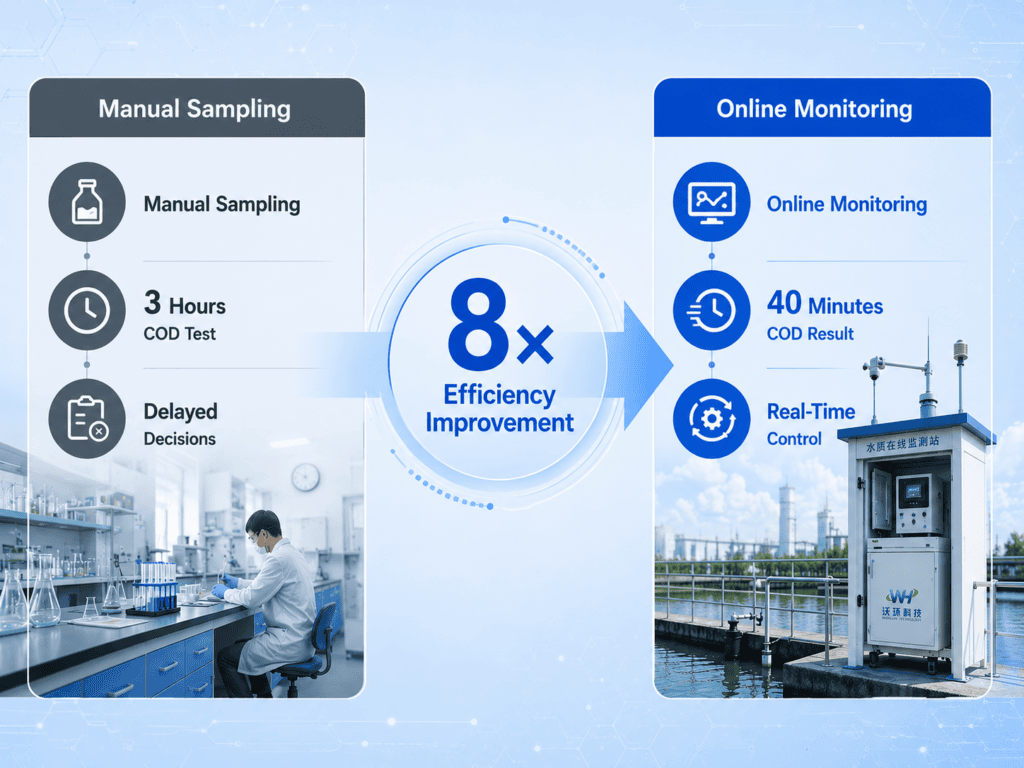
One wastewater treatment plant we supported relied heavily on manual sampling and laboratory analysis.
Operators collected water samples throughout the day and sent them to the laboratory for testing.
For COD analysis alone, a single test required approximately three hours.
The process created two major challenges.
First, laboratory capacity limited the number of samples that could be analyzed each day.
Second, delayed results prevented operators from adjusting treatment processes in time, reducing overall treatment efficiency.
To solve these problems, the facility upgraded to an online water monitoring system incorporating:
- pH analyzers
- Dissolved oxygen sensors
- COD analyzers
- Ammonia nitrogen analyzers
- Total phosphorus analyzers
- Total nitrogen analyzers
- Heavy metal analyzers
The results were significant.
Overall operational efficiency increased by approximately eight times.
COD analysis time was reduced from three hours to around forty minutes.
Daily testing capacity exceeded 1,000 samples.
More importantly, operators no longer spent most of their time collecting samples and performing routine laboratory work.
Instead, they focused on process optimization, pollution source analysis, and operational decision-making.
This project demonstrated that real-time monitoring is not only about collecting data faster. It fundamentally changes how treatment plants operate and make decisions.
Benefits of Real-Time Water Monitoring
The value of continuous monitoring extends far beyond convenience.
Real-time data allows operators to:
- Detect contamination events earlier
- Improve treatment efficiency
- Optimize chemical dosing
- Reduce operating costs
- Improve regulatory compliance
- Minimize environmental risks
In many facilities, the savings generated through improved process control can quickly offset the initial investment.
IoT and Smart Water Monitoring
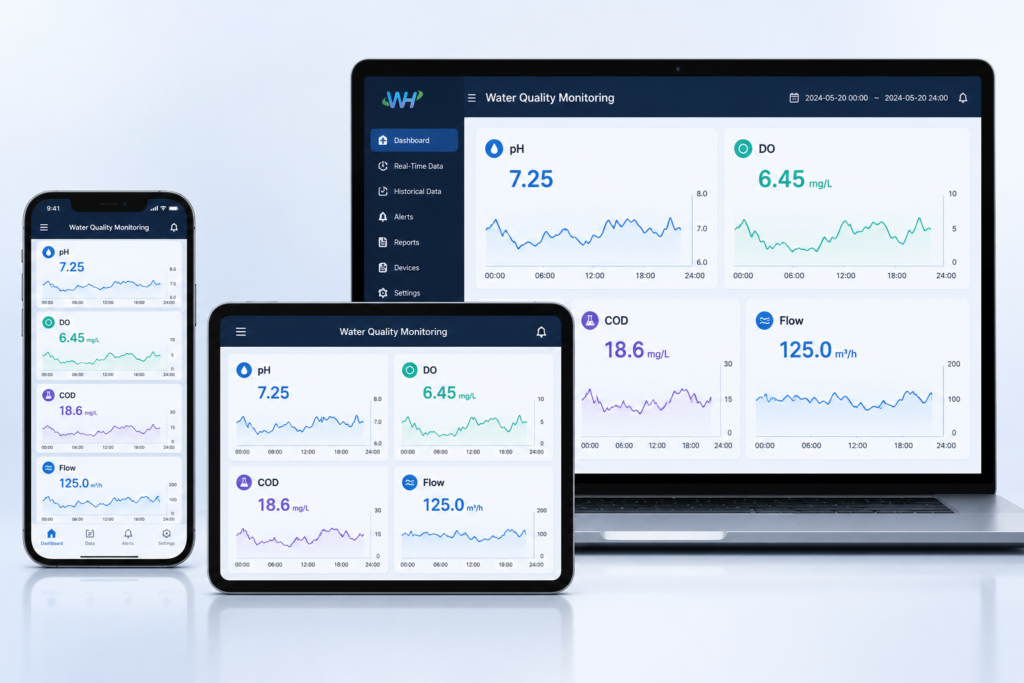
The rapid growth of IoT technology has transformed the water industry.
Modern monitoring systems are no longer isolated instruments.
They are connected devices that continuously exchange data with cloud platforms, mobile applications, and control systems.
This connectivity allows operators to manage facilities more efficiently, even when they are not physically on site.
Mobile Access and Remote Monitoring
Plant managers can now view water quality data directly from:
- Smartphones
- Tablets
- Laptops
- Remote control centers
Instead of waiting for daily reports, operators can access live measurements at any time.
This improves visibility and speeds up decision-making.
Automatic Alarms and Notifications
Modern systems can automatically generate alerts when abnormal conditions occur.
Examples include:
- High turbidity
- Low dissolved oxygen
- Excessive ammonia levels
- Abnormal pH values
- Communication failures
Notifications can be delivered through:
- SMS
- Mobile applications
- SCADA alarm systems
Fast alerts help operators respond before small issues become major problems.
Low-Power Communication Networks
Remote monitoring stations often operate in locations without wired communication infrastructure.
To solve this challenge, modern systems use technologies such as:
- NB-IoT
- LoRaWAN
- 4G
- 5G
These networks allow monitoring stations to transmit data reliably while minimizing power consumption.
For remote river monitoring stations and environmental monitoring projects, battery life can often be measured in years rather than months.
Integration with Existing Systems
Most facilities already operate some form of automation system.
Modern water monitoring systems are designed to integrate with:
- SCADA systems
- PLCs
- Cloud platforms
- Environmental reporting systems
Common communication protocols include:
- Modbus RTU
- Modbus TCP
- OPC UA
- REST APIs
This allows operators to combine water quality information with other operational data for a complete view of facility performance.
Applications Across Different Industries
Water monitoring systems are used in nearly every industry where water quality affects safety, compliance, production, or environmental performance.
Drinking Water Treatment
Drinking water facilities use monitoring systems to control:
- Coagulation
- Filtration
- Disinfection
- Distribution network quality
Continuous monitoring helps operators maintain safe drinking water while minimizing chemical consumption.
Wastewater Treatment
Wastewater treatment plants continuously monitor:
- pH
- Dissolved oxygen
- COD
- Ammonia nitrogen
- Total phosphorus
- Total nitrogen
These measurements help optimize biological treatment processes and ensure discharge compliance.
Industrial Process Water
Industrial facilities use water monitoring systems to:
- Protect equipment
- Improve product quality
- Reduce corrosion
- Optimize chemical dosing
Common industries include:
- Petrochemical
- Chemical manufacturing
- Power generation
- Food processing
- Mining
Pharmaceutical and High-Purity Water Systems
Pharmaceutical manufacturers require extremely stable water quality.
Monitoring systems are commonly used to measure:
- Conductivity
- TOC
- pH
- Flow
- Temperature
Continuous monitoring helps maintain product quality and regulatory compliance.
Environmental Monitoring
Government agencies and environmental organizations use monitoring systems in:
- Rivers
- Lakes
- Reservoirs
- Coastal waters
Continuous monitoring allows early detection of pollution events and provides valuable environmental data for long-term planning.
Ensuring Data Quality and Sensor Performance
Even the most advanced monitoring system cannot deliver reliable results if data quality is poor.
Many users assume that unstable readings automatically indicate faulty sensors or calibration problems.
In reality, data quality depends on several factors working together, including:
- Sensor selection
- Installation location
- Sampling conditions
- Maintenance practices
- Operator training
A well-designed system should address all of these factors.
Best Practices for Reliable Data
To maintain stable performance:
- Use sensors designed for the application
- Follow calibration schedules
- Inspect sampling systems regularly
- Clean sensors before fouling affects measurements
- Compare online data with laboratory results periodically
Preventive maintenance is usually less expensive than troubleshooting unexpected failures.
From Our Field Experience:
Why Accurate Instruments Still Produced Unstable Data
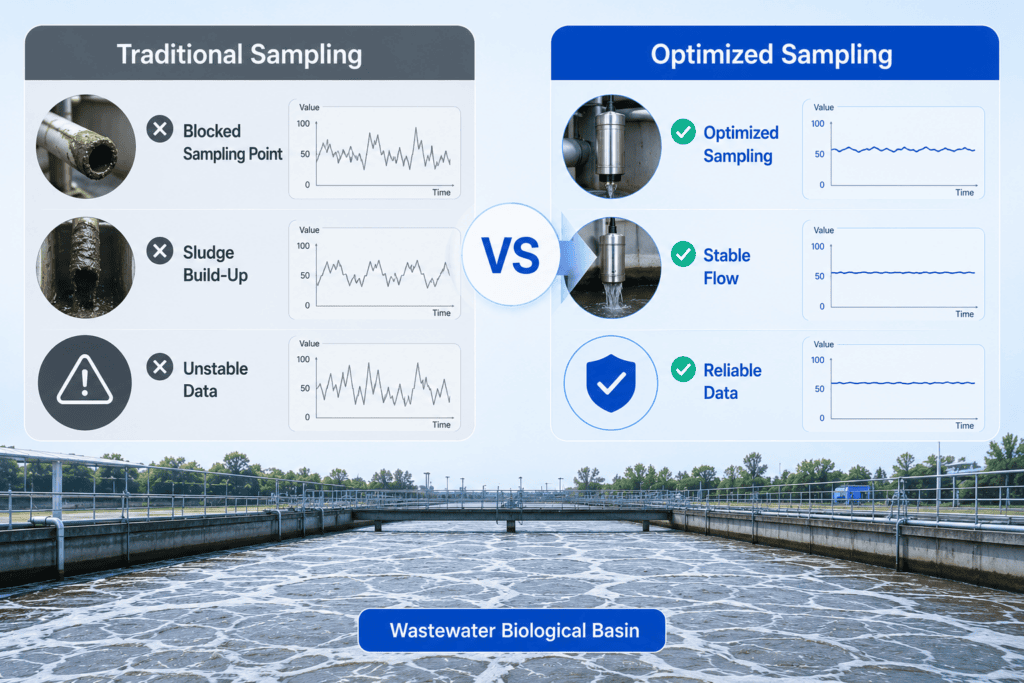
We once supported a wastewater treatment plant that had recently completed installation of an online water quality monitoring system.
Shortly after commissioning, operators reported unstable readings from ammonia nitrogen, total phosphorus, and turbidity analyzers.
The customer initially believed the problem was caused by poor sensor quality or incorrect factory calibration.
They even requested replacement of the entire monitoring system.
Our engineers visited the site and began troubleshooting.
First, each analyzer was tested individually using standard solutions.
The readings were accurate, confirming that the instruments were operating correctly.
Next, we inspected the installation method and sensor positioning.
Again, no problems were found.
The real issue was eventually discovered inside the biological treatment basin.
Large amounts of sludge had accumulated around the sampling point.
Over time, the sludge partially blocked the intake line, causing inconsistent sample flow and non-representative water samples.
As a result, the monitoring data fluctuated significantly even though the analyzers were functioning properly.
To solve the problem, we recommended two improvements:
- Install a pretreatment unit with sedimentation and filtration before the sampling point
- Upgrade to self-cleaning sensors designed for high-solids applications
We also provided operator training covering routine inspection, pipeline maintenance, and sensor cleaning procedures.
After implementing these changes, the monitoring system delivered stable and reliable data.
The plant was able to improve process control and significantly increase operational efficiency.
This case highlights an important lesson: data quality depends not only on the analyzer itself but also on sampling conditions, installation design, and maintenance practices.
Balancing Performance and Cost
Every monitoring project has budget limitations.
The goal is not always to purchase the most expensive equipment.
The goal is to achieve the best balance between:
- Accuracy
- Reliability
- Maintenance requirements
- Lifecycle cost
In many projects, a combination of premium analyzers and cost-effective sensors provides the best overall value.
Factors That Influence System Cost
Several factors affect project cost:
- Number of monitoring parameters
- Required accuracy
- Communication method
- Automation level
- Environmental conditions
- Maintenance requirements
Understanding these requirements early helps avoid unnecessary spending.
Designing and Implementing a Water Monitoring Project
Successful projects begin with clear objectives.
Before selecting equipment, define:
- Which parameters need monitoring
- Required accuracy
- Reporting frequency
- Communication requirements
- Regulatory obligations
This information helps ensure the system is properly designed from the beginning.
Typical Implementation Process
Most projects follow these steps:
- Requirement analysis
- Site survey
- Equipment selection
- Installation
- Commissioning
- Calibration and verification
- Operator training
- Ongoing maintenance
A structured implementation process helps reduce project risk and improve long-term performance.
Conclusion
Water monitoring systems have become an essential tool for modern water management.
By combining sensors, analyzers, communication networks, and software platforms, these systems provide continuous visibility into water quality and process performance.
As the real-world examples in this guide demonstrate, real-time monitoring can significantly improve operational efficiency, reduce response times, and support better decision-making.
At the same time, reliable data depends on more than just selecting the right analyzer. Proper installation, representative sampling, and routine maintenance are equally important.
Whether you operate a wastewater treatment plant, drinking water facility, industrial process, or environmental monitoring network, a well-designed water monitoring system can help improve performance while reducing long-term operating costs.
About Water Monitoring Solutions
Effective water monitoring is no longer limited to collecting data. The real value comes from transforming that data into actionable decisions that improve water quality, reduce operating costs, and support regulatory compliance.
As the examples in this guide demonstrate, successful monitoring projects require more than sensors alone. System design, sampling conditions, communication infrastructure, and maintenance practices all influence long-term performance.
Wohuan Instrument specializes in water quality analyzers, online monitoring systems, radar level meters, flow meters, and industrial process instrumentation. We support wastewater treatment plants, water utilities, industrial facilities, and environmental monitoring projects with reliable monitoring solutions designed for real-world operating conditions.
Need Help Selecting a Water Monitoring System?
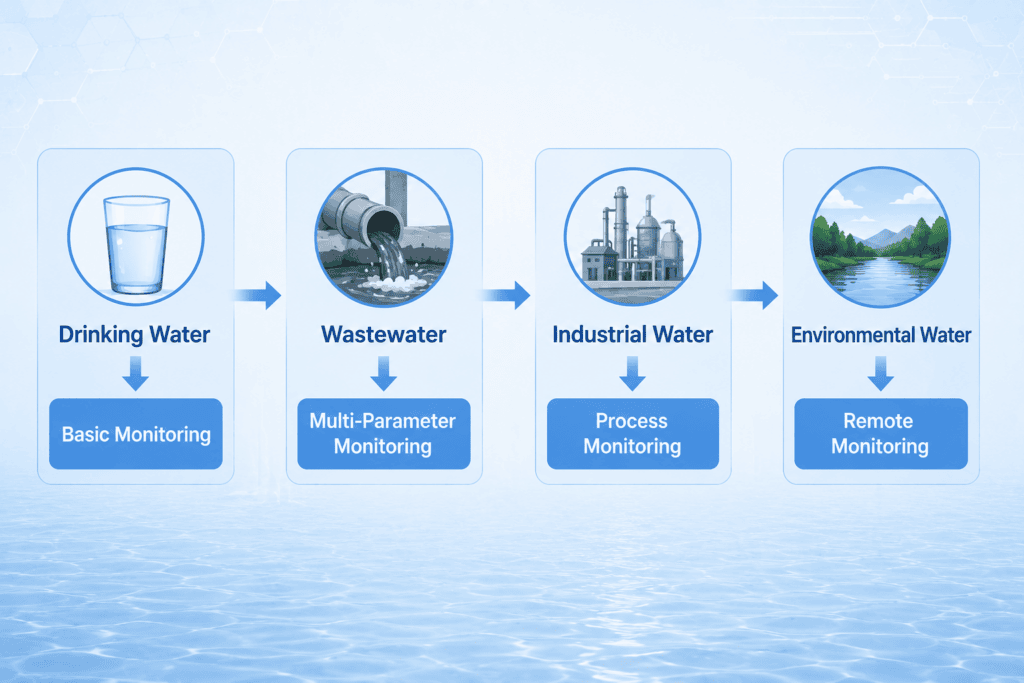
Choosing the right water monitoring system depends on more than just the sensors. Water quality parameters, installation conditions, communication requirements, maintenance strategy, and future expansion plans all affect long-term performance.
Whether you are monitoring wastewater treatment processes, drinking water networks, industrial process water, or environmental monitoring stations, selecting the right solution can improve operational efficiency, reduce maintenance costs, and provide more reliable data.
If you are looking for online water quality analyzers, water monitoring systems, flow meters, radar level sensors, or complete monitoring stations, our engineering team can help recommend suitable solutions based on your application requirements.
Explore More Solutions
Homepage
https://wxinstrument.com/
Water Quality Monitoring Solutions
https://wxinstrument.com/application/water-wastewater/
Water Quality Analyzers & Sensors
https://wxinstrument.com/product-cate/process-analyzers/
Contact Our Engineers
https://wxinstrument.com/contact/
Get a Quote
Tell us your monitoring parameters, installation environment, and communication requirements. Our engineers will recommend a suitable water monitoring solution for your project.