Introduction
An ORP sensor provides one of the fastest ways to evaluate the oxidizing or reducing condition of water. Unlike laboratory analysis that measures individual chemicals, an ORP sensor continuously monitors the overall oxidation-reduction potential of a solution, giving operators immediate feedback on process conditions.
ORP measurement plays an essential role in drinking water disinfection, wastewater treatment, cooling water systems, swimming pools, aquaculture, and chemical processing. A stable ORP value helps operators optimize chemical dosing, improve treatment efficiency, and maintain regulatory compliance.
However, selecting the wrong sensor, installing it in the wrong location, or overlooking routine maintenance can lead to unstable readings, frequent calibration, and unnecessary sensor replacement.
This guide explains how ORP sensors work, how to choose the right probe for different applications, common troubleshooting methods, and practical maintenance tips based on real engineering experience.
Quick Answer
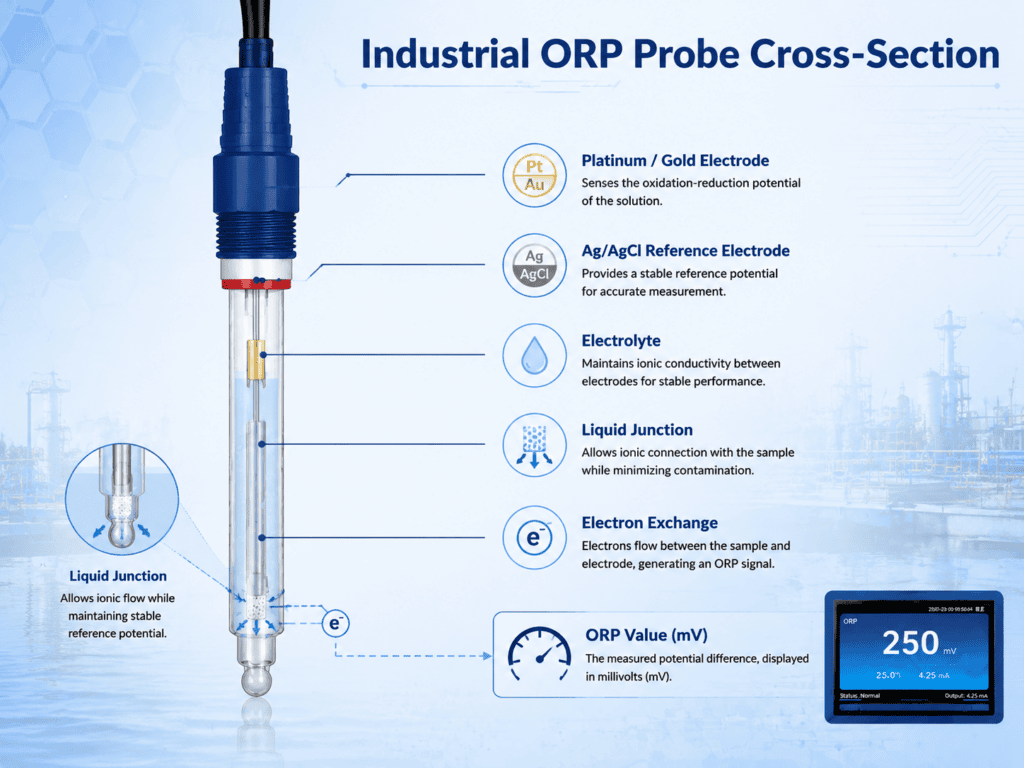
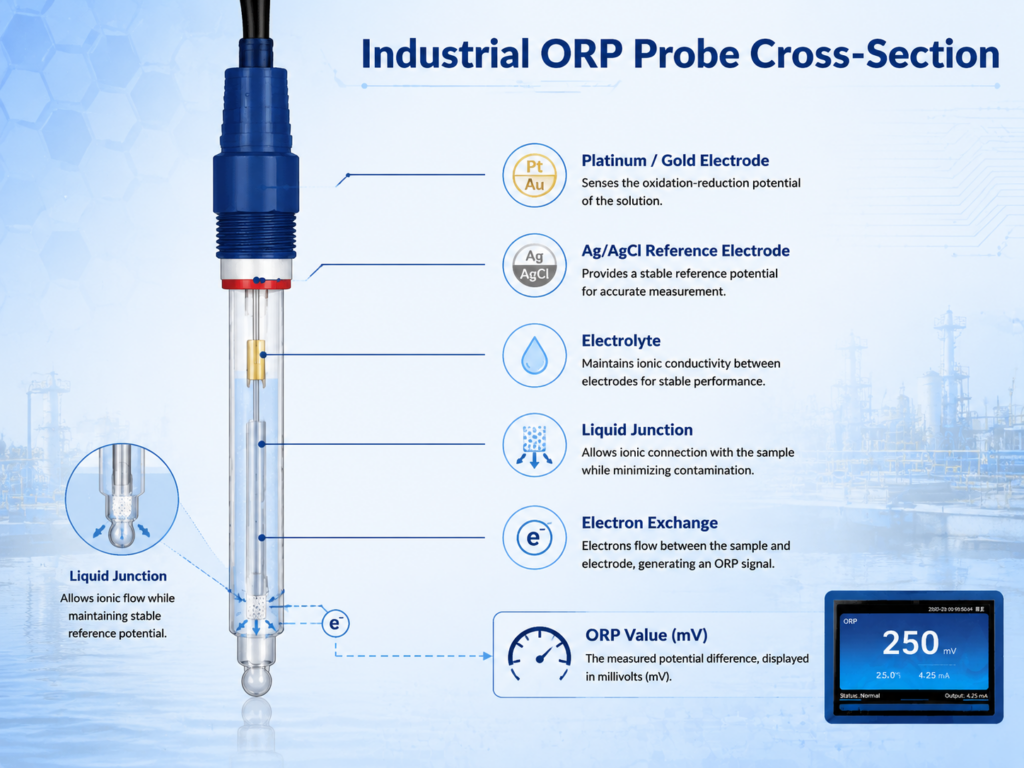
An ORP (Oxidation-Reduction Potential) sensor, also known as a REDOX sensor, measures the electrical potential created by oxidation and reduction reactions in a liquid. Instead of measuring the concentration of a specific chemical, it indicates whether the solution has a stronger tendency to gain electrons (oxidizing) or lose electrons (reducing).
A typical ORP probe contains two electrodes:
- A measuring electrode, usually platinum or gold.
- A stable Ag/AgCl reference electrode.
The controller measures the voltage difference between these two electrodes and displays the result in millivolts (mV).
In general:
- Positive ORP values indicate stronger oxidizing conditions.
- Negative ORP values indicate stronger reducing conditions.
Reliable ORP measurement depends on selecting the correct electrode material, installing the sensor properly, keeping the sensing surface clean, and performing routine calibration when required.
What Is an ORP Sensor?
What Does ORP Mean?
ORP stands for Oxidation-Reduction Potential, sometimes called Redox Potential.
It represents the tendency of a solution to either accept or donate electrons during chemical reactions. Unlike pH, which measures hydrogen ion activity, ORP reflects the combined effect of all oxidizing and reducing substances present in the water.
Because many industrial processes rely on oxidation or reduction reactions, ORP provides a simple way to monitor process performance without measuring every chemical individually.
What Does an ORP Sensor Measure?
An ORP sensor measures the electrical potential generated between a measuring electrode and a reference electrode after both are immersed in the same solution.
The result is expressed in millivolts (mV) rather than concentration.
For example:
| Typical Process | Typical ORP Range |
|---|---|
| Drinking water disinfection | +650 to +850 mV |
| Swimming pools | +650 to +750 mV |
| Municipal wastewater aeration | +50 to +250 mV |
| Anoxic denitrification | −50 to −150 mV |
| Anaerobic digestion | −250 to −450 mV |
Although these values provide useful references, the ideal ORP range always depends on the specific treatment process and operating objectives.
How Does an ORP Sensor Work?
The operating principle of an ORP sensor is based on electrochemical potential measurement.
The sensing electrode continuously exchanges electrons with oxidizing and reducing substances in the sample, while the reference electrode maintains a stable electrical potential.
The controller measures the voltage difference between these two electrodes and converts it into an ORP value.
Unlike amperometric sensors, an ORP sensor does not consume chemicals during measurement. It simply detects the balance between oxidation and reduction reactions occurring in the process.
This makes ORP monitoring well suited for continuous online measurement in industrial applications.
The Two Main Components of an ORP Probe
Every industrial ORP sensor contains two essential parts.
Measuring Electrode
The measuring electrode is normally made from platinum (Pt) or gold (Au).
Its surface exchanges electrons with the surrounding solution, allowing the sensor to respond to changes in oxidation-reduction conditions.
The electrode material significantly affects long-term stability in different process environments, making proper selection an important part of sensor performance.
Reference Electrode
The reference electrode maintains a stable electrical potential regardless of changes in the sample.
Most industrial ORP probes use an Ag/AgCl reference system with an electrolyte solution connected to the process through a liquid junction.
If the reference junction becomes contaminated or blocked, the ORP value may drift even though the measuring electrode remains in good condition.
What Factors Influence ORP Readings?
Many users expect ORP values to remain constant.
In reality, ORP changes whenever the balance between oxidizing and reducing substances changes.
Several factors influence the measurement, including:
- Free chlorine or other oxidizing chemicals
- Hydrogen sulfide and reducing compounds
- pH
- Temperature
- Dissolved oxygen
- Organic contamination
- Water flow conditions
For this reason, ORP should always be interpreted together with the process conditions instead of relying on the millivolt value alone.
ORP vs pH: What’s the Difference?
Although ORP and pH sensors look similar, they measure completely different properties.
| pH | ORP |
|---|---|
| Measures hydrogen ion activity | Measures oxidation-reduction potential |
| Unit: pH | Unit: mV |
| Indicates acidity or alkalinity | Indicates oxidizing or reducing strength |
| Used for acid/alkali control | Used for disinfection and process control |
In many industrial water treatment systems, pH and ORP are monitored together because pH directly influences the effectiveness of many oxidizing chemicals, especially free chlorine.
Understanding both parameters provides a more complete picture of water chemistry and enables more accurate process control.
How to Choose the Right ORP Sensor
Selecting an ORP sensor is about more than matching a measuring range. Long-term measurement stability depends on the water chemistry, the installation environment, and the electrode design.
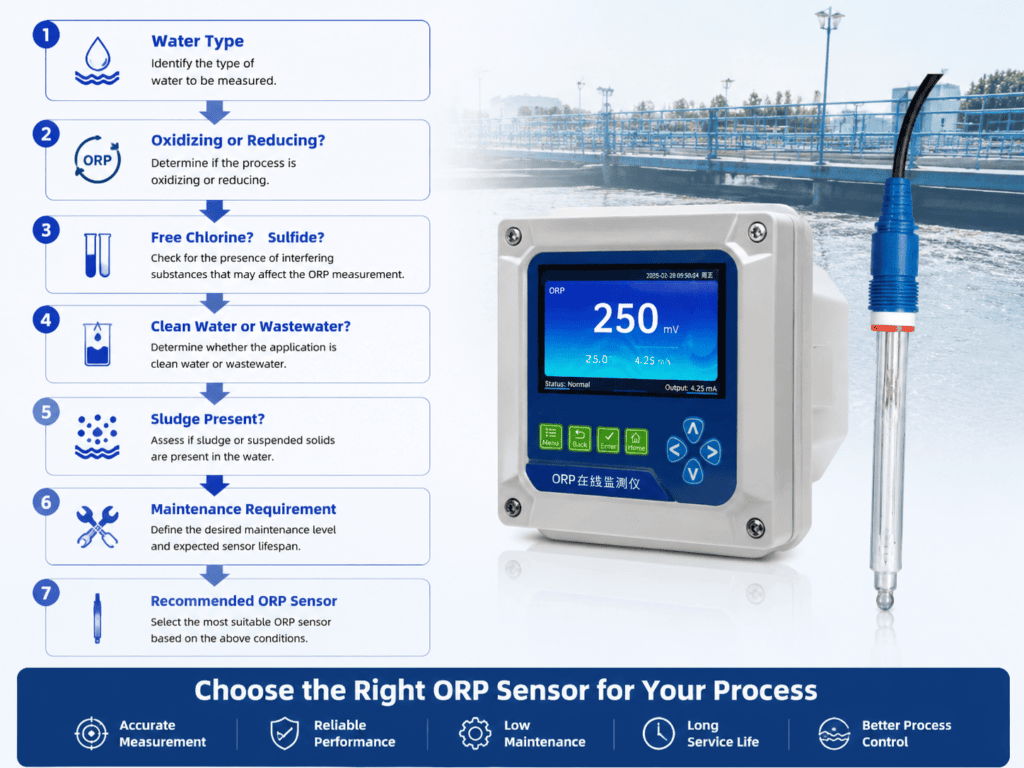
Many users compare only price or output signal, but the real differences often appear after several months of operation. Choosing the right sensor at the beginning usually reduces calibration frequency, extends service life, and lowers maintenance costs.
Before purchasing an ORP sensor, confirm the following questions:
- What type of water will be measured?
- Which oxidizing or reducing chemicals are present?
- Is the process clean water or wastewater?
- Are there suspended solids or sludge?
- What are the operating temperature and pressure?
- Will the sensor be installed inline, submerged, or in a flow cell?
Answering these questions first makes selecting the right ORP sensor much easier.
Platinum vs Gold ORP Electrodes
The measuring electrode is the heart of every ORP sensor.
Most industrial ORP probes use either platinum (Pt) or gold (Au) as the sensing material. Both measure oxidation-reduction potential, but they perform differently in different chemical environments.
As a general guideline:
| Platinum Electrode | Gold Electrode |
|---|---|
| Drinking water | Cyanide solutions |
| Chlorination systems | Sulfide-containing wastewater |
| Swimming pools | Heavy metal processes |
| Cooling water | Electroplating wastewater |
| General water treatment | Special chemical processes |
Platinum electrodes are the most common choice because they perform well in oxidizing environments containing free chlorine, ozone, or other disinfectants.
Gold electrodes are generally preferred where sulfur compounds, cyanides, or certain heavy metals may affect platinum performance.
Selecting the correct electrode material helps improve long-term stability and reduces unnecessary maintenance.
Consider the Process Environment
The same ORP sensor does not perform equally well in every application.
For example, a municipal drinking water plant and an anaerobic wastewater tank both measure ORP, but the process chemistry is completely different.
When evaluating a sensor, consider:
- Oxidizing or reducing conditions
- Chemical composition
- Contamination level
- Sludge concentration
- Flow conditions
- Maintenance accessibility
A sensor that performs well in clean water may not survive long in heavily contaminated wastewater.
Consider Maintenance Requirements
Maintenance costs are often higher than the purchase price over the life of an ORP sensor.
Applications with clean water usually require only periodic cleaning and calibration.
In wastewater treatment, however, sludge, grease, biological growth, and chemical deposits can contaminate the sensing surface much more quickly.
If maintenance access is limited, selecting a sensor with a contamination-resistant design can significantly reduce operating costs.
Verify Controller Compatibility
Before purchasing an ORP sensor, confirm that it is compatible with the existing monitoring system.
Typical considerations include:
- Analog 4–20 mA output
- RS485 Modbus RTU communication
- Controller connector type
- Cable length
- Mounting thread or flange
- Automatic cleaning system compatibility
Checking these details in advance helps avoid installation delays and unnecessary modifications.
From Our Field Experience:
Why Two Platinum ORP Electrodes Delivered Very Different Results
Many engineers assume that any platinum ORP electrode is suitable for chlorinated drinking water.
One project taught us that this is not always the case.
We worked with a municipal drinking water treatment plant monitoring disinfected water containing 0.3–3 ppm free chlorine, with a process pH maintained between 7.0 and 7.8.
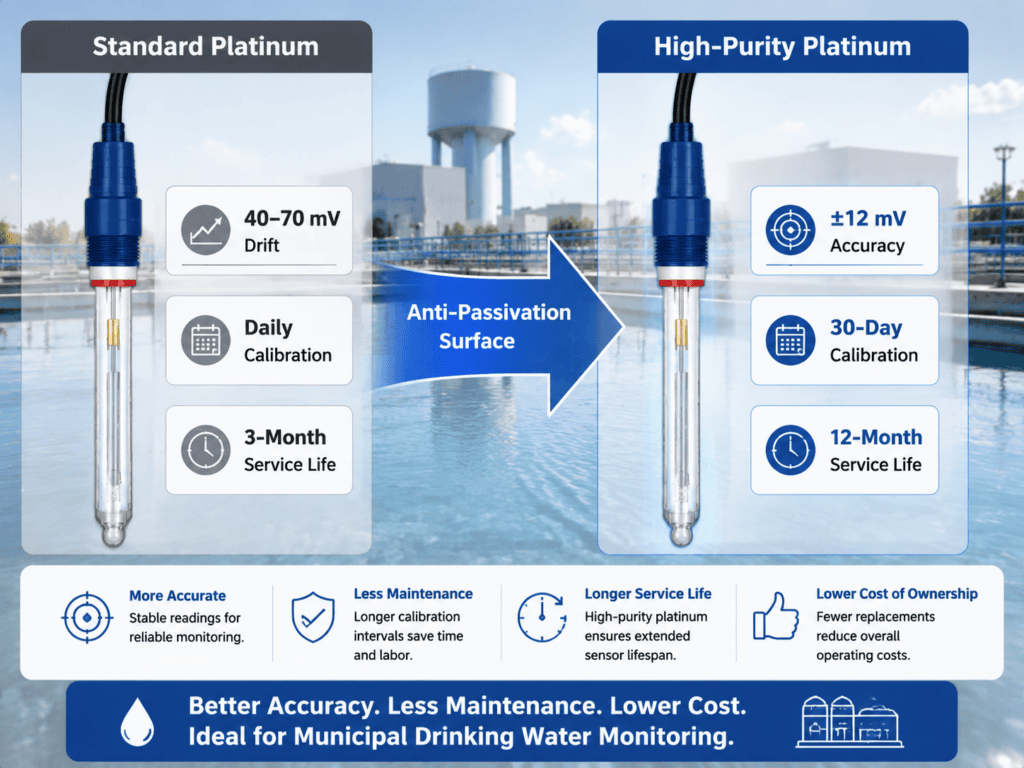
The plant had been using a standard platinum-ring ORP electrode. Although the probe appeared to be operating normally, the ORP value drifted by 40–70 mV every day. After each calibration, the reading remained stable for only 12–18 hours before drifting again.
Our engineers removed the sensor for inspection and found that the reference electrode and sensor body were still in good condition. After cleaning and polishing the platinum surface, the readings immediately returned to normal. However, the same drift appeared again the following day.
This repeated pattern showed that the problem was not the reference system or the electronics. Instead, the platinum sensing surface had become passivated under long-term chlorination conditions, reducing its ability to exchange electrons efficiently.
After reviewing the operating conditions, we recommended replacing the probe with a high-purity platinum ORP electrode featuring an anti-passivation sensing surface.
The improvement was significant.
- Calibration interval increased from 1 day to 30 days.
- Agreement with laboratory measurements improved from ±100 mV to ±12 mV.
- Surface passivation no longer caused continuous drift.
- Electrode service life increased from 3 months to approximately 12 months.
This project reminded us that electrode quality is just as important as electrode material. Two sensors may both use platinum, yet differences in surface treatment and manufacturing quality can produce very different long-term performance.
Typical Applications of ORP Sensors
ORP measurement is used wherever oxidation or reduction reactions influence process performance.
Although the measurement principle remains the same, the operating conditions vary considerably between industries.
Drinking Water Treatment
ORP monitoring helps verify the effectiveness of chlorine or ozone disinfection while avoiding excessive chemical dosing.
Municipal Wastewater Treatment
Operators use ORP values to monitor biological treatment zones, including anoxic and anaerobic processes, supporting nitrogen removal and process optimization.
Swimming Pools
Continuous ORP monitoring helps maintain effective disinfection while minimizing unnecessary chlorine consumption.
Cooling Water Systems
ORP sensors assist in controlling oxidizing biocides, helping reduce microbial growth, corrosion risks, and operating costs.
Chemical Processing
Many oxidation and reduction reactions depend on precise ORP control. Continuous monitoring improves product consistency and process safety.
ORP Sensor Installation Best Practices
Even the highest-quality ORP sensor cannot deliver reliable measurements if it is installed incorrectly.
Many unstable readings that are blamed on the sensor are actually caused by poor installation location, inadequate flow conditions, or contamination around the sensing surface.
Following a few installation principles can significantly improve measurement stability and extend sensor life.
Choose a Representative Sampling Point
Install the sensor where the measured liquid accurately represents the overall process.
Avoid locations immediately after chemical dosing points because the chemicals may not yet be fully mixed. Measurements taken in these areas often fluctuate and do not reflect the actual process conditions.
For wastewater treatment, choose a location with continuous mixing rather than stagnant zones.
Avoid Dead Zones and Sediment Accumulation
Heavy sludge, scale, or suspended solids can gradually cover the sensing surface and isolate it from the surrounding liquid.
This contamination slows sensor response, causes unstable readings, and increases maintenance frequency.
If the process contains sludge or sediment, position the sensor above the accumulation layer whenever possible.
Maintain Proper Flow Conditions
A gentle, continuous flow across the sensing surface helps maintain measurement stability.
Water that is completely stagnant may allow deposits to build up, while excessive turbulence can introduce unstable readings caused by air bubbles or rapid chemical fluctuations.
For flow-cell installations, maintain a steady sample flow according to the manufacturer’s recommendations.
Install the Probe Correctly
The sensor should be installed so that the sensing surface remains fully immersed during operation.
For submersible installations, many engineers recommend mounting the probe at a slight angle rather than vertically. This allows air bubbles and deposits to slide away from the sensing surface more easily.
The installation should also allow operators to remove the sensor safely for routine cleaning and calibration.
ORP Sensor Calibration and Maintenance
Routine maintenance is essential for obtaining reliable ORP measurements.
Unlike pH electrodes, ORP sensors generally require less frequent calibration, but the sensing surface should still be inspected regularly.
Verify Calibration with Standard Solution
Calibration is typically performed using a certified ORP standard solution with a known millivolt value.
If the measured value differs significantly from the standard after temperature stabilization, inspect the sensor before assuming the controller is faulty.
Always follow the calibration procedure recommended by the sensor manufacturer.
Keep the Electrode Clean
Deposits on the sensing surface reduce the efficiency of electron exchange and often cause slow response or measurement drift.
The cleaning method depends on the contamination type:
- Soft deposits can usually be removed with clean water and a soft cloth.
- Mineral scale may require a mild acid cleaning solution.
- Oil or grease can often be removed with a suitable detergent.
- Heavy industrial contamination may require specialized cleaning procedures.
Avoid abrasive polishing unless recommended by the manufacturer, as excessive polishing may damage the sensing surface.
Store the Sensor Properly
If the sensor will not be used for an extended period, follow the manufacturer’s storage recommendations.
Proper storage helps protect both the measuring electrode and the reference system, reducing the risk of performance degradation before the next installation.
Troubleshooting Common ORP Sensor Problems
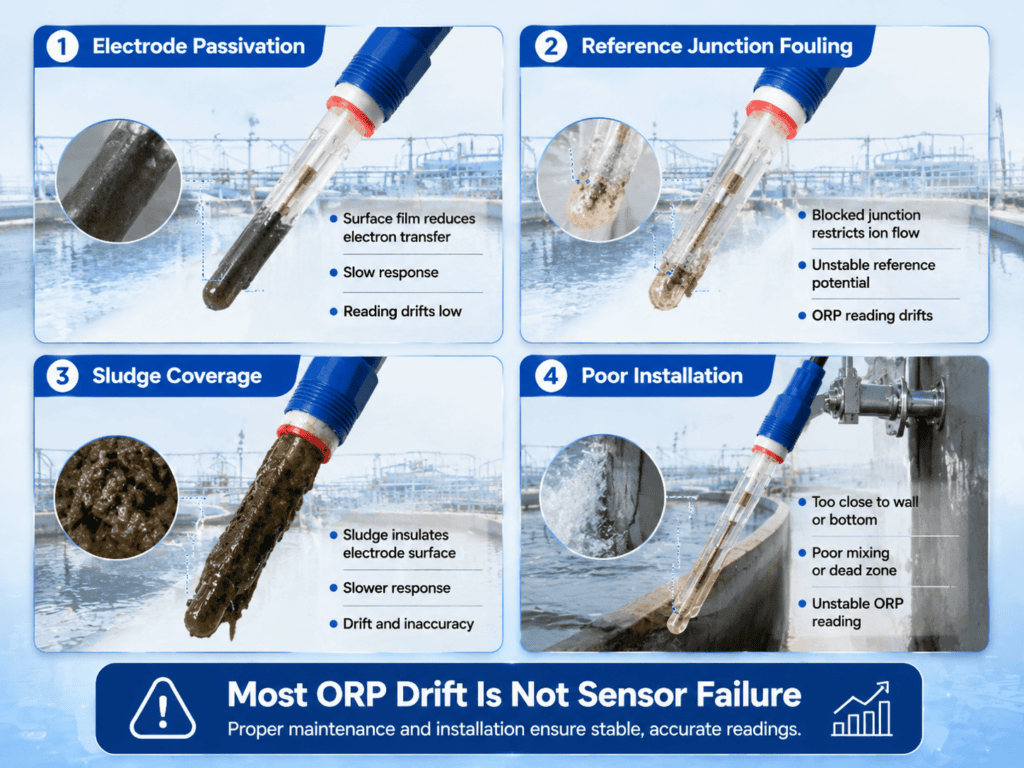
Many ORP problems that appear to be sensor failures are actually caused by process conditions or installation issues.
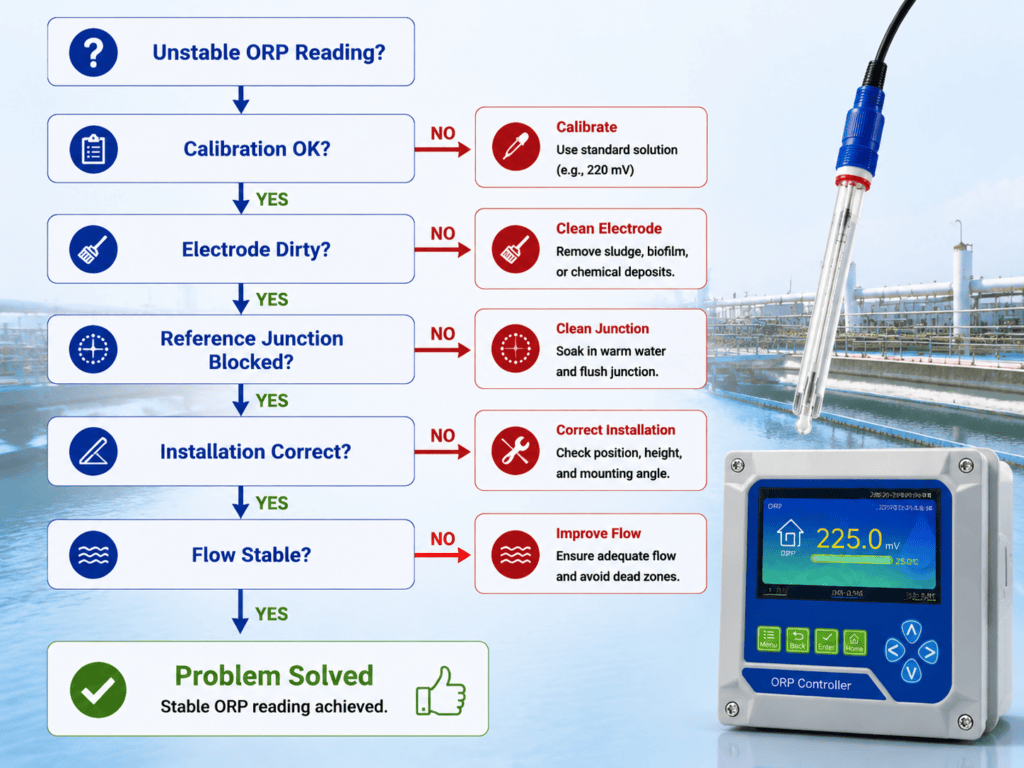
A systematic inspection often identifies the real cause more quickly than replacing the probe.
Problem: ORP Reading Drifts Continuously
Possible causes include:
- Contaminated sensing surface
- Reference junction contamination
- Chemical deposits
- Electrode surface passivation
- Process chemistry changes
Begin by cleaning the sensor and verifying its performance in a standard solution before replacing it.
Problem: Slow Response Time
If the sensor requires an unusually long time to stabilize, check for:
- Deposits on the measuring electrode
- Sludge covering the sensing surface
- Poor sample circulation
- Aging reference system
Cleaning or improving the installation conditions often restores normal response.
Problem: Unstable ORP Readings
Fluctuating readings may result from:
- Air bubbles
- Poor grounding
- Turbulent flow
- Incomplete chemical mixing
- Improper installation location
Before replacing the sensor, verify whether the surrounding process conditions have changed.
Problem: Frequent Calibration
If calibration is required much more often than expected, inspect:
- Electrode contamination
- Process compatibility
- Installation location
- Sensor aging
- Electrode material selection
Repeated calibration rarely solves a process-related problem permanently.
From Our Field Experience:
Four New ORP Sensors Didn’t Solve the Problem
A municipal wastewater treatment plant contacted us because the ORP value in its anaerobic tank remained consistently lower than expected.
The customer believed that hydrogen sulfide had poisoned the silver reference electrode. Over several months, the maintenance team replaced four new ORP sensors, but the readings remained almost unchanged.
Before recommending another replacement, our engineers inspected the installation conditions.
The sensors themselves were operating normally.
Instead, we discovered that the installation point was located in a heavy sludge accumulation zone near the bottom of the tank. Thick sludge had gradually surrounded the sensing surface, preventing direct contact between the electrode and the flowing process liquid. As a result, the ORP value remained artificially low regardless of the condition of the sensor.
Rather than replacing the probe again, we recommended several installation improvements:
- Raise the mounting position by 1.2 meters above the sludge layer.
- Install the probe at a 45° angle.
- Add a small flow-deflecting plate to reduce sludge accumulation.
After these changes, the improvement was immediate.
- The difference between online and laboratory measurements decreased from 80 mV to ≤12 mV.
- Average sensor service life increased from 2 months to approximately 7 months.
- The plant no longer needed repeated sensor replacement.
This project reminded us that installation conditions often have a greater impact on ORP measurement than the sensor itself. Before replacing a probe, always inspect the process environment first.
Frequently Asked Questions
How often should an ORP sensor be calibrated?
The calibration interval depends on the application. Clean water systems may require calibration only every few weeks or months, while contaminated industrial wastewater may require more frequent verification. Always confirm performance using a certified ORP standard solution.
What is a normal ORP value?
There is no universal “normal” ORP value.
Acceptable ranges vary depending on the process. Drinking water disinfection typically operates at positive ORP values, while anaerobic biological treatment requires strongly negative ORP values.
Can ORP sensors measure chlorine concentration directly?
No.
An ORP sensor measures the overall oxidation-reduction potential, not the concentration of free chlorine. In chlorinated water, ORP often correlates with disinfecting capability, but it should not be interpreted as a direct chlorine measurement.
Why does my ORP sensor drift after cleaning?
Persistent drift after cleaning may indicate electrode passivation, reference system contamination, unsuitable electrode selection, or process-related installation issues. Checking the sensor in a standard solution helps distinguish between sensor problems and process problems.
How long does an industrial ORP sensor last?
Service life depends on water chemistry, maintenance, and installation conditions.
In clean applications, many industrial ORP sensors operate reliably for several years. In heavily contaminated wastewater, poor installation or severe fouling can shorten service life significantly.
Conclusion
An ORP sensor is more than just another water quality instrument. It provides continuous insight into the oxidation and reduction conditions that influence disinfection efficiency, biological treatment, and many industrial chemical processes.
Achieving reliable measurements requires more than selecting a quality probe. Correct electrode selection, proper installation, routine maintenance, and regular performance verification all contribute to long-term stability.
As our engineering projects have shown, many ORP problems originate from the application itself rather than the sensor. Evaluating the process conditions before replacing equipment often saves both maintenance costs and downtime.
About Wohuan
At Wuxi Wohuan Instrument Co., Ltd., we specialize in industrial online water quality monitoring solutions for municipal utilities, environmental monitoring, and industrial process control.
Our product portfolio includes ORP sensors, pH sensors, dissolved oxygen analyzers, conductivity meters, turbidity analyzers, residual chlorine analyzers, and multi-parameter monitoring systems. With experience across drinking water plants, wastewater treatment facilities, chemical processing, and power generation, we help customers select instruments that match real operating conditions rather than simply meeting specification sheets.
Whether you are upgrading an existing monitoring system or designing a new project, our engineering team can help you evaluate the right sensing technology, installation method, and maintenance strategy.
Need Help Selecting the Right ORP Sensor?
Every water treatment process is different, and the best ORP sensor depends on the water chemistry, installation environment, and maintenance requirements.
If you are selecting an ORP sensor for a new project or troubleshooting unstable measurements, our engineers can help you evaluate your application and recommend a suitable solution.
Before requesting a quotation, it is helpful to prepare the following information:
- Water or process type
- Main oxidizing or reducing chemicals
- Operating temperature
- Installation method
- Existing controller or communication protocol
- Maintenance expectations
The more process information available, the easier it is to recommend a sensor that delivers stable long-term performance rather than simply meeting the initial specification.