Introduction
Choosing the right dissolved oxygen sensor is critical for wastewater treatment, aquaculture, environmental monitoring, and industrial process control.
A dissolved oxygen sensor does more than measure oxygen concentration. It provides the data needed to control aeration, protect aquatic organisms, improve biological treatment efficiency, and reduce unnecessary energy consumption.
However, many users face the same question before purchasing:
Should I choose a polarographic dissolved oxygen sensor or an optical dissolved oxygen sensor?
Both technologies can provide accurate measurements, but they perform differently under different operating conditions. The best choice depends on water quality, maintenance requirements, installation environment, and how long the sensor needs to operate without manual intervention.
This guide compares polarographic vs optical dissolved oxygen sensors, explains how each technology works, highlights their advantages and limitations, and shares real engineering experience from wastewater and industrial applications to help you select the right solution.
Quick Answer: Polarographic vs Optical Dissolved Oxygen Sensors
The short answer:
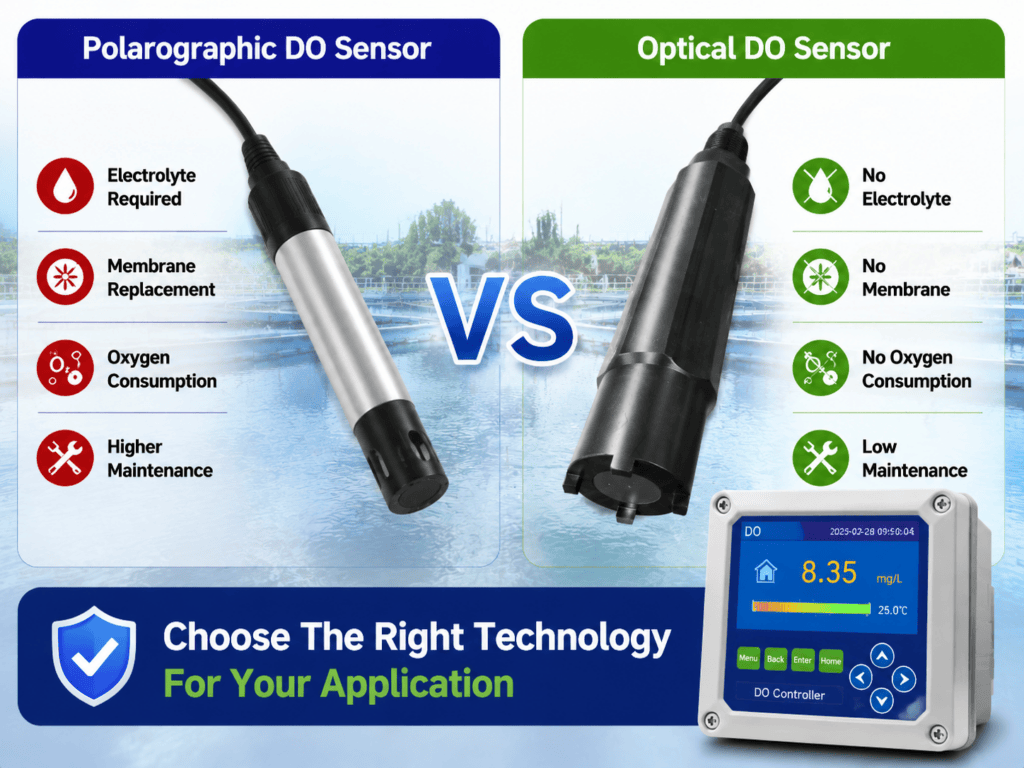
Choose an optical dissolved oxygen sensor for wastewater treatment, aquaculture, and long-term continuous monitoring where low maintenance and stable performance are important.
Choose a polarographic dissolved oxygen sensor for laboratory testing, short-term measurements, and cost-sensitive applications where regular maintenance is acceptable.
The main difference is the measurement principle.
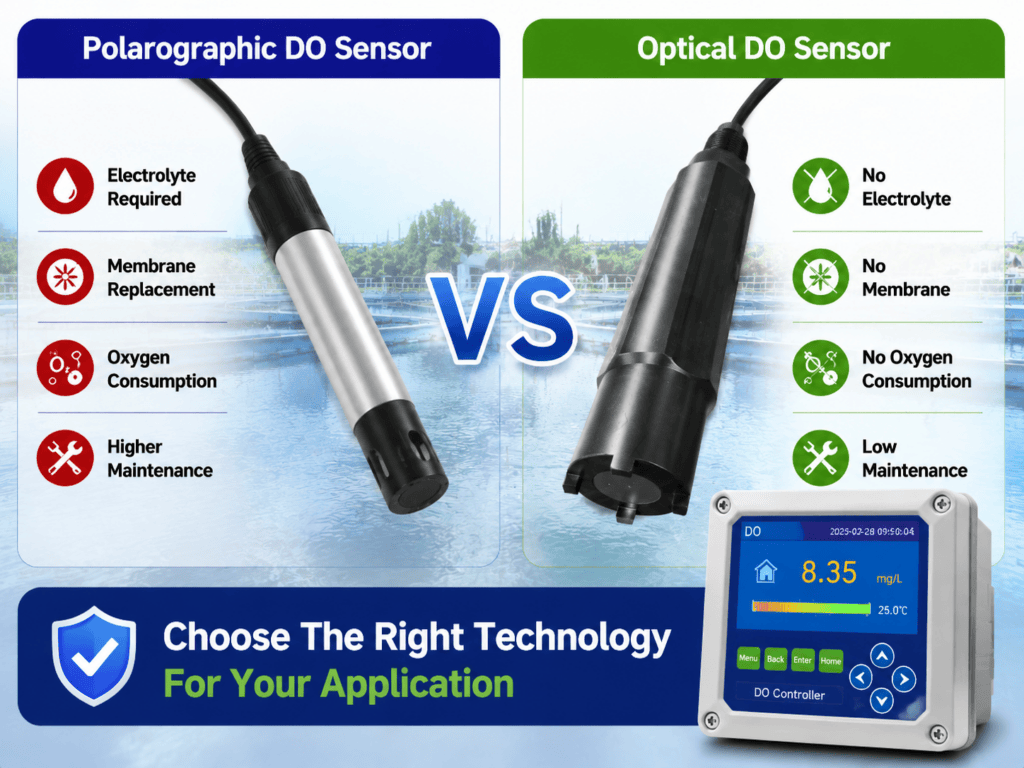
A polarographic sensor uses an electrochemical reaction involving:
- Cathode
- Anode
- Electrolyte
- Oxygen-permeable membrane
An optical sensor uses a fluorescent sensing layer and light measurement technology.
The key differences are:
| Feature | Polarographic DO Sensor | Optical DO Sensor |
|---|---|---|
| Measurement principle | Electrochemical reaction | Fluorescence quenching |
| Electrolyte | Required | Not required |
| Membrane | Required | No oxygen membrane |
| Oxygen consumption | Yes | No |
| Maintenance | Higher | Lower |
| Long-term stability | Moderate | Excellent |
| Best application | Laboratory and controlled processes | Wastewater and continuous monitoring |
For harsh wastewater environments containing sludge, chemicals, or biological contamination, optical technology usually provides better long-term reliability.
What Is a Dissolved Oxygen Sensor?
A dissolved oxygen sensor is an analytical device used to measure the amount of oxygen dissolved in water.
The measurement result is usually displayed as:
- mg/L
- ppm
- % saturation
Dissolved oxygen concentration directly affects many biological and chemical processes.
In wastewater treatment plants, oxygen availability determines how efficiently microorganisms remove organic pollutants and nitrogen compounds.
In aquaculture, dissolved oxygen affects fish health and survival.
In environmental monitoring, DO indicates water quality and ecosystem conditions.
Because oxygen levels can change quickly, continuous online monitoring is often more effective than manual sampling.
Why Dissolved Oxygen Measurement Matters
Dissolved oxygen is one of the most important parameters in biological treatment systems.
In activated sludge processes, microorganisms require oxygen to break down organic matter.
If DO is too low:
- Biological activity decreases
- Ammonia removal becomes unstable
- Effluent quality may deteriorate
If DO is too high:
- Aeration energy increases
- Operating costs rise
- Excess oxygen does not necessarily improve treatment efficiency
For many wastewater plants, aeration accounts for a significant percentage of total energy consumption.
A reliable dissolved oxygen sensor helps operators maintain the right oxygen level while reducing unnecessary blower operation.
How Does a Polarographic Dissolved Oxygen Sensor Work?
A polarographic dissolved oxygen sensor is an electrochemical sensor based on oxygen reduction.
Inside the sensor are:
- A cathode
- An anode
- Electrolyte solution
- Gas-permeable membrane
During measurement, oxygen passes through the membrane and reaches the cathode.
An external voltage is applied between the electrodes, causing oxygen reduction at the cathode. The generated current is proportional to the oxygen concentration in the sample.
The analyzer converts this electrical signal into a dissolved oxygen reading.
Advantages of Polarographic DO Sensors
Polarographic sensors have been widely used for many years because of their proven measurement technology.
Main advantages include:
- Mature technology
- Good measurement accuracy
- Fast response
- Lower initial purchase cost
For applications where regular maintenance is acceptable, polarographic sensors remain a practical solution.
Limitations of Polarographic DO Sensors
The biggest challenge is maintenance.
Because the measurement process consumes oxygen, polarographic sensors require stable flow conditions.
They also rely on consumable components:
- Membrane caps
- Electrolyte solution
Over time:
- The membrane becomes contaminated
- Electrolyte performance decreases
- Calibration frequency increases
In harsh wastewater environments, these maintenance requirements can significantly increase operating costs.
How Does an Optical Dissolved Oxygen Sensor Work?
An optical dissolved oxygen sensor uses fluorescence technology instead of an electrochemical reaction.
The sensing cap contains a special fluorescent material.
During measurement:
- A blue LED excites the fluorescent layer.
- Oxygen interacts with the fluorescent material.
- The fluorescence lifetime changes.
- The sensor calculates dissolved oxygen concentration.
Because oxygen is not consumed during measurement, optical sensors do not require electrolyte and do not depend on oxygen diffusion through a membrane.
Advantages of Optical DO Sensors
Optical technology has become increasingly popular for continuous monitoring because of its low maintenance requirements.
Main advantages include:
- No electrolyte replacement
- No membrane replacement
- Better resistance to fouling
- Longer calibration intervals
- Stable long-term performance
This makes optical dissolved oxygen sensors especially suitable for:
- Municipal wastewater plants
- Industrial wastewater
- Remote monitoring stations
- Long-term unattended operation
Limitations of Optical DO Sensors
Optical sensors usually have a higher initial purchase price compared with polarographic sensors.
However, the total cost should include:
- Maintenance labor
- Replacement parts
- Calibration frequency
- Downtime risk
In many continuous monitoring applications, lower maintenance costs make optical sensors more economical over their service life.
Polarographic vs Optical: Key Differences at a Glance
| Factor | Polarographic Sensor | Optical Sensor |
|---|---|---|
| Principle | Electrochemical reduction | Fluorescence measurement |
| Electrolyte | Required | No |
| Membrane | Required | No |
| Oxygen consumption | Yes | No |
| Warm-up | Polarization required | Immediate operation |
| Maintenance | Frequent | Minimal |
| Fouling resistance | Moderate | High |
| Long-term monitoring | Limited | Excellent |
How to Choose the Right Dissolved Oxygen Sensor for Your Application
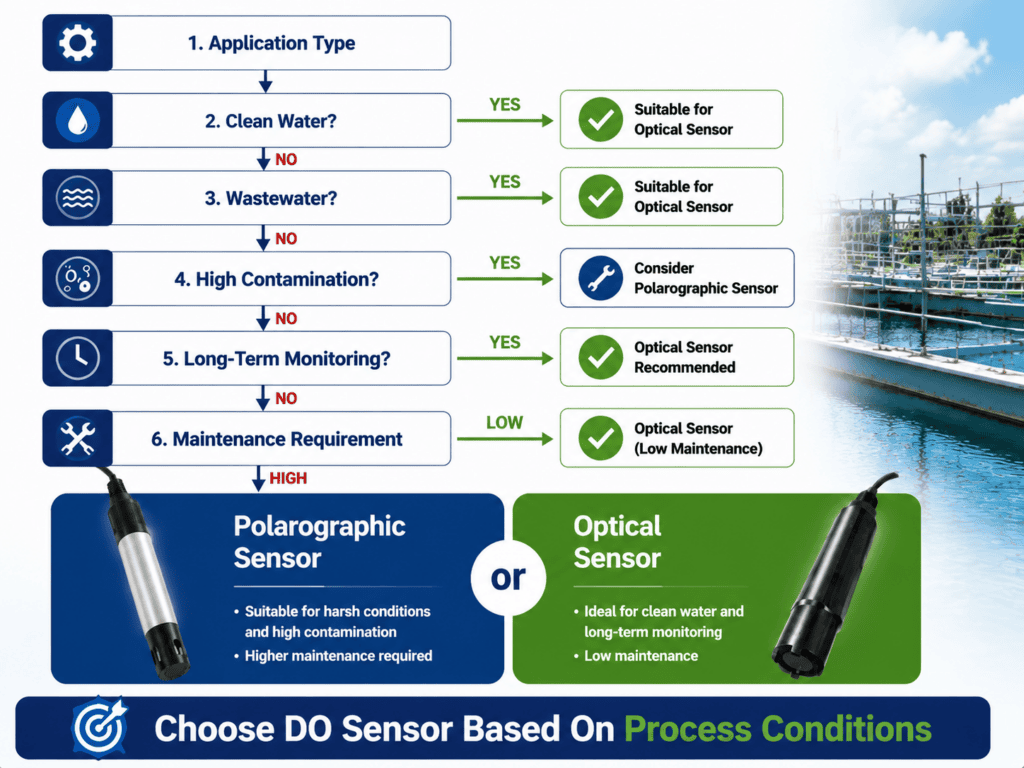
Choosing a dissolved oxygen sensor should always start with the application conditions, not the sensor price.
The same DO sensor may perform well in one environment but fail quickly in another.
Before selecting a probe, consider:
- Water type
- Contamination level
- Required maintenance frequency
- Measurement location
- Flow conditions
- Temperature and salinity
- Required communication method
A correct selection can reduce maintenance work, improve process stability, and lower the total operating cost.
Freshwater vs Seawater Applications
The water matrix directly affects dissolved oxygen measurement.
Freshwater Applications
Freshwater applications include:
- Aquaculture ponds
- Rivers and lakes
- Aquarium systems
- Environmental monitoring
Both polarographic and optical sensors can provide accurate measurements in freshwater.
For short-term testing, polarographic sensors may be sufficient because they provide reliable readings at a lower initial cost.
For long-term monitoring, optical sensors are often preferred because they require less maintenance and provide better stability.
Seawater Applications
Seawater measurement requires additional consideration because salinity affects oxygen solubility.
As salinity increases, the amount of oxygen that can dissolve in water decreases.
Therefore, a dissolved oxygen analyzer must apply proper salinity compensation to avoid inaccurate readings.
When selecting a DO sensor for seawater applications, confirm:
- Salinity compensation capability
- Temperature compensation
- Sensor material compatibility
- Long-term fouling resistance
Optical sensors are often a better choice for marine environments because they do not rely on electrolyte chemistry that can be affected by harsh conditions.
Wastewater and Industrial Applications
Wastewater treatment creates some of the most challenging conditions for dissolved oxygen sensors.
Typical wastewater environments may contain:
- Suspended solids
- Biological sludge
- Sulfides
- Oil contamination
- High organic loading
- Chemical pollutants
In these conditions, sensor maintenance becomes a major factor.
Why Optical DO Sensors Are Preferred for Wastewater
Optical dissolved oxygen sensors have several advantages in wastewater applications:
- No electrolyte contamination
- No membrane replacement
- Lower sensitivity to chemical interference
- Longer calibration intervals
- Better long-term stability
For continuous monitoring in:
- Aeration tanks
- SBR reactors
- Biological treatment systems
optical technology usually provides better reliability.
When Polarographic Sensors Are Still Suitable
Polarographic DO sensors are not obsolete.
They remain suitable for applications where:
- Initial equipment cost is important
- Operators can perform regular maintenance
- Water quality is relatively stable
- Fast response is required
The key is matching the technology to the operating environment.
A lower purchase price does not always mean lower operating costs.
Key Parameters to Consider Before Buying
Accuracy and Response Time
Both optical and polarographic sensors can provide accurate measurements when correctly installed and maintained.
However, the more important question is:
How stable is the measurement over months or years?
For continuous industrial monitoring, long-term stability is often more valuable than the fastest response time.
Maintenance Interval
Maintenance requirements directly affect operating costs.
Consider:
- How often the sensor needs cleaning
- Calibration frequency
- Replacement parts
- Labor requirements
A sensor that requires weekly maintenance may cost much more over several years compared with a low-maintenance alternative.
Temperature Compensation
Temperature affects dissolved oxygen solubility.
A reliable DO sensor should include automatic temperature compensation to maintain accurate readings under changing operating conditions.
Salinity Compensation
For seawater or high-salt industrial applications, salinity correction is essential.
Without proper compensation, dissolved oxygen readings may be inaccurate even if the sensor itself is working correctly.
Communication and System Integration
Before purchase, confirm compatibility with your control system.
Common options include:
- 4–20 mA output
- RS485 Modbus
- Digital communication
- PLC integration
- SCADA systems
A sensor that integrates easily into existing automation systems reduces future upgrade costs.
From Our Field Experience:
Why a Chemical Wastewater Plant Replaced Polarographic DO Sensors with Optical Technology
Many industrial users initially choose polarographic dissolved oxygen sensors because of their lower purchase cost.
However, under severe wastewater conditions, the maintenance cost can become much higher than expected.
We supported a chemical industrial park wastewater treatment plant where dissolved oxygen was monitored in:
- Biological treatment tanks
- SBR reactors
The wastewater contained:
- Sulfides
- Trace heavy metals
- High COD shock loads
The plant originally used polarographic dissolved oxygen sensors.
During operation, the sensors experienced repeated failures.
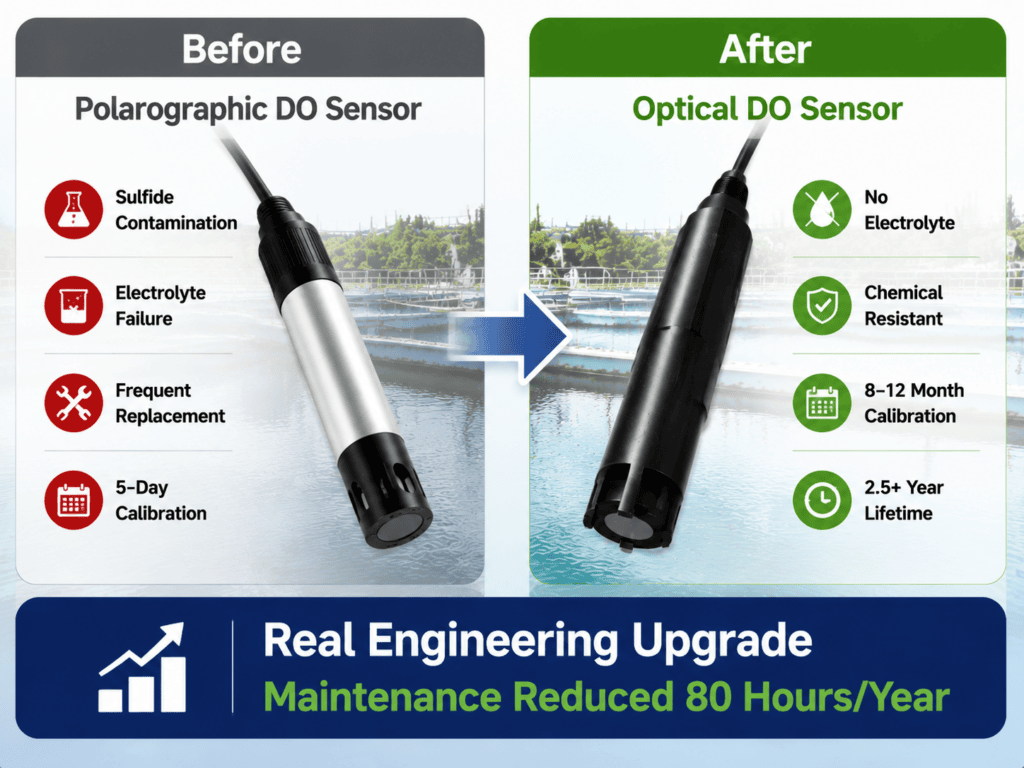
The main problems included:
- Chemical contamination of the membrane
- Electrolyte degradation caused by sulfides and heavy metals
- Sensor readings becoming frozen or inaccurate
- Frequent shutdowns for inspection and replacement
Because DO monitoring was unstable, biological process control became delayed, and ammonia nitrogen levels in the treated water became difficult to control.
Our engineers reviewed the actual wastewater conditions and found that the issue was not sensor accuracy.
The problem was that the measurement technology was not suitable for the chemical environment.
The plant was upgraded to optical fluorescence dissolved oxygen sensors.
Unlike polarographic sensors, optical sensors:
- Do not use electrolyte
- Do not suffer electrolyte poisoning from sulfides and heavy metals
- Do not require membrane replacement
- Provide better long-term stability in harsh wastewater
After the upgrade, the improvement was significant:
- Calibration frequency changed from every 5 days to every 8–12 months.
- Polarographic sensor life improved from 4–6 months to more than 2.5 years.
- Weekly troubleshooting work was replaced by quarterly inspection.
- Annual maintenance labor was reduced by approximately 80 hours.
This project showed an important lesson:
Choosing a dissolved oxygen sensor is not only about measurement accuracy. The sensor technology must match the chemistry of the water.
For wastewater containing sulfides, heavy metals, and high organic loads, optical technology can provide a much lower total cost of ownership.
Total Cost of Ownership: More Than the Purchase Price
Many buyers compare only the initial sensor price.
However, the real cost includes:
- Sensor replacement
- Membrane and electrolyte consumption
- Calibration labor
- Cleaning frequency
- Process downtime
- Production impact
A lower-cost sensor that requires frequent maintenance may become more expensive over time.
For continuous wastewater monitoring, evaluating the total cost of ownership (TCO) is often more important than the initial purchase price.
Installation and Connectivity Considerations
Even the best dissolved oxygen sensor requires proper installation.
Before installation, confirm:
- Measurement point represents the actual process
- Water flow is sufficient
- Sensor is not exposed to excessive air bubbles
- Maintenance access is available
For automation systems, verify:
- Signal type
- Communication protocol
- Controller compatibility
- Data logging requirements
A well-designed installation improves measurement reliability and extends sensor service life.
Polarographic vs Optical Dissolved Oxygen Sensor: Which One Should You Choose?
There is no single dissolved oxygen sensor that is perfect for every application.
The correct choice depends on the actual operating environment, water quality, and maintenance requirements.
A polarographic sensor can still be a practical solution for clean water applications where regular maintenance is acceptable.
An optical dissolved oxygen sensor is usually a better choice for continuous industrial monitoring, especially in wastewater and harsh environments.
The most important question is not:
“Which technology is better?”
The better question is:
“Which technology is suitable for my process?”
Best Applications for Polarographic DO Sensors
Polarographic dissolved oxygen sensors have been widely used for many years because of their mature technology and reliable measurement performance.
They are suitable for applications such as:
- Laboratory testing
- Clean freshwater monitoring
- Short-term measurements
- Controlled process environments
In these applications, operators can regularly perform:
- Membrane replacement
- Electrolyte refilling
- Sensor cleaning
- Calibration
When maintenance resources are available, polarographic sensors can provide stable dissolved oxygen measurement.
Best Applications for Optical DO Sensors
Optical dissolved oxygen sensors are becoming increasingly popular in applications where long-term stability and low maintenance are important.
They are especially suitable for:
- Municipal wastewater treatment
- Industrial wastewater
- Aeration tanks
- SBR reactors
- Biological treatment systems
- Remote monitoring applications
Because optical sensors do not consume oxygen and do not use electrolyte, they avoid many common problems associated with traditional electrochemical sensors.
Common Dissolved Oxygen Sensor Problems and Troubleshooting
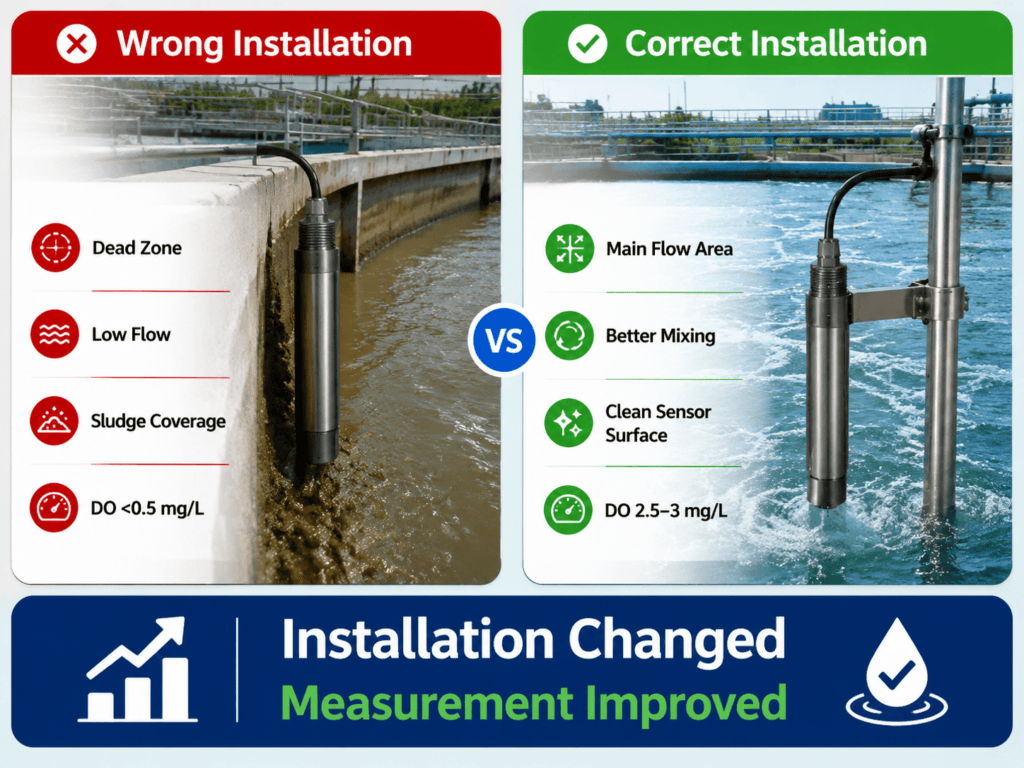
Even a high-quality dissolved oxygen sensor may provide unstable readings if the installation environment is incorrect.
Before replacing a sensor, engineers should check the complete measurement system, including:
- Sensor condition
- Installation location
- Water flow
- Cleaning condition
- Calibration status
Problem 1: DO Reading Is Too Low
Possible causes include:
- Sensor installed in a stagnant area
- Insufficient water circulation
- Sludge covering the sensing surface
- Incorrect calibration
- Air bubble interference
A low DO reading does not always mean the sensor has failed.
The first step is to confirm whether the sensor is measuring representative process water.
Problem 2: DO Reading Fluctuates Frequently
Common causes include:
- Sensor installed too close to aeration bubbles
- Unstable water flow
- Excessive turbulence
- Poor installation position
- Electrical interference
In wastewater applications, the installation location often has a greater influence on measurement stability than the sensor itself.
Problem 3: Frequent Calibration Is Required
If calibration is required much more often than expected, check:
- Sensor contamination
- Incorrect sensor selection
- Process changes
- Installation problems
- Aging components
Frequent calibration may only treat the symptom.
Finding the real cause is usually more important.
Problem 4: Slow Sensor Response
Possible reasons:
- Biological fouling
- Sludge accumulation
- Dirty optical cap
- Damaged membrane
- Aging sensor components
Regular inspection and suitable cleaning methods can prevent unnecessary replacement.
From Our Field Experience:
The DO Sensor Was Not Faulty — The Installation Location Was the Problem
We supported a fine chemical coating wastewater treatment plant where the dissolved oxygen reading in the biological tank remained unusually low.
The DO value stayed below 0.5 mg/L for an extended period.
Even after increasing aeration output, the DO reading did not improve.
Because the biological process became unstable and ammonia nitrogen levels increased, the customer believed the DO sensor had failed and planned to replace the complete probe.
Our engineers inspected the system and found that the sensor itself was operating normally.
The real problem was the installation location.
The probe had been installed in a dead zone with poor water circulation.
As a result:
- Water flow around the sensor was insufficient.
- Sludge continuously accumulated on the sensing surface.
- The sensor could not measure representative oxygen levels.
The low DO reading was caused by the installation environment, not sensor failure.
The recommended improvements included:
- Moving the sensor to the main circulation flow area.
- Adjusting the mounting bracket.
- Adding a flow-guiding plate to improve water movement around the sensor.
After optimization:
- DO concentration increased from below 0.5 mg/L to a stable 2.5–3 mg/L.
- Measurement fluctuation decreased to ≤0.15 mg/L.
- Calibration interval improved from 3 months to 10 months.
This project demonstrated an important lesson:
Before replacing a dissolved oxygen sensor, always check installation conditions, flow characteristics, and measurement location.
A correctly working sensor installed in the wrong position can still produce inaccurate data.
Dissolved Oxygen Sensor Calibration and Maintenance
Proper maintenance helps ensure long-term measurement reliability.
Although optical sensors require less maintenance than polarographic sensors, regular inspection is still necessary.
Calibration Recommendations
Calibration frequency depends on:
- Water quality
- Sensor technology
- Operating conditions
- Required measurement accuracy
For stable applications, calibration may only be required periodically.
For wastewater applications, calibration frequency should be based on actual sensor performance rather than a fixed schedule.
Cleaning Recommendations
Cleaning requirements depend on the type of contamination.
For wastewater applications:
- Remove sludge deposits carefully.
- Avoid damaging the sensing surface.
- Follow recommended cleaning procedures.
For demanding applications, automatic cleaning systems can reduce manual maintenance.
Common cleaning methods include:
- Air cleaning
- Water spray cleaning
- Mechanical wiping systems
Frequently Asked Questions
Is an optical DO sensor better than a polarographic sensor?
Not always.
Optical sensors usually provide lower maintenance and better long-term stability, especially in wastewater and industrial applications.
Polarographic sensors can still be suitable for clean water and controlled environments.
The right choice depends on the application conditions.
How long does a dissolved oxygen sensor last?
Sensor lifetime depends on:
- Water quality
- Installation conditions
- Maintenance frequency
- Sensor technology
In harsh wastewater applications, optical sensors often provide longer service life because they avoid electrolyte and membrane-related problems.
Why is my DO sensor reading lower than expected?
Common causes include:
- Incorrect installation location
- Poor water circulation
- Sludge coverage
- Air bubbles
- Calibration problems
Always check the process conditions before replacing the sensor.
How often should a DO sensor be calibrated?
There is no universal calibration interval.
The correct frequency depends on the application.
Stable industrial systems may operate for many months, while more challenging environments may require more frequent verification.
Can dissolved oxygen monitoring reduce energy costs?
Yes.
In wastewater treatment, accurate DO monitoring allows better blower control.
Maintaining the required oxygen level helps avoid unnecessary aeration and can reduce energy consumption.
Conclusion
Choosing the right dissolved oxygen sensor requires more than comparing product specifications.
Both polarographic and optical technologies have advantages.
The correct choice depends on:
- Water quality
- Contamination level
- Maintenance requirements
- Installation conditions
- Long-term operating costs
For clean and controlled environments, polarographic sensors remain a practical option.
For wastewater treatment and harsh industrial applications, optical dissolved oxygen sensors usually provide better stability, lower maintenance requirements, and lower long-term operating costs.
Our engineering experience shows that many DO measurement problems are not caused by sensor quality alone.
Correct technology selection and proper installation are equally important for reliable dissolved oxygen monitoring.
Dissolved Oxygen Monitoring Solutions
Reliable dissolved oxygen monitoring depends not only on selecting the right sensor technology, but also on choosing the correct installation method, monitoring system configuration, and maintenance strategy.
Wuxi Wohuan Instrument provides complete industrial dissolved oxygen monitoring solutions, including optical dissolved oxygen sensors, electrochemical dissolved oxygen sensors, dissolved oxygen analyzers, automatic cleaning systems, and online water quality monitoring systems.
Our dissolved oxygen solutions are widely used in:
- Municipal wastewater treatment plants
- Industrial wastewater treatment
- Chemical processing
- Food and beverage wastewater
- Aquaculture systems
- Environmental monitoring applications
Based on actual operating conditions, our engineering team helps customers select suitable dissolved oxygen monitoring solutions to improve measurement stability, reduce maintenance frequency, and optimize long-term operating costs.
Need Help Choosing the Right Dissolved Oxygen Sensor?
Selecting the right dissolved oxygen sensor depends on more than the measurement range or product specifications.
The correct solution should consider:
- Application requirements
- Water quality characteristics
- Contamination level
- Installation environment
- Required maintenance frequency
- Process control requirements
Whether you are replacing an existing dissolved oxygen sensor or designing a new online monitoring system, our engineers can help evaluate your application and recommend the most suitable solution.
Explore Related Solutions
Learn more about our industrial water quality monitoring solutions for wastewater treatment and process applications.
Explore our:
- Optical Dissolved Oxygen Sensors
- Electrochemical Dissolved Oxygen Sensors
- Online Dissolved Oxygen Analyzers
- pH Monitoring Solutions
- ORP Monitoring Solutions
- Conductivity Monitoring Solutions
- Turbidity Monitoring Solutions
- Multi-Parameter Water Quality Monitoring Systems
Our engineering team can provide technical recommendations based on your process conditions, helping you build a more reliable online water quality monitoring system.
Request a Free Consultation
To recommend the most suitable dissolved oxygen monitoring solution, please provide the following information:
- Application or industry
- Water type
- Dissolved oxygen measurement range
- Operating temperature
- Installation method
- Water quality conditions (sludge, sulfides, oil, chemicals, suspended solids, etc.)
- Communication requirements (4–20 mA, RS485, Modbus, PLC, SCADA)
Our engineering team will evaluate your application and recommend the most suitable dissolved oxygen monitoring solution for your project.