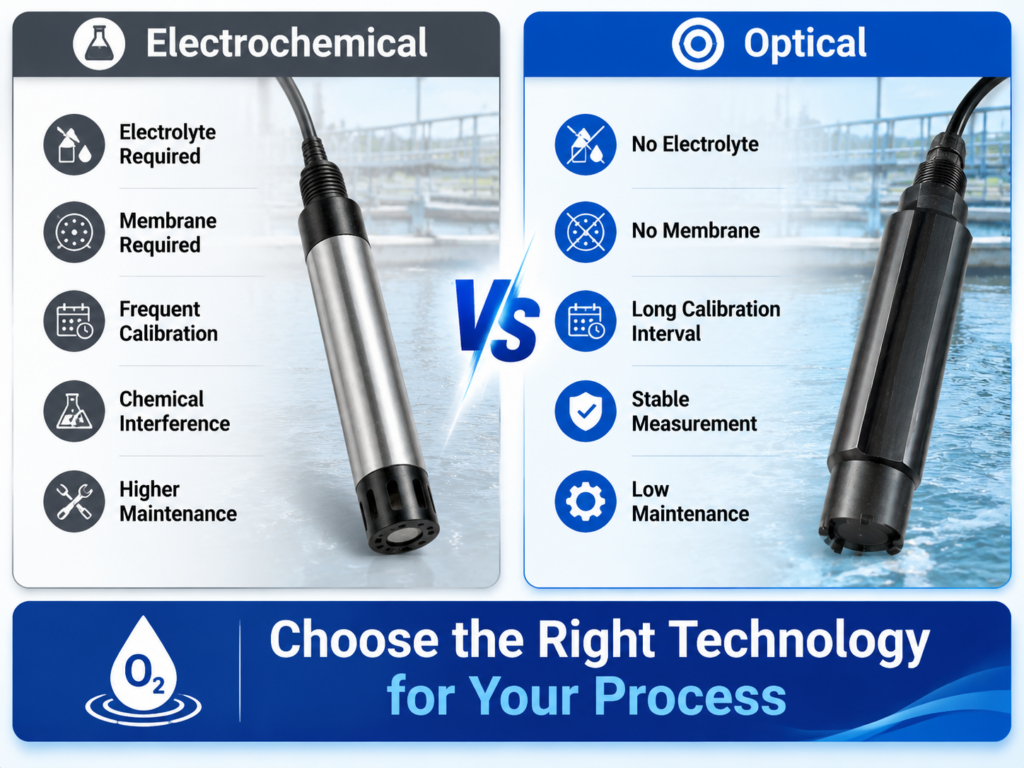
Introduction
Dissolved oxygen (DO) is one of the most important parameters in water quality monitoring. Whether you are managing a wastewater treatment plant, operating an aquaculture system, monitoring industrial processes, or maintaining a research laboratory, accurate dissolved oxygen measurement directly affects process efficiency, biological activity, and operating costs.
Choosing the right dissolved oxygen monitor, however, is becoming increasingly challenging. Today’s market offers multiple sensor technologies, each with different operating principles, maintenance requirements, and long-term costs. Many buyers focus only on initial purchase price, while overlooking factors such as water chemistry, maintenance frequency, and sensor lifespan.
In many industrial applications, selecting the wrong dissolved oxygen sensor does not simply result in inaccurate measurements. It can lead to unstable aeration control, increased energy consumption, unnecessary maintenance, and premature sensor replacement.
This guide explains how dissolved oxygen sensors work, compares optical and electrochemical technologies, discusses their advantages and limitations, and shares real engineering experience from industrial wastewater treatment projects to help you choose the most suitable solution.
Understanding Dissolved Oxygen and Why Monitoring Matters
What Is Dissolved Oxygen and Why Does It Affect Water Quality?
Dissolved oxygen (DO) refers to the amount of oxygen gas dissolved in water. It is one of the most widely used indicators of water quality because nearly all aerobic organisms—including fish, microorganisms, and aquatic plants—depend on oxygen for survival. Regular dissolved oxygen monitoring helps operators identify changing water conditions before they affect biological performance or environmental compliance.
In biological wastewater treatment, dissolved oxygen directly influences microbial activity. When oxygen levels become too low, aerobic bacteria cannot efficiently decompose organic pollutants, resulting in lower treatment efficiency and higher ammonia concentrations. On the other hand, excessive aeration wastes electricity and increases operating costs without providing additional treatment benefits.
For aquaculture, insufficient dissolved oxygen can reduce feeding activity, slow growth rates, and increase fish mortality. In industrial process water, unstable oxygen levels may affect product quality, biological reactions, or process consistency.
Because dissolved oxygen changes continuously, real-time monitoring allows operators to respond quickly instead of relying on periodic laboratory testing.
What Factors Affect Dissolved Oxygen Levels?
Dissolved oxygen is not constant throughout the day. Several environmental and process conditions influence oxygen concentration. Temperature, biological activity, and water movement all play important roles. During daylight, photosynthesis increases oxygen production, while respiration and microbial decomposition consume oxygen continuously. These natural fluctuations make continuous monitoring valuable for understanding changing water conditions.
Industrial wastewater introduces additional variables.
High organic loading increases oxygen demand.
Chemical reactions may consume dissolved oxygen rapidly.
Aeration systems continuously change oxygen concentration inside biological treatment tanks.
In many wastewater treatment plants, dissolved oxygen values may fluctuate significantly within minutes as influent conditions change. A reliable online dissolved oxygen monitor allows operators to adjust blower output automatically, maintaining stable biological treatment while minimizing unnecessary energy consumption.
Selection Criteria
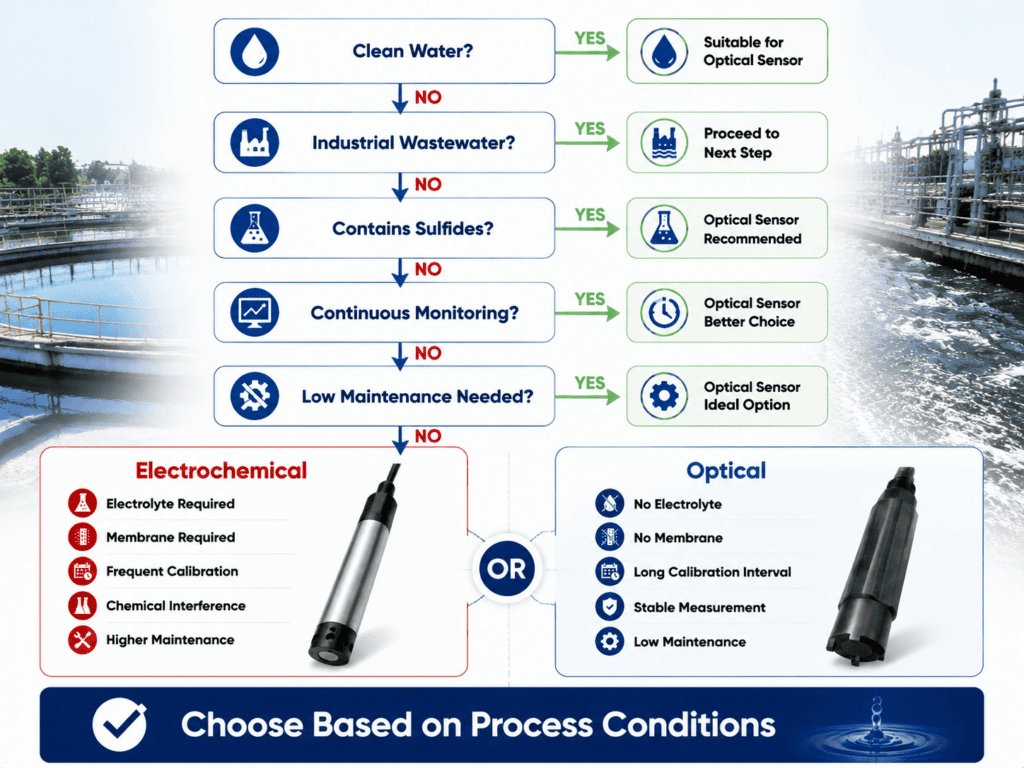
Choosing a dissolved oxygen monitor involves much more than comparing sensor specifications.
The sensor technology must match the actual operating environment.
Optical dissolved oxygen sensors measure oxygen using luminescent technology. Because they do not rely on electrolyte or electrochemical reactions, they generally provide stable long-term measurements with relatively low maintenance requirements.
Electrochemical dissolved oxygen sensors—including galvanic and polarographic designs—measure oxygen by generating an electrical current through an electrochemical reaction. These sensors are widely used because they respond quickly and have proven performance in many applications, but they require regular calibration, membrane replacement, and electrolyte maintenance. Sensor selection should therefore consider water quality, maintenance capability, required accuracy, and installation conditions rather than purchase price alone.
For applications requiring continuous operation, long-term stability often becomes more important than the initial equipment cost.
From Our Field Experience:
Why a Chemical Plant Replaced Electrochemical DO Sensors with Optical Technology
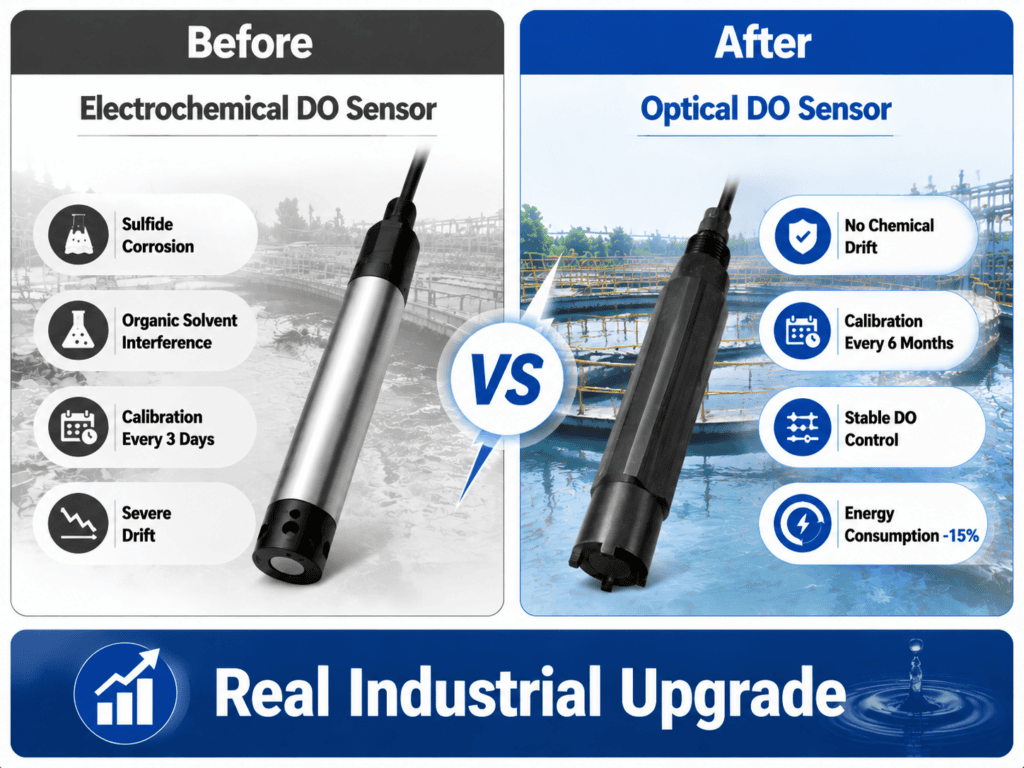
Many engineers compare dissolved oxygen sensors based primarily on purchase price.
One project demonstrated why actual wastewater conditions are often more important than the sensor’s initial cost.
We worked with a fine chemical manufacturing plant where dissolved oxygen was monitored in the biological treatment tank and SBR reactor.
The wastewater contained sulfides, organic solvents, and other reducing chemicals.
The plant originally installed electrochemical dissolved oxygen sensors. Although the sensors worked after installation, failures quickly became frequent.
Within only two days, the readings began to drift noticeably, forcing operators to recalibrate the sensors every three days. The unstable measurements made automatic aeration control unreliable and increased maintenance workload.
After investigating the process, our engineers found that calibration was not the real problem.
The wastewater chemistry itself was affecting the sensor.
The precious metal anode inside the electrochemical sensor was gradually attacked by reducing chemicals, while the oxygen-permeable membrane could not effectively isolate sulfides and oily contaminants. As a result, the electrochemical measurement current was continuously influenced by the wastewater composition.
Instead of replacing the same type of sensor again, we recommended upgrading to an optical dissolved oxygen sensor.
Because optical technology does not rely on electrolyte or electrochemical reactions, it is far less susceptible to chemical interference.
After the upgrade:
- Calibration interval increased from every 3 days to once every 6 months.
- Measurement drift caused by wastewater chemistry was eliminated.
- Stable DO control prevented unnecessary over-aeration.
- Combined chemical dosing and aeration energy consumption decreased by approximately 15%.
This project reinforced an important lesson:
In aggressive industrial wastewater, selecting the appropriate sensing technology often has a greater impact on performance than simply choosing a more expensive electrochemical sensor.
Which Dissolved Oxygen Sensor Fits Your Application?
Different applications require different dissolved oxygen monitoring strategies.
For laboratories and clean water testing, electrochemical sensors remain a practical option because they provide fast response times and can be maintained under controlled conditions.
For aquaculture, galvanic sensors are often used for portable measurements where rapid readings are important.
For municipal wastewater treatment, industrial wastewater, and continuous online monitoring, optical dissolved oxygen sensors have become increasingly popular because they require less routine maintenance and maintain stable performance during long-term operation.
The best sensor is not necessarily the newest or the most expensive.
It is the one that matches your process conditions, maintenance capability, and long-term operating objectives.
Optical vs. Electrochemical DO Sensors: How They Work
Understanding how each dissolved oxygen sensing technology works makes it much easier to choose the right monitor for your application.
Although both optical and electrochemical sensors measure dissolved oxygen concentration, they rely on completely different measurement principles. These differences directly affect accuracy, maintenance requirements, sensor lifespan, and long-term operating costs.
How Optical Dissolved Oxygen Sensors Work
Optical dissolved oxygen sensors, also known as luminescent DO sensors, measure oxygen concentration using the principle of fluorescence quenching.
Inside the sensor cap is a luminescent dye. When excited by a blue LED, the dye emits red light. Oxygen molecules reduce—or “quench”—this light signal. By measuring the change in light intensity or decay time, the sensor calculates the dissolved oxygen concentration.
Because this measurement is based on an optical reaction rather than an electrochemical reaction, the sensor offers several important advantages:
- No electrolyte
- No oxygen consumption during measurement
- No polarization time
- Lower measurement drift
- Reduced maintenance requirements
These characteristics make optical sensors particularly suitable for continuous online monitoring in industrial environments.
How Electrochemical Dissolved Oxygen Sensors Work
Electrochemical dissolved oxygen sensors generate an electrical current that is proportional to the oxygen concentration in water.
Oxygen diffuses through an oxygen-permeable membrane and reacts with the electrolyte and electrodes inside the sensor. The resulting electrical current is converted into a dissolved oxygen reading.
There are two common electrochemical technologies:
Polarographic Sensors
Polarographic sensors require an external polarization voltage before measurement.
After powering on, the sensor must stabilize for a short period before accurate readings can be obtained.
These sensors are widely used in laboratories and controlled industrial applications where warm-up time is acceptable.
Galvanic Sensors
Galvanic sensors generate their own electrical potential internally.
Because they do not require an external polarization voltage, they begin measuring almost immediately after immersion.
For portable instruments and field measurements, this faster startup can be a significant advantage.
Optical vs. Electrochemical DO Sensors: Key Performance Differences
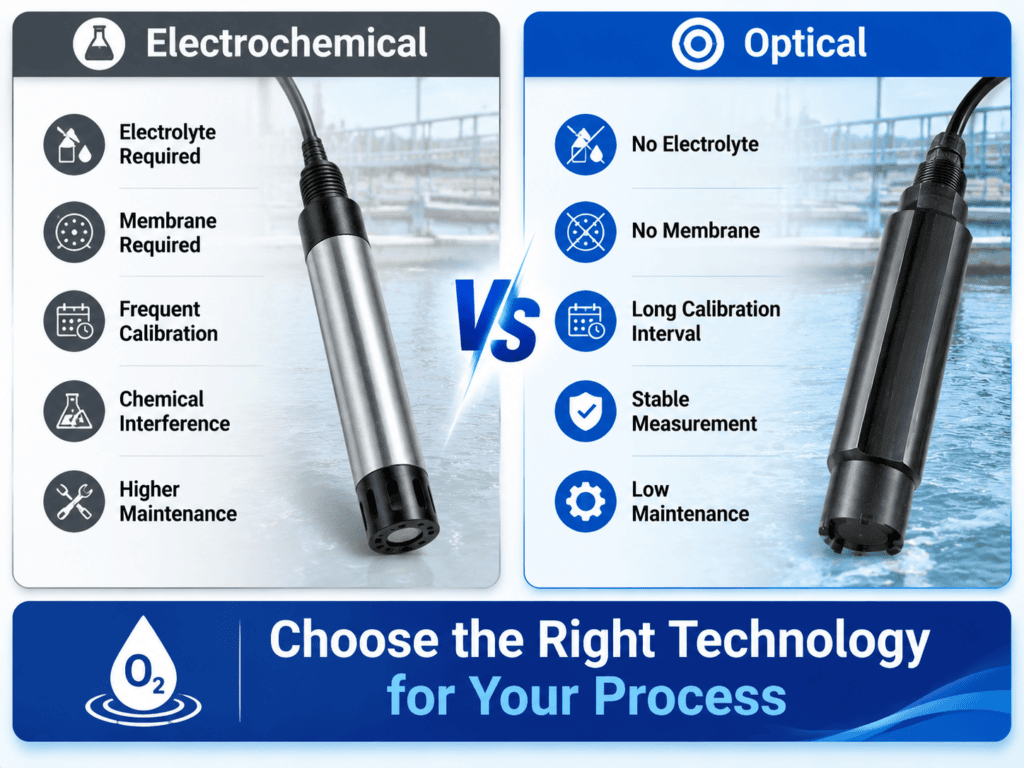
Although both technologies can provide accurate dissolved oxygen measurements, their long-term performance differs significantly in industrial applications.
| Feature | Optical DO Sensor | Electrochemical DO Sensor |
|---|---|---|
| Measurement Principle | Fluorescence quenching | Electrochemical reaction |
| Electrolyte | Not required | Required |
| Membrane | Not required | Required |
| Oxygen Consumption | None | Yes |
| Warm-Up Time | None | Required for polarographic sensors |
| Long-Term Drift | Very low | Higher due to electrolyte aging |
| Routine Maintenance | Low | Moderate to high |
| Typical Industrial Use | Continuous online monitoring | Portable testing and laboratory applications |
The differences become more noticeable as maintenance intervals become longer or wastewater conditions become more aggressive.
In clean water applications, both technologies can deliver reliable results.
In industrial wastewater containing suspended solids, sulfides, oils, or other contaminants, maintenance frequency often becomes the deciding factor.
Which Technology Performs Better in Industrial Applications?
There is no universal “best” dissolved oxygen sensor.
Instead, the best choice depends on the operating environment.
For applications requiring continuous operation, optical sensors generally offer greater advantages because they maintain stable performance over long periods with less routine servicing.
Typical examples include:
- Municipal wastewater treatment
- Industrial wastewater treatment
- Biological treatment systems
- SBR reactors
- Activated sludge processes
- Remote monitoring stations
Electrochemical sensors remain an excellent choice for applications such as:
- Laboratory analysis
- Portable field measurements
- Educational use
- Clean water monitoring
- Projects with limited initial budgets
Selecting the appropriate technology should always consider the entire operating lifecycle rather than only the purchase price.
Accuracy and Response Time
Many buyers assume that the most accurate dissolved oxygen sensor is automatically the best option.
In reality, measurement stability is often more valuable than laboratory-level accuracy.
Outdoor monitoring, wastewater treatment, and industrial processes expose sensors to changing temperatures, varying flow conditions, fouling, and chemical interference. These factors can have a much greater impact on measurement quality than the sensor’s specified accuracy. A suitable DO monitor should therefore provide stable readings under real operating conditions rather than only under laboratory testing.
Response time is another important consideration.
Galvanic sensors respond almost immediately because they do not require polarization.
Polarographic sensors require a warm-up period before measurement.
Optical sensors may respond slightly more slowly than galvanic probes, but their excellent long-term stability usually outweighs this difference in continuous monitoring applications.
Maintenance Requirements and Calibration Frequency
Maintenance requirements often determine the true operating cost of a dissolved oxygen monitoring system.
Electrochemical sensors require periodic replacement of membrane caps and electrolyte solution. Although these consumable components are relatively inexpensive, maintenance must be performed carefully because the membrane is delicate and the electrolyte can be corrosive.
Optical dissolved oxygen sensors eliminate both electrolyte replacement and membrane maintenance.
Routine maintenance generally consists of:
- Cleaning the optical cap
- Periodic inspection
- Occasional calibration verification
- Replacing the optical cap at the recommended service interval
For facilities with limited maintenance personnel or remote installations, reducing routine service requirements can significantly lower operating costs over the lifetime of the monitoring system.
Choosing the Right DO Monitor for Different Applications
The operating environment should always determine sensor selection.
Aquaculture
Reliable dissolved oxygen monitoring helps maintain healthy fish growth and prevent oxygen depletion.
Portable galvanic sensors are often suitable for routine field measurements, while optical sensors are preferred where continuous monitoring is required.
Laboratory Testing
Both optical and electrochemical sensors perform well under controlled laboratory conditions.
Selection usually depends on testing frequency, maintenance preference, and equipment budget.
Municipal Wastewater Treatment
Long-term online monitoring is essential for biological treatment control.
Optical dissolved oxygen sensors have become increasingly common because they reduce maintenance while providing stable measurements for automatic aeration systems.
Industrial Wastewater
Chemical plants, food processing facilities, pharmaceutical manufacturers, and other industrial users often face challenging water chemistry.
Sensor selection should consider:
- Chemical compatibility
- Fouling resistance
- Maintenance accessibility
- Expected operating life
Choosing the correct sensor technology for these environments can significantly improve measurement reliability and reduce overall maintenance costs.
Looking Beyond the Purchase Price
The purchase price represents only a small portion of the total investment.
The total cost of ownership (TCO) includes:
- Calibration labor
- Sensor maintenance
- Replacement parts
- Equipment downtime
- Process efficiency
- Energy consumption
- Sensor lifespan
A sensor with a higher initial cost may ultimately become the more economical choice if it requires fewer maintenance visits, reduces aeration energy consumption, and provides more stable process control.
For most continuous industrial monitoring applications, evaluating the complete lifecycle cost rather than the initial purchase price leads to a better long-term investment decision.
Using a Dissolved Oxygen Meter for Pond Water Quality Management
Although dissolved oxygen monitoring is widely associated with industrial wastewater treatment, it is equally important for ponds, lakes, aquaculture, and other natural water bodies.
Unlike industrial systems where aeration can be automatically controlled, pond oxygen levels are heavily influenced by weather, biological activity, and seasonal changes. Regular monitoring helps prevent sudden oxygen depletion and provides early warning before fish become stressed or water quality deteriorates.
Best Practices for Measuring Dissolved Oxygen in Ponds
Obtaining accurate dissolved oxygen data requires more than simply placing a sensor into the water.
For reliable results:
- Measure both dissolved oxygen (mg/L) and water temperature.
- Calibrate the instrument before important measurements.
- Test at different depths when the pond is deep.
- Record readings at the same locations each time.
- Compare measurements taken in the early morning and late afternoon.
Early morning is often when dissolved oxygen reaches its lowest level because photosynthesis has stopped overnight while aquatic organisms continue consuming oxygen. Measuring at consistent times helps establish long-term trends rather than relying on isolated readings.
Understanding DO Readings
Interpreting dissolved oxygen data is just as important as measuring it.
A low reading does not always indicate equipment failure.
Instead, operators should first evaluate whether changing environmental conditions are affecting oxygen concentration.
For pond management, declining dissolved oxygen may result from:
- Rising water temperature
- Excessive algae growth
- Organic matter decomposition
- High fish density
- Insufficient aeration
Continuous monitoring allows these problems to be identified before fish kills or water quality deterioration occur.
Common Dissolved Oxygen Sensor Problems and Troubleshooting
Even high-quality dissolved oxygen sensors can produce unstable readings if the installation environment or maintenance routine is incorrect.
Many users immediately suspect sensor failure when measurements fluctuate.
However, our field experience shows that installation conditions and process changes are often the real causes.
Before replacing a dissolved oxygen sensor, engineers should systematically inspect the complete measurement system.
Problem 1: Calibration Drift
Gradual calibration drift is common with electrochemical dissolved oxygen sensors.
Possible causes include:
- Electrolyte aging
- Membrane deterioration
- Temperature variation
- Long operating periods without recalibration
Optical dissolved oxygen sensors generally experience much lower drift because they do not rely on electrochemical reactions. When drift occurs, contamination of the optical cap is often the first item to inspect.
Problem 2: Slow Response or Low Readings
A slow response or consistently low dissolved oxygen reading may be caused by:
- Biofouling
- Sludge accumulation
- Membrane contamination
- Optical cap contamination
- Poor water circulation
Cleaning the sensing surface and confirming proper installation should always be completed before replacing the sensor.
Problem 3: Erratic or Unstable Measurements
Rapid fluctuations often indicate problems beyond the sensor itself.
Possible causes include:
- Air bubble interference
- Incorrect installation location
- Inadequate immersion depth
- Water level changes
- Unstable process flow
Investigating these operating conditions usually provides a faster and more economical solution than replacing the probe.
From Our Field Experience:
The DO Sensor Was Working Properly — The Installation Depth Was the Real Problem
A meat processing wastewater treatment plant contacted us because the dissolved oxygen readings in its aerobic tank appeared highly inconsistent.
During the day, the sensor continuously measured 4–6 mg/L.
At night, the reading dropped below 1 mg/L.
These large fluctuations caused the blower control system to reduce aeration during the day and operate at full capacity overnight. Biological treatment became unstable, energy consumption increased, and the customer concluded that the dissolved oxygen sensor had failed.
Before recommending a replacement, our engineers carried out a complete inspection of the installation.
The sensor itself was functioning normally.
The real issue was installation depth.
The probe had been mounted only 15 cm below the water surface, where surface foam, atmospheric reoxygenation, and water level fluctuations significantly influenced the measurement.
Instead of replacing the sensor, we recommended:
- Increasing the installation depth to 60 cm below the water surface.
- Positioning the sensor away from the surface foam and atmospheric reoxygenation zone.
- Installing a longer adjustable mounting bracket to maintain a constant immersion depth even when the water level changed.
After the modification:
- The day-night DO fluctuation decreased from approximately 4 mg/L to only 0.3 mg/L.
- The DO trend became smooth and suitable for automatic blower control.
- Aeration electricity consumption decreased by 18%.
- Sensor maintenance intervals increased by approximately three times.
This project demonstrated an important lesson:
Before replacing a dissolved oxygen sensor, always verify whether the installation depth and measurement location truly represent the process conditions. A correctly functioning sensor installed in the wrong position can still produce misleading data.
Frequently Asked Questions
Which dissolved oxygen sensor is better: optical or electrochemical?
Neither technology is universally better.
Optical dissolved oxygen sensors are generally preferred for continuous industrial monitoring because they require less maintenance and provide excellent long-term stability.
Electrochemical sensors remain a reliable choice for laboratory testing, portable measurements, and clean water applications where routine maintenance is acceptable.
How often should a dissolved oxygen sensor be calibrated?
Calibration frequency depends on the sensor type and operating environment.
Electrochemical sensors typically require more frequent calibration because electrolyte aging and membrane wear gradually affect measurement accuracy.
Optical sensors usually maintain calibration for much longer periods, although regular verification is still recommended according to the manufacturer’s maintenance schedule.
Why does my dissolved oxygen reading suddenly become unstable?
Unstable readings may result from:
- Incorrect installation location
- Insufficient immersion depth
- Air bubbles
- Biofouling
- Sensor contamination
- Calibration drift
Field experience shows that installation problems are often mistaken for sensor failure.
What causes dissolved oxygen to decrease?
Several factors can reduce dissolved oxygen concentration, including:
- Higher water temperatures
- Organic pollution
- Microbial respiration
- Excessive algae growth
- Poor aeration
- Increased biological oxygen demand
Continuous monitoring allows operators to identify these trends early and take corrective action before treatment performance or aquatic life is affected.
Conclusion
Selecting the right dissolved oxygen monitor requires more than comparing technical specifications.
The most suitable solution depends on:
- Water quality
- Process conditions
- Maintenance capability
- Installation environment
- Long-term operating costs
Electrochemical dissolved oxygen sensors remain a practical option for laboratories, portable instruments, and clean water applications.
For municipal wastewater treatment, industrial wastewater, and other demanding continuous monitoring applications, optical dissolved oxygen sensors generally provide greater long-term stability, lower maintenance requirements, and reduced operating costs.
Our engineering projects have also shown that many dissolved oxygen measurement problems are not caused by sensor quality alone. Choosing the appropriate sensing technology and installing the sensor correctly are equally important for obtaining reliable process data.
Dissolved Oxygen Monitoring Solutions
Reliable dissolved oxygen monitoring depends on more than choosing the right sensor. Successful projects also require the appropriate sensing technology, installation method, controller configuration, and maintenance strategy.
Wuxi Wohuan Instrument provides complete dissolved oxygen monitoring solutions, including optical dissolved oxygen sensors, electrochemical dissolved oxygen sensors, dissolved oxygen analyzers, automatic cleaning systems, and online water quality monitoring solutions for municipal wastewater, industrial wastewater, aquaculture, and process water applications.
Our engineering team recommends monitoring solutions based on actual operating conditions, helping customers improve measurement reliability while reducing maintenance frequency and long-term operating costs.
Need Help Choosing the Right Dissolved Oxygen Sensor?
Selecting the right dissolved oxygen sensor depends on your application, water quality, process conditions, and maintenance requirements.
Whether you are upgrading an existing monitoring system or designing a new project, choosing the appropriate sensing technology can improve process control, reduce maintenance, and extend sensor service life.
Explore Related Solutions
Learn more about industrial water quality monitoring solutions for municipal and industrial water treatment applications.
Explore our industrial dissolved oxygen analyzers, optical dissolved oxygen sensors, electrochemical dissolved oxygen sensors, pH analyzers, ORP analyzers, conductivity analyzers, turbidity analyzers, and other online water quality monitoring instruments.
If you need technical advice, our engineering team can recommend a suitable monitoring solution based on your process requirements and operating conditions.
Request a Free Consultation
To help us recommend the most suitable dissolved oxygen monitoring solution, please provide the following information:
- Application or industry
- Water type
- Expected dissolved oxygen range
- Operating temperature
- Installation method
- Controller or communication requirements
Our engineers will recommend the most appropriate dissolved oxygen monitoring solution for your application and provide professional technical support for your project.