Introduction
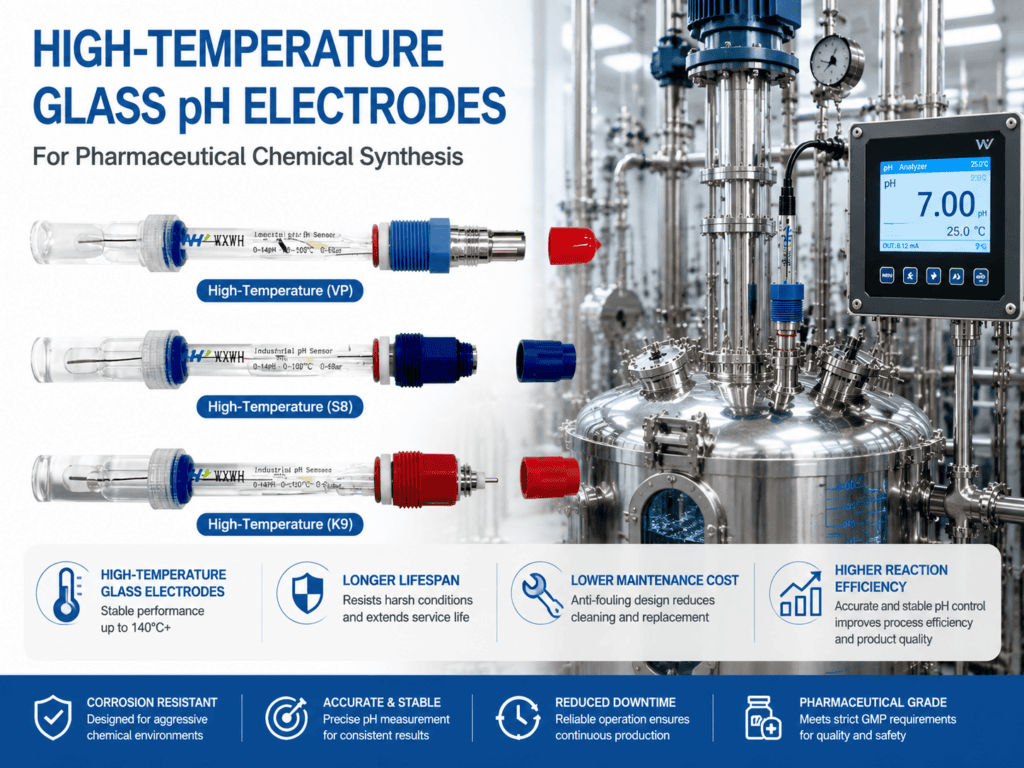
In pharmaceutical manufacturing, pH control is one of the most important process parameters throughout drug synthesis and production.
Processes such as API synthesis, fermentation, and purified water treatment often involve high-temperature sterilization, corrosive chemicals, and strict GMP requirements, making continuous pH monitoring highly challenging.
Traditional pH electrodes are usually designed for temperatures below 80°C. Under pharmaceutical high-temperature conditions, they often experience signal drift, slow response, reference contamination, and shortened service life.
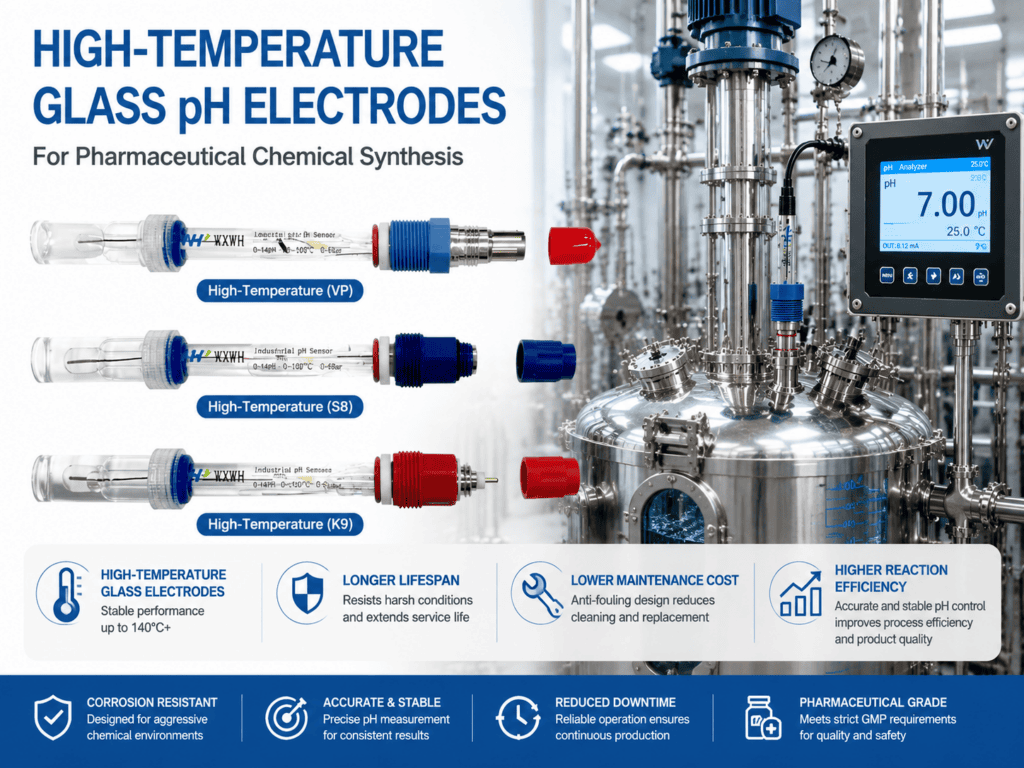
Industrial high-temperature glass pH meters are designed to overcome these limitations, enabling stable online pH measurement in demanding pharmaceutical processes up to 130°C or higher.
Challenges of pH Measurement in Pharmaceutical Synthesis
High-temperature and corrosive reaction conditions
Pharmaceutical chemical synthesis often involves complex operating environments, including:
- High-temperature reactions between 80–130°C
- Strong acids and alkalis
- Organic solvents
- High-pressure reaction systems
Typical examples include esterification, hydrolysis, hydrogenation, and other API synthesis processes.
In these conditions, pH measurement directly affects reaction efficiency, product purity, and impurity control.
Why conventional pH electrodes fail
Under harsh pharmaceutical conditions, standard electrodes commonly face three major problems:
Glass membrane damage
Repeated temperature changes can cause thermal stress and shorten glass bulb life.
Reference system contamination
High salt, chemicals, and reaction by-products can block the junction and cause unstable readings.
Material corrosion
Traditional sealing materials and cables may degrade when exposed to aggressive chemical media.
When pH measurement becomes unreliable, production processes may move outside the optimal reaction range, affecting product quality and yield.
High-Temperature pH Measurement in API Production
Real application challenge: high-temperature acidic reaction process
A pharmaceutical API manufacturer required continuous pH monitoring during a cephalosporin intermediate synthesis process.
The reaction involved:
- Temperature: 95°C
- High salt concentration: approximately 15% NaCl
- Acidic reaction medium
- Continuous endpoint monitoring requirement
The original solution used cooling and cleaning pretreatment before measurement.
However, this introduced additional problems:
- Salt crystallization blocked sample pipelines
- Frequent cleaning was required
- Cooling created measurement delays
- Thermal shock increased electrode failure risk
The pretreatment system solved the temperature problem but created new maintenance challenges.
Direct high-temperature measurement solution
After evaluating the process conditions, the customer adopted a high-temperature pH sensor designed for direct installation in high-temperature chemical processes.
The optimized configuration included:
- High-temperature resistant glass sensing element
- PPS sensor body
- Titanium alloy protection tube
- Chemical-resistant sealing materials
This allowed direct measurement without additional cooling equipment.
Application Results and Process Improvements
Improved measurement stability
After installation, the sensor operated continuously for more than 9 months without replacement.
The pH signal was transmitted to the DCS system through 4–20 mA + HART communication, enabling automatic process control and reaction endpoint monitoring.
Reduced maintenance workload
Compared with the previous pretreatment system:
- Manual cleaning frequency decreased from 2–3 times per week to monthly inspection
- Electrode replacement interval increased from approximately 3 months to more than 9 months
- Reaction endpoint control became more consistent
For pharmaceutical manufacturers, reliable pH measurement helps reduce downtime while improving process repeatability.
Material Design Behind High-Temperature pH Reliability
Advanced materials improve durability
The service life of high-temperature pH sensors depends largely on material selection.
| Component | Conventional Material | High-Temperature Solution | Advantage |
|---|---|---|---|
| Electrode Body | PVC / Glass | PPS | High temperature and chemical resistance |
| Protection Tube | 316L Stainless Steel | Titanium Alloy / Hastelloy | Better resistance to chloride and high-salt media |
| Sealing Ring | Standard Rubber | Perfluoroelastomer | High chemical resistance |
| Cable Sheath | PVC | PTFE / Silicone Rubber | Heat and chemical resistance |
These material improvements allow sensors to operate more reliably in pharmaceutical synthesis environments.
Structural design improves measurement stability
Besides materials, sensor structure also affects long-term performance.
Key design features include:
- High-temperature glass membrane to maintain stable response under repeated heating cycles
- Dual liquid junction design to reduce reference contamination
- Gel electrolyte structure to reduce maintenance requirements
The combination of materials and structure determines whether a pH sensor can survive long-term industrial operation.
How to Select a High-Temperature pH Meter for Pharmaceutical Applications
Evaluate the complete process conditions
Temperature alone should not determine electrode selection.
Engineers should consider:
- Operating temperature range
- Chemical composition
- Pressure conditions
- Sterilization frequency
- Fouling tendency
- Installation location
A suitable pH sensor must match the complete process environment.
Direct measurement vs pretreatment systems
Traditional solutions often modify the process conditions to protect the sensor, such as:
- Cooling systems
- External cleaning units
- Sample conditioning equipment
However, these systems increase complexity and maintenance requirements.
High-temperature resistant pH meters allow enterprises to move toward direct measurement and real-time control, simplifying the overall analytical system.
Conclusion: High-Temperature pH Measurement Supports Smarter Pharmaceutical Processes
In pharmaceutical synthesis, online pH monitoring is not only a measurement requirement but also an important part of process control.
High-temperature environments, corrosive chemicals, and strict production standards require pH sensors with better material performance, stronger structural design, and higher operational reliability.
For pharmaceutical manufacturers, the key value of high-temperature glass pH meters includes:
- Maintaining stable pH monitoring under harsh conditions
- Reducing sensor replacement frequency
- Improving process consistency
- Supporting automated production control
With the growth of biopharmaceuticals, synthetic biology, and advanced chemical manufacturing, demand for reliable high-temperature pH measurement will continue increasing.
Through years of experience in industrial water analysis and process instrumentation, Wohuan focuses on developing pH measurement solutions adapted to real industrial conditions, helping customers achieve more stable and efficient production processes.