Introduction
How can estuary restoration projects understand water quality changes caused by tides, upstream inflow, and freshwater–seawater mixing in real time? This case study shows how an online water quality monitoring system supports continuous monitoring of pH, turbidity, dissolved oxygen, conductivity, suspended solids, and COD in a Shenzhen Bay estuary project.
By replacing low-frequency manual sampling with 24/7 continuous monitoring, the project can capture rapid water quality fluctuations and provide earlier warnings of abnormal conditions.
In this article, we’ll look at the monitoring challenges, system configuration, key instruments, and practical value of online monitoring for estuary water quality management and ecological restoration.
Challenges in Estuary Water Quality Management
Tidal Conditions Make Water Quality Highly Dynamic
The project is located in an estuary within the Futian National Nature Reserve in Shenzhen Bay. Fish ponds, gei wai shrimp ponds, mangrove forests, and tidal flats are distributed along the river.
Historically, uncontrolled pollution sources, slow water flow, and tidal backwater contributed to black and odorous water. Poor water quality also affected mangrove habitats and the surrounding ecological environment.
Unlike conventional inland water bodies, this estuary is influenced by both upstream freshwater and seawater tides.
As a result, water quality can change significantly within a short period, making periodic manual sampling insufficient for understanding actual conditions.
Limitations of Traditional Manual Sampling
Traditional sampling only provides a snapshot of water quality at a specific time.
In a tidal estuary, conditions may already have changed by the time laboratory results become available.
This makes it difficult for operators to identify short-term fluctuations during tidal cycles or respond quickly to abnormal water quality.
An online water quality monitoring system fills this gap by continuously recording changes throughout the day.
pH, Turbidity and Suspended Solids Require Continuous Attention
pH can fluctuate because of freshwater inflow and seawater intrusion.
Abnormal pH conditions may affect aquatic organisms and can also influence the behavior of some pollutants in the water.
Turbidity and suspended solids are another major concern. High turbidity reduces light penetration and can affect aquatic vegetation, while sediment accumulation may reduce the performance of treatment facilities.
Continuous monitoring therefore provides an important data foundation for both treatment operation and ecological restoration.
Online Monitoring Solution for Estuary Water Purification
Full-Process Monitoring from Inflow to Effluent
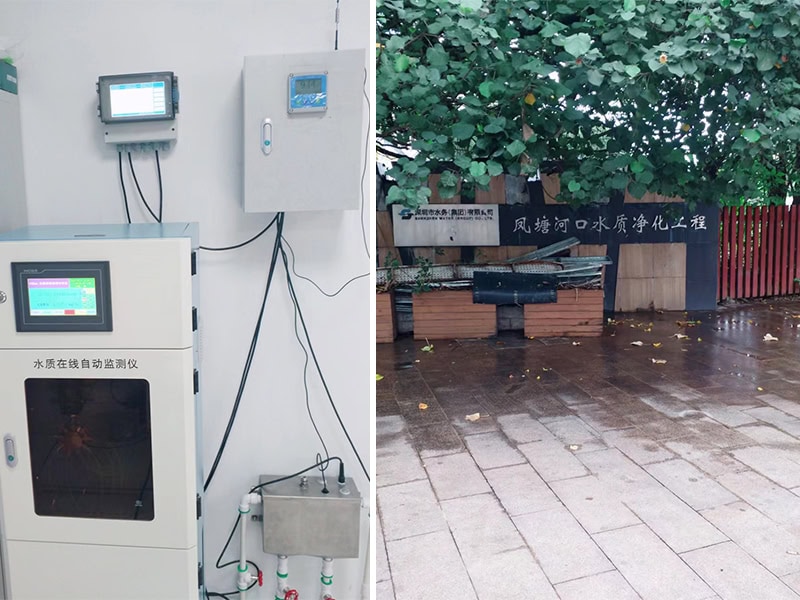
For this project, monitoring stations were deployed at key locations across the water purification process.
The system forms a monitoring network covering:
Inflow → Treatment → Effluent
Three monitoring substations collect water quality data and transmit it to a centralized data acquisition and management platform.
This structure allows operators to compare incoming and treated water quality rather than relying on a single monitoring point.
Core Water Quality Monitoring Parameters
Online pH Monitoring
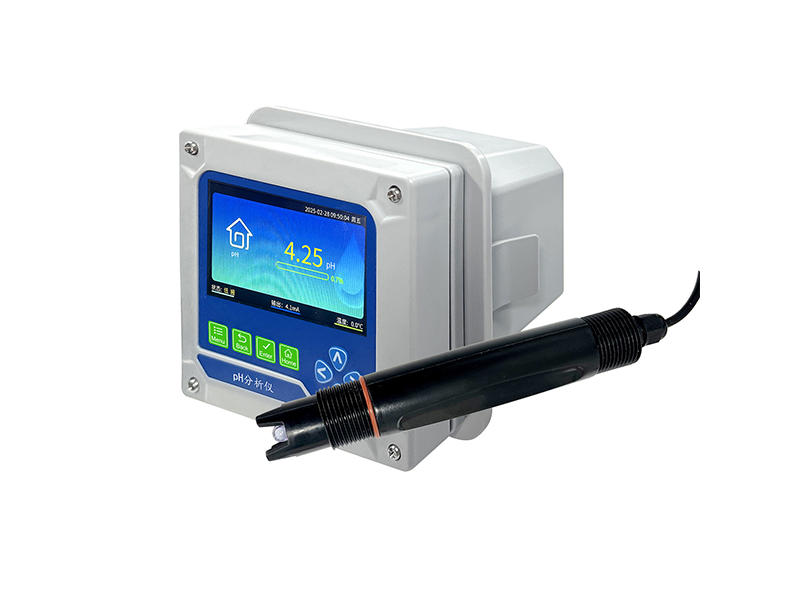
The online pH monitor continuously tracks pH changes in incoming and treated water.
Because the estuary contains mixed freshwater and seawater, the electrode needs stable performance under changing salinity conditions.
The configured pH analyzer provides:
- Measuring range: 0.01–14.00 pH
- Resolution: 0.01 pH
- Temperature compensation: 0–110°C
- Output: 4–20 mA + RS485
Continuous pH data helps operators identify abnormal fluctuations and evaluate changes during tidal cycles.
Online Turbidity Monitoring
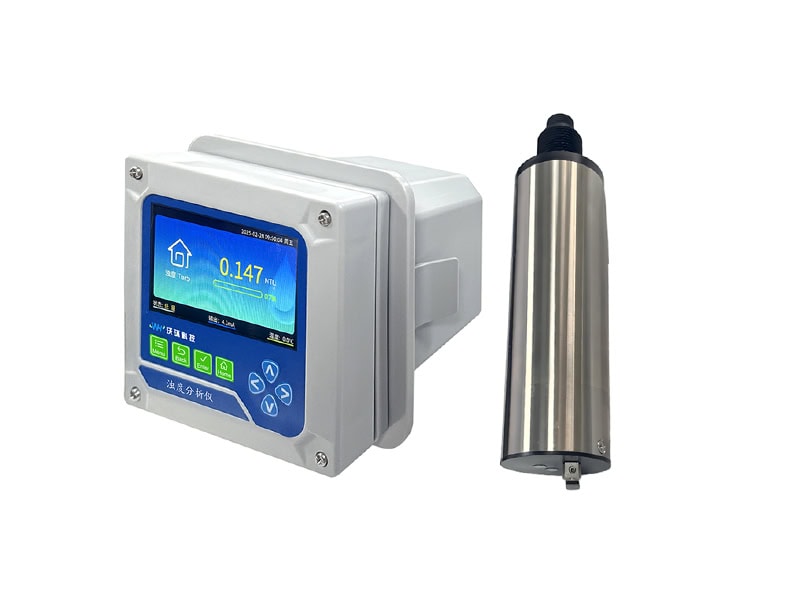
The turbidity analyzer uses the 90° scattered-light principle to continuously monitor suspended particles in the water.
Measurements are taken from raw water and treated effluent, allowing operators to evaluate treatment performance in real time.
The system supports measuring ranges of 0.001–400 NTU or 0.001–4000 NTU, with an accuracy of ±5% and IP68 protection.
This is particularly useful in estuary environments where sediment movement and tidal changes can cause rapid turbidity fluctuations.
Multi-Parameter Water Quality Monitoring
A five-parameter analyzer expands the monitoring system beyond pH and turbidity.
It measures:
- Temperature
- pH
- Dissolved oxygen
- Electrical conductivity
- Suspended solids
Conductivity provides useful information about freshwater–seawater mixing, while dissolved oxygen helps operators evaluate aquatic conditions and water self-purification capacity.
Together, these parameters provide a broader view of estuary water quality than a single sensor can provide.
Online COD Monitoring
An online COD analyzer is also included to track organic pollution.
The analyzer uses potassium dichromate high-temperature digestion with photometric detection and supports 4–20 mA and RS485 communication.
Combining COD with pH, turbidity, dissolved oxygen, conductivity, and suspended solids gives operators a more complete understanding of treatment performance.
Centralized Data and Intelligent O&M Management
Real-Time Data Transmission and Early Warning
Monitoring instruments connect to the data acquisition system through RS485 communication.
Data is then transmitted to the central management platform through optical fiber or 4G communication.
Operators can view key water quality indicators and historical trends from one platform.
When a monitored parameter exceeds its preset threshold, the system can generate an alarm so that staff can investigate the problem earlier.
Historical Data Supports Ecological Management
Continuous monitoring provides more than immediate alarms.
Over time, the system builds a long-term water quality database that can be used to analyze:
- Tidal water quality changes
- Treatment performance
- Seasonal trends
- Abnormal pollution events
- Ecological restoration conditions
This historical information provides useful evidence for adjusting water purification and ecological restoration strategies.
Key Equipment Advantages for Estuary Applications
Anti-Fouling Design for Complex Water Conditions
Estuary water contains suspended solids and experiences significant salinity changes.
These conditions can cause sludge adhesion, deposits, and salt crystallization on conventional sensors.
For this application, anti-fouling sensors and automatic cleaning functions help reduce contamination and lower manual cleaning requirements.
This is particularly important for instruments expected to operate continuously in outdoor ecological monitoring stations.
Standardized Operation and Maintenance
Reliable data depends on more than sensor selection.
The project uses a structured O&M approach that includes remote monitoring, routine inspection, periodic maintenance, calibration, and fault response.
This combination of online instrumentation + data management + standardized maintenance helps maintain long-term measurement reliability.
Field Application Results
From Periodic Sampling to Continuous Monitoring
Before deployment, water quality management depended heavily on periodic manual sampling, providing only a limited number of data points.
After deployment, three monitoring substations provide 24-hour continuous online monitoring with minute-level data acquisition.
This makes it possible to observe short-term changes that traditional sampling could easily miss.
Better Support for Ecological Restoration
Continuous pH, dissolved oxygen, turbidity, conductivity, and other monitoring data provide a more complete picture of estuary conditions.
These measurements can support the evaluation of water purification performance and provide background data for mangrove and wetland restoration.
The monitoring system therefore serves two purposes:
Process monitoring for water purification and environmental monitoring for ecological restoration.
Digital Water Quality Management Improvements
| Indicator | Before Deployment | After Deployment |
|---|---|---|
| Monitoring Method | Periodic manual sampling | 24/7 continuous online monitoring |
| Monitoring Coverage | Limited parameters | Multi-parameter monitoring |
| Water Quality Changes | Difficult to capture between samples | Minute-level trend tracking |
| Alarm Mechanism | Delayed discovery | Automatic over-limit warning |
| Data Records | Mainly manual records | Automatic storage and historical trends |
| Equipment Inspection | Mainly on-site inspection | Remote monitoring + scheduled maintenance |
| Quality Control | Limited standardized procedures | Regular calibration and verification |
The biggest improvement is not simply collecting more data.
It is giving operators a continuous view of how the estuary changes before, during, and after treatment.
Conclusion: Online Monitoring Supports Smarter Estuary Restoration
Estuary water quality management is more complex than conventional river monitoring because tides, salinity, upstream inflow, suspended solids, and ecological conditions change continuously.
Periodic sampling alone cannot fully capture these changes.
A full-process online water quality monitoring system provides continuous data for pH, turbidity, dissolved oxygen, conductivity, suspended solids, COD, and other important parameters.
For this Shenzhen Bay estuary project, the monitoring network connects inflow, treatment, and effluent data to support early warning, treatment evaluation, historical analysis, and ecological restoration management.
By combining ecological treatment with reliable online monitoring, estuary restoration projects can move from periodic water quality inspection to continuous, data-driven management—providing stronger support for long-term water quality improvement and mangrove ecosystem protection.