Introduction
Conductivity measurement is one of the most widely used methods for monitoring water quality and chemical concentration in industrial processes.
A process conductivity sensor provides real-time information about the ability of a solution to conduct electrical current, which is directly related to the concentration of dissolved ions in the liquid.
In industrial applications, conductivity monitoring is commonly used for:
- Water treatment systems.
- Boiler feed water monitoring.
- Cooling water control.
- Chemical concentration measurement.
- CIP cleaning processes.
- Food and beverage production.
- Pharmaceutical water systems.
Compared with manual laboratory testing, an online conductivity measurement system provides:
- Continuous monitoring.
- Faster process response.
- Automatic control capability.
- Historical data recording.
However, selecting the correct conductivity sensor is not only about measuring conductivity range.
Engineers also need to consider:
- Water characteristics.
- Conductivity level.
- Chemical compatibility.
- Fouling conditions.
- Installation environment.
- Maintenance requirements.
For example:
A pure water application with conductivity below 1 μS/cm requires a completely different sensor configuration compared with a high-concentration chemical process.
A wastewater application containing organic matter and suspended contaminants may require a different solution from a clean water system.
Choosing the wrong sensor type may result in:
- Measurement drift.
- Frequent calibration.
- Short sensor lifetime.
- Unstable process control.
This guide explains:
- What a process conductivity sensor is.
- How conductivity measurement works.
- Differences between contacting and inductive conductivity sensors.
- How to select inline conductivity meters and transmitters.
- Common application considerations.
- Real industrial cases from field experience.
Quick Answer: What Is a Process Conductivity Sensor?
A process conductivity sensor is a device that measures the electrical conductivity of a liquid by detecting how easily electrical current passes through the solution.
Because dissolved ions carry electrical current, conductivity changes according to the concentration of ionic substances in the liquid.
Typical ions affecting conductivity include:
- Sodium ions.
- Chloride ions.
- Calcium ions.
- Sulfate ions.
- Other dissolved salts.
The measurement unit is usually:
- μS/cm (microsiemens per centimeter)
- mS/cm (millisiemens per centimeter)
The system can provide:
- Real-time conductivity values.
- Temperature compensation.
- Alarm functions.
- Data recording.
- Automatic process adjustment.
Understanding Conductivity Measurement
What Does Conductivity Represent?
Conductivity indicates the concentration of dissolved ions in a solution.
Generally:
Higher ion concentration
↓
More electrical carriers
↓
Higher conductivity value
Lower ion concentration
↓
Fewer electrical carriers
↓
Lower conductivity value
For example:
Pure Water
Pure water contains very few dissolved ions.
Typical characteristics:
- Very low conductivity.
- High sensitivity requirements.
- Small contamination changes can significantly affect readings.
Applications include:
- RO water.
- EDI water.
- Boiler makeup water.
- Pharmaceutical purified water.
Industrial Process Water
Industrial water may contain:
- Salts.
- Chemicals.
- Cleaning agents.
- Process residues.
Conductivity monitoring helps control:
- Chemical concentration.
- Water quality changes.
- Treatment efficiency.
Wastewater
Wastewater conductivity can vary significantly depending on:
- Industrial process.
- Chemical discharge.
- Salt concentration.
- Treatment conditions.
Monitoring conductivity helps identify:
- Process changes.
- Abnormal discharge.
- Treatment performance.
How Does a Conductivity Sensor Work?
A conductivity sensor measures how electrical current flows through a liquid.
The measurement principle depends on the sensor design.
The two main technologies are:
- Contacting conductivity sensors.
- Inductive (toroidal) conductivity sensors.
1. Contacting Conductivity Sensor Working Principle
Contacting conductivity sensors use metal electrodes that directly contact the liquid.
The basic structure includes:
- Two electrodes or four electrodes.
- Electrical field between electrodes.
- Measurement circuit.
The sensor measures the resistance of the solution and converts it into conductivity.
Advantages of Contacting Conductivity Sensors
Contacting sensors are widely used because they provide:
- High measurement accuracy.
- Good sensitivity.
- Fast response.
- Excellent performance in low conductivity applications.
Typical applications:
- Pure water.
- Ultrapure water.
- Boiler feed water.
- Laboratory water systems.
Limitations of Contacting Conductivity Sensors
Because electrodes directly contact the process liquid, they may be affected by:
- Electrode contamination.
- Coating formation.
- Chemical attack.
- Polarization effects.
They require careful selection when used in:
- High-organic liquids.
- Dirty wastewater.
- High concentration chemicals.
2. Inductive / Toroidal Conductivity Sensor Working Principle
Inductive conductivity sensors, also called toroidal conductivity sensors, measure conductivity without direct contact between electrodes and the process liquid.
The sensor uses:
- Primary coil.
- Secondary coil.
- Electromagnetic field.
Advantages of Toroidal Conductivity Sensors
Because there are no exposed measurement electrodes, inductive sensors provide advantages in difficult applications.
Benefits include:
- Strong fouling resistance.
- Better chemical compatibility.
- Reduced polarization effects.
- Lower maintenance requirements.
They are suitable for:
- Chemical solutions.
- High-concentration liquids.
- Dirty wastewater.
- CIP cleaning systems.
Limitations of Inductive Conductivity Sensors
Toroidal sensors may not be suitable for every application.
Considerations include:
- Lower sensitivity in very low conductivity water.
- Larger installation space.
- Higher initial cost.
For ultrapure water applications, contacting conductivity sensors are usually preferred.
Contacting vs Inductive Conductivity Sensor Comparison
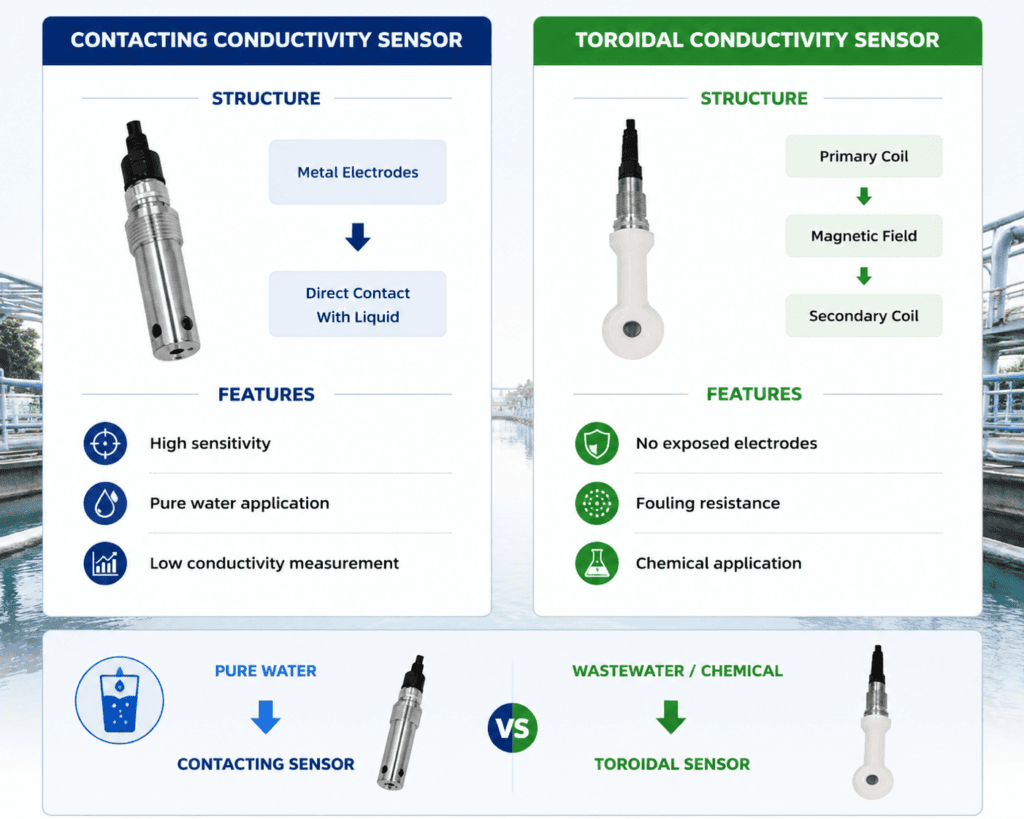
| Item | Contacting Conductivity Sensor | Inductive/Toroidal Sensor |
|---|---|---|
| Measurement Method | Direct electrode contact | Electromagnetic induction |
| Best Application | Pure water, low conductivity | Chemical, wastewater, high fouling |
| Fouling Resistance | Lower | Higher |
| Polarization Risk | Possible | Very low |
| Maintenance Requirement | Higher in dirty media | Lower |
| Chemical Resistance | Depends on electrode material | Generally stronger |
Conductivity Sensor vs Conductivity Meter vs Transmitter
Although these terms are often used together, they represent different parts of a conductivity monitoring system.
Conductivity Sensor
The sensor is the measurement element.
Its function:
- Detect conductivity changes.
- Generate electrical signals.
- Contact or sense the liquid.
Conductivity Transmitter
The transmitter processes the sensor signal.
Functions include:
- Signal conversion.
- Temperature compensation.
- Communication output.
Common outputs:
- 4–20 mA.
- RS485.
- Modbus.
Conductivity Meter / Analyzer
The conductivity meter or analyzer displays and manages measurement data.
Functions include:
- Display conductivity values.
- Set alarms.
- Store data.
- Connect with control systems.
This allows continuous monitoring and automatic process control.
Field Experience:
Improving Conductivity Measurement Stability in Boiler Feed Water Systems
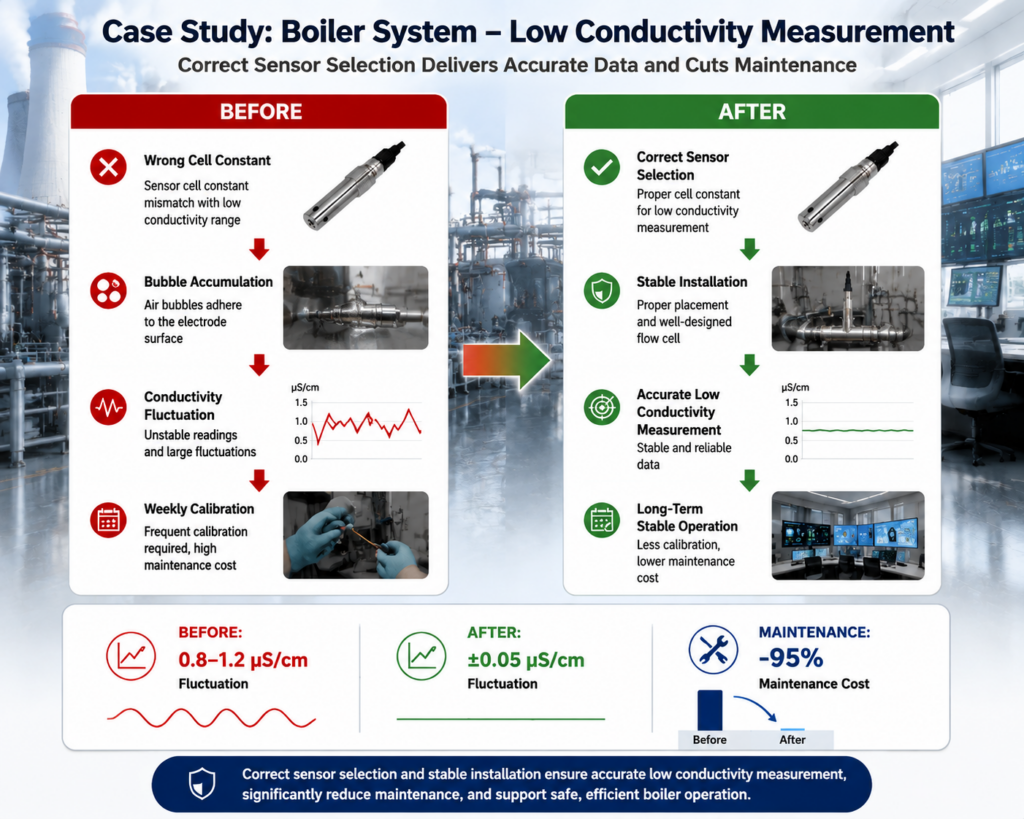
Low-conductivity water applications require careful sensor selection because even small measurement errors can create significant process deviations.
We worked with a thermal power plant where conductivity monitoring was applied to boiler makeup water.
The original system used:
- Online conductivity meter.
- Daily manual sampling.
- Laboratory verification.
During operation, the customer experienced:
- Frequent conductivity fluctuations.
- Day and night variation of approximately 0.8–1.2 μS/cm.
- Slow response under low conductivity conditions.
- Around 30 minutes delay after water quality changes.
- Weekly electrode removal and calibration.
The customer needed a more stable solution for continuous monitoring.
Root Cause Analysis
After investigation, our engineers identified two main issues.
1. Incorrect Sensor Selection
The installed electrode constant was too high for the low conductivity application.
For pure and low-conductivity water:
- Measurement sensitivity is critical.
- Cell constant selection directly affects accuracy.
The unsuitable configuration caused:
- Poor low conductivity resolution.
- Slow response.
- Measurement instability.
2. Air Bubble Interference
Small air bubbles accumulated near pipeline bends.
These bubbles attached to the electrode surface and affected the measurement environment.
The result was:
- Signal fluctuation.
- Unstable conductivity readings.
- Incorrect water quality trends.
Improvement Results
After optimization:
- Conductivity fluctuation was controlled within ±0.05 μS/cm.
- Difference between online measurement and laboratory results was less than 0.03 μS/cm.
- Daily sampling verification was eliminated.
- Weekly electrode removal and calibration were no longer required.
- Manual maintenance workload decreased by 95%.
This project demonstrated that stable low-conductivity measurement depends on:
- Correct sensor selection.
- Proper cell constant matching.
- Suitable installation.
- Bubble prevention.
Key Factors When Choosing a Process Conductivity Sensor
Selecting the correct process conductivity sensor requires more than checking the conductivity range.
In industrial applications, sensor performance depends on whether the sensor design matches:
- The water quality.
- Chemical characteristics.
- Conductivity level.
- Installation environment.
- Maintenance requirements.
A sensor that performs well in pure water may not be suitable for wastewater or chemical processes.
Before choosing a conductivity sensor, engineers should evaluate the following factors.
1. Measurement Range
The first consideration is the expected conductivity range of the application.
Different conductivity levels require different sensor technologies.
Low Conductivity Applications
Examples:
- RO water.
- EDI water.
- Boiler makeup water.
- Pharmaceutical purified water.
Typical characteristics:
- Very low ion concentration.
- High sensitivity requirements.
- Small contamination changes can affect readings.
Recommended considerations:
- Low cell constant sensor.
- High measurement resolution.
- Stable temperature compensation.
- Proper installation to avoid bubble interference.
Medium Conductivity Applications
Examples:
- Cooling water.
- Process water.
- Treated wastewater.
Typical characteristics:
- Moderate dissolved ion concentration.
- Need for stable long-term monitoring.
Recommended considerations:
- General-purpose contacting conductivity sensor.
- Reliable temperature compensation.
- Suitable chemical resistance.
High Conductivity Applications
Examples:
- Brine solutions.
- Chemical production.
- CIP cleaning solutions.
Typical characteristics:
- High salt concentration.
- Strong chemical exposure.
- Potential electrode contamination.
Recommended considerations:
- Inductive/toroidal conductivity sensor.
- Chemical-resistant materials.
- Fouling-resistant design.
2. Cell Constant Selection
Cell constant is one of the most important parameters affecting conductivity measurement accuracy.
The cell constant represents the geometric relationship between the sensor electrodes.
Common values include:
- K=0.01
- K=0.1
- K=1.0
- K=10
Different cell constants are suitable for different conductivity ranges.
Low Cell Constant
Suitable for:
- Ultrapure water.
- Pure water.
- Low conductivity applications.
Advantages:
- Higher sensitivity.
- Better low conductivity resolution.
High Cell Constant
Suitable for:
- High conductivity solutions.
- Chemical processes.
- Concentrated salt solutions.
Advantages:
- Prevents measurement overload.
- Suitable for high ionic concentration.
Choosing an incorrect cell constant may cause:
- Slow response.
- Poor resolution.
- Measurement deviation.
The sensor should always match the actual conductivity range.
3. Temperature Compensation
Conductivity changes significantly with temperature.
As temperature increases:
- Ion movement becomes faster.
- Electrical conductivity increases.
Therefore, conductivity measurement usually requires temperature compensation.
A reliable conductivity sensor should include:
- Temperature measurement.
- Automatic compensation.
- Adjustable reference temperature.
Common reference temperatures include:
- 20°C.
- 25°C.
Why Temperature Compensation Matters
Without compensation:
- Different temperatures create different conductivity readings.
- Process comparison becomes inaccurate.
- Control decisions may be incorrect.
This is especially important for:
- Boiler water.
- Pure water.
- Chemical concentration monitoring.
4. Material Compatibility
The sensor material must match the process medium.
Different applications expose sensors to different conditions:
- Acids.
- Alkalis.
- Organic compounds.
- Salts.
- Cleaning chemicals.
Important material considerations include:
- Electrode material.
- Sensor body material.
- Sealing material.
- Temperature resistance.
Example Applications
Chemical Industry
Requires:
- Strong chemical resistance.
- Corrosion-resistant materials.
- Stable long-term operation.
Food and Beverage
Requires:
- Hygienic design.
- CIP compatibility.
- Easy cleaning.
Pharmaceutical Industry
Requires:
- High purity materials.
- Low contamination risk.
- Reliable traceability.
5. Response Time
Response time determines how quickly the conductivity system reacts to water quality changes.
Fast response is important for:
- Chemical dosing control.
- CIP monitoring.
- Process protection.
Slow response may cause:
- Delayed process adjustment.
- Excess chemical consumption.
- Reduced control accuracy.
Factors affecting response time include:
- Sensor design.
- Installation position.
- Flow condition.
- Measurement range.
6. Cleaning and Maintenance Requirements
Maintenance requirements depend heavily on the application.
Clean water applications usually require:
- Less frequent cleaning.
- Longer maintenance intervals.
Industrial processes may require:
- Regular inspection.
- Fouling prevention.
- Chemical-resistant designs.
Contacting Conductivity Sensor Maintenance
Because electrodes directly contact the liquid, they may experience:
- Organic deposits.
- Scaling.
- Chemical contamination.
Maintenance may include:
- Electrode cleaning.
- Calibration.
- Inspection.
Toroidal Conductivity Sensor Maintenance
Inductive sensors reduce direct contact problems.
Advantages:
- Less fouling.
- Lower maintenance frequency.
- Better performance in dirty media.
They are commonly selected for:
- Wastewater.
- Chemical processes.
- CIP systems.
Application Guide: Choosing the Right Conductivity Sensor
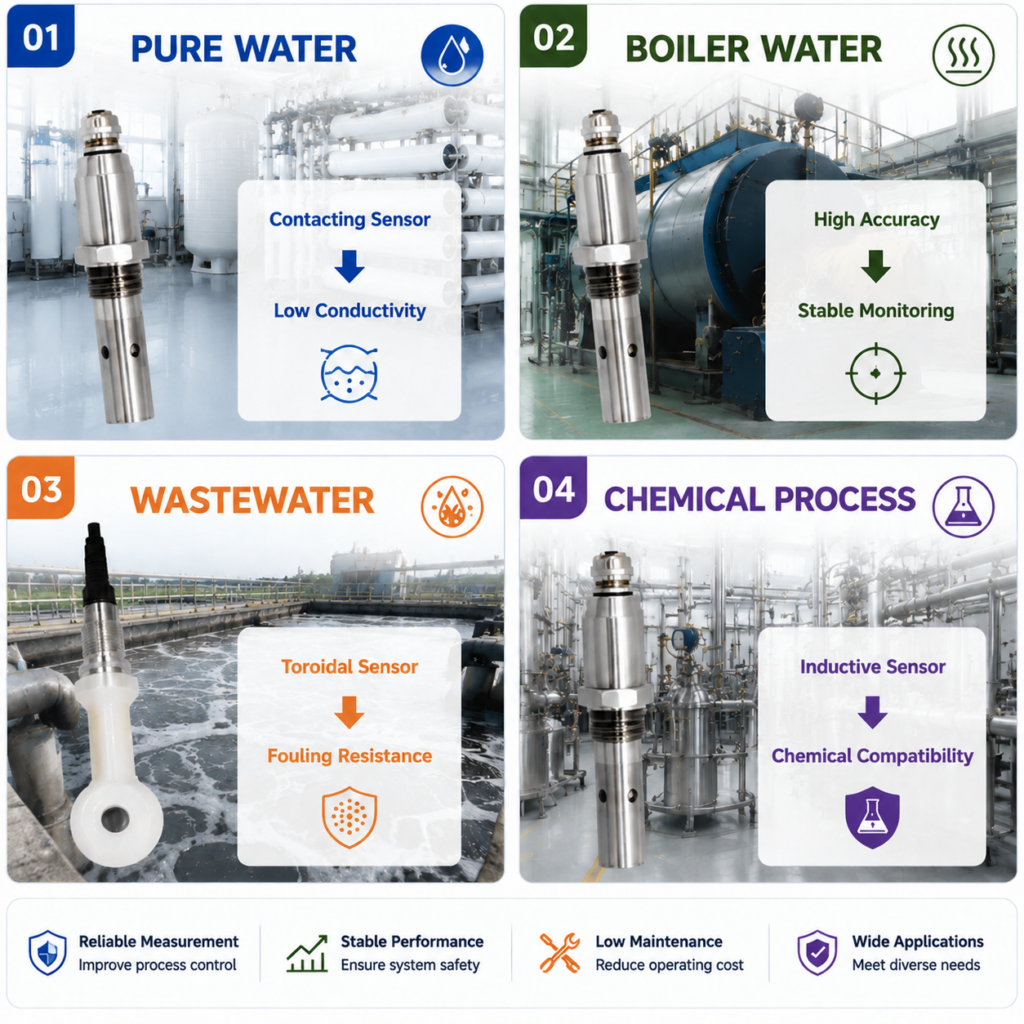
The correct conductivity sensor depends on the process conditions.
Different industries have different requirements.
1. Pure Water and Ultrapure Water Applications
Pure water applications require extremely sensitive conductivity measurement.
Examples:
- RO water.
- EDI water.
- Pharmaceutical purified water.
- Boiler makeup water.
Challenges include:
- Very low conductivity.
- Small contamination changes.
- Bubble interference.
- Sensor selection sensitivity.
Recommended solution:
- Contacting conductivity sensor.
- Low cell constant design.
- High-resolution measurement.
2. Boiler and Cooling Water Monitoring
Conductivity monitoring plays an important role in power plant water management.
Applications include:
- Boiler makeup water.
- Condensate monitoring.
- Cooling water control.
Conductivity data helps identify:
- Water contamination.
- Chemical concentration changes.
- Treatment problems.
Key requirements:
- Stable low conductivity measurement.
- Reliable temperature compensation.
- Continuous online monitoring.
3. Wastewater and Industrial Effluent Measurement
Industrial wastewater often contains complex components:
- Suspended solids.
- Organic matter.
- Salts.
- Chemicals.
Challenges include:
- Sensor contamination.
- Fouling.
- Measurement drift.
- Frequent maintenance.
For difficult wastewater applications, engineers should consider:
- Inductive conductivity sensors.
- Fouling-resistant designs.
- Easy maintenance solutions.
4. Food, Pharmaceutical, and Chemical Process Streams
Conductivity measurement is widely used in process industries.
Applications include:
- CIP cleaning.
- Product concentration monitoring.
- Chemical mixing control.
- Process water monitoring.
However, each application has different requirements.
Food and Beverage Applications
Conductivity is used for:
- Cleaning process monitoring.
- Chemical concentration control.
- Wastewater management.
Important considerations:
- Hygienic design.
- Organic fouling resistance.
- Cleaning compatibility.
Pharmaceutical Applications
Conductivity monitoring helps verify:
- Purified water quality.
- Cleaning effectiveness.
- Process consistency.
Requirements:
- High accuracy.
- Stable low conductivity measurement.
- Reliable documentation.
Chemical Applications
Chemical processes may involve:
- Strong acids.
- Strong alkalis.
- High salt concentration.
Recommended considerations:
- Chemical-resistant sensor materials.
- Toroidal conductivity sensors for difficult media.
- Long-term stability.
Field Experience:
Why Contacting Conductivity Sensors Failed in High-Organic Food Wastewater
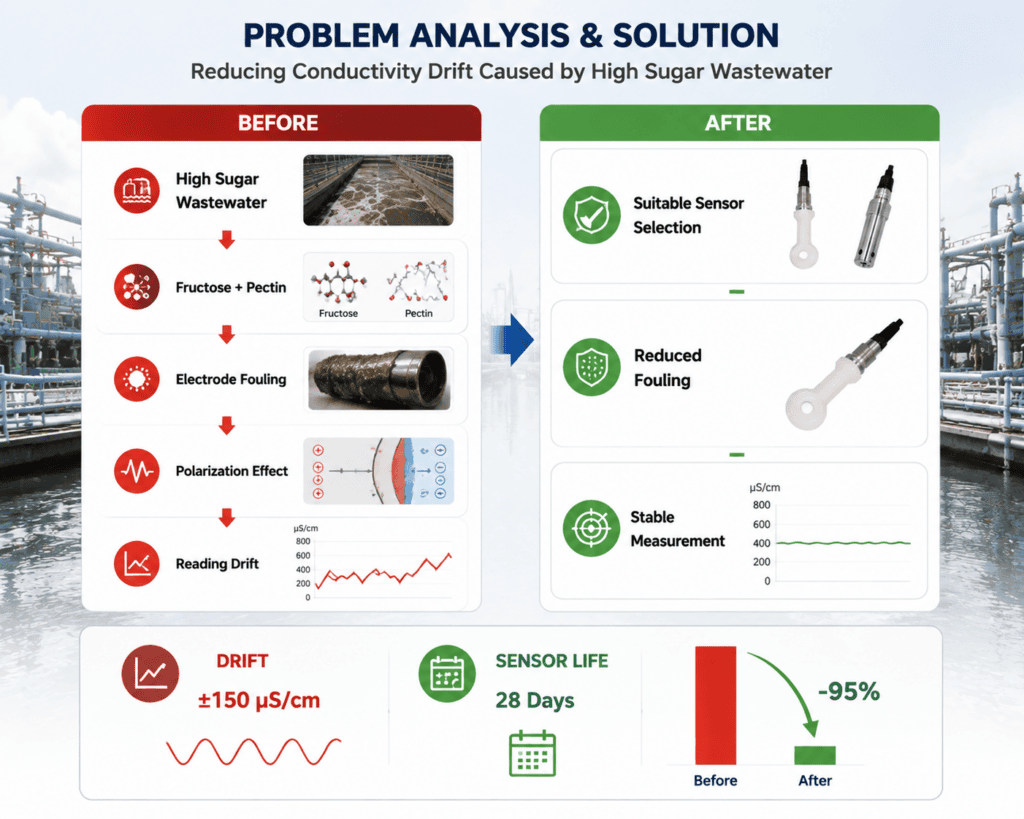
In food processing applications, conductivity measurement problems are often caused by sensor selection rather than instrument failure.
We worked with a fruit juice production facility where conductivity monitoring was applied to concentrated cleaning wastewater containing high levels of sugar and organic substances.
The customer originally used a 2-electrode contacting conductivity sensor.
During operation, several problems occurred:
- Conductivity readings continuously drifted over 24 hours.
- Measurement fluctuation reached approximately ±150 μS/cm.
- The electrode surface was easily coated by fructose and pectin deposits.
- Manual cleaning and calibration were required every day.
- The average sensor service life was only around 28 days.
Root Cause Analysis
After inspection, our engineers found that the problem was related to the wastewater characteristics.
The cleaning wastewater contained:
- High sugar concentration.
- Pectin.
- Organic compounds.
These substances easily formed sticky deposits on the metal electrode surface.
Because the contacting conductivity sensor directly contacts the process liquid:
- Organic fouling accumulated quickly.
- Electrode surfaces became difficult to clean.
- Measurement stability decreased.
Polarization Effect
High organic concentration also increased polarization effects on the electrode surface.
This caused:
- Baseline drift.
- Reduced measurement repeatability.
- Conductivity values exceeding the stable operating range.
The original sensor design was not suitable for this application.
Improvement Solution
The conductivity measurement solution was optimized by:
- Selecting a sensor suitable for high-fouling process conditions.
- Reducing direct electrode contamination risks.
- Improving long-term measurement stability.
Results After Improvement
After optimization:
- Frequent electrode cleaning was significantly reduced.
- Conductivity data became more stable.
- Sensor replacement frequency decreased.
- Maintenance workload was greatly reduced.
This case demonstrates that conductivity sensor selection should consider not only:
- Conductivity range.
but also:
- Organic loading.
- Fouling potential.
- Chemical compatibility.
- Long-term maintenance requirements.
Common Conductivity Measurement Problems and Troubleshooting
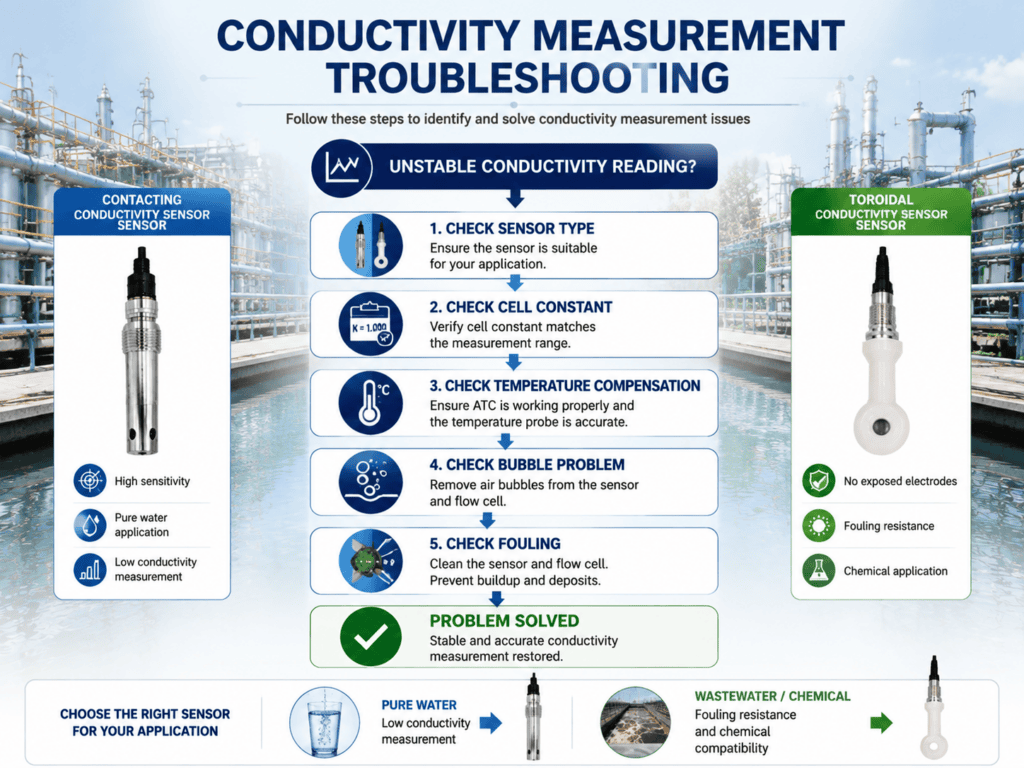
Even with a properly selected process conductivity sensor, measurement problems may still occur during long-term operation.
In many industrial applications, abnormal conductivity readings are not always caused by sensor failure.
The actual cause may come from:
- Incorrect sensor selection.
- Unsuitable cell constant.
- Installation problems.
- Bubble interference.
- Electrode contamination.
- Poor temperature compensation.
- Incorrect calibration.
Before replacing a conductivity sensor, engineers should first evaluate the complete measurement system.
Problem 1: Conductivity Reading Keeps Drifting
Possible Causes
1. Sensor Fouling
For contacting conductivity sensors, the electrodes directly contact the process liquid.
In applications containing:
- Organic compounds.
- Suspended solids.
- Chemical residues.
- Biological materials.
Deposits may form on the electrode surface.
This can cause:
- Reduced measurement sensitivity.
- Signal drift.
- Frequent calibration.
2. Incorrect Sensor Selection
A conductivity sensor must match the application.
Common selection mistakes include:
- Using contacting sensors in high-fouling media.
- Using high cell constant sensors for low conductivity water.
- Selecting materials that are not chemically compatible.
These mistakes may result in:
- Unstable readings.
- Short sensor lifetime.
- Increased maintenance.
Recommended Solutions
Check:
- Is the sensor type suitable for the medium?
- Is the cell constant correct?
- Is the sensor contaminated?
- Is the installation location appropriate?
Problem 2: Conductivity Reading Is Unstable in Pure Water
Low conductivity applications are especially sensitive because even small interference can create large measurement changes.
Common symptoms include:
- Conductivity values fluctuating.
- Difference between online and laboratory results.
- Slow response after water quality changes.
- Frequent calibration.
Possible Causes
Incorrect Cell Constant
Pure water applications require high sensitivity.
If the cell constant is too high:
- Measurement resolution decreases.
- Response becomes slower.
- Low conductivity changes may not be detected accurately.
Air Bubble Interference
Small bubbles can attach to the sensor surface.
Common causes:
- Pipeline bends.
- Incorrect installation angle.
- Excessive flow turbulence.
Effects:
- Measurement instability.
- Signal fluctuation.
- Incorrect conductivity trends.
Recommended Solutions
For low conductivity water:
- Select the correct cell constant.
- Install the sensor in a stable flow area.
- Avoid bubble accumulation.
- Ensure proper temperature compensation.
Problem 3: Conductivity Measurement Does Not Match Laboratory Results
This is a common issue in industrial applications.
Operators often assume:
The conductivity sensor is inaccurate.
However, the difference may come from several factors.
Possible Causes
Different Sampling Conditions
The online sensor measures continuously at the installation point.
Laboratory samples may differ because of:
- Sampling location.
- Sampling time.
- Sample storage.
- Temperature differences.
Poor Temperature Compensation
Conductivity is strongly affected by temperature.
Without correct compensation:
- Online values may differ from laboratory measurements.
- Process comparison becomes unreliable.
Calibration Problems
Incorrect calibration procedures may cause:
- Measurement deviation.
- Frequent adjustment.
- Poor repeatability.
Recommended Solutions
Before replacing the sensor:
- Compare samples under the same conditions.
- Verify temperature compensation.
- Check calibration procedures.
- Inspect sensor installation.
Problem 4: Conductivity Sensor Requires Frequent Calibration
Frequent calibration usually indicates that the system needs optimization.
Possible causes:
- Sensor contamination.
- Incorrect sensor type.
- Chemical attack.
- Poor installation.
- Unstable process conditions.
Improvement Options
Solutions may include:
For Pure Water Applications
Optimize:
- Cell constant selection.
- Installation location.
- Temperature compensation.
For Dirty Industrial Processes
Consider:
- Inductive/toroidal conductivity sensors.
- Better chemical resistance.
- Reduced direct electrode contact.
How to Select the Right Conductivity Sensor
A correct conductivity sensor selection process should follow these steps:
Step 1: Identify the Application
Determine:
- What liquid is being measured?
- What conductivity range is expected?
- Are there contaminants?
- Is continuous monitoring required?
Examples:
Pure Water
Need:
- High sensitivity.
- Low cell constant.
- Stable low conductivity measurement.
Wastewater
Need:
- Fouling resistance.
- Chemical compatibility.
- Long maintenance intervals.
Chemical Process
Need:
- Corrosion resistance.
- Wide measurement range.
- Stable operation.
Step 2: Select the Correct Sensor Technology
Choose Contacting Conductivity Sensors When:
Suitable for:
- Pure water.
- Ultrapure water.
- Boiler makeup water.
Advantages:
- High sensitivity.
- Excellent low conductivity performance.
Choose Inductive/Toroidal Conductivity Sensors When:
Suitable for:
- Wastewater.
- Chemical solutions.
- High-organic liquids.
- CIP systems.
Advantages:
- Fouling resistance.
- Low polarization risk.
- Reduced maintenance.
Step 3: Confirm Communication Requirements
Modern industrial conductivity systems often connect to automation platforms.
Confirm compatibility with:
- PLC.
- DCS.
- SCADA.
Common outputs:
- 4–20 mA.
- RS485.
- Modbus.
Step 4: Consider Maintenance Requirements
A low-cost sensor may create higher long-term operating costs if:
- Cleaning is frequent.
- Calibration is difficult.
- Replacement is frequent.
A suitable sensor should balance:
- Initial investment.
- Service life.
- Maintenance frequency.
- Measurement reliability.
Conductivity Sensor Selection Matrix
| Application | Recommended Sensor Type | Main Challenge | Key Requirement |
|---|---|---|---|
| Pure Water | Contacting Conductivity Sensor | Very low conductivity | High sensitivity, correct cell constant |
| Boiler Feed Water | Contacting Sensor | Low conductivity stability | Accurate temperature compensation |
| Cooling Water | Contacting / Inductive | Scaling and concentration changes | Stable long-term monitoring |
| Wastewater | Inductive/Toroidal Sensor | Fouling and contamination | Low maintenance operation |
| Chemical Process | Inductive/Toroidal Sensor | Corrosion and high concentration | Chemical resistance |
| Food & Beverage CIP | Inductive/Toroidal Sensor | Organic fouling and cleaning chemicals | Hygienic and fouling-resistant design |
Frequently Asked Questions
What is a process conductivity sensor?
A process conductivity sensor is an industrial device used to measure the electrical conductivity of liquids by detecting dissolved ions.
It is widely used in:
- Water treatment.
- Chemical processing.
- Food production.
- Pharmaceutical systems.
- Power plants.
What is the difference between contacting and inductive conductivity sensors?
A contacting conductivity sensor uses electrodes directly contacting the liquid.
It provides excellent sensitivity for low conductivity water.
An inductive or toroidal conductivity sensor uses electromagnetic induction without exposed electrodes.
It is better suited for:
- Dirty liquids.
- Chemical solutions.
- High-fouling applications.
Which conductivity sensor is best for pure water?
Pure water applications usually require contacting conductivity sensors with a suitable low cell constant.
Important factors include:
- High sensitivity.
- Proper installation.
- Temperature compensation.
Which conductivity sensor is best for wastewater?
Wastewater often contains:
- Organic matter.
- Suspended solids.
- Chemical contaminants.
Inductive/toroidal conductivity sensors are often preferred because they reduce fouling and polarization problems.
Why does my conductivity sensor reading drift?
Common causes include:
- Sensor contamination.
- Incorrect sensor selection.
- Wrong cell constant.
- Bubble interference.
- Poor installation.
- Temperature compensation issues.
Conclusion
A process conductivity sensor is a critical instrument for monitoring water quality and chemical concentration in industrial processes.
However, reliable conductivity measurement depends on more than choosing a sensor with the correct range.
A successful conductivity monitoring system requires:
- Correct sensor technology selection.
- Proper cell constant matching.
- Suitable material compatibility.
- Stable installation conditions.
- Effective maintenance strategy.
For low conductivity applications such as:
- Pure water.
- Ultrapure water.
- Boiler makeup water.
Contacting conductivity sensors provide high sensitivity and accurate measurement.
For challenging applications such as:
- Wastewater.
- Chemical processes.
- High-organic liquids.
Inductive/toroidal conductivity sensors provide better fouling resistance and lower maintenance requirements.
By matching the conductivity sensor design with actual process conditions, users can achieve:
- More stable measurement.
- Reduced maintenance.
- Longer sensor service life.
- Better process control.
Conductivity Monitoring Solutions
Reliable conductivity monitoring requires a complete solution rather than only a sensor.
Wuxi Wohuan Instrument provides complete industrial conductivity measurement solutions, including:
- Process conductivity sensors
- Inline conductivity meters
- Conductivity transmitters
- Toroidal conductivity sensors
- Contacting conductivity electrodes
- Industrial water quality monitoring systems
Our solutions are designed for:
- Pure water systems.
- Boiler feed water.
- Cooling water.
- Wastewater treatment.
- Chemical processes.
- Food and beverage applications.
Based on:
- Conductivity range.
- Water characteristics.
- Chemical conditions.
- Installation requirements.
Our engineering team helps customers select suitable conductivity monitoring solutions for reliable long-term operation.
Need Help Choosing the Right Process Conductivity Sensor?
Selecting the correct conductivity sensor depends on more than conductivity range.
A suitable solution should consider:
- Application type.
- Conductivity level.
- Medium characteristics.
- Fouling risk.
- Communication requirements.
- Maintenance expectations.
Whether you need a conductivity sensor for pure water monitoring, wastewater measurement, or chemical process control, our engineering team can provide technical recommendations.
Explore Related Solutions
Explore more industrial water quality monitoring solutions:
- Online pH Sensor
- ORP Sensor
- Dissolved Oxygen Sensor
- Residual Chlorine Analyzer
- Turbidity Analyzer
- Multi-Parameter Water Quality Analyzer
Request a Free Consultation
Please provide:
- Application or industry.
- Water or process medium.
- Expected conductivity range.
- Temperature conditions.
- Installation method.
- Communication requirements.
- Maintenance expectations.
Our technical team will recommend the most suitable process conductivity sensor solution and provide configuration advice.